Electric Motocross vs Electric Enduro: What’s the Difference?
Electric motocross and electric enduro motorcycles can look very similar, and in some cases they even share the same motor,

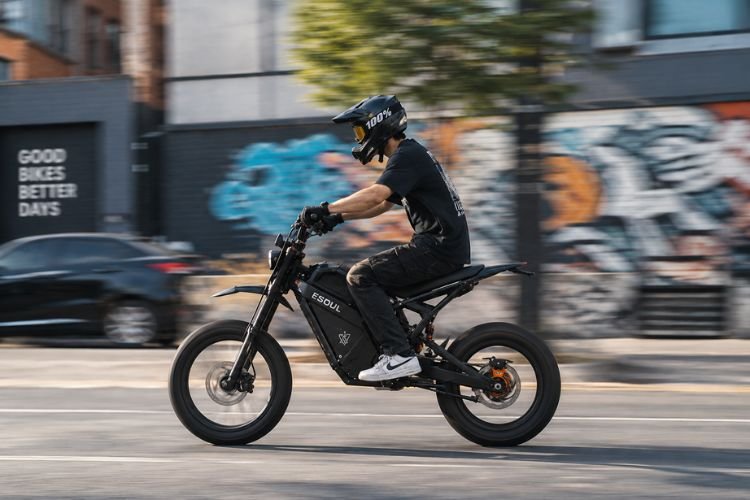
Are electric dirt bikes street legal? In the United States, the answer depends on the specific vehicle and where you plan to ride it.
Some electric motorcycles are manufactured and certified for highway use and can be registered for public roads when state requirements are met. Many high-performance electric dirt bikes, however, are manufactured primarily or exclusively for off-road use. They do not automatically become street legal simply because they have a headlight, brake light, mirrors, or turn signals.
The key question isn’t whether your bike is electric.
It’s how the vehicle is classified, how it was manufactured and certified, whether it is eligible for registration in your state, and whether both the bike and rider satisfy applicable road-use requirements.
That distinction matters for popular high-performance e-motos because a machine can look like an oversized e-bike while legally falling outside the electric-bicycle category.
This guide explains the U.S. framework, why federal and state rules both matter, what equipment is commonly associated with street motorcycles, and what you should check before taking an electric dirt bike onto a public road.
Important: This article provides general educational information, not legal advice. Vehicle laws and administrative procedures vary by state and can change. Always verify the current rules with your state DMV or equivalent agency and the authorities responsible for the roads or trails where you intend to ride.
There is no nationwide rule saying that every electric dirt bike is either legal or illegal on public streets.
Instead, electric dirt bikes can fall into very different legal categories.
A low-speed electric bicycle that meets a state’s e-bike definition may be governed largely by bicycle/e-bike rules.
A high-powered machine without functional pedals may instead be treated as a motorcycle, motor-driven cycle, moped, off-highway vehicle, or another motor-vehicle category depending on the jurisdiction and vehicle.
And an electric motorcycle manufactured and certified for highway use is a different proposition from an off-road e-moto that happens to have lights.
That leads to the most important rule in this article:
Street equipment and street-legal status are not the same thing.
Adding mirrors and turn signals may address some equipment requirements, but it does not necessarily make an off-road vehicle eligible for a title, registration, or license plate.
One of the biggest sources of confusion is the word bike.
Electric bicycle, electric dirt bike, e-moto, and electric motorcycle are often mixed together in casual conversation and marketing. Legally, those labels can describe very different vehicles.
Electric bicycles generally occupy a special low-speed vehicle category defined by federal and state rules, but the exact rules governing operation are heavily dependent on state law.
Pedals, motor output, assisted speed, and how propulsion works can all matter.
For example, California’s electric-bicycle definition requires fully operable pedals and an electric motor that does not exceed 750 watts, with Class 1, 2, and 3 rules further defining how and when motor assistance operates.
That is very different from a multi-kilowatt electric dirt bike capable of motorcycle-like performance.
So don’t assume:
Electric motor + two wheels = electric bicycle.
A high-performance e-moto can be electric without legally being an e-bike.
An off-highway electric motorcycle is designed primarily for off-road use.
California now provides a particularly useful example. Its DMV identifies qualifying off-highway electric motorcycles, commonly called eMotos, as off-highway motorcycles subject to OHV identification requirements.
The California definition includes vehicles designed by the manufacturer primarily for off-highway operation, powered by an electric motor, with handlebars, a manufacturer-provided straddle seat, two wheels, and no pedals.
That is much closer to how many riders actually use the term electric dirt bike.
A street electric motorcycle is built for operation on public highways and must fit the applicable highway-motor-vehicle framework.
At the federal level, manufacturers of new motor vehicles are responsible for certifying compliance with applicable Federal Motor Vehicle Safety Standards (FMVSS).
For motorcycles, applicable federal standards can address items such as lighting and reflective devices, mirrors, brake systems, controls and displays, tires and rims, and other relevant equipment.
States then control important aspects of registration, licensing, insurance, inspection, and operation.
That is why a highway electric motorcycle and an off-road e-moto should not be treated as interchangeable just because both use batteries and electric motors.
Understanding street legality requires separating vehicle manufacturing compliance from permission to operate a vehicle on a particular public road.
At the federal level, NHTSA administers Federal Motor Vehicle Safety Standards for new motor vehicles and motor-vehicle equipment.
An important detail is that NHTSA does not generally pre-approve a vehicle before sale in the way the phrase “DOT approved” sometimes implies.
Manufacturers are responsible for certifying that vehicles subject to the standards comply with applicable FMVSS requirements.
For motorcycles, federal standards may cover areas such as:
Then state law enters the picture.
States determine matters such as vehicle registration and titling procedures, driver licensing, insurance requirements, inspections where applicable, equipment and operating rules, and which vehicles can use particular roads.
Local governments and land managers may add another layer of restrictions for specific streets, paths, parks, and trails.
So there isn’t a reliable national shortcut such as:
“It has a VIN and turn signals, therefore it is street legal everywhere.”
The complete vehicle and the jurisdiction matter.
There is no universal parts list that converts every electric dirt bike into a street-legal motorcycle.
However, when dealing with a motorcycle that is actually eligible for on-highway registration, several categories of requirements commonly become relevant.
| Area | What to Check |
|---|---|
| Vehicle classification | Was it manufactured/certified for highway use? |
| VIN and documentation | Does it have the documentation required for title/registration? |
| Federal compliance | Does the vehicle carry the applicable manufacturer certification? |
| Lighting | Headlight, tail/brake lighting, reflectors and other required lamps |
| Mirrors | Requirements depend on applicable law |
| Brakes | Must satisfy applicable vehicle requirements |
| Tires and rims | Highway motorcycle requirements may apply |
| Controls/displays | Motorcycle standards may apply |
| Registration | State on-highway registration may be required |
| License plate | Normally follows successful motorcycle registration |
| Driver license/endorsement | Depends on vehicle classification and state law |
| Insurance | Depends on state motorcycle/vehicle requirements |
| Helmet | State motorcycle helmet laws vary |
Treat this as a checklist of questions, not a conversion recipe.
A bike can have every obvious piece of road equipment and still have a registration problem if it was manufactured or documented as an off-highway-only vehicle.
This is probably the most misunderstood part of the subject.
Suppose you buy an off-road electric dirt bike and install:
The bike certainly looks more road-ready.
But have you changed how it was originally manufactured and certified?
Not necessarily.
This matters because federal motorcycle requirements extend beyond simply having visible accessories, and state registration agencies can consider the vehicle’s original classification, certification, VIN, title or manufacturer documentation, and other requirements.
California provides a particularly clear example.
California DMV says an OHV must be manufactured for both on- and off-highway use to qualify for on-highway registration under the relevant OHV guidance. Its motorcycle procedures also state that a vehicle originally manufactured for off-highway use cannot simply be converted for on-highway registration unless it was manufactured for dual purposes, subject to the detailed eligibility rules and exceptions in DMV procedures.
In other words:
Bolting street equipment onto an off-road bike does not automatically change its legal identity.
This is why riders should investigate registration eligibility before spending money on a street conversion kit.
You’ll frequently see sellers use phrases such as:
DOT approved lights
DOT tires
DOT-approved conversion kit
Be careful with how these terms are interpreted.
NHTSA does not generally “approve” motor vehicles and motor-vehicle equipment before sale. The U.S. system relies largely on manufacturer certification to applicable federal standards.
For a complete motorcycle, having individual components marketed as DOT-compliant doesn’t by itself establish that the complete motorcycle has been manufactured and certified as a compliant highway vehicle.
This distinction sounds technical, but it matters.
Buying road-oriented lights and tires is not the same as obtaining federal certification for an off-road motorcycle.
So when evaluating an electric dirt bike for street use, look beyond accessory descriptions.
Check the complete vehicle’s manufacturer documentation and certification, then confirm whether your state will title and register that specific vehicle for highway use.
Sometimes, depending on the vehicle and state—but you should never assume that every off-road electric dirt bike can be converted simply by installing street equipment.
Some jurisdictions provide procedures for certain conversions or specially constructed vehicles. Others place substantial restrictions on converting vehicles originally manufactured exclusively for off-road use.
California is one example where the original manufacturing status is critical.
Therefore, instead of buying a universal “street legal kit” first, use this process.
Start with the manufacturer’s documentation.
Was the bike sold as:
Marketing language isn’t enough.
Look at the actual documentation and certification labels.
Determine what documentation came with the vehicle.
Depending on the state and vehicle, this could include a VIN, title, manufacturer’s certificate or statement of origin, bill of sale, previous registration, or other ownership records.
A VIN alone doesn’t guarantee street legality.
It identifies the vehicle; it doesn’t automatically prove the vehicle qualifies for on-highway registration.
Don’t simply ask:
“Are electric dirt bikes legal?”
That’s too broad.
A better question is:
“Is this exact year, make, model, VIN and manufacturer classification eligible for on-highway motorcycle registration in this state?”
That gives the agency enough context to distinguish your vehicle from an ordinary electric bicycle or a factory street motorcycle.
If the vehicle is eligible, determine the equipment requirements for its registration category.
Don’t rely exclusively on a universal aftermarket checklist because requirements and inspection procedures can vary.
Some registration processes may require vehicle verification, safety inspection, or other documentation.
Find this out before modifying the bike.
Even after the vehicle is properly registered, the rider may still need a motorcycle license or endorsement, insurance, a compliant helmet, and other requirements depending on state law.
Only after all applicable requirements are satisfied should you assume the vehicle is legal to operate on public roads.
This is where broad internet answers become dangerous.
It would be inaccurate to say that every Sur Ron, Talaria, E Ride Pro, 79Bike, or similar electric dirt bike is automatically street legal—or automatically illegal—everywhere in the United States.
Different models and market versions can have different manufacturer documentation and intended uses. State registration rules also differ.
The better approach is to check the exact model and version.
If you’re considering a high-performance model from our Best Electric Dirt Bikes in 2026 guide, do not use its top speed, motor wattage, headlight, or appearance as proof of legal classification.
For example, the fact that a bike has motorcycle-style suspension and a powerful 72V system tells you a lot about performance. It tells you very little about whether your state’s DMV will issue an on-highway registration.
Similarly, restricting a bike’s speed through a ride mode or software setting doesn’t necessarily transform its underlying legal classification.
Performance settings and legal classification are different questions.
California deserves special attention because its rules changed for off-highway eMotos in 2026.
Effective January 1, 2026, California DMV guidance states that qualifying off-highway electric motorcycles are classified as off-highway motorcycles and are subject to OHV identification requirements.
To fit California’s off-highway eMoto definition, the vehicle must be designed by the manufacturer primarily for off-highway operation, powered by an electric motor, have handlebars, a manufacturer-provided straddle seat, two wheels, and no pedals.
That does not mean the OHV identification makes the bike street legal.
California DMV distinguishes off-highway identification from on-highway motorcycle registration.
Its OHV guidance states that OHVs are used off public roads and highways and must display the appropriate DMV-issued identification. For on-highway eligibility, the original manufacturing and certification status becomes important.
California also has a separate electric-bicycle framework. A qualifying e-bike must have fully operable pedals and meet the state’s motor-output and class requirements.
That means a high-powered pedal-less e-moto should not simply be assumed to qualify as a Class 1, 2, or 3 electric bicycle.
California riders should read our full California Electric Dirt Bike Laws in 2026 guide before riding on public streets or public OHV land.
Not simply because it is electric.
Whether a vehicle can use a bike lane depends on how that jurisdiction classifies the vehicle and the rules governing that lane.
A legal electric bicycle may have bicycle-lane access under applicable state and local rules.
A high-powered electric motorcycle does not automatically inherit those privileges.
This distinction is particularly important for electric dirt bikes that visually resemble bicycles but lack pedals and produce several kilowatts of motor power.
Don’t assume that slowing down to e-bike speed makes the vehicle legally become an e-bike.
Classification rules matter.
Again, don’t assume so.
Sidewalks, multi-use paths, mountain-bike trails, and bicycle paths can have their own rules, and motorized vehicles may be restricted even when they are legal somewhere else.
A motorcycle that is legal on a public road isn’t automatically legal on a bicycle path.
Likewise, an OHV registration doesn’t automatically authorize riding on every trail.
Before riding, check the rules for the specific facility or land manager.
This is especially important when you’re choosing a machine primarily for trail use. Our Electric Off-Road Motorcycle vs Dirt Bike guide explains the practical differences between off-road electric motorcycles and conventional dirt bikes, but legal access still needs to be checked separately for the riding area.
It depends on the vehicle classification and where you’re operating it.
If your electric dirt bike is legally registered and operated as a motorcycle on public roads, expect motorcycle licensing rules to become relevant according to your state’s requirements.
A qualifying electric bicycle can operate under a different licensing framework.
Off-highway operation may have yet another set of age, safety, permit, or supervision requirements.
This is another reason the question “Do I need a license for an electric dirt bike?” cannot be answered accurately without knowing the state, vehicle, and riding location.
For street use, insurance requirements generally follow the vehicle’s legal classification and state law.
A registered street motorcycle may be subject to the state’s motor-vehicle financial-responsibility or motorcycle insurance requirements.
An electric bicycle may be treated differently.
Off-highway insurance requirements can also differ from road requirements.
Before buying coverage, give the insurer the exact VIN, make, model, intended use, and any modifications. Don’t assume a standard e-bike policy will cover a high-performance e-moto being operated as a motorcycle.
If the vehicle is registered as an on-highway motorcycle, it will generally need the registration and plate required by that state.
But don’t confuse an off-highway identification plate or sticker with an on-highway motorcycle license plate.
California illustrates the difference clearly.
Its qualifying eMotos are subject to OHV identification requirements. That identification authorizes the vehicle within the applicable OHV framework; it does not by itself turn an off-highway motorcycle into a street-registered motorcycle.
This distinction is easy to miss when someone says, “My dirt bike is registered.”
The next question should be:
Registered for what type of use?
Another common assumption is that riding is acceptable because the road is quiet, residential, or has a low speed limit.
That isn’t a reliable legal test.
A public residential street is still a public roadway.
Going only 15 or 20 mph does not necessarily change the vehicle’s legal classification or remove registration, licensing, insurance, or equipment requirements.
Private property is different, but property-owner permission, local ordinances, nuisance rules, and other restrictions can still apply.
Don’t use low traffic volume as a substitute for checking the law.
Street legality should be investigated before purchase if public-road riding is important to you.
Ask the seller or manufacturer for clear answers to these questions:
Get important claims in writing when possible.
A salesperson saying “people ride these on the street all the time” is not evidence that the vehicle is legally registrable.
Neither is a product page describing the bike as “street capable.”
If road use is essential, a factory highway-certified electric motorcycle can be a much simpler starting point than buying an off-road model and hoping to convert it later.
If off-road riding is your main goal instead, our Best 72V Electric Dirt Bikes in 2026 guide compares high-performance off-road options without treating road legality as a performance feature.
Some are, but many off-road electric dirt bikes are not street legal in their factory configuration. Legality depends on the vehicle’s classification and certification as well as state registration, equipment, licensing, insurance, and operating requirements.
Not necessarily. Headlights, brake lights, mirrors, turn signals, and other equipment may satisfy part of a jurisdiction’s equipment rules, but installing them does not automatically change an off-road motorcycle into a highway-eligible vehicle.
Do not assume every Sur Ron model or version has the same legal status. Check the exact model’s manufacturer classification and certification documentation, then verify registration eligibility with your state DMV. The answer can vary by model, market version, and jurisdiction.
The same principle applies to Talaria. A bike’s lights, top speed, or ability to operate at low speed does not establish street legality. Verify the exact model and documentation with the relevant state authority.
If the vehicle is legally classified and registered as a motorcycle, state motorcycle licensing requirements generally apply. Electric bicycles and off-highway vehicles can follow different rules. Check your state’s requirements for the exact vehicle.
It depends on classification and use. Street motorcycles generally require on-highway registration, while some states have separate identification or registration systems for off-highway vehicles. California, for example, now specifically includes qualifying off-highway eMotos in its OHV identification framework.
No. A VIN identifies a vehicle but does not by itself establish that the vehicle was manufactured and certified for highway use or that your state will register it for public-road operation.
Possibly in some jurisdictions and circumstances, but not every off-road electric dirt bike is eligible for on-highway registration. The answer depends on the original vehicle classification, certification and documentation, plus state-specific conversion and registration rules.
Not necessarily. High-performance electric dirt bikes can fall outside state electric-bicycle definitions because of factors such as lack of functional pedals, motor output, speed capability, or other classification requirements. Never assume that “electric bike” in marketing means “electric bicycle” under state law.
That depends on the trail and vehicle classification. A legal electric bicycle, off-highway motorcycle, and street motorcycle can have very different access rights. Check the rules of the land manager or trail authority before riding.
So, are electric dirt bikes street legal?
Some can be. Many high-performance electric dirt bikes designed primarily for off-road use are not automatically legal for public-road operation in their factory configuration.
The biggest mistake is treating street legality as an accessory checklist.
A headlight, turn signals, mirrors, horn, and road-oriented tires may be relevant equipment, but they don’t necessarily establish that the complete vehicle is eligible for highway registration.
Instead, check four things:
1. What is the vehicle legally classified as?
2. Was it manufactured and certified for highway use?
3. Will your state title and register that exact vehicle for on-highway operation?
4. Do the vehicle and rider meet all applicable equipment, licensing, insurance, and operating requirements?
And remember that electric dirt bike, electric bicycle, off-highway eMoto, and street electric motorcycle are not interchangeable legal categories.
If you’re in California, this distinction is particularly important in 2026 because the state now explicitly includes qualifying off-highway electric motorcycles in its OHV identification framework. Read our complete California Electric Dirt Bike Laws in 2026 guide for the state-specific rules.
Before buying a bike for commuting or public-road use, verify the exact model with the manufacturer, your state DMV, and your insurer.
Doing that before purchase is much easier than discovering afterward that a powerful off-road e-moto cannot be registered the way you expected.
Electric motocross and electric enduro motorcycles can look very similar, and in some cases they even share the same motor,
Electric enduro motorcycles are becoming an increasingly appealing option for riders who want strong acceleration, precise low-speed control, and less
Electric enduro motorcycles are becoming an increasingly appealing option for riders who want strong acceleration, precise low-speed control, and less
The Talaria XXX Pro and Talaria Sting R MX4 are two popular options for riders looking for a lightweight electric
