
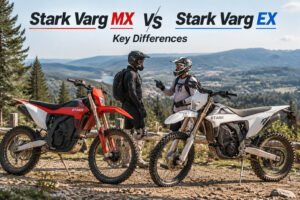
Stark Varg MX vs Stark Varg EX: Key Differences
Electric enduro motorcycles are becoming an increasingly appealing option for riders who want strong acceleration, precise low-speed control, and less
Electric motocross and electric enduro motorcycles can look very similar, and in some cases they even share the same motor, battery, frame, and basic suspension components. But they are designed for different riding environments. An electric motocross bike is primarily optimized for closed-course tracks, jumps, berms, braking bumps, and short periods of high-intensity riding, while an electric enduro motorcycle is designed for longer, more varied off-road routes that can include rocks, roots, steep climbs, mud, tight single-track, and slower technical sections.
That difference affects far more than the tires.
Motocross bikes generally favor firmer suspension settings, track-focused tires, aggressive handling, minimal equipment, and a setup intended to tolerate repeated jumps and high-speed impacts. Enduro motorcycles typically use a more compliant suspension setup, an 18-inch rear wheel, trail-oriented tires, additional equipment such as a side stand and lighting where applicable, and chassis tuning designed to maintain traction over unpredictable terrain. Traditional gas enduro bikes may also use wider-ratio transmissions and larger fuel tanks, although the transmission distinction changes with electric motorcycles because many use single-speed drivetrains. Dirt Rider and KTM both document these basic differences between conventional motocross and enduro platforms.
Electric power adds another layer to the comparison. Battery capacity, power mapping, regenerative braking, charging time, and sustained output become part of the setup. A motocross rider may care most about completing a full race or track session with consistent power, while an enduro rider may care more about how many hours of mixed terrain the battery can cover before charging becomes necessary.
The current Stark VARG lineup demonstrates the distinction particularly well. The VARG MX 1.2 and VARG EX both offer 60 hp or 80 hp configurations and use the same 7.2 kWh battery, yet Stark gives them different suspension specifications, tire configurations, ground-clearance setups, and intended uses. The EX is also developed as a homologated enduro motorcycle, while the MX is the dedicated motocross platform.
So the difference between electric motocross and electric enduro is not simply that one rides on a track and one rides in the woods.
The motorcycle is engineered around those environments.
Motocross riding takes place on a relatively controlled circuit. The surface can change during a race, but the rider repeatedly encounters the same general layout: jumps, berms, ruts, braking bumps, straights, and acceleration zones. The motorcycle therefore needs to handle repeated hard landings, aggressive braking, fast directional changes, and strong acceleration out of corners.
Weight, suspension support, chassis response, and predictable power delivery are especially important in this environment. The rider may use substantial power repeatedly, but the riding session is normally structured around laps rather than hours of exploration.
Enduro riding is less predictable.
A single route can move from hard-packed dirt into rocks, loose climbs, wet roots, mud, narrow forest trails, creek crossings, and open sections. The motorcycle may need to travel quickly for several minutes and then crawl almost at walking speed through a technical obstacle.
KTM describes enduro as riding against constantly changing terrain and conditions, while Dirt Rider notes that enduro motorcycles are generally configured for exploring and racing across varied terrain rather than being optimized exclusively for a motocross circuit.
That difference explains many of the hardware choices.
A motocross motorcycle needs enough suspension support to resist bottoming during jumps and hard impacts. It needs responsive handling for berms and ruts and usually avoids unnecessary equipment that adds weight.
An enduro motorcycle needs more sensitivity over smaller obstacles and enough traction to remain manageable on rocks, roots, and slippery climbs. It may spend far more time operating at low or medium speed, where precise throttle response and chassis balance matter more than maximum horsepower.
Electric motors suit both disciplines because power delivery can be highly adjustable. Modern electric motorcycles can offer different power curves and regenerative braking levels without changing mechanical gearing. But manufacturers still need to tune that electrical performance differently for different terrain.
The Stark VARG makes this easy to see. The current VARG MX 1.2 uses a 48 mm KYB closed-cartridge fork with 310 mm of front travel, while the VARG EX uses a 48 mm KYB closed-cartridge fork with 300 mm of travel and an enduro-specific configuration. Both use 303 mm of rear-wheel travel in Stark’s current specification.
Ten millimeters of travel does not determine which bike is better. Suspension spring rates, damping, chassis geometry, rider weight, tires, and intended terrain all matter. What is important is that Stark does not simply put lights on the MX and call it an enduro motorcycle. The EX is configured around a different type of riding.
That same principle applies across the category.
One of the easiest mistakes when comparing electric motocross and electric enduro motorcycles is focusing on motor output.
A bike producing 60 or 80 horsepower sounds dramatically different from one producing 20 or 30 kW, but off-road performance depends on whether the chassis can actually put that power into the ground.
Traction often becomes the limiting factor long before motor output does.
On a prepared motocross track, the motorcycle can use firmer suspension to manage jumps, deep braking bumps, and aggressive cornering. The chassis is expected to remain composed when the rider lands hard or enters a rough section at speed.
Enduro suspension usually needs more compliance. The front tire needs to follow rocks and roots rather than bounce across them, while the rear needs to maintain traction during slow climbs and irregular impacts. This does not mean enduro suspension is simply “soft.” A competitive enduro motorcycle still needs substantial bottoming resistance and control. The emphasis is different.
KTM’s 2026 off-road platform comparison illustrates the traditional design approach clearly: its SX motocross models use the firmest suspension settings, while XC models are somewhat softer and EXC/XC-W enduro configurations are softer again. KTM also specifies 21/19-inch wheels for its SX motocross platform and 21/18-inch wheels for the enduro platforms.
The rear wheel difference is important.
A 19-inch motocross rear wheel typically allows a lower-profile tire and contributes to the responsive handling expected on a track. An 18-inch enduro rear wheel provides room for a taller tire sidewall, which can help with compliance and traction on rocks, roots, and irregular terrain.
The current Stark VARG MX 1.2 can be configured with either an 18- or 19-inch rear setup depending on use, while the VARG EX uses a 21-inch front and 18-inch rear enduro configuration. Stark offers the EX with enduro-oriented tire choices such as the Dunlop Geomax EN91 and Michelin Enduro 2.
This is why tire choice deserves as much attention as motor power.
A motorcycle with enormous torque but the wrong tire for wet roots can struggle to turn that output into useful forward motion. A less powerful bike with good traction can be easier to ride quickly because the rider spends less time correcting wheelspin.
Ground clearance follows the same logic.
Enduro routes can contain logs, rocks, ledges, deep ruts, and uneven terrain that place more emphasis on protecting the underside of the motorcycle. The exact numbers vary by model, but manufacturers often design enduro configurations around obstacle clearance and trail durability.
None of these differences means an electric motocross bike cannot ride a trail. It can.
Likewise, an electric enduro motorcycle can usually be ridden on a motocross track.
The question is not whether it is physically possible.
The question is which environment the motorcycle was optimized for.
Gas motocross and enduro motorcycles traditionally differ partly in fuel capacity. An enduro rider needs enough fuel to cover longer routes, while a motocross rider can return to the paddock between sessions.
Electric motorcycles replace the fuel tank with a battery, but the basic problem remains: how much usable riding time does the motorcycle provide for the discipline?
Battery capacity alone does not answer that question.
The Stark VARG MX 1.2 and VARG EX are a useful example because both use a 7.2 kWh battery. They have the same nominal energy capacity, yet Stark publishes very different riding-time scenarios for motocross, enduro, and hard enduro because energy consumption changes dramatically with terrain and riding intensity.
A professional motocross rider repeatedly accelerating hard, jumping, and braking can consume battery energy rapidly. A recreational enduro rider moving at moderate speed may ride much longer. Hard enduro introduces another pattern: speed can be low, but steep climbs, wheelspin, and repeated high-torque maneuvers can still demand substantial energy.
This is why advertised “range” figures should be treated carefully.
Distance in miles is often less useful for off-road motorcycles than usable riding time under your conditions. A rider covering fast open trails might travel many miles in an hour, while someone navigating extreme technical terrain might cover only a small distance during the same period.
Electric motorcycles also introduce adjustable power delivery.
The VARG allows riders to configure power and regenerative braking curves. KTM’s new FREERIDE E similarly offers three ride modes and multiple recuperation settings, allowing the motorcycle’s response to be adapted to terrain.
These controls are particularly valuable in enduro riding.
Maximum power can help on fast open sections, but technical terrain often rewards predictable delivery instead. A softer power map can make it easier to find traction on wet rocks or slippery climbs. Regenerative braking settings can also change how much the motorcycle slows when the rider closes the throttle.
Motocross riders can use power mapping differently. A particular track may reward aggressive output on long straights while another may require more manageable traction through hard-packed corners.
Electric power therefore makes the difference between MX and enduro less dependent on mechanical engine tuning than it once was.
But it does not eliminate the difference.
Instead, software becomes another part of the setup.
A dedicated motocross motorcycle is designed around one primary job: performing on a motocross circuit.
Anything unnecessary for that purpose can add weight or complexity.
This is why traditional motocross motorcycles generally do not need headlights, tail lights, side stands, or other trail-oriented equipment. Enduro motorcycles commonly include several of these features because riders may stop on trails, ride in changing light conditions, or travel through environments where that equipment is useful.
KTM’s conventional platform comparison shows the pattern clearly. Its enduro models include side stands, headlights, tail lights, handguards, and larger fuel tanks, while its SX motocross platform eliminates most of this equipment.
The same philosophy appears in electric motorcycles.
The Stark VARG EX includes enduro-specific equipment and is offered as a homologated motorcycle. The VARG MX 1.2 remains the motocross-specific machine. Both share major powertrain components, but the EX is designed for a broader range of conditions.
KTM’s 2027 FREERIDE E demonstrates another approach to electric trail riding. It uses a 21-inch front and 18-inch rear wheel, 250 mm of front suspension travel, 240 mm at the rear, a side stand, and a 5.5 kWh removable battery. KTM also describes it as having road-legal capability in applicable markets.
That versatility creates trade-offs.
An enduro motorcycle may be slightly heavier because it carries additional equipment. The current VARG EX weighs 264 pounds according to Stark, compared with 260 pounds for the VARG MX 1.2. The difference is small in this case, but it demonstrates that an enduro configuration is not necessarily the lightest version of the platform.
For an MX racer, unnecessary equipment adds little value.
For an enduro rider, a side stand, trail navigation, lighting, increased protection, or road-registration capability may be extremely useful.
This is why choosing an electric motorcycle based purely on weight can lead to the wrong decision.
The equipment needs to be judged against the job.
One of the most important distinctions for buyers is that enduro does not automatically mean street legal.
An enduro motorcycle is defined primarily by its intended type of off-road riding, not by whether it can legally operate on a public road.
Some enduro motorcycles are manufactured in homologated configurations that can qualify for registration. Others remain off-road-only machines despite having headlights and trail equipment.
The Stark VARG EX is specifically positioned as a homologated enduro motorcycle. Stark states that the U.S. model is homologated for road use with the appropriate motorcycle licensing and registration process. Buyers should still verify state-specific registration, insurance, documentation, and equipment requirements because U.S. motor vehicle rules are not identical everywhere.
The VARG MX is different.
It is a motocross motorcycle intended primarily for closed-course and off-road use. Adding lights, mirrors, or a license plate holder does not automatically transform a motocross bike into a legally registrable street motorcycle.
The same caution applies throughout the electric dirt bike market.
Terms such as “enduro,” “trail,” “off-road,” and “street legal” are sometimes used loosely in advertising. Buyers should verify the exact vehicle certification rather than assuming a product category determines road legality.
If your riding consists entirely of private motocross tracks, street registration may have no value.
If your enduro routes require short public-road connections between trail systems, a homologated motorcycle can become much more useful.
For riders who want significant pavement use as well as off-road capability, a dual-sport or road-homologated enduro motorcycle may ultimately be more appropriate than either a pure motocross bike or an off-road-only enduro model.
The easiest way to decide is to ignore the maximum power number for a moment and think about where the motorcycle will spend most of its time.
Choose an electric motocross bike if your riding is primarily on a prepared motocross track. You will benefit from track-focused suspension, motocross tires, minimal additional equipment, and a chassis tuned around jumps, berms, hard braking, and repeated high-intensity laps.
A bike such as the Stark VARG MX 1.2 represents this category well. Its 310 mm front suspension travel, motocross wheel options, configurable power, and track-focused electronics are designed around this environment.
Choose an electric enduro motorcycle if you ride forest trails, rocks, roots, steep climbs, technical single-track, and varied off-road routes. Enduro-oriented suspension, an 18-inch rear wheel, trail tires, additional ground clearance, and useful trail equipment become more important than having a pure motocross setup.
The Stark VARG EX demonstrates the high-performance end of that category, while the KTM FREERIDE E shows how a more moderate-power electric motorcycle can use traditional enduro geometry and equipment.
Rider experience matters as well.
Electric motorcycles can be mechanically simpler to operate because many do not require conventional clutch or gear-shifting techniques. That does not make a high-performance electric MX or enduro motorcycle beginner-friendly by default.
Instant torque, motorcycle weight, powerful brakes, and difficult terrain still require skill.
A beginner should prioritize controllable power, suitable rider fit, predictable suspension, protective equipment, and access to appropriate training. Adjustable power maps can help, but they do not replace riding technique.
Budget should also include more than the purchase price.
Electric motorcycles avoid many combustion-engine maintenance jobs, but tires, chains, sprockets, brake pads, bearings, suspension, wheels, and crash-damaged parts still require attention. Battery replacement cost, charger compatibility, dealer support, and parts availability should be investigated before purchase.
Finally, consider charging.
A motocross rider with electricity available in the paddock may have an easy place to recharge between sessions. An enduro rider starting a long route deep in the forest may have no charging opportunity at all.
The same battery can therefore feel completely adequate in one discipline and limiting in another.
That is the electric version of the motocross-versus-enduro decision: not simply how much energy the bike carries, but whether that energy fits the ride you are planning.
Electric motocross motorcycles are primarily designed for closed-course tracks, jumps, berms, and repeated high-intensity laps. Electric enduro motorcycles are optimized for varied terrain such as forest trails, rocks, roots, steep climbs, and technical single-track. Suspension setup, tires, wheel sizes, equipment, and range priorities usually differ.
Neither is universally better. An electric motocross bike is usually the better tool for motocross tracks, while an electric enduro motorcycle is generally more suitable for technical trails and longer off-road routes. The better choice depends on where you actually ride.
Yes, provided motorized riding is permitted there, but it may not be optimized for that terrain. Motocross suspension can feel firmer on rocks and roots, track-oriented tires may provide less suitable traction, and the motorcycle may lack trail equipment such as a side stand or lighting.
Yes. A capable electric enduro motorcycle can usually handle motocross riding, but its suspension, tires, additional equipment, and chassis tuning may not be optimized for repeated jumps and race-pace track riding. A dedicated MX bike remains the better choice for riders focused primarily on motocross.
An 18-inch rear wheel allows room for a taller tire sidewall, which can improve compliance and traction over rocks, roots, and uneven terrain. Traditional motocross motorcycles commonly use a 19-inch rear wheel with a lower-profile tire optimized for track handling. KTM’s current off-road platform comparison follows this 21/18 enduro versus 21/19 motocross pattern.
There is no universal winner. Range depends on battery capacity, power settings, terrain, rider weight, speed, and riding intensity. The Stark VARG MX 1.2 and VARG EX use the same 7.2 kWh battery but produce very different riding-time results depending on whether they are used for motocross, enduro, or hard enduro conditions.
Some are, but not all. Enduro describes the intended type of off-road riding, not automatic road legality. The Stark VARG EX is offered as a homologated motorcycle, while other electric enduro bikes may be off-road only. Always verify certification and registration requirements for the exact motorcycle and jurisdiction.
A lower-powered electric motocross motorcycle can be suitable for a developing rider when correctly sized and used with training. High-performance models such as an 80 hp Stark VARG should not be considered beginner motorcycles simply because they have no conventional clutch or gearbox. Rider fit, controllable power, terrain, and training matter more.
They generally eliminate combustion-engine tasks such as engine oil changes, valve adjustments, spark plugs, and fuel-system servicing. However, tires, chains, sprockets, brakes, suspension, bearings, wheels, fasteners, and electrical components still require maintenance. Electric does not mean maintenance-free.
The VARG EX is the more appropriate factory configuration for trail and enduro riding because of its enduro-specific suspension setup, 21/18-inch wheel configuration, trail-oriented tires, greater enduro-focused clearance, and homologated equipment. The VARG MX 1.2 is the track-focused model.
The difference between electric motocross vs electric enduro motorcycles comes down to what the motorcycle is engineered to do.
Electric motocross bikes are built around the demands of a closed circuit: jumps, berms, braking bumps, fast acceleration, and repeated high-intensity laps. Their suspension tends to be more track-focused, their equipment is kept minimal, and their tire and wheel choices prioritize motocross performance.
Electric enduro motorcycles are built for unpredictability. Rocks, roots, mud, steep climbs, narrow trails, changing traction, and longer routes require a different balance of suspension compliance, traction, ground clearance, rider control, and usable battery time.
Electric power does not eliminate those differences.
In some ways, it makes them more interesting.
A manufacturer can use the same motor and battery platform for both disciplines while changing suspension, tires, software, regenerative braking, ergonomics, and equipment around the intended terrain. The Stark VARG MX 1.2 and VARG EX are a particularly clear example: both offer 60 or 80 hp and the same 7.2 kWh battery, yet they remain distinctly different motorcycles because the complete setup is optimized for different jobs.
If you spend most of your riding time on a motocross track, buy the electric motocross bike.
If your rides involve technical trails, forest routes, rocks, roots, climbs, and mixed terrain, buy the electric enduro motorcycle.
And if public-road connections are important, look specifically for a properly homologated model rather than assuming the word “enduro” makes a motorcycle street legal.
The best choice is not the motorcycle with the most horsepower. It is the motorcycle whose suspension, tires, battery use, chassis, and equipment match the terrain you actually ride.
Stark Future’s current VARG MX 1.2 specifications confirm the motocross model’s 60/80 hp options, 7.2 kWh battery, 310 mm front suspension travel, 303 mm rear travel, and motocross-oriented wheel configurations.
Stark Future’s VARG EX specifications confirm the same 60/80 hp power options and 7.2 kWh battery alongside enduro-specific suspension, 21/18-inch wheels, trail-oriented tire options, and U.S. homologation information.
KTM’s 2026 off-road platform comparison documents the broader traditional differences between enduro and motocross motorcycles, including softer enduro suspension settings, 21/18-inch enduro wheels versus 21/19-inch motocross wheels, side stands, lighting, and other trail-oriented equipment.
Dirt Rider similarly describes enduro motorcycles as using softer suspension, 18-inch rear wheels, larger-range equipment and trail-specific hardware compared with motocross motorcycles, which favor firmer suspension and reduced weight for track use.
KTM’s current FREERIDE E provides another modern electric example, using 21/18-inch wheels, WP XACT/XPLOR suspension, a 5.5 kWh removable battery, multiple ride and recuperation modes, and road-legal capability in applicable configurations.
Electric enduro motorcycles are becoming an increasingly appealing option for riders who want strong acceleration, precise low-speed control, and less
Electric enduro motorcycles are becoming an increasingly appealing option for riders who want strong acceleration, precise low-speed control, and less
The Talaria XXX Pro and Talaria Sting R MX4 are two popular options for riders looking for a lightweight electric

The Surron Hyper Bee and Surron Light Bee X are both high-performance electric dirt bikes, but they are designed for

ALTIS is about more than just bikes. it’s about being fearless, pure, future-focused, and creative. That's what we stand for, and it's what drives everything we do