Electric Motocross vs Electric Enduro: What’s the Difference?
Electric motocross and electric enduro motorcycles can look very similar, and in some cases they even share the same motor,

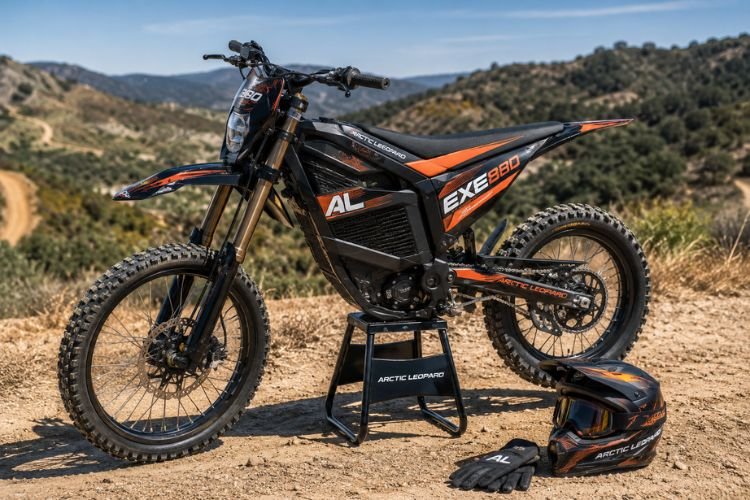
The Arctic Leopard EXE 880 is the kind of electric dirt bike that can look extremely convincing on a specification sheet. A large battery, serious electric power, off-road-focused suspension, and motorcycle-level performance put it well beyond the traditional lightweight e-bike category. For riders comparing newer electric dirt bikes with established platforms such as the Sur Ron Ultra Bee, those numbers naturally attract attention.
But this is also exactly where a careful review becomes important.
Arctic Leopard motorcycles appear in different markets and through different distributors, and published specifications for the EXE 880 aren’t always presented consistently. Battery configuration, rated and peak motor output, wheel setup, weight, maximum speed, and equipment can vary by version or seller. Treating every number found online as though it describes the exact same bike can therefore create a misleading picture.
This Arctic Leopard EXE 880 Review takes a different approach. Instead of simply repeating the largest performance claims, we’ll look at what the EXE 880 offers as a complete electric dirt bike: power delivery, top speed, weight, handling, suspension, braking, battery and real-world range, reliability, maintenance, parts support, and ultimately whether it makes sense compared with better-established alternatives.
The EXE 880’s biggest attraction is straightforward: it offers a lot of electric motorcycle for riders who want serious off-road performance without immediately moving to a conventional gas dirt bike or full-size electric motocross machine.
Its battery capacity and performance-oriented hardware make it especially interesting for trail riders who want more riding time than smaller lightweight e-motos typically provide. The chassis also moves away from the bicycle-derived feel associated with early electric dirt bikes and toward something more substantial and motorcycle-like.
The question mark isn’t whether the specifications are impressive. They are.
The more important questions involve refinement, verified real-world performance, long-term reliability, replacement parts, and dealer support. Those areas matter increasingly as the bike ages, and they’re also where an established platform such as the Sur Ron Ultra Bee currently has a natural advantage.
| Category | Review Takeaway |
|---|---|
| Power | Strong performance-oriented electric platform |
| Top Speed | Motorcycle-level, but verify version-specific claims |
| Battery | One of the EXE 880’s biggest attractions |
| Range | Strong potential, highly dependent on riding style |
| Handling | More motorcycle-like than lightweight e-motos |
| Weight | Battery capacity and substantial construction add mass |
| Suspension | Designed for serious off-road use |
| Brakes | Must be judged against the bike’s weight and performance |
| Reliability | Long-term evidence is still developing |
| Parts Support | Important consideration before buying |
| Beginner Friendly | Better suited to riders with some experience |
| Overall | Compelling on paper, but ownership support matters |
The EXE 880 therefore isn’t a bike we would recommend purely because one specification is bigger than a competitor’s. Its value depends on whether the complete ownership package supports the performance.
The EXE 880 belongs to the increasingly important middle ground between lightweight e-motos and full-size electric dirt motorcycles.
That distinction matters.
A conventional lightweight electric dirt bike can be exceptionally agile, but riders often reach a point where they want more battery capacity, stronger suspension, larger brakes, better high-speed stability, and a chassis designed around higher power.
At the opposite end of the market, full-size electric motocross motorcycles offer extraordinary performance but bring more size, weight, cost, and physical commitment.
The EXE 880 attempts to occupy the space between those extremes.
Its design places significant emphasis on battery capacity and off-road performance. That makes it attractive to riders who want longer trail sessions and more serious motorcycle capability while still benefiting from instant electric torque, low drivetrain noise, and the simplicity of not having a conventional combustion engine.
In concept, that puts the EXE 880 into the same broader buying conversation as machines such as the Sur Ron Ultra Bee and other increasingly powerful mid-weight electric dirt bikes.
Before discussing performance, there’s one issue every prospective EXE 880 buyer should understand: verify the exact motorcycle you’re buying.
Arctic Leopard specifications can appear differently across international distributor pages and listings. Even when two motorcycles carry similar names, equipment or specifications may not be identical.
That means buyers should confirm the model year and exact configuration rather than relying on a specification table copied from another market.
The most important items to verify are:
| Specification | What to Confirm |
|---|---|
| Battery | Voltage, Ah rating and usable/nominal capacity |
| Motor | Rated output and peak output |
| Controller | Maximum output and riding modes |
| Top Speed | Claimed speed and test conditions |
| Range | Test speed and conditions behind the claim |
| Weight | Whether figure includes battery |
| Wheels | Front/rear diameter and tire specification |
| Suspension | Exact fork and shock configuration |
| Charger | Voltage, amperage and expected charging time |
| Road Equipment | Off-road or homologated configuration |
| Warranty | Local distributor coverage |
| Parts | Availability within your country |
This may sound less exciting than discussing horsepower, but it’s one of the most important pieces of buying advice in the entire review.
If a dealer advertises a particular battery capacity or power figure, ask whether that specification applies to the exact motorcycle being delivered.
Electric motorcycle specifications can be surprisingly difficult to compare because manufacturers and sellers don’t always describe power in the same way.
One listing may emphasize rated or continuous output. Another may advertise the maximum peak power available for a shorter period. Comparing those two numbers directly can make one motorcycle appear much stronger even when the real-world difference is smaller.
Peak power is still useful. It tells us something about maximum acceleration potential and the electrical system’s ability to deliver short bursts of performance.
But trail riding doesn’t happen entirely at peak power.
Low-speed throttle response, sustained climbing performance, thermal management, traction, controller calibration, and how power changes as battery charge decreases can all matter more than one maximum kilowatt figure.
That’s why this review treats the EXE 880 as a complete system rather than a single number.
The EXE 880 is clearly intended to provide substantially more performance than a conventional e-bike. This is a motorcycle-level electric platform, and buyers should approach it accordingly.
The most useful part of that performance isn’t necessarily maximum speed.
On a trail, the rider repeatedly slows for corners, climbs, obstacles, roots, rocks, and changing surfaces. Strong midrange response allows the motorcycle to regain speed quickly without requiring a clutch or conventional transmission.
Electric power also gives the rider immediate access to torque.
That’s extremely useful on a climb when applied correctly. It can also become a disadvantage if throttle response is too abrupt, because excessive torque can break rear-wheel traction immediately.
A well-calibrated electric dirt bike therefore needs more than power. It needs controllable power.
This is one area where prospective EXE 880 owners should pay particular attention during a test ride.
Start slowly.
Instead of immediately selecting the most aggressive power setting, test how the motorcycle responds to small throttle inputs. Ride at walking speed. Make tight turns. Climb a loose section with partial throttle. Accelerate out of a corner without spinning the rear tire.
Those situations reveal throttle calibration far better than simply opening the throttle on a straight road.
A good electric motorcycle should allow the rider to request a small amount of torque predictably while still providing strong acceleration when needed.
This matters especially in technical terrain. Rocks, roots, steep switchbacks, and loose climbs reward precision. An electric dirt bike that feels spectacular in a straight-line acceleration video may be frustrating if the first few millimeters of throttle travel are difficult to control.
Top speed is likely to be one of the most searched questions surrounding this motorcycle, but it’s also an area where buyers should be careful with online claims.
Published EXE 880 speed figures can differ depending on configuration and source. Rather than presenting the highest number we can find as a universal fact, the more responsible approach is to treat the manufacturer’s or distributor’s figure as a claimed top speed for that specific version unless repeatable independent GPS testing confirms it.
Actual speed can change with battery state of charge, rider weight, wheel and tire setup, gearing, wind, terrain, temperature, controller programming, and measurement method.
Display speed can also differ from GPS speed.
This doesn’t mean the EXE 880 isn’t fast. The platform clearly operates at motorcycle-level speeds. It means that a buyer comparing two motorcycles shouldn’t conclude that one is definitively faster because one seller lists a slightly larger number.
A properly controlled GPS test is much more useful than comparing two website specification tables.
A useful electric dirt bike top-speed test should tell you more than the final number.
Ideally, the test should disclose battery percentage, rider weight, wheel and tire configuration, surface, wind conditions, riding mode, and whether the result comes from GPS or the motorcycle display.
Battery state is particularly important.
An electric motorcycle tested near a high state of charge may not produce exactly the same maximum performance later in the battery cycle. Comparing a fully charged EXE 880 with another motorcycle tested at a significantly lower battery percentage wouldn’t be particularly meaningful.
For buyers, the important conclusion is simple: don’t purchase the EXE 880 solely because of an advertised top-speed advantage.
Acceleration, handling, range, suspension, and support will affect ownership far more often.
Acceleration is where a powerful electric motorcycle can feel most impressive.
Unlike a combustion engine that needs to operate through a transmission and specific rev range, an electric motor can provide immediate response. On open terrain, that creates rapid acceleration with very little rider effort.
Hill climbing is more complicated.
Having enough motor power matters, but traction becomes just as important. A rear tire spinning aggressively isn’t converting all available motor output into forward progress.
Weight distribution, tire compound, pressure, terrain, suspension behavior, and throttle control all influence whether the bike climbs effectively.
This is why maximum power and hill-climbing ability aren’t interchangeable measurements.
The best setup allows the rider to feed power into the ground without constantly breaking traction.
Handling may ultimately matter more than power for many riders.
The EXE 880’s larger battery and substantial motorcycle construction mean it shouldn’t be expected to feel exactly like an ultra-light e-moto. That additional mass can become noticeable during slow technical maneuvers, tight direction changes, lifting the motorcycle, and correcting mistakes.
But weight isn’t automatically negative.
A more substantial motorcycle can feel planted at higher speeds. It may track more confidently through rough terrain and feel less nervous when the trail opens up.
Where the weight is positioned also matters enormously.
Two motorcycles with similar scale weights can feel completely different if one carries more mass high in the chassis while the other concentrates it lower and closer to the center.
This is why a test ride tells you more than the weight figure alone.
Electric dirt bike buyers often focus on curb weight, but the consequences of weight appear throughout a ride.
On flowing terrain, extra mass can contribute to stability.
On very tight single-track, it requires more effort to change direction.
When jumping, additional mass influences how much effort is required to adjust the motorcycle in the air.
When braking, the braking system and tires need to manage greater momentum.
During repeated technical sections, rider fatigue can become a factor.
And, yes, after a fall on an awkward hill, you eventually have to pick the motorcycle up.
The EXE 880’s battery capacity is part of the attraction, but battery energy isn’t free from a weight perspective. Buyers should therefore think about range and mass as two sides of the same design decision.
Potentially, but this depends strongly on the rider and setup.
A high-capacity electric motorcycle can work extremely well in technical terrain because electric torque eliminates the need to manage clutch engagement or engine rpm. Riders can concentrate on balance, line choice, braking, and throttle.
The disadvantage is physical mass.
On narrow switchbacks, difficult rock sections, and terrain where the rider frequently needs to reposition the motorcycle manually, a lighter platform can be easier.
That doesn’t make the EXE 880 unsuitable for technical riding. It means buyers should understand what they’re trading.
If most of your riding consists of fast trails, climbs, and more open terrain, additional stability and battery capacity may be worth the weight.
If your favorite riding involves extremely tight hard-enduro-style terrain, weight deserves much greater consideration.
Suspension is one of the areas where a serious electric dirt bike needs to prove that its chassis can support its power and weight.
It’s easy to evaluate suspension by reading travel figures or component names. It’s much harder to know how well the fork and shock actually work for a specific rider.
Rider weight changes suspension behavior. So does speed. So do jumps, rocks, braking forces, and terrain.
For recreational trail riding, the ideal suspension should remain comfortable enough to absorb smaller impacts while providing enough support to prevent excessive diving or bottoming.
Aggressive riders need more.
Repeated jumps, high-speed whoops, hard braking, and rough enduro terrain expose weaknesses much faster than casual riding.
That’s why an EXE 880 buyer shouldn’t assume the suspension is excellent simply because it has substantial travel.
Pay attention to what the motorcycle does rather than how expensive the fork looks.
Under hard braking, does the front collapse excessively?
Through repeated rough terrain, does the suspension recover quickly enough to remain controlled?
On larger impacts, does it use the available travel progressively or bottom harshly?
Does the rear remain composed under acceleration, or does it squat excessively?
Can the available adjustments create a meaningful difference?
These observations provide a much better picture of suspension quality than travel numbers alone.
Before replacing suspension, owners should also establish correct sag and baseline settings for their weight. Tire pressure should be checked at the same time.
Many riders start buying suspension parts before determining whether the original setup was ever properly adjusted.
That answer should depend on the rider rather than the internet.
A recreational trail rider may find the stock equipment entirely adequate. A heavier or faster rider may reach its limits much sooner.
Motocross-style jumping creates another level of demand.
If you’re repeatedly bottoming the suspension despite correct setup, losing chassis control through rough terrain, or exceeding the useful adjustment range, an upgrade or professional revalve becomes easier to justify.
But suspension shouldn’t be replaced simply because aftermarket parts exist.
Ride first. Identify the limitation. Upgrade second.
A powerful electric dirt bike needs brakes that match its acceleration and weight.
This sounds obvious, but the electric dirt bike industry has historically included machines where motor performance evolved faster than braking hardware.
The EXE 880 should therefore be judged by more than rotor diameter.
Initial bite matters, but so does modulation. A brake that immediately locks the front wheel isn’t necessarily better than one that gives the rider precise control over braking force.
Heat management matters too.
A braking system that feels strong for one emergency stop may behave differently after repeated hard braking or a long technical descent.
This is particularly important on a heavier, powerful electric motorcycle.
Regenerative braking can add another useful layer to electric dirt bike control.
Depending on how the exact EXE 880 configuration implements regen, riders may be able to use motor braking to reduce speed while returning a small amount of energy to the battery.
The energy recovery itself shouldn’t be exaggerated. Regen isn’t going to magically replace all of the energy used climbing a hill.
Its more useful benefit off-road can be control.
A predictable amount of regenerative deceleration can reduce reliance on mechanical brakes and help the motorcycle feel more settled during descents.
However, regen behavior needs to be predictable. Too much sudden deceleration can disturb traction, particularly on loose terrain.
Again, calibration matters more than simply having the feature.
Much closer to a motorcycle.
That’s an important distinction for buyers moving up from lower-powered electric bicycles.
The speed, mass, braking demands, suspension loads, and available torque require motorcycle-level respect. Protective equipment should reflect that performance.
A motorcycle helmet, appropriate boots, gloves, eye protection, knee protection, and suitable riding gear make far more sense than treating the EXE 880 like a conventional bicycle simply because it has an electric motor.
The same applies to riding technique.
Higher speed magnifies mistakes. More weight increases momentum. Stronger acceleration demands better throttle discipline.
Electric power makes the drivetrain easy to operate.
It doesn’t make high-performance off-road riding risk-free.
Initial component quality is only one part of build quality.
The more meaningful test is what happens after months of dust, mud, vibration, charging cycles, impacts, and repeated suspension movement.
Frame hardware should remain secure. Wheel bearings should remain smooth. Suspension pivots shouldn’t develop abnormal play. Connectors should remain protected. Plastics and controls should tolerate normal off-road use.
This is where the EXE 880 faces a different challenge from a Sur Ron Ultra Bee.
The Ultra Bee has a larger established ownership base and a mature aftermarket. There is already a substantial amount of knowledge surrounding replacement parts, modifications, maintenance, and troubleshooting.
The EXE 880 has to prove that the ownership ecosystem can support the impressive hardware.
For a buyer planning to keep the motorcycle several years, that question deserves as much attention as peak power.
The battery is one of the biggest reasons riders consider the EXE 880. The model name itself is closely associated with its large-battery positioning, but this is also an area where buyers should verify the exact specification supplied in their market. Arctic Leopard models and distributor listings have appeared with different battery descriptions, so voltage, amp-hour rating, cell specification, total energy capacity, and charger should be confirmed for the exact bike being purchased rather than assumed from another seller’s page.
Battery energy is ultimately more useful than looking at amp-hours alone. Two batteries with similar Ah ratings can store very different amounts of energy if their operating voltages differ. When comparing the EXE 880 with another electric dirt bike, watt-hours or kilowatt-hours provide a more meaningful starting point. Even then, a larger battery doesn’t automatically guarantee proportionally greater range because motorcycle weight, controller efficiency, motor efficiency, gearing, tires, terrain, and riding style all affect consumption.
This becomes particularly obvious off-road. A rider maintaining moderate speeds on flowing fire roads may achieve dramatically better efficiency than someone repeatedly accelerating hard up steep technical climbs. Deep sand, mud, loose soil, low tire pressure, aggressive knobby tires, elevation gain, cold weather, and a heavier rider can all increase energy consumption. Sustained high-speed riding can be especially demanding because aerodynamic drag rises rapidly with speed.
For that reason, we would treat any advertised EXE 880 maximum-range figure as a test-condition reference rather than a guaranteed trail range. A useful range claim should always tell you the speed, rider weight, terrain, temperature, and riding mode used during the test. Without that information, comparing two manufacturers’ range numbers can be misleading.
Rather than planning a ride around the maximum mileage printed on a specification page, owners should build their own energy baseline. Ride a familiar route, record starting and ending battery percentage, note the distance and elevation, and repeat the route under similar conditions. After several rides, you’ll have a much more useful understanding of what the EXE 880 can do for your terrain and riding style.
This also makes it easier to build a reserve into longer rides. Returning with 15 or 20 percent remaining may feel conservative, but off-road energy consumption can change unexpectedly. A trail that was easy on the way out may require significantly more energy on the return because of elevation, mud, wind, or a change in pace. Battery percentage should therefore be treated as an energy budget rather than a challenge to reach zero.
Riders coming from gas dirt bikes need to adjust their thinking here. A gas motorcycle can often be refueled quickly during a long riding day. With an electric dirt bike, usable range and charging access become part of route planning. The EXE 880’s battery capacity can reduce that limitation, but it doesn’t eliminate it.
High-performance electric motorcycles create an interesting contradiction: the more frequently you use the performance you paid for, the less range you generally receive. Repeated hard acceleration demands high current from the battery, while sustained high speed increases aerodynamic losses. Long climbs require the motor to work continuously against gravity, and soft terrain adds rolling resistance. Combining all three can consume energy surprisingly quickly.
Temperature adds another variable. Lithium-ion batteries generally deliver their best performance within an appropriate operating range. Cold conditions can temporarily reduce available power and usable energy, while prolonged exposure to excessive heat can contribute to accelerated aging. This means an EXE 880 ridden during cold winter conditions shouldn’t automatically be expected to reproduce the range achieved on a mild day.
Battery state of charge can also influence performance. Voltage changes as the pack discharges, and the battery-management system and controller may adjust available output according to voltage, temperature, and current limits. Riders shouldn’t assume that maximum acceleration at a nearly full battery will feel identical near the bottom of the charge. What matters more for ownership is whether the behavior remains predictable. Sudden unexplained power loss, charging errors, warning codes, abnormal heat, or large changes in performance at normal battery levels deserve investigation.
Charging sounds simple, but it is one of the areas where distributor support and exact configuration matter. Buyers should confirm which charger is supplied with their motorcycle, its output rating, compatible input voltage, and realistic full-charge time. If a faster charger is available, confirm that both the battery-management system and manufacturer officially support it before assuming that higher charging current is harmless.
For everyday ownership, charging usually becomes part of the post-ride routine. The motorcycle comes back, the rider performs a quick inspection, allows the battery to return to an appropriate charging temperature if necessary, and then connects the approved charger according to the manufacturer’s procedure. Riders shouldn’t improvise with incompatible chargers, damaged connectors, adapters of questionable quality, or modified charging systems. The EXE 880 contains a large amount of stored electrical energy, so charging equipment should be treated as part of the motorcycle’s safety system rather than a generic accessory.
Long-term storage deserves similar attention. If the bike won’t be used for weeks or months, follow the current Arctic Leopard battery instructions regarding storage state of charge and temperature instead of leaving the pack indefinitely at an arbitrary percentage. Battery aging is influenced by time, temperature, cycling, storage conditions, and depth of discharge, which is why nobody can responsibly promise that every EXE 880 battery will last an exact number of years or miles.
The EXE 880’s motorcycle-like construction changes the riding experience compared with smaller e-motos. A larger chassis can give adult riders more room to move, particularly when transitioning between seated and standing positions. Off-road comfort, however, isn’t primarily about having a soft seat. Handlebar position, footpeg relationship, control placement, seat-to-peg distance, and the ability to move forward and backward on the motorcycle matter much more during serious trail riding.
This is also where rider height becomes difficult to judge from specifications alone. Two riders of identical height may have different inseams, arm lengths, mobility, and preferred riding positions. Taller riders should pay particular attention to standing ergonomics, while shorter riders should consider seat height together with motorcycle weight. Reaching the ground becomes more important when stopping on an uneven side slope with a relatively substantial electric dirt bike.
Before purchasing, a physical test ride is therefore much more valuable than assuming the EXE 880 will fit because another rider of similar height likes it. If a test ride isn’t available, at minimum compare seat height, peg-to-seat relationship, handlebar dimensions, and overall chassis measurements with a motorcycle you already know fits you.
New motorcycles are easy to make impressive in a showroom. Long-term build quality is revealed by repeated impacts, vibration, dust, mud, water, heat cycles, charging cycles, and maintenance. On the EXE 880, owners should pay attention to the same areas they would inspect on any serious off-road motorcycle: wheel and steering bearings, suspension pivots, spokes and rims, chain and sprockets, brake components, fork and shock seals, controls, fasteners, plastics, electrical connectors, and charging hardware.
The electric powertrain can actually make some mechanical changes easier to notice. Without a combustion engine and exhaust dominating the soundscape, chain noise, brake rubbing, bearing sounds, or new chassis noises may stand out more clearly. Learning what the motorcycle normally sounds and feels like is useful because a sudden change often provides an early warning that something deserves inspection.
This is also why durability shouldn’t be reduced to “the motor is reliable.” An electric dirt bike is an entire mechanical system. A motor can operate perfectly while wheel bearings, brake pads, suspension components, tires, or chain components wear normally around it.
This is one of the most important sections of the review, and it requires some restraint. Compared with a platform such as the Sur Ron Ultra Bee, there is less mature, large-scale English-language ownership information available for the EXE 880. That makes it difficult to responsibly describe every complaint found online as a “common problem.”
A single owner reporting a connector issue doesn’t prove that EXE 880 electrical connectors are defective. One rider replacing a bearing early doesn’t establish a universal bearing problem. The same applies to controller errors, suspension complaints, battery behavior, or drivetrain noise. To call something a genuine common problem, we would want to see a repeated pattern across multiple independent owners or credible technical sources.
At this stage, the more useful buying concerns are broader. Buyers should investigate local parts availability, warranty administration, diagnostic support, replacement battery availability, controller and display support, and whether their dealer has actual experience servicing Arctic Leopard motorcycles. These aren’t necessarily defects in the EXE 880, but they can strongly influence the ownership experience if something eventually requires repair.
This distinction is important for SEO content too. A review becomes less trustworthy when it invents a dramatic “common problems” list simply because users search for that phrase. Where the evidence is limited, saying the evidence is limited is the more useful answer.
The most accurate answer today is that there isn’t yet enough mature, broad long-term evidence to give the EXE 880 the same confidence level as an electric dirt bike platform with many years and a much larger owner base.
That doesn’t mean the EXE 880 is unreliable.
It means unknown and unreliable aren’t the same thing.
When assessing reliability, buyers should separate the major systems. Battery health, battery-management behavior, motor operation, controller performance, charging, drivetrain condition, suspension, bearings, brakes, and chassis hardware all have different failure modes and maintenance requirements. A meaningful long-term reliability picture emerges only after enough motorcycles accumulate substantial mileage under different riding conditions.
Modifications complicate the picture further. A stock EXE 880 ridden recreationally isn’t experiencing the same electrical and mechanical stresses as a motorcycle with modified controller settings, increased current limits, non-standard gearing, heavier tires, or repeated motocross-style use. When reading owner reports, always ask how the motorcycle was configured.
This is one of the areas we would investigate carefully before buying an EXE 880.
Electric dirt bikes wear normal motorcycle parts. Tires, brake pads, chains, sprockets, bearings, seals, controls, plastics, and suspension components eventually need replacement. Crashes can create additional needs with little warning. Major electrical components such as displays, chargers, controllers, motors, battery-management hardware, and batteries are less frequently replaced but potentially much more important when they are needed.
A mature platform such as the Sur Ron Ultra Bee benefits from a large aftermarket and substantial owner knowledge. If you need a wheel, suspension component, brake upgrade, skid plate, replacement control, or troubleshooting advice, there are already numerous established paths.
The EXE 880 needs to be evaluated partly on whether the dealer or distributor can close that ecosystem gap. A good dealer with stocked parts and technical support can make ownership considerably easier. A motorcycle purchased from a seller that disappears after delivery can create an entirely different experience even if the bike itself is mechanically good.
For a buyer planning to keep the EXE 880 for several years, asking “Can I get parts?” may ultimately be more important than asking whether it has another kilowatt of peak output.
Warranty coverage should be read rather than assumed. Before purchasing, confirm the duration of coverage, which components are included, whether the battery has separate terms, who pays shipping or labor, and how a claim is actually processed. Also ask what happens if a major component fails: does the local seller diagnose the motorcycle, send replacement parts, or require the bike or component to be shipped elsewhere?
Dealer competence matters too. Selling an electric dirt bike and servicing one are different skills. A dealer who understands diagnostic codes, battery systems, controllers, drivetrain setup, and parts sourcing can add real value even if the initial purchase price is slightly higher.
This is particularly important for high-voltage electrical work. Routine chain, brake, wheel, and chassis maintenance may be approachable for experienced owners, but internal battery repairs and major electrical diagnosis shouldn’t be treated like casual bicycle work. Knowing where qualified support is available before a failure occurs is part of responsible purchasing.
The EXE 880 eliminates many familiar combustion-engine tasks, but it remains an off-road motorcycle. Dirt, water, torque, impacts, suspension movement, and braking forces still produce wear. Owners need to monitor tires, brakes, chain and sprockets, wheels, bearings, suspension, controls, fasteners, and electrical connections according to the service information for their exact version.
Chain care deserves particular attention because high electric torque can be hard on drivetrain components. Correct tension matters; simply tightening a noisy chain as much as possible can increase loads on bearings and other components as the suspension moves. Cleaning and lubrication should reflect riding conditions, with muddy, sandy, or wet environments requiring more frequent attention.
Brakes and tires are similarly dependent on riding style. Hard acceleration can shorten rear-tire life, while long technical descents can accelerate brake-pad wear. Aggressive riding also increases the frequency with which wheels, spokes, bearings, and suspension components should be inspected. Mileage alone isn’t enough to determine maintenance requirements; 500 easy road miles and 500 hard off-road miles are mechanically very different.
Electricity is unlikely to be the largest routine ownership expense. Consumables and off-road wear matter more. Tires, brake pads, chain and sprockets, bearings, suspension service, cleaning products, damaged plastics, controls, and protection components can all contribute to ownership cost.
The largest potential expenses are the major electrical components, particularly the battery. These aren’t routine replacement items, so it would be misleading to include a new battery in every annual maintenance estimate. However, buyers planning long-term ownership should know what a replacement battery costs, whether it can actually be ordered in their market, and what warranty coverage applies.
The same logic applies to the controller, motor, charger, and display. A low advertised purchase price becomes less attractive if essential proprietary components are difficult to obtain later.
Total ownership cost is therefore more useful than purchase price alone.
The answer depends on what kind of beginner we’re talking about. Someone new to the EXE 880 but experienced with dirt bikes, motorcycles, mountain bikes, or high-powered e-motos may adapt relatively quickly. A person with almost no powered two-wheel experience is different.
Electric powertrains are mechanically easy to operate because there is no conventional clutch and gear-selection routine, but that simplicity can hide how much performance is immediately available. A small throttle mistake can produce a much larger response than a new rider expects. The motorcycle’s weight also becomes important during slow turns, awkward stops, and uneven terrain.
A complete beginner should therefore prioritize predictable low-power settings, braking practice, body position, slow-speed balance, and progressive terrain. There’s no benefit in accessing maximum performance before the rider can consistently control the motorcycle at low speed.
The EXE 880 may be a bike a rider can grow into, but that doesn’t automatically make it the easiest motorcycle to learn on.
Once the excitement of acceleration fades, electric dirt bike ownership becomes relatively straightforward. You charge the motorcycle, inspect tires and brakes, monitor the drivetrain, clean it appropriately after dirty rides, and pay attention to anything that changes. There is no fuel to mix, no conventional engine warm-up, and fewer combustion-related service items competing for attention.
The convenience is real, but so is the responsibility. A powerful electric motorcycle shouldn’t be treated as a consumer electronic device that requires attention only when a warning appears. Preventive inspection remains one of the cheapest forms of maintenance, particularly for a motorcycle repeatedly exposed to off-road conditions.
For many riders, this combination is exactly what makes high-performance electric dirt bikes attractive: less engine-related routine without giving up serious trail capability. Whether the EXE 880 delivers that convenience over several years will ultimately depend not only on the motorcycle itself, but also on how well Arctic Leopard’s dealer, parts, and technical-support network develops around it.
After looking beyond the headline specifications, the Arctic Leopard EXE 880 becomes a much more interesting motorcycle to evaluate. Its appeal is easy to understand: substantial battery capacity, strong electric performance, serious off-road hardware, and a platform aimed at riders who want more capability than a lightweight e-moto. The harder question is whether those strengths are enough to choose it over more established alternatives.
That decision depends on more than speed. The EXE 880 has to make sense as something you will charge, maintain, repair, find parts for, and ride for several years. For some buyers, its battery-focused design and performance will outweigh concerns about platform maturity. For others, the larger support ecosystem around Sur Ron or another established brand may matter more.
The EXE 880 is strongest when viewed as a high-capacity, performance-focused electric dirt bike rather than as a machine trying to win every category. Its larger-battery philosophy can be particularly attractive to trail riders, while its more substantial construction provides a motorcycle-like experience that some riders prefer over lighter, more bicycle-like e-motos. The same decisions also create tradeoffs in weight and maneuverability.
| Pros | Cons |
|---|---|
| Large-battery approach is attractive for trail riding | More battery capacity contributes to additional weight |
| Strong electric performance | Exact specifications should be verified by version |
| Motorcycle-style chassis and riding experience | Less mature owner ecosystem than Sur Ron |
| Serious off-road potential | Long-term reliability data is still developing |
| Instant electric torque | Parts availability can depend heavily on distributor |
| Less combustion-related maintenance | Still requires normal dirt-bike maintenance |
| Potentially strong range for its category | Aggressive riding can reduce range significantly |
| Suitable for riders progressing beyond lightweight e-motos | May be more motorcycle than a complete beginner needs |
| Quiet electric drivetrain | Charging takes longer than refueling a gas bike |
| Interesting alternative to mainstream platforms | Dealer and warranty support should be checked before buying |
None of these disadvantages automatically makes the EXE 880 a poor choice. They simply identify where the buying decision needs more thought. A rider with a strong Arctic Leopard dealer nearby may view parts support very differently from someone ordering the motorcycle from an overseas seller with no clear service network.
Value is where specification-based comparisons become particularly dangerous. A motorcycle that offers a larger battery or more advertised power for the same price can appear to be the obvious winner, but purchase price represents only the beginning of ownership.
The EXE 880 makes the strongest value argument when the buyer wants its combination of battery capacity, off-road capability, and electric performance without immediately planning major modifications. If the stock motorcycle already provides the range, power, suspension capability, and ergonomics you need, paying for a complete package can be better value than buying a cheaper bike and replacing major components.
Support changes that calculation. Before purchasing, check what the seller actually provides after the sale. Can you order brake components, bodywork, drivetrain parts, bearings, a charger, controller, display, motor, or replacement battery? Who handles warranty diagnosis? Are components stocked domestically, or will every proprietary part need to come from overseas?
A competitive purchase price is valuable. A competitive purchase price backed by reliable parts and technical support is much more valuable.
The Sur Ron Ultra Bee is one of the most useful reference points because it already occupies the middle ground between lightweight e-motos and full-size dirt motorcycles.
The EXE 880’s appeal centers strongly on battery and specification value. Depending on the exact configuration available in your market, it may look particularly attractive to riders prioritizing battery energy and performance per dollar. The Ultra Bee answers with something harder to quantify: maturity.
As discussed in our Sur Ron Ultra Bee Review, the Ultra Bee now has an extensive owner community, broad aftermarket support, established wheel and suspension options, performance upgrades, protection components, and substantial real-world setup knowledge. That can make it easier to own, repair, and modify over time.
| Category | Arctic Leopard EXE 880 | Sur Ron Ultra Bee |
|---|---|---|
| Main Appeal | Battery capacity and performance | Balanced, mature platform |
| Off-Road Focus | Strong | Strong |
| Weight | Substantial | Mid-weight motorcycle feel |
| Range Potential | One of the major attractions | Good, riding-dependent |
| Aftermarket | Developing | Excellent |
| Owner Knowledge | Growing | Extensive |
| Parts Access | Highly seller/location dependent | Generally more established |
| Modification Paths | Developing | Very broad |
| Best For | Battery/performance-focused buyers | Riders wanting a proven ecosystem |
If your priority is maximizing battery and performance for the purchase price, the EXE 880 deserves serious consideration. If your priority is knowing that a large community has already solved many common setup and modification questions, the Ultra Bee remains difficult to beat.
Neither answer is automatically correct.
The comparison with the Altis Sigma is different because Sigma buyers tend to place greater emphasis on outright factory performance.
As covered in our Altis Sigma Review, the Sigma established itself with very strong stock output and motorcycle-level high-speed capability. It appeals to riders who don’t want to buy a lower-powered platform and immediately begin upgrading the battery and controller.
The EXE 880 makes a different argument. Its battery-focused positioning can appeal to riders who place a high value on usable riding time and want serious off-road capability without making peak output the only purchasing criterion.
The most important question isn’t simply which one produces the larger advertised number. Ask what happens during your normal ride. Do you need maximum acceleration? Do you regularly cover longer trail distances? How technical is your terrain? Which bike fits you physically? Which dealer can actually support you? How easy will replacement parts be to obtain?
Those questions are more useful than choosing whichever product page has the biggest number in bold.
Some buyers may also be deciding whether they need an EXE 880 at all.
A lighter e-moto has several advantages that don’t show up in power comparisons. Lower mass makes a bike easier to turn, lift, transport, recover after a fall, and maneuver through extremely tight terrain. Less experienced riders may also find a lighter motorcycle less intimidating.
The EXE 880 trades some of that lightweight character for battery capacity, stability, and a more substantial motorcycle experience. On faster trails and longer rides, that trade can make sense. On extremely tight trails, a smaller bike may simply be more fun.
This is why upgrading to a bigger electric dirt bike isn’t automatically an upgrade in every situation.
Sometimes the lighter motorcycle is the better tool.
The comparison with gas becomes less about specifications and more about lifestyle.
The EXE 880 offers instant torque, quiet operation, no conventional engine warm-up, and fewer combustion-related maintenance tasks. For riders who can charge at home and whose normal riding fits comfortably within the battery’s practical range, that simplicity can be extremely attractive.
Gas still has a major advantage in energy replenishment. Refueling takes minutes, which matters during long riding days or in remote areas where charging isn’t available. A gasoline dirt bike also benefits from an enormous existing service ecosystem and decades of mechanical knowledge.
Electric wins when quiet operation, straightforward daily use, immediate torque, and home charging align with the rider’s priorities. Gas remains compelling when long-distance flexibility and rapid refueling matter most.
The EXE 880 doesn’t need to replace every gas dirt bike to make sense. It only needs to fit your type of riding better.
The ideal EXE 880 buyer is someone who already understands why they want a substantial high-performance electric dirt bike. Riders progressing from mountain bikes, e-bikes, or lighter e-motos may appreciate the increased battery capacity, stability, suspension capability, and motorcycle-style chassis. Experienced dirt-bike riders interested in electric power may also find its larger, more serious format easier to relate to than a bicycle-derived e-moto.
It makes particular sense for riders who regularly spend meaningful time on trails and consider battery capacity a major purchasing priority. It can also appeal to buyers who prefer purchasing strong factory hardware rather than immediately building a motorcycle through expensive aftermarket upgrades.
The strongest case exists when there is also a trustworthy dealer or distributor supporting the motorcycle. Good local parts access turns one of the EXE 880’s biggest uncertainties into a much smaller concern.
A complete beginner may be better served by something lighter and less powerful. Electric controls are simple, but simple controls don’t eliminate the consequences of strong acceleration, motorcycle-level speed, or substantial weight.
Riders who prioritize the largest possible aftermarket may also prefer the Sur Ron ecosystem. The EXE 880 can be modified, but it doesn’t yet have the same depth of established third-party support.
Someone who rides extremely tight hard-enduro terrain should carefully consider weight as well. A large battery is excellent when you’re riding, but every additional pound becomes noticeable when you’re trying to pivot the motorcycle on a steep switchback or recover it after a fall.
Finally, buyers without clear parts or warranty support should think carefully before purchasing solely because the specifications look attractive. A motorcycle you can’t easily repair can become frustrating regardless of how impressive it was when new.
Probably not.
A common mistake in the electric dirt bike world is ordering modifications before the motorcycle arrives. That makes sense when a known stock component clearly can’t meet your needs, but otherwise it is better to establish a baseline first.
Ride the motorcycle in stock form. Set tire pressures correctly, adjust controls, establish appropriate suspension settings, and learn the different power or regenerative-braking modes available on your exact version. Then identify what is actually limiting you.
If traction is poor, tires may provide more benefit than additional power. If the chassis becomes unsettled through rough terrain, suspension setup deserves attention. If standing position feels uncomfortable, ergonomics may be the answer. If rocks regularly contact vulnerable components, protection should become the priority.
Power modifications make the most sense only when power is genuinely the limiting factor.
For a trail-focused EXE 880, the first “upgrade” should be setup rather than hardware. Correct suspension sag, lever position, handlebar position, tire pressure, and control familiarity cost little and can dramatically improve the motorcycle.
After that, upgrades should follow terrain. Tires are often one of the most effective changes because they influence acceleration, braking, cornering, climbing, and confidence simultaneously. Protection can be worthwhile for rocky terrain, while suspension work becomes more relevant for heavier or aggressive riders.
Additional power would sit much farther down the list.
A powerful electric dirt bike with poor traction and badly adjusted suspension doesn’t become better simply because the controller delivers more current.
A used EXE 880 can be attractive if the price reflects its age and condition, but electric motorcycles add several inspection points beyond ordinary chassis wear.
Start mechanically. Inspect wheels, tires, brake pads and rotors, chain and sprockets, suspension seals, steering bearings, linkage, controls, frame, swingarm, skid plate, and visible hardware. Look for signs of hard impacts or repeated muddy and wet use.
Then evaluate the electrical system. The motorcycle should charge normally, power on without unexplained warnings, and deliver consistent performance. Inspect accessible connectors and wiring for damage or improvised modifications. Ask whether the controller or battery settings have been changed.
Battery condition deserves particular attention because replacement can be expensive. Mileage alone doesn’t reveal battery health. Charging history, temperature exposure, storage, cycles, and depth of discharge all matter.
A cheaper used motorcycle isn’t automatically a bargain if the battery or proprietary electrical components soon require replacement.
This is especially relevant with a developing platform.
Before buying used, identify the distributor or dealer that will support the motorcycle even though you weren’t the original purchaser. Determine whether warranty coverage transfers, if applicable, and whether proprietary components remain available.
A used Sur Ron may command a certain premium because the aftermarket makes many replacement decisions straightforward. A less mature platform should be priced with its parts ecosystem in mind.
This doesn’t mean an EXE 880 should automatically be cheap.
It means support has economic value.
Don’t assume so simply because it is electric.
The EXE 880’s performance places it well beyond typical low-power e-bike classifications. Public-road registration, licensing, insurance, lighting, mirrors, turn signals, equipment requirements, and vehicle classification vary by jurisdiction and by the exact version of the motorcycle.
Some markets may offer configurations intended for registration, while an off-road version shouldn’t automatically be assumed road legal.
The same warning applies to bicycle trails. Quiet operation doesn’t mean legal access. High-powered electric dirt motorcycles may be prohibited from trails where conventional pedal-assist e-bikes are permitted.
Check local rules before purchasing if public-road or public-trail access is important to your decision.
For the right buyer, yes—but the reason should go beyond the specification sheet.
The EXE 880 is most compelling when its large-battery philosophy, off-road capability, and performance align with the way you actually ride. A rider who wants meaningful trail range, substantial motorcycle construction, and strong electric performance may find the overall package very attractive.
The decision becomes more complicated when support is uncertain. If your local dealer stocks parts, understands the motorcycle, and provides clear warranty assistance, the EXE 880 becomes much easier to recommend. If you’re purchasing through a seller with little after-sales infrastructure, the risk increases.
That is the central conclusion of this review:
The EXE 880 should be evaluated as both a motorcycle and an ownership ecosystem.
The motorcycle can look excellent on paper. The ecosystem determines how easy it remains to own after the warranty questions, worn components, and eventual repairs begin.
Top-speed claims vary by version and seller, so buyers should verify specifications for the exact EXE 880 configuration they’re purchasing. Real maximum speed also depends on battery state, gearing, wheel and tire setup, rider weight, terrain, temperature, wind, and whether speed is measured using GPS or the motorcycle display.
There isn’t one reliable mileage figure for every rider. Real-world range depends heavily on terrain, speed, rider weight, elevation, temperature, tires, and throttle use. A moderate trail ride can consume dramatically less energy than repeated high-power climbs or sustained high-speed riding.
Battery specifications should be verified for the exact model year and market configuration. When comparing batteries, look at voltage, amp-hour rating, total energy in Wh or kWh, cell specification where available, and the supported charging system rather than relying on Ah alone.
Charging time depends on battery capacity, starting state of charge, charger output, battery temperature, and the charger supplied with your particular version. Confirm the supplied charger’s specifications with the dealer rather than relying on a charging time quoted for another configuration.
Available evidence isn’t yet broad enough to make the same long-term reliability conclusions possible for more mature platforms. That doesn’t mean the EXE 880 is unreliable; it means long-term evidence is still developing. Dealer support and parts availability should be considered alongside mechanical reliability.
There isn’t enough high-quality evidence to responsibly label every isolated owner complaint as a widespread EXE 880 problem. Prospective buyers should instead pay attention to drivetrain wear, suspension and bearing condition, charging behavior, electrical warnings, parts availability, and dealer support.
It can work for someone with previous two-wheel experience, but complete beginners may find a lighter and less powerful electric dirt bike easier to learn on. The EXE 880’s performance and weight require appropriate throttle, braking, and balance skills.
It depends on priorities. The EXE 880 can be attractive to battery- and specification-focused buyers, while the Ultra Bee has a major advantage in platform maturity, aftermarket depth, and accumulated owner knowledge. Local dealer support can significantly influence the decision.
The two emphasize somewhat different strengths. The Sigma is particularly attractive for riders prioritizing high factory performance, while the EXE 880’s battery-oriented approach may appeal more to riders concerned with usable trail time. Exact model-year specifications should be compared before choosing.
Yes. Electric power eliminates several combustion-engine maintenance tasks, but tires, brakes, chain and sprockets, bearings, suspension, wheels, controls, fasteners, and electrical components still require inspection and service.
That depends on the exact motorcycle configuration and local law. An off-road EXE 880 shouldn’t automatically be treated as a street-legal motorcycle or conventional e-bike simply because it uses an electric motor.
The Arctic Leopard EXE 880 represents an increasingly important direction in electric dirt bikes. Instead of building an ultra-light platform and asking owners to accept limited battery capacity or begin upgrading immediately, it emphasizes substantial energy storage, serious off-road capability, and motorcycle-level performance from the start.
That approach has real advantages. A large battery can make longer trail sessions more practical, a substantial chassis can improve stability, and strong electric torque creates the responsive riding experience that attracts people to high-performance e-motos in the first place. For riders progressing beyond lightweight electric dirt bikes, the EXE 880 can therefore make a convincing case.
Its biggest challenge isn’t necessarily performance.
It’s maturity.
The Sur Ron Ultra Bee benefits from years of accumulated owner experience and an enormous aftermarket. Other competitors such as the Altis Sigma have attracted attention with aggressive factory performance. The EXE 880 has to compete not only with those motorcycles but with the support networks developing around them.
That means the smartest EXE 880 buyer should look beyond battery capacity, peak power, and top speed. Check the exact model specification. Verify the warranty. Ask whether replacement batteries and proprietary electrical parts can actually be ordered. Find out who will diagnose the motorcycle if a controller or charging issue appears. Consider whether the local dealer intends to support the platform for years rather than simply sell the bike today.
If those answers are good, the Arctic Leopard EXE 880 becomes a much more compelling electric dirt bike. Its combination of battery capacity, off-road hardware, electric performance, and motorcycle-like construction gives it genuine appeal for riders who value usable trail capability over chasing the lightest possible machine.
If support is weak, an established alternative may still be the safer long-term purchase.
Ultimately, that’s what separates a promising specification sheet from a motorcycle worth owning. The EXE 880 has the ingredients to be a strong high-performance electric dirt bike; the deciding factor for many buyers will be whether the ownership ecosystem proves as capable as the machine itself.
Electric motocross and electric enduro motorcycles can look very similar, and in some cases they even share the same motor,
Electric enduro motorcycles are becoming an increasingly appealing option for riders who want strong acceleration, precise low-speed control, and less
Electric enduro motorcycles are becoming an increasingly appealing option for riders who want strong acceleration, precise low-speed control, and less
The Talaria XXX Pro and Talaria Sting R MX4 are two popular options for riders looking for a lightweight electric
