Electric Motocross vs Electric Enduro: What’s the Difference?
Electric motocross and electric enduro motorcycles can look very similar, and in some cases they even share the same motor,

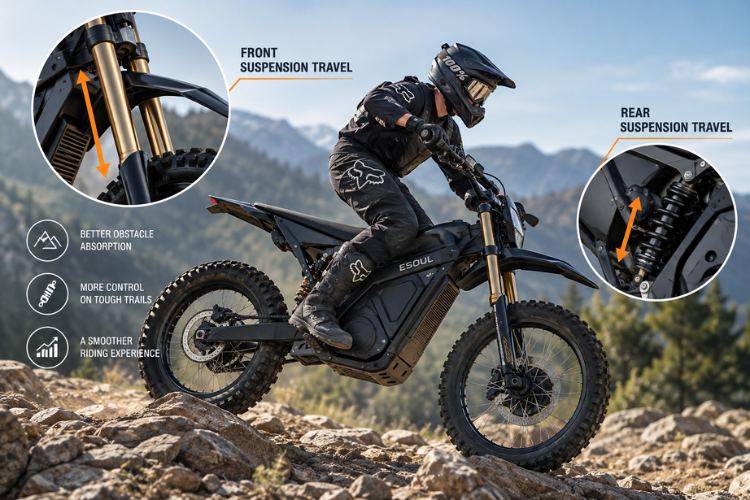
Electric dirt bike specifications are full of numbers: 150mm, 200mm, 240mm, 300mm. Manufacturers often make suspension travel sound simple—the larger the number, the better the suspension.
It isn’t that simple.
Suspension travel is the amount of movement available for the wheel and suspension system to absorb terrain changes and impacts. More travel can provide additional room to absorb large rocks, drops, jumps, and hard landings, but travel alone does not tell you how well a suspension system performs.
A well-set-up 200mm suspension can offer better control than a poorly sprung or poorly damped system with more travel.
There is another complication: front fork travel, rear shock stroke, and rear-wheel travel are not necessarily the same measurement.
Understanding these differences makes it much easier to compare electric dirt bikes without being misled by specification sheets.
| Suspension Term | What It Means | Why It Matters |
|---|---|---|
| Front fork travel | Maximum designed movement of the fork through its stroke | Determines how much front suspension movement is available |
| Rear shock stroke | Physical distance the shock shaft moves | Not necessarily the same as rear-wheel travel |
| Rear-wheel travel | Total movement available at the rear wheel | Better number for comparing rear suspension movement |
| Sag | Suspension travel used by bike/rider weight at rest | Determines where the bike sits in its available travel |
| Spring rate | How much force is required to compress the spring | Must suit rider/bike load and use |
| Compression damping | Controls how suspension compresses | Influences support and impact response |
| Rebound damping | Controls how suspension extends | Influences recovery between impacts |
| Bottom-out | Suspension reaching or approaching the end of usable compression travel | Can indicate a setup or capacity issue if frequent/severe |
The most important takeaway is:
Travel tells you how far the suspension can move. It does not tell you how well that movement is controlled.
Suspension travel describes the available movement of the suspension as the wheels respond to bumps, holes, rocks, roots, landings, braking loads, and changes in terrain.
At the front, the fork compresses as the front wheel moves relative to the chassis.
At the rear, the wheel moves through the swingarm and suspension system while the rear shock compresses.
The purpose isn’t simply to make the ride softer.
A properly functioning suspension system helps the tires follow uneven terrain. That can improve:
This becomes especially important on an electric dirt bike because many modern e-motos combine motorcycle-like speeds and mass with relatively compact chassis dimensions.
A bike that feels perfectly acceptable on pavement may expose its suspension limitations quickly when ridden through repeated roots, rocks, ruts, or braking bumps.
If an electric dirt bike is advertised with 200mm of front suspension travel, the manufacturer is generally describing the designed amount of movement available through the fork’s suspension stroke.
Two hundred millimeters is approximately:
7.9 inches
So a 200mm fork has substantially more available movement than a 120mm fork.
That extra travel gives the suspension more distance in which to manage wheel movement before reaching the end of its compression stroke.
But this does not mean:
A 200mm fork absorbs exactly 200mm-tall obstacles.
A wheel doesn’t simply move vertically by the height of every rock it hits. Tire deformation, wheel path, fork angle, bike movement, rider movement, speed, obstacle shape, and suspension dynamics all influence the impact.
Travel is therefore best understood as available suspension movement, not maximum obstacle height.
This is one of the most common mistakes when reading electric dirt bike specifications.
Suppose a manufacturer lists:
Rear shock stroke: 75mm
That does not necessarily mean the rear wheel only has 75mm of travel.
On many motorcycles, the rear shock and rear wheel move different distances because the swingarm and linkage create a leverage relationship.
For a simplified example, imagine a rear suspension with an average effective motion ratio where:
50mm of shock compression results in 150mm of wheel movement.
The shock stroke is 50mm.
The rear-wheel movement in this simplified example is 150mm.
Those two numbers describe different parts of the system.
This is why comparing:
Bike A: 85mm rear shock stroke
with:
Bike B: 200mm rear-wheel travel
doesn’t tell you that Bike B has more than twice as much rear suspension.
You may simply be comparing shock stroke with wheel travel.
When comparing specifications, look carefully for wording such as:
If the manufacturer doesn’t clearly define what it measured, don’t assume the numbers are directly comparable.
A rear suspension linkage sits between the swingarm, shock, and frame and changes how wheel movement is transferred into shock movement.
One of its benefits is that designers can tune the mechanical relationship between the wheel and shock through the suspension stroke.
This relationship is often discussed as a leverage ratio.
A simplified ratio might look like:
3:1
In a simplified constant-ratio example, roughly 3mm of wheel movement would correspond to about 1mm of shock movement.
Real suspension systems can be more complicated because leverage ratio may change as the suspension moves through its travel.
That’s one reason manufacturers can create progressive suspension behavior, where the relationship between wheel movement and shock movement changes deeper in the stroke.
The important thing for a buyer is simpler:
Rear-wheel travel is usually more useful than shock stroke when you want to understand how much rear suspension movement the complete bike provides.
Shock dimensions become especially important when replacing or upgrading the shock.
No.
More travel provides more potential movement for dealing with large impacts, but suspension quality depends on much more than travel.
Consider two hypothetical forks:
Fork A
Fork B
Fork B has 40mm more travel on paper.
That doesn’t mean it will perform better.
If it sits too deeply into its stroke, dives excessively under braking, blows through travel on impacts, or rebounds unpredictably, the additional travel isn’t being used effectively.
That’s why suspension should be evaluated as a complete system:
Travel + spring rate + damping + sag + chassis geometry + rider weight + terrain.
The longest-travel fork isn’t automatically the best fork.
There is no universal ideal because electric dirt bikes cover an enormous range—from relatively light recreational e-motos to full-size electric enduro motorcycles.
A practical way to think about it is by riding intensity.
| Riding Type | Suspension Priority |
|---|---|
| Street / smooth dirt roads | Long travel is less important |
| Light recreational trails | Moderate travel with good setup |
| Technical singletrack | Traction, control and usable travel matter heavily |
| Rocky / rough trails | Longer, well-damped travel becomes valuable |
| Aggressive off-road | Long travel, proper spring rate and damping |
| Jumps / hard landings | Travel, bottom-out control and chassis setup are critical |
| Enduro / hard enduro | Long, high-quality motorcycle suspension is highly valuable |
Be careful with articles that assign rigid numbers such as:
“120mm is for this terrain, 160mm is for that terrain, and 200mm is always better.”
Electric dirt bikes vary too much for that rule to work reliably.
A 130-pound lightweight e-moto and a full-size electric enduro motorcycle may require very different suspension designs even when ridden on similar terrain.
For many lightweight electric dirt bikes, around 200mm of front travel can represent a serious off-road suspension package, provided the fork is properly designed, sprung, damped, and set up for the rider.
But the number alone cannot answer whether it’s “enough.”
Ask:
Enough for what?
A recreational rider navigating forest trails and moderate rocks places different demands on suspension than a heavier rider repeatedly hitting large jumps.
Even two riders on the same trail may need different spring rates and settings because of differences in body weight, speed, riding style, and skill.
If your main use is tight rocks, roots, and switchbacks, outright travel may also be less important than suspension sensitivity, traction, bike weight, and controllability.
That is why choosing the best electric dirt bike for technical trails shouldn’t be based on travel numbers alone.
Your suspension doesn’t normally begin a ride fully extended.
When the bike and rider load the suspension, it compresses into part of its travel.
That amount is called sag.
Sag is important because suspension needs room to move in both directions.
If the wheel encounters a bump, the suspension needs compression travel.
If the wheel drops into a depression, the suspension needs the ability to extend so the tire can continue following the ground.
Imagine a 200mm system that settles 50mm under the relevant loaded measurement.
The bike begins its ride somewhere within the suspension stroke rather than at full extension.
That is intentional.
But excessive sag can leave less compression travel available before bottoming. Too little sag can also create handling and traction problems.
The correct target should come from the suspension or motorcycle manufacturer because sag measurement methods and recommended values vary between systems.
Avoid blindly applying a universal percentage from a mountain bike, motocross bike, or another e-moto to your own machine.
Spring rate and travel solve different problems.
Travel tells you how far the suspension can move.
Spring rate describes how the spring responds to load.
A heavier rider doesn’t automatically need more travel.
They may need a different spring rate.
If the spring is too soft, the suspension may:
If the spring is too stiff, the suspension may:
This is why buying a 200mm aftermarket fork without checking the recommended rider-weight range can be a mistake.
The right suspension isn’t just the one with enough travel.
It needs to support your weight correctly through that travel.
The spring isn’t the only thing resisting suspension movement.
Damping controls the rate of movement.
Compression damping controls how the suspension behaves as it compresses.
This matters during:
Too little appropriate compression control can make the bike dive or move through its stroke too easily.
Too much can make the suspension feel harsh and prevent the wheel from responding freely to terrain.
Some higher-end suspension separates adjustments into low-speed and high-speed compression.
These terms refer primarily to suspension shaft movement speed, not simply whether the motorcycle itself is traveling slowly or quickly.
A sharp rock hit can generate high suspension-shaft speed even when the bike’s forward speed isn’t particularly high.
That’s an important distinction when adjusting suspension.
After suspension compresses, the spring wants to extend again.
Rebound damping controls the rate of that return.
If rebound is too fast, the bike can feel springy, unsettled, or kick back after impacts.
If rebound is too slow, the suspension may not recover sufficiently before the next obstacle.
Repeated impacts make this particularly important.
Imagine riding across a series of closely spaced roots.
The fork compresses on the first root and begins extending. Before it has fully recovered, the second impact arrives, then the third.
If the suspension repeatedly fails to recover enough between impacts, it can progressively ride lower in its travel—a behavior commonly described as packing.
So again, having 200mm of theoretical travel doesn’t guarantee that the rider can use it effectively.
Damping determines how that travel behaves dynamically.
Bottoming occurs when suspension reaches, or effectively reaches, the end of its available compression stroke.
An occasional controlled use of nearly all available travel during a major impact does not automatically mean the suspension is bad.
Repeated harsh bottoming is more concerning.
Possible contributors include:
Don’t immediately assume you need a longer fork.
First determine why the existing suspension is bottoming.
A spring-rate or damping issue won’t necessarily be solved properly by buying more travel.
Technical trail riding is a perfect example of why travel isn’t everything.
Rocks, wet roots, switchbacks, ledges, and steep climbs require the suspension to maintain tire contact while the rider carefully manages balance and throttle.
A massive travel number doesn’t help much if the bike:
For technical terrain, prioritize traction and control.
A correctly set up moderate-to-long travel suspension can be more useful than maximum travel combined with poor chassis balance.
This also connects directly with power delivery. As explained in our Electric Dirt Bike Torque vs Horsepower guide, additional torque only helps if the rear tire can transfer that force into the ground.
Suspension plays a major role in maintaining that contact.
Jumps place different demands on suspension.
Now there may be substantial impact energy to manage during landing.
Longer travel provides more distance over which the suspension can manage wheel movement and dissipate energy through the spring-and-damper system.
But a jump setup still needs:
Don’t assume that installing a long-travel fork turns a lightweight electric bike into a motocross machine.
The frame, swingarm, wheels, bearings, brakes, tires, and rear suspension all need to suit the intended loads.
For frequent large jumps, choose a bike designed for that type of riding rather than judging capability from fork travel alone.
A common upgrade mistake is focusing entirely on the fork.
Imagine fitting a much taller, longer-travel front fork while leaving the rear suspension unchanged.
That can alter:
Changing fork length or travel isn’t necessarily a plug-and-play performance improvement.
Likewise, an extremely stiff front with a soft rear can make the chassis feel unbalanced.
The goal is not to maximize front and rear travel independently.
The goal is to make both ends work together as part of the chassis.
If you’re modifying suspension beyond manufacturer-supported adjustments or direct replacement specifications, professional suspension setup is worthwhile.
Electric dirt bikes create an interesting suspension challenge.
Many carry substantial battery mass while also delivering strong motor torque and quick throttle response.
The suspension therefore has to manage more than bumps.
During hard acceleration, braking, climbing, cornering, and landing, weight transfers through the chassis while the tires are also trying to maintain traction.
Battery placement and overall mass distribution influence how the bike responds.
This is another reason two electric dirt bikes with identical 200mm travel numbers can feel completely different.
One may have better mass centralization, geometry, spring selection, damping, and chassis balance.
Suspension travel is only one specification inside a much larger system.
When comparing bikes, don’t stop at:
Front travel: 200mm
Instead, work through this checklist.
Is it:
Don’t compare different measurements.
Knowing the actual fork or shock can reveal far more than a generic “hydraulic suspension” description.
Can the suspension be matched to your riding weight?
This becomes particularly important for riders well above or below the manufacturer’s assumed average.
Look for clearly defined adjustments such as:
More adjusters don’t automatically mean better suspension, but useful adjustment can help properly equipped riders or tuners adapt the bike.
Suspension doesn’t operate independently of:
Tires are particularly important because they are the first part of the system to interact with the terrain. See our Electric Dirt Bike Tire Pressure Guide for more on balancing traction, impact protection, and tire pressure.
Don’t buy enduro-level travel because the specification looks impressive if you mainly ride smooth recreational trails.
Likewise, don’t choose a lightly built suspension package if you routinely ride rough terrain or large jumps.
Buy for your terrain, weight, pace, and skill level.
If you’re deciding between:
Bike A: More suspension travel, basic components
and
Bike B: Slightly less travel, higher-quality suspension properly matched to your weight
don’t automatically choose Bike A.
For many riders, controlled suspension is more useful than maximum travel.
Think of travel as the size of the workspace.
Spring rate determines how the bike is supported within that workspace.
Compression damping helps control how it moves into the workspace.
Rebound damping controls how it comes back.
Sag determines where you begin.
All of those elements have to work together.
That’s why premium full-size machines can feel so different from inexpensive electric dirt bikes even when a specification table makes their suspension travel look surprisingly similar.
Suspension travel is the designed amount of movement available as the suspension responds to terrain and impacts. Front fork travel describes movement through the fork’s stroke, while rear specifications may refer to either shock stroke or rear-wheel travel, which are not necessarily the same measurement.
No. More travel can help manage larger impacts, but suspension performance also depends on spring rate, damping, sag, geometry, rider weight, and setup. A well-controlled shorter-travel system can perform better than a poorly set-up longer-travel system.
Around 200mm of front travel is substantial for many lightweight electric dirt bikes and can suit serious trail use when the suspension is appropriately designed and set up. Whether it is enough depends on rider weight, terrain, speed, jumps, and riding style.
Not necessarily. Rear suspension often uses the swingarm and linkage to create a leverage relationship between wheel movement and shock movement. A shock may move a relatively short distance while the rear wheel moves much farther.
Sag is the amount the suspension compresses under specified static or rider-loaded conditions. Proper sag helps position the suspension within its usable travel so it can both compress over bumps and extend into depressions. Use the manufacturer’s measurement procedure and target for your specific bike or suspension.
Not automatically. A heavier rider often needs an appropriate spring rate and suspension setup rather than simply more travel. Incorrect spring rate can cause excessive sag, bottoming, harshness, or poor traction even when plenty of travel is available.
For the intended riding, insufficient usable travel can contribute to frequent bottoming and reduced ability to manage large impacts. However, bottoming can also result from incorrect spring rate, sag, or damping, so travel shouldn’t be diagnosed in isolation.
Excessive or inappropriate changes to suspension length can affect ride height and chassis geometry. Longer travel can also add weight or complexity and may be unnecessary for smoother riding. Suspension should match the complete chassis and intended use.
Both matter, but a large travel number without effective damping doesn’t guarantee good performance. Damping controls how the suspension moves through its available travel, making it essential for traction, braking support, repeated impacts, and stability.
Electric dirt bike suspension travel is important, but it’s one of the most misunderstood numbers on a specification sheet.
More travel gives the suspension additional movement to manage rough terrain and large impacts. It does not automatically mean better traction, better handling, or a higher-quality suspension system.
When comparing bikes, first determine whether the manufacturer is quoting:
front fork travel, rear shock stroke, or actual rear-wheel travel.
Then look beyond the millimeters.
Consider:
spring rate, sag, compression damping, rebound damping, rider weight, bike weight, wheel and tire setup, chassis geometry, and intended terrain.
For recreational trail riding, you may not need the longest suspension available.
For technical terrain, usable traction and controlled movement matter more than a headline number.
For aggressive jumps and hard enduro, longer travel becomes increasingly valuable—but only when the rest of the suspension and chassis are designed to handle those loads.
So instead of asking:
“Which electric dirt bike has the most suspension travel?”
ask:
“Does this suspension have enough well-controlled travel for my weight, terrain, and riding style?”
That question will tell you far more about how the bike is likely to perform.
Technical suspension concepts in this guide should be checked against the motorcycle or suspension manufacturer’s specifications because travel definitions, linkage designs, sag procedures, spring rates, and adjustment ranges differ between products.
Recommended technical references include:
Always use the setup instructions and limits provided for the exact suspension and motorcycle being adjusted.
Use Article and BreadcrumbList schema.
The visible FAQ section can be marked up only where FAQ structured data is appropriate under current search-engine guidelines. Avoid Product or Review schema unless the page contains genuine corresponding product or review content.
Electric motocross and electric enduro motorcycles can look very similar, and in some cases they even share the same motor,
Electric enduro motorcycles are becoming an increasingly appealing option for riders who want strong acceleration, precise low-speed control, and less

Electric enduro motorcycles are becoming an increasingly appealing option for riders who want strong acceleration, precise low-speed control, and less
The Talaria XXX Pro and Talaria Sting R MX4 are two popular options for riders looking for a lightweight electric
