Electric Motocross vs Electric Enduro: What’s the Difference?
Electric motocross and electric enduro motorcycles can look very similar, and in some cases they even share the same motor,

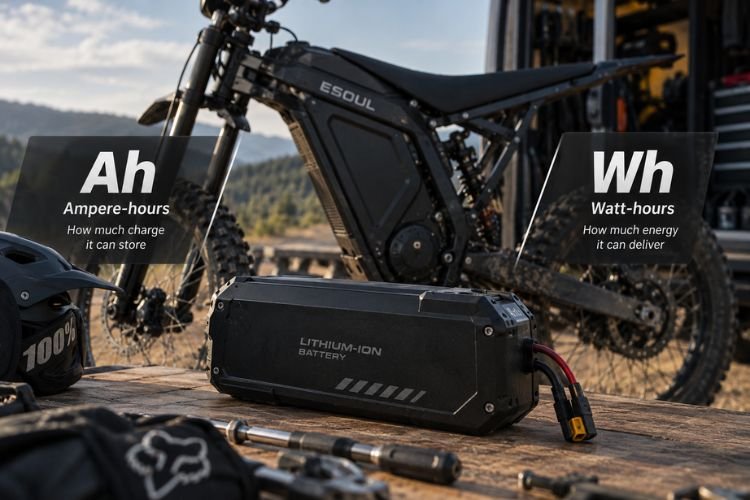
When comparing electric dirt bikes, battery specifications can become confusing surprisingly quickly. One model might advertise a 72V 30Ah battery, another a 60V 40Ah pack, while a third lists its battery as 2.5kWh. If you look only at the biggest number, it is easy to reach the wrong conclusion about which bike actually carries more energy.
The most important distinction is simple: Ah (amp-hours) measures electric charge capacity, while Wh (watt-hours) measures energy. For electric dirt bike buyers, Wh is usually the more useful figure when comparing battery energy because it takes both battery voltage and Ah into account.
The basic calculation is:
Watt-hours (Wh) = Volts (V) × Amp-hours (Ah)
For example, a 72V 30Ah battery represents approximately:
72 × 30 = 2,160Wh, or 2.16kWh
A 60V 40Ah battery represents:
60 × 40 = 2,400Wh, or 2.4kWh
So even though the second battery operates at a lower nominal voltage, it actually has more nominal energy. This is exactly why Ah should not be used by itself when comparing electric dirt bikes with different battery voltages.
To understand an electric dirt bike battery specification, it helps to separate three measurements: voltage, amp-hours, and watt-hours.
Voltage describes electrical potential difference and is one of the defining characteristics of the bike’s electrical architecture. Amp-hours describe electric charge capacity. Watt-hours combine voltage and charge capacity into a measurement of energy.
In simplified terms, you can think of the relationship like this:
| Specification | Meaning | Example |
|---|---|---|
| Voltage (V) | Electrical potential difference | 72V |
| Amp-hours (Ah) | Electric charge capacity | 35Ah |
| Watt-hours (Wh) | Nominal battery energy | 2,520Wh |
| Kilowatt-hours (kWh) | 1,000 watt-hours | 2.52kWh |
| Watts (W) | Power | 10,000W |
| Kilowatts (kW) | 1,000 watts | 10kW |
If a battery is rated at 72V 35Ah, multiplying the two gives:
72V × 35Ah = 2,520Wh
That can also be written as:
2.52kWh
This distinction becomes particularly useful because electric dirt bikes do not all use the same voltage. Depending on the bike, you may encounter 48V, 60V, 72V, 74V, 80V, or other battery architectures.
If two batteries operate at the same nominal voltage, Ah is a useful shortcut. For example, a 72V 40Ah battery contains more nominal energy than a 72V 30Ah battery:
72V 30Ah = 2,160Wh
72V 40Ah = 2,880Wh
The second pack therefore has approximately 33.3% more nominal energy.
But as soon as voltage changes, Ah alone stops being a reliable energy comparison. Consider a 72V 30Ah pack against a 60V 40Ah pack. Looking only at Ah makes the 40Ah pack seem larger, but the correct comparison is 2,160Wh versus 2,400Wh. In this case it really does have more energy—but the reason becomes clear only after voltage is included.
Now change the 60V battery to 35Ah:
60V × 35Ah = 2,100Wh
The 72V 30Ah battery now has slightly more nominal energy despite having fewer amp-hours.
This is the central idea to remember:
Ah is useful when voltage is the same. Wh is more useful when comparing battery energy across different voltages.
One technical detail is also important. A battery marketed as “72V” does not remain at exactly 72.0 volts throughout its discharge. Battery voltage varies with state of charge, load, chemistry, cell configuration, temperature, and other conditions. The advertised voltage is a nominal system voltage.
For that reason, multiplying nominal voltage by rated Ah gives you a useful nominal energy figure, not a guarantee of exactly how many watt-hours will reach the motor or rear wheel during every ride.
Electric dirt bike marketing often puts Ah front and center because it is an easy number to understand: 40Ah sounds better than 30Ah.
But without voltage, Ah is incomplete.
Here are several battery configurations to show why:
| Battery | Nominal Energy |
|---|---|
| 48V 20Ah | 960Wh |
| 60V 30Ah | 1,800Wh |
| 72V 30Ah | 2,160Wh |
| 60V 40Ah | 2,400Wh |
| 72V 35Ah | 2,520Wh |
| 72V 40Ah | 2,880Wh |
| 80V 40Ah | 3,200Wh |
| 72V 45Ah | 3,240Wh |
Notice what happens with the two 40Ah batteries. A 60V 40Ah pack represents approximately 2,400Wh, while an 80V 40Ah pack represents approximately 3,200Wh. They have identical Ah ratings, yet the latter has about 33.3% more nominal energy.
The reverse is also possible: a battery with fewer Ah can store more nominal energy than one with a larger Ah rating if its voltage is sufficiently higher.
This is why Wh is one of the first numbers we recommend calculating when comparing bikes in categories such as our Best 72V Electric Dirt Bikes in 2026. It creates a much more meaningful starting point than comparing Ah figures without considering system voltage.
However, Wh should not become another oversimplified ranking metric. Two batteries with the same 2,500Wh nominal energy can still perform very differently. Their cells, battery management systems, maximum current capability, voltage sag, thermal performance, weight, packaging, and usable energy can all differ.
The same applies to advertised capacity versus usable capacity. A simple calculation such as 72V × 40Ah = 2,880Wh should not be interpreted as a promise that exactly 2,880Wh will be available at the rear wheel.
The battery management system protects the pack by controlling operating limits, while voltage changes during discharge. Temperature, current demand, battery age, cell condition, electrical losses, and cutoff behavior can also affect how much energy is actually delivered during a ride.
For shopping comparisons, therefore, calculated Wh is best treated as nominal battery energy unless the manufacturer clearly specifies usable energy separately.
A battery with more usable energy generally offers more potential range if everything else remains equal. The problem is that everything else rarely remains equal between electric dirt bikes.
Imagine two otherwise identical bikes. One carries a 2,160Wh battery and the other carries a 2,880Wh battery. The second bike has about 33.3% more nominal energy, so you would reasonably expect greater range under equivalent conditions.
Now imagine that the second bike is heavier, has a more powerful controller, uses aggressive off-road tires, and is ridden faster. Its larger battery may be offset partly by higher energy consumption.
Real electric dirt bike range is affected by rider weight, bike weight, speed, throttle use, acceleration, elevation gain, terrain, tire pressure, tire construction, temperature, mud, sand, wind, motor efficiency, controller tuning, battery condition, and riding mode.
That is why a manufacturer advertising 70 miles from one battery and another advertising 50 miles from a similar-size battery does not automatically prove that the first bike is dramatically more efficient. Unless the test conditions are comparable, those numbers are not an apples-to-apples range test.
A better technical concept is Wh per mile.
Suppose, purely as an illustration, that a bike has 2,400Wh of usable energy and averages 40Wh/mile under a particular riding condition:
2,400Wh ÷ 40Wh/mile = 60 miles
If aggressive riding on steep, loose terrain increases consumption to 80Wh/mile:
2,400Wh ÷ 80Wh/mile = 30 miles
Nothing happened to the battery capacity. The bike simply consumed its available energy twice as quickly per mile.
Those numbers are examples rather than expected consumption figures for a specific electric dirt bike, but they demonstrate the correct relationship:
Approximate range = usable battery energy ÷ average energy consumption per mile
This also explains why trail conditions matter so much. Long climbs, soft sand, mud, low tire pressure, repeated hard acceleration, and high speeds can consume significantly more energy than gentle riding on easier terrain.
If range and long-term battery ownership are priorities, our How to Extend Electric Dirt Bike Battery Life guide covers the practical side of charging, storage, temperature, and riding habits.
The takeaway is that Wh tells you how much nominal energy a battery represents; it does not tell you exactly how far the bike will travel.
This is where battery terminology is most commonly misunderstood.
A larger Ah rating does not automatically make an electric dirt bike faster. Ah is a charge-capacity measurement. It does not directly tell you top speed, peak motor power, or acceleration.
Suppose two hypothetical compatible packs are both 72V:
Battery A: 72V 30Ah
Battery B: 72V 40Ah
Battery B has more nominal energy, but that alone does not mean it provides higher voltage to the motor or produces a higher top speed.
Likewise, two batteries can both be labeled 72V 40Ah and still have very different power-delivery capabilities.
To understand that side of battery performance, you need additional information about cell characteristics, pack configuration, maximum and continuous discharge current, BMS current limits, controller limits, wiring, connectors, thermal behavior, and voltage sag.
Electrical power is related to voltage and current:
Power (W) = Voltage (V) × Current (A)
As a simplified theoretical example:
72V × 100A = 7,200W
while:
72V × 200A = 14,400W
That does not mean every 72V battery can safely supply 100A or 200A. The examples simply show why an Ah rating cannot tell you the battery’s power capability by itself.
This distinction is particularly important when comparing high-performance electric dirt bikes. A pack designed to store a large amount of energy is not necessarily designed to deliver extremely high current continuously. Energy capacity and power capability are related aspects of battery design, but they are not the same specification.
The same distinction applies to Wh versus W.
Watts measure power. Watt-hours measure energy.
A bike advertised with a 10kW motor and a 2.5kWh battery is giving you two completely different pieces of information. The first describes a power level; the second describes an amount of battery energy.
You should not simply divide 2.5kWh by 10kW and conclude that the bike will run at full advertised peak power for exactly 15 minutes. Peak motor output may not equal continuous battery draw, and usable battery energy, controller behavior, efficiency, voltage sag, thermal limits, and riding conditions all affect the result.
Voltage creates another common misunderstanding. A 72V bike is not automatically faster or longer-range than a 60V bike simply because 72 is the larger number.
For a given electrical power level, higher voltage can reduce the current required. Ignoring losses, delivering 10,000W would theoretically require approximately:
10,000W ÷ 72V ≈ 139A
At 60V:
10,000W ÷ 60V ≈ 167A
This is one reason higher-voltage architectures can be useful in high-power applications. But the complete system has to be designed around that voltage. Motor design, controller limits, battery current capability, gearing, software, thermal management, and many other factors determine actual performance.
Voltage by itself does not tell you range either. A 72V 20Ah battery represents about 1,440Wh, while a 60V 30Ah pack represents about 1,800Wh. The lower-voltage battery has more nominal energy in that comparison.
So when you see voltage, Ah, Wh, and kW on the same electric dirt bike specification sheet, don’t treat them as competing versions of the same number. They answer different questions.
Let’s put all of this into a realistic shopping comparison.
Suppose Electric Dirt Bike A has:
72V 30Ah battery
and Electric Dirt Bike B has:
60V 40Ah battery
Bike A:
72 × 30 = 2,160Wh
Bike B:
60 × 40 = 2,400Wh
Bike B therefore carries 240Wh more nominal battery energy, which is approximately 11.1% more than Bike A.
If your only question is:Which battery has more nominal energy? the answer is Bike B.
But if your question is: Which electric dirt bike is better?
there is nowhere near enough information.
We still don’t know the usable battery energy, cell specifications, BMS limits, current capability, bike weight, motor efficiency, controller tuning, gearing, tires, riding modes, or real-world energy consumption.
We also cannot conclude that Bike B will have 11.1% more real-world range. If Bike A is lighter and more efficient, the difference could shrink. If Bike B is ridden more gently, the difference could grow. Range is the result of both energy capacity and energy consumption.
The same principle applies when comparing two 72V batteries.
A 72V 30Ah pack is approximately 2,160Wh, while a 72V 35Ah pack is approximately 2,520Wh. Because the voltage is the same, the 35Ah battery has approximately 16.7% more nominal energy.
This is a situation where comparing Ah directly works because the voltage is identical.
But even here, a 16.7% increase in nominal energy does not guarantee exactly 16.7% more miles.
This is why our electric dirt bike comparisons should never rank battery performance by Ah alone. The correct approach is to calculate nominal Wh first, then evaluate the battery as part of the complete motorcycle.
When you’re reading an electric dirt bike specification sheet, start with nominal voltage, Ah, and Wh, but don’t stop there.
Voltage tells you about the electrical architecture. Ah gives you charge capacity. Wh gives you the best simple comparison of nominal battery energy.
After that, look for information about the cells and pack itself. If a manufacturer identifies the cell manufacturer, model, chemistry, pack configuration, BMS, or discharge limits, those details can provide valuable context. Two 72V 40Ah batteries are not necessarily equivalent simply because their headline specifications match.
For a high-performance electric dirt bike, current capability deserves particular attention. A battery has to support the controller and motor’s power demands without exceeding its designed electrical or thermal limits. Avoid assuming that a high Ah number means the battery can safely provide unlimited current.
Weight also matters more on a dirt bike than it might on a stationary battery system. Adding battery energy often requires more cells, which can increase mass and physical size. For a rider doing long-distance trail rides, that trade-off may be worthwhile. On tight technical terrain, additional battery weight can affect how easily the bike changes direction or is recovered after a tip-over.
Charging is another part of the equation. Larger energy capacity often takes longer to replenish when charger power remains similar, although actual charge time depends on charger output, BMS behavior, battery limits, temperature, and how charge rate changes as the pack approaches full.
Finally, consider battery warranty, replacement availability, and replacement cost. The battery is one of the most important and expensive systems on an electric dirt bike. A slightly larger pack is not necessarily the better ownership proposition if replacement support is poor.
A useful buying checklist therefore looks like this:
When comparing batteries, Wh should be your starting point for energy—not your final verdict on the bike.
Ah measures electric charge capacity, while Wh measures energy. Because Wh includes battery voltage, it is generally more useful for comparing nominal battery energy across electric dirt bikes using different voltage systems.
Multiply the battery’s nominal voltage by its Ah rating:
Wh = V × Ah
For example, a 72V 40Ah battery has a nominal energy figure of:
72 × 40 = 2,880Wh, or 2.88kWh.
If both batteries operate at the same nominal voltage, the 40Ah battery has more nominal energy. If their voltages differ, Ah alone is not enough to make the comparison. Calculate Wh first.
Using nominal values:
72V × 30Ah = 2,160Wh
That is approximately 2.16kWh of nominal battery energy.
A 72V 40Ah battery represents approximately:
72 × 40 = 2,880Wh
or 2.88kWh of nominal energy.
At the same voltage and under otherwise identical conditions, more Ah means more nominal energy and therefore greater potential range. Across different bikes or voltages, Ah alone cannot reliably predict range.
For comparing battery energy across different voltage systems, Wh is generally more useful because it includes both voltage and Ah. However, Wh does not tell you battery current capability, cell quality, BMS limits, efficiency, or exact real-world range.
Not automatically. Ah is a charge-capacity rating, not a direct measurement of speed or power. Performance depends on voltage, battery current capability, controller limits, motor characteristics, gearing, traction, software, and other factors.
One kilowatt-hour equals 1,000 watt-hours:
1kWh = 1,000Wh
A 2,520Wh battery can therefore also be described as a 2.52kWh battery.
Yes. Batteries with similar nominal energy can have different voltages, cells, current capabilities, BMS limits, thermal characteristics, weights, voltage sag, and usable-energy windows. Wh measures energy; it does not describe every aspect of battery performance.
When comparing electric dirt bike battery Ah vs Wh, the most useful formula to remember is:
Wh = V × Ah
Ah tells you electric charge capacity. Wh combines that charge capacity with voltage to tell you nominal battery energy.
If two batteries operate at the same nominal voltage, Ah is a convenient comparison. A 72V 40Ah battery has more nominal energy than a 72V 30Ah battery.
But when voltage changes, never judge battery energy from Ah alone.
A 60V 40Ah battery represents approximately 2,400Wh, while a 72V 30Ah battery represents approximately 2,160Wh. Despite having a lower voltage, the 60V battery stores more nominal energy in that example.
Wh is therefore the better starting point when comparing battery capacity across electric dirt bikes.
It still isn’t the whole story.
Battery cells, BMS limits, current capability, usable energy, bike efficiency, battery weight, charging performance, temperature, warranty, and replacement support all matter. Real-world range also depends heavily on how and where you ride.
A bigger Ah number can look impressive on a product page, but without knowing the voltage it doesn’t tell you how much energy the battery actually represents.
Compare Wh for energy. Compare the complete battery system for performance. And compare the complete bike for range.
Electric motocross and electric enduro motorcycles can look very similar, and in some cases they even share the same motor,

Electric enduro motorcycles are becoming an increasingly appealing option for riders who want strong acceleration, precise low-speed control, and less

Electric enduro motorcycles are becoming an increasingly appealing option for riders who want strong acceleration, precise low-speed control, and less
The Talaria XXX Pro and Talaria Sting R MX4 are two popular options for riders looking for a lightweight electric
