Electric Motocross vs Electric Enduro: What’s the Difference?
Electric motocross and electric enduro motorcycles can look very similar, and in some cases they even share the same motor,

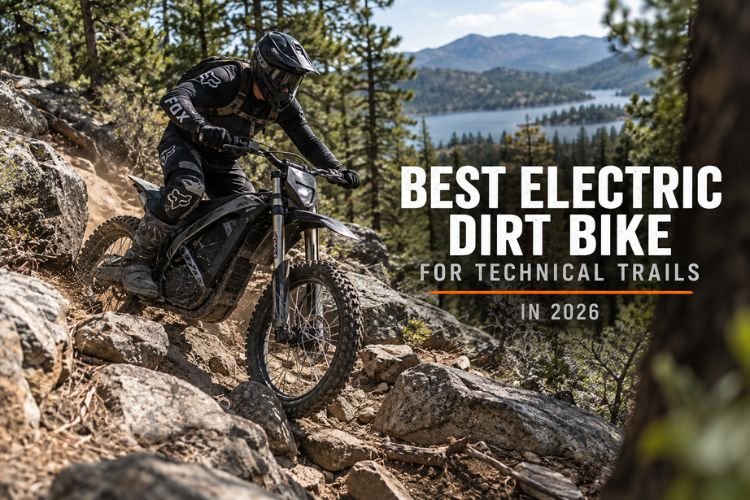
The best electric dirt bike for technical trails isn’t necessarily the fastest or most powerful bike you can buy. On tight singletrack, rocky climbs, roots, switchbacks, ruts, and slow-speed obstacles, a lighter and more controllable bike can be easier to ride than a heavier machine with dramatically more peak power.
For most riders, our top lightweight technical-trail pick is the Talaria Sting MX5, thanks to its combination of compact dimensions, strong electric performance, and manageable size. The 79Bike Falcon Pro is another compelling lightweight option, particularly for riders who value a 130-pound chassis and Fastace suspension. For riders coming from full-size enduro motorcycles and tackling genuinely demanding hard-enduro terrain, the Stark VARG EX is in a different class, with full-size geometry, KYB suspension, and far more performance—but also substantially more weight and cost.
The important lesson is simple:
For technical trails, control beats top speed.
If your riding is mostly open terrain, fast fire roads, or motocross-style tracks, our Best Electric Dirt Bikes in 2026 guide covers a wider range of machines. This guide is specifically about bikes that make sense when the trail gets narrow, slow, steep, rocky, and difficult.
| Model | Best For | Why It Works on Technical Trails |
|---|---|---|
| Talaria Sting MX5 | Best Overall Lightweight Pick | Compact, agile, strong performance |
| 79Bike Falcon Pro | Best Lightweight Alternative | 130 lbs, 10kW, Fastace suspension |
| Sur Ron Ultra Bee | Best Mid-Size Trail Bike | Larger chassis, stronger off-road platform |
| Stark VARG EX | Best Premium / Hard Enduro | Full-size enduro chassis, KYB suspension |
| Happyrun G300 Pro | Best Budget-Friendly Option | Lower price, 72V system, manageable power |
| 79Bike Falcon GT | Best High-Power Lightweight Option | More power and battery without full-size enduro dimensions |
This isn’t a ranking based on which model has the biggest motor.
Instead, we’re looking at the characteristics that matter when you’re trying to turn around between trees, maintain traction on a steep rocky climb, pick a clean line through roots, or recover the bike after losing balance halfway up a technical section.
Technical trail riding changes what “performance” means.
On an open dirt road, additional power and higher top speed are easy to use. On a narrow wooded trail, you may spend most of the ride well below maximum speed.
Instead, you’re constantly asking the bike to change direction, maintain balance, find traction, climb over obstacles, and respond predictably to small throttle inputs.
That puts the priority on six things.
Weight matters everywhere off-road, but it becomes especially noticeable on technical terrain.
Imagine stopping halfway through a rocky climb with the bike leaning downhill. Or needing to make a tight turn around a tree. Or picking the bike up after a low-speed fall.
A 125–140-pound lightweight e-moto and a 260-pound full-size enduro motorcycle can both be excellent machines, but recovering them in awkward terrain is a completely different experience.
This is why smaller bikes remain attractive even as more powerful electric motorcycles enter the market.
Technical riding needs power, but it needs usable power.
A rear tire only has so much traction. If aggressive throttle input immediately overwhelms the tire, additional motor output can create wheelspin rather than forward progress.
Good controller tuning, ride modes, predictable throttle mapping, and a rider’s ability to meter torque matter more than simply having the largest peak-kW number.
Our guide to Electric Dirt Bike Torque vs Horsepower explains this relationship in more detail: low-speed wheel torque is extremely useful, but traction determines how much of that torque can actually become forward motion.
Suspension isn’t just about making rocks and roots more comfortable.
Its real job includes helping the tires remain connected to uneven ground.
On repeated roots, rocks, ledges, ruts, and braking bumps, poorly controlled suspension can cause the wheel to skip across the surface. That reduces grip and makes the bike harder to place accurately.
Technical trail riders therefore benefit from suspension that is appropriate for their weight, speed, and terrain—not simply the fork with the longest travel number.
Technical trails frequently involve logs, rocks, ledges, deep ruts, and abrupt changes in elevation.
Ground clearance matters, but so does wheelbase, wheel size, suspension sag, and the rider’s ability to accurately position the front and rear wheels.
A compact bike can change direction quickly. A larger platform can feel more planted. Neither approach is universally better.
The motor can only do useful work if the rear tire can transfer force into the ground.
Loose dirt, wet roots, mud, rocks, and sand all change how much throttle you can use.
Tire pressure also affects the contact patch, comfort, rim protection, and traction. If you’re setting up a bike specifically for trail riding, our Electric Dirt Bike Tire Pressure Guide is worth reading alongside this guide.
Maximum advertised range can be misleading for technical riding.
Slow trails don’t necessarily mean low energy consumption. Repeated climbing, aggressive bursts of torque, loose surfaces, elevation changes, and difficult terrain can consume substantial battery energy.
Instead of relying only on an advertised mileage figure, look at battery energy capacity, riding intensity, elevation, and whether you have a realistic charging plan.
The Talaria Sting MX5 makes a strong case for technical trails because it stays close to the lightweight e-moto philosophy.
That’s important.
Technical singletrack often rewards a bike that feels easy to place rather than one that dominates a specification table. When you’re constantly moving around obstacles, making tight turns, or correcting your line at low speed, compact dimensions can become a genuine performance advantage.
The MX5 combines that relatively compact platform with enough electric performance for serious recreational riding.
Its appeal becomes particularly clear when compared with a larger bike such as the Sur Ron Ultra Bee.
As we explain in our Sur Ron Ultra Bee vs Talaria MX5 comparison, the MX5 has the stronger argument for tight recreational trails because the smaller platform requires less motorcycle management.
That can help in switchbacks, narrow wooded sections, and awkward climbs where the rider may need to quickly dab a foot or reposition the bike.
There is another advantage: fatigue.
A few pounds may not sound important while reading a specification sheet, but technical riding involves repeated braking, standing, balancing, turning, and correcting. A machine that requires less physical effort to manage can leave the rider with more energy later in the ride.
The limitation is that compact size isn’t ideal for everyone. Taller riders and those coming from conventional full-size dirt bikes may prefer more room and a more substantial chassis.
Best for: Riders who prioritize agility, compact dimensions, and maneuverability over maximum size or outright power.
The 79Bike Falcon Pro is one of the more interesting alternatives for technical riding because its specifications combine serious power with relatively low weight.
79Bike currently lists the Falcon Pro at 130 pounds, with a 10kW peak mid-mounted motor, 72V 35Ah battery, and Fastace front and rear suspension.
For technical trails, the 130-pound figure may matter more than its claimed 56 mph maximum speed.
You rarely need 56 mph between rocks and trees.
What you do need is enough power for steep climbs, a chassis that doesn’t become exhausting at low speed, and suspension capable of controlling rough surfaces.
The Falcon Pro’s Fastace 2.0 front fork and Fastace rear shock make its stock suspension package another reason to consider it for trail use.
Its 10kW peak motor also provides plenty of performance without pushing the bike into the dramatically heavier full-size motorcycle category.
However, more power isn’t automatically better on technical terrain. Throttle control remains important, particularly on loose climbs where excessive rear-wheel torque can break traction.
We explore the Falcon Pro’s complete battery-controller-motor-drivetrain relationship in our 79Bike Falcon Pro Review.
Best for: Riders who want lightweight handling but more stock performance and suspension hardware.
The Sur Ron Ultra Bee makes more sense when technical riding starts moving closer to traditional enduro terrain.
Compared with smaller lightweight e-motos, the Ultra Bee provides a more substantial motorcycle platform.
That brings advantages and disadvantages.
The larger chassis gives the rider more room to move, particularly when standing on the pegs and shifting body position forward or backward to manage traction. It can also feel more stable when terrain becomes faster and rougher.
This is useful on rocky climbs, larger obstacles, rough descents, and trails where suspension capability matters more than minimum weight.
The trade-off appears when the trail becomes extremely tight.
More motorcycle means more motorcycle to turn, catch, pick up, and reposition.
This is why we don’t automatically rank the Ultra Bee above smaller models for every technical trail.
A narrow wooded trail filled with slow switchbacks may favor something like the Talaria MX5. A rougher, faster trail with larger impacts and more conventional enduro terrain can shift the advantage toward the Ultra Bee.
Rider size matters too. Taller or heavier riders may find the larger cockpit more comfortable than lightweight e-moto dimensions.
Best for: Riders who want more traditional dirt-bike proportions and a stronger chassis for rougher technical terrain.
The Stark VARG EX belongs in a different category from the lightweight e-motos above.
This is a full-size electric enduro motorcycle.
Stark currently lists the VARG EX at 60 or 80 hp, approximately 264 pounds, and a 7.2kWh battery. More important for this discussion, it uses KYB suspension with 300mm front travel and 303mm rear-wheel travel, plus a full-size 21-inch front and 18-inch rear wheel setup.
This is the bike to consider when “technical trails” means actual hard-enduro terrain rather than recreational singletrack.
Its full-size chassis, suspension, ground clearance, brakes, and ergonomics are designed for substantially more demanding riding.
The electric powertrain also brings an interesting technical-trail advantage: no conventional clutch or multi-speed gearbox to manage. Stark additionally provides adjustable power delivery and a crawl function that can move the motorcycle at walking speed forward or backward.
But there is no escaping the weight difference.
At around 264 pounds, the VARG EX is roughly twice the weight of several lightweight e-motos.
An experienced enduro rider may accept that because the full-size chassis and suspension provide capabilities smaller bikes can’t match. A recreational rider trying to wrestle the motorcycle around a tight uphill switchback may feel very differently.
Price is another major dividing line. The VARG EX sits far above the lightweight electric dirt bike category.
So while it may be the most capable technical enduro machine here, it isn’t the automatic recommendation for most trail riders.
Best for: Experienced enduro riders tackling genuinely difficult terrain who want a full-size premium electric motorcycle.
Technical trail riding doesn’t require a $10,000-plus motorcycle.
The Happyrun G300 Pro offers a more budget-oriented route into 72V electric dirt bike performance.
HappyRun lists a 6.5kW peak motor, 72V 30Ah battery, full suspension, hydraulic brakes, and a claimed maximum speed of 50 mph in off-road mode.
For technical riding, that 50 mph figure isn’t particularly important.
The more relevant question is whether 6.5kW is enough.
For many recreational riders, yes.
A technical trail often gives you fewer opportunities to use enormous peak output than an open road or track. Controllable acceleration, grip, rider confidence, and manageable speed can be more useful.
The G300 Pro’s biggest advantage is value. It can provide meaningful electric off-road performance without requiring the budget of premium lightweight e-motos or full-size electric enduro motorcycles.
The compromise is hardware. Riders who push hard through repeated rocks, large impacts, and aggressive technical terrain may place greater value on higher-end suspension and chassis components.
If you’re deciding between value and a more premium lightweight package, our Happyrun G300 Pro vs 79Bike Falcon Pro comparison breaks down that trade-off directly.
Best for: Recreational trail riders prioritizing price-to-performance over premium stock hardware.
What if you like the lightweight e-moto format but want significantly more performance?
That’s where the 79Bike Falcon GT becomes interesting.
The GT moves beyond the Falcon Pro with a larger battery and substantially higher peak output while still occupying a different physical category from a full-size machine like the Stark VARG EX.
That sounds ideal, but technical riders should ask an important question:
Will you actually use the additional power?
On a fast climb with good traction, extra output can be useful.
On wet roots, loose rocks, mud, or a narrow switchback, the limiting factor may be traction and rider control rather than motor capability.
This is the same reason our Best 72V Electric Dirt Bikes in 2026 guide doesn’t simply rank every model by peak watts.
The Falcon GT makes the most sense for experienced riders who want a high-performance lightweight electric platform that can handle both technical sections and faster, more open terrain.
For purely slow technical riding, a lighter or less aggressive bike may actually be easier to use.
Best for: Experienced riders who combine technical trails with faster open sections and want substantial power without moving to a full-size enduro motorcycle.
This may be the most important decision in this guide.
A lightweight e-moto such as the Talaria MX5 or Falcon Pro is attractive because it can be easier to maneuver, recover, transport, and control at low speed.
That matters enormously on technical singletrack.
A full-size electric enduro such as the Stark VARG EX offers something different: more substantial suspension, larger wheels, full-size ergonomics, greater ground clearance, and a chassis designed around serious motorcycle-level off-road use.
Neither is universally better.
Choose the lightweight approach if your trails involve:
Move toward the full-size enduro approach if your riding involves:
The middle ground—represented by bikes such as the Ultra Bee—can make sense for riders who want more dirt-bike capability without going all the way to a 260-plus-pound premium enduro motorcycle.
Probably less than the specification race suggests.
Technical trails reward usable wheel torque, not the biggest peak-kW number.
A 6.5–10kW lightweight bike can already provide substantial performance. Beyond that, additional output can be useful, but only when traction, terrain, chassis, and rider skill allow it.
Think about a steep loose climb.
If the rear tire begins spinning at 8kW of available output, increasing the motor’s capability to 15kW doesn’t automatically make the bike climb faster.
You may need better traction, smoother throttle control, a different tire, altered gearing, or better body positioning.
On the other hand, a long, steep climb at higher speed can demand sustained power as well as torque.
This is why technical performance cannot be reduced to one motor specification.
If you have to choose between an extra 5 mph of claimed top speed and better suspension for technical trail riding, we’d usually pay more attention to the suspension.
Technical terrain repeatedly asks the suspension to manage impacts while preserving traction.
A good setup helps the front tire follow uneven terrain instead of deflecting unpredictably. The rear suspension needs to maintain grip while absorbing roots, rocks, and ledges.
Setup matters as much as brand.
Spring rate, preload, compression damping, rebound damping, tire pressure, rider weight, and riding speed all affect how the suspension behaves.
A premium fork set up incorrectly for the rider can perform worse than a more modest system that is properly adjusted.
Manufacturers often advertise maximum range under favorable conditions.
Technical trails aren’t favorable conditions.
Repeated climbs, loose ground, acceleration out of slow corners, low-speed maneuvering, and elevation gain can all affect consumption.
A better buying strategy is to look at battery energy and then build in a substantial safety margin for your intended route.
Never plan a remote trail ride around achieving the manufacturer’s maximum advertised mileage.
Battery condition also changes over time. Charging habits, storage, temperature, and usage can influence long-term performance, which is why our guide on how to extend electric dirt bike battery life is useful for riders planning regular off-road use.
If your definition of technical riding is tight singletrack, switchbacks, roots, and low-speed obstacles, we’d lean toward the Talaria Sting MX5 or another lightweight e-moto.
If you want a similarly lightweight package with a strong 72V system and upgraded stock hardware, the 79Bike Falcon Pro deserves serious consideration.
If your terrain is rougher and faster and you prefer motorcycle-like dimensions, the Sur Ron Ultra Bee becomes more attractive.
If you’re an experienced enduro rider and “technical” means hard enduro, large rocks, ledges, steep climbs, and serious full-size motorcycle terrain, the Stark VARG EX is the most capable machine in this group—but its price, size, and weight make it excessive for many recreational riders.
And if budget matters more than having premium suspension or maximum output, the Happyrun G300 Pro provides a lower-cost way into electric trail riding.
The best technical-trail bike isn’t the one that wins the drag race.
It’s the one you can accurately control when the trail gives you almost no room for error.
For lightweight technical trail riding, the Talaria Sting MX5 is one of the strongest options because its compact dimensions and manageable mass suit tight terrain. Riders wanting a more premium lightweight alternative should consider the 79Bike Falcon Pro, while experienced hard-enduro riders may prefer a full-size machine such as the Stark VARG EX.
Often, yes. Lower weight can make direction changes, balance corrections, tight turns, recoveries, and picking up the bike easier. However, full-size heavier bikes can provide better suspension, stability, ergonomics, and capability on larger obstacles and faster rough terrain.
There is no universal requirement. A lightweight 6.5–10kW bike can already provide substantial performance for recreational technical riding. Higher output becomes more useful when terrain, traction, rider skill, and speed allow it.
Low-speed wheel torque is very important, but it should not be considered alone. Traction, gearing, total weight, controller tuning, motor speed, and available power all affect performance. Too much poorly controlled torque can simply spin the rear tire.
They can be. Electric motors can provide strong low-speed torque, while single-speed drivetrains remove clutch and gear-selection requirements on many models. However, tire grip, rider technique, bike weight, gearing, battery output, and controller temperature still influence climbing performance.
There is no single ideal size. Larger front wheels can roll over obstacles more easily, while smaller and more compact setups can contribute to agility. The complete chassis, tire choice, suspension, rider size, and terrain matter more than wheel diameter alone.
Not automatically. The VARG EX provides full-size enduro suspension, wheels, chassis, and performance for genuinely demanding terrain. But its roughly 264-pound weight makes it far more motorcycle to manage than a 130-pound lightweight e-moto. The better choice depends on rider experience and terrain.
Choose tires for the actual surface. Loose soil, mud, rocks, roots, hardpack, and mixed terrain require different tread and compound priorities. Tire pressure should also be adjusted within safe limits for rider weight, tire construction, terrain, speed, and rim protection.
Do not assume they are. High-powered electric dirt bikes may be treated as motor vehicles rather than bicycles or conventional pedal-assist e-bikes. Access rules vary by trail, land manager, state, and jurisdiction. Always verify the rules for the specific trail before riding.
The best electric dirt bike for technical trails in 2026 depends on what “technical” means for you.
For tight recreational singletrack, the Talaria Sting MX5 offers the type of compact, agile platform that makes technical riding easier rather than simply more powerful.
The 79Bike Falcon Pro is a compelling alternative for riders who want a lightweight 130-pound platform combined with a 10kW peak motor, 72V 35Ah battery, and Fastace suspension.
The Sur Ron Ultra Bee makes more sense as terrain becomes rougher and riders want a larger, more motorcycle-like chassis.
And at the extreme end, the Stark VARG EX is the choice for experienced riders looking for full-size electric enduro capability rather than lightweight recreational trail performance.
But whichever bike you choose, remember the principle that matters most:
Technical trails reward control, traction, manageable weight, good suspension, and rider skill—not the largest top-speed or peak-power number.
Buy the bike that makes difficult terrain easier to manage, not the one that looks fastest in a specification table.
Specifications and technical information should be verified against current manufacturer documentation before publication or purchase. Model specifications, pricing, battery configurations, software, and regional versions can change.
Primary manufacturer references used for current specifications include 79Bike and Stark Future. eSouleGMT’s existing electric dirt bike comparisons and buying guides provide supporting context for rider fit, technical terrain, batteries, and purchasing decisions.
Use Article and BreadcrumbList schema.
The visible FAQ section may support FAQ structured data where appropriate under current search-engine guidelines. Do not add Review, AggregateRating, or first-hand testing claims unless the page contains genuine supporting data.
Electric motocross and electric enduro motorcycles can look very similar, and in some cases they even share the same motor,
Electric enduro motorcycles are becoming an increasingly appealing option for riders who want strong acceleration, precise low-speed control, and less
Electric enduro motorcycles are becoming an increasingly appealing option for riders who want strong acceleration, precise low-speed control, and less
The Talaria XXX Pro and Talaria Sting R MX4 are two popular options for riders looking for a lightweight electric
