Electric Motocross vs Electric Enduro: What’s the Difference?
Electric motocross and electric enduro motorcycles can look very similar, and in some cases they even share the same motor,

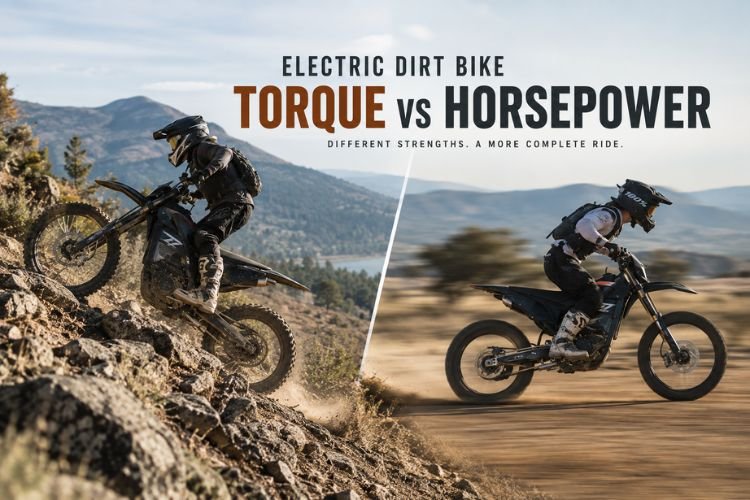
When comparing electric dirt bikes, you’ll often see manufacturers promote huge torque figures, high peak kilowatt ratings, or both. But is torque or horsepower more important on an electric dirt bike?
The short answer is: torque matters heavily for the pulling force available at the wheel, especially during launches, technical riding, and climbing, while power—usually expressed in kilowatts rather than horsepower on electric dirt bikes—becomes increasingly important as speed rises.
Neither number tells the full story.
Motor torque, wheel torque, RPM, gearing, controller tuning, battery output, bike weight, traction, and tire size all influence what you actually feel at the throttle.
That’s why a bike advertising 400 Nm isn’t automatically twice as quick as one advertising 200 Nm, and why the model with the highest peak kW isn’t automatically the fastest bike on every trail.
Understanding the difference can make electric dirt bike specifications much easier to compare.
| Question | Torque | Horsepower / kW |
|---|---|---|
| What does it describe? | Rotational force | Rate of doing work |
| Common unit on electric dirt bikes | Nm | kW |
| Important for initial pull? | Yes | Yes |
| Important for hill climbing? | Yes | Yes |
| Important at higher speed? | Yes, but available torque changes with speed | Increasingly important |
| Related to top-speed potential? | Indirectly | More useful, but not enough alone |
| Affected by gearing? | Wheel torque: strongly | Gearing changes speed/force trade-off |
| Can manufacturer figures always be compared directly? | No | Not without context |
| Biggest buying mistake | Comparing Nm without knowing where it is measured | Comparing peak kW as if it were continuous output |
A simple way to remember the difference is this:
Torque is rotational force. Power tells you how quickly work can be done.
But on an electric dirt bike, those two ideas are connected rather than competing specifications.
Torque is a twisting or rotational force. In electric dirt bike specifications, it is usually expressed in Newton-meters (Nm).
When you open the throttle, the electric motor creates torque. The drivetrain then transfers that torque toward the rear wheel, where it can create force at the tire contact patch and accelerate the bike.
This is why riders often associate torque with that immediate pulling sensation when an electric bike launches from low speed.
Torque is especially relevant when:
But there is an important problem with comparing torque specifications.
Not every manufacturer is necessarily talking about torque at the same location.
One specification may describe motor torque. Another may describe torque after gear reduction. Another may be presented as wheel torque.
Unless you know exactly what the number represents, comparing two advertised Nm figures can be misleading.
Horsepower measures power, not force.
More precisely, power describes the rate at which work is done. Gasoline motorcycles have traditionally used horsepower, while electric dirt bike manufacturers more commonly advertise motor output in watts (W) or kilowatts (kW).
The units can be converted:
1 kW ≈ 1.341 horsepower
That means the approximate equivalents are:
| Motor Power | Approx. Horsepower |
|---|---|
| 5 kW | 6.7 hp |
| 6.5 kW | 8.7 hp |
| 8 kW | 10.7 hp |
| 10 kW | 13.4 hp |
| 15 kW | 20.1 hp |
| 17 kW | 22.8 hp |
| 20 kW | 26.8 hp |
These conversions are mathematically useful, but they don’t mean a bike advertising 10kW peak output continuously produces 13.4 hp under every riding condition.
That’s because peak power and continuous power are different specifications.
We’ll return to that distinction later.
Torque and power aren’t rival forces where one makes a bike accelerate and the other makes it fast.
They are mathematically related.
In SI units:
Power (W) = Torque (Nm) × Angular Speed (rad/s)
This relationship explains something important about electric dirt bike performance.
A motor can produce strong torque at low RPM but still have relatively modest maximum power. Another motor may continue producing useful torque at much higher RPM, allowing it to produce significantly more power.
For readers more familiar with gasoline-engine formulas, horsepower is also commonly calculated from torque and engine speed when the appropriate units are used. This is why it’s important not to mix Nm, lb-ft, RPM, horsepower, and conversion constants without accounting for units correctly.
The practical takeaway is much simpler:
Torque tells you how much rotational force is being produced at a given moment. Power accounts for both torque and rotational speed.
That’s why you need both concepts to understand performance.
One reason riders talk so much about electric dirt bike torque is the way electric powertrains deliver it.
A gasoline dirt bike has an engine operating across an RPM range, usually combined with a clutch and multi-speed transmission. The rider selects gears and uses engine speed and clutch control to keep the engine in a useful part of its powerband.
Many electric dirt bikes use a much simpler single-speed reduction drivetrain.
The controller can respond very quickly to throttle input, and strong motor torque can be available from low rotational speeds. There is no conventional multi-speed transmission shifting between ratios during acceleration on many lightweight e-motos.
That creates the direct throttle response riders often describe as “instant torque.”
However, instant response does not mean unlimited traction or maximum torque at every RPM.
The battery has current limits. The controller has current and thermal limits. The motor has an efficiency and torque curve. Software can intentionally soften throttle response. And the rear tire can only transmit so much force before it starts spinning.
That’s why the most powerful throttle map isn’t always the fastest setting on a dirt trail.
On loose terrain, controllable torque can be more useful than maximum torque.
This may be the most important part of the entire electric dirt bike torque vs horsepower discussion.
Suppose two electric dirt bikes advertise:
Bike A: 100 Nm
Bike B: 400 Nm
At first glance, Bike B appears to have four times as much torque.
But what if Bike A’s number is measured at the motor shaft and Bike B’s number represents torque after reduction at the wheel?
Now you’re comparing two different measurements.
Consider a simplified example.
Imagine an electric motor produces:
80 Nm of motor torque
and the drivetrain has a:
5:1 reduction ratio
Ignoring drivetrain losses for illustration, the output side could theoretically see:
80 Nm × 5 = 400 Nm
The drivetrain hasn’t magically created additional power. It has traded rotational speed for additional torque.
That’s exactly what gearing does.
This is why a high wheel-torque number can look spectacular on a product page without necessarily proving that the motor itself is dramatically stronger than a competitor’s.
When comparing electric dirt bikes, ask:
Is this motor torque or wheel torque?
If the manufacturer doesn’t specify the measurement point or method, treat direct torque comparisons cautiously.
This is where the usual statement that “torque equals acceleration” becomes too simplistic.
Torque is critical to acceleration because torque delivered through the drivetrain creates force at the driven wheel. But actual acceleration depends on more than the motor’s Nm rating.
A simplified relationship is:
Wheel Force ≈ Wheel Torque ÷ Tire Radius
Then, in basic physics:
Acceleration ≈ Net Force ÷ Mass
That tells us why bike weight matters.
Imagine two bikes can produce similar useful force at the tire, but one weighs substantially less. Everything else being equal, the lighter system has less mass to accelerate.
But dirt adds another limitation: traction.
If the rear tire can only transfer a certain amount of force before spinning, adding more wheel torque beyond that point doesn’t automatically produce more forward acceleration.
It may simply produce more wheelspin.
This is why our electric dirt bike comparisons don’t rank acceleration based on peak kW alone. In our 79Bike Falcon Pro Review, for example, we look at the entire path from battery and controller to motor, reduction drive, rear wheel, and finally traction.
For real-world acceleration, think about usable wheel force, power, mass, and grip together.
Torque is extremely important for climbing, particularly at lower speeds.
A steep climb requires the rear wheel to produce enough force to overcome gravity and other resistance. Gear reduction can help an electric motor produce substantial wheel torque, which is one reason electric dirt bikes can feel so capable on steep technical terrain.
But again, torque isn’t the whole answer.
Imagine two climbs.
The first is short, steep, and covered in loose dirt. Here, throttle control and traction may be the limiting factors. Sending maximum torque to the rear tire can make it spin rather than climb.
The second is a long sustained hill at higher speed. Now the battery, controller, motor temperature, and ability to sustain power become increasingly important.
A bike may advertise an enormous peak torque figure yet struggle to maintain maximum performance if its electrical system reaches thermal or current limits during a long climb.
So for hill climbing:
Low-speed wheel torque matters. Sustained power matters. Traction matters. Thermal management matters.
You can’t reliably judge climbing performance from one number.
If you’re comparing top-speed potential, power is generally more informative than a standalone torque figure—but even power doesn’t determine maximum speed by itself.
Top speed depends on several interacting factors:
As speed increases, aerodynamic drag becomes increasingly important. Maintaining additional speed requires more power, which is why higher-speed performance becomes increasingly power-sensitive.
Gearing also creates a compromise.
A shorter reduction can increase wheel torque but may reduce the speed available at a given motor RPM. Taller gearing can increase speed potential but reduce wheel torque multiplication.
So if one electric dirt bike has more torque but another has more power and different gearing, you cannot determine their top speeds from the torque figures alone.
Once buyers learn not to obsess over torque, there’s another trap waiting for them: peak power.
Electric dirt bike manufacturers frequently promote numbers such as:
6.5kW peak
10kW peak
15kW peak
17kW peak
Those figures can help indicate the general performance category of a bike, but peak output is not the same thing as continuous output.
A bike advertising 15kW peak power isn’t necessarily capable of delivering 15kW indefinitely.
Peak performance may depend on battery state of charge, controller settings, motor temperature, battery temperature, riding mode, and how long the high-output demand continues.
Continuous or rated power, when provided under clearly defined conditions, helps describe a different aspect of the system.
This distinction is particularly important when comparing the increasingly powerful machines in our Best 72V Electric Dirt Bikes 2026 guide. A large peak number can look impressive in a comparison table, but the complete battery-controller-motor system determines how useful that output actually is.
Don’t replace torque obsession with peak-kW obsession.
Consider two bikes we’ve already compared on eSouleGMT.
The Happyrun G300 Pro is manufacturer-rated at up to 6.5kW peak power.
The 79Bike Falcon Pro is listed at 10kW peak power, and 79Bike also publishes a 410 Nm torque figure for the Falcon Pro.
It would be tempting to look at those numbers and calculate a simple percentage difference, then declare exactly how much harder one bike accelerates.
That would be misleading.
The published numbers tell us the Falcon Pro belongs to a higher peak-power class on paper. They don’t tell us an exact real-world acceleration difference by themselves.
To determine that properly, you would need comparable information or controlled testing that accounts for:
bike and rider mass, controller tuning, battery output, gearing, wheel torque, tire grip, state of charge, surface conditions, speed, and temperature.
That’s why our Happyrun G300 Pro vs 79Bike Falcon Pro comparison treats peak motor output as one part of the purchase decision rather than using it as a substitute for actual performance testing.
This is a good rule for reading any electric dirt bike specification sheet:
Published specifications can tell you what class of hardware you’re looking at. They don’t automatically tell you exactly how the bike will perform in every real-world situation.
Power-to-weight is another useful piece of the puzzle.
Suppose two electric dirt bikes both advertise 10kW peak power.
Bike A weighs 120 pounds.
Bike B weighs 170 pounds.
You shouldn’t automatically expect them to feel the same under acceleration, because the motor has to accelerate the mass of the bike and rider.
The rider’s weight matters too.
A 50-pound difference between bikes becomes proportionally less significant once you add a 180-pound rider, but total system mass still affects acceleration, braking, handling, and climbing.
Again, power-to-weight isn’t a perfect performance predictor.
A lightweight bike with poor traction can still waste energy spinning its rear tire. A heavier bike with better suspension, tires, throttle calibration, and weight distribution may be easier to ride quickly in certain conditions.
This is why our Best Electric Dirt Bikes in 2026 guide considers the complete bike rather than ranking models solely by motor output.
If you’re shopping for an electric dirt bike, don’t start and finish with horsepower or torque.
Start with the complete system.
Power: Compare peak output, but look for continuous or rated output where manufacturers provide comparable figures.
Battery: Voltage alone isn’t enough. A 72V 30Ah battery and a 72V 40Ah battery have very different nominal energy capacities. If you’re shopping specifically in this performance class, our Best 72V Electric Dirt Bikes 2026 guide explains why battery capacity matters alongside voltage.
Weight: Compare bike weight and consider total rider-plus-bike mass. More power doesn’t automatically compensate for every disadvantage of a heavier machine.
Torque: Find out whether the advertised number represents motor torque, output torque, or wheel torque before comparing it with another bike.
Gearing: Reduction ratio changes the balance between wheel torque and wheel speed.
Controller: Throttle mapping, current limits, ride modes, traction-related strategies, and thermal management can dramatically change how a motor’s potential performance reaches the tire.
Tires and traction: The rear tire is where torque finally has to become forward motion. On loose dirt, excessive wheel torque can simply create wheelspin.
Suspension and brakes: A fast electric dirt bike needs chassis hardware capable of controlling its speed and mass. Motor output is only one part of performance.
Battery condition: Available performance and range can change with state of charge, temperature, age, and other conditions. Our Electric Dirt Bike Battery Life Guide covers the ownership side in more detail.
The key is context.
A 17kW bike isn’t automatically better than a 10kW bike for every rider. A 400 Nm specification isn’t automatically better than 200 Nm unless the measurements are genuinely comparable.
For technical trail riders, controllable wheel torque, throttle response, traction, weight, and gearing may matter more than chasing maximum peak output.
For hill-climbing riders, low-speed torque is important, but so are sustained power, battery output, temperature management, tires, and rider technique.
For high-speed riders, power becomes increasingly important because maintaining acceleration at higher speed requires substantial energy delivery. Gearing, motor RPM, aerodynamics, and controller limits also matter.
For beginners, neither maximum torque nor maximum horsepower should be the priority. Predictable throttle response, manageable ride modes, rider fit, brakes, weight, and appropriate protective equipment matter more. Our Best Electric Dirt Bikes for Beginners guide focuses on those factors.
And for buyers comparing specification sheets, the most important skill is knowing when two numbers are actually comparable.
Neither is universally more important. Torque describes rotational force and is especially relevant to low-speed pulling performance, while horsepower or kW describes power and becomes increasingly important as speed rises. Real performance also depends on gearing, weight, traction, battery output, controller tuning, and other factors.
Not automatically. Acceleration depends on usable force at the tire, total mass, traction, gearing, power delivery, and other factors. If additional torque simply causes the rear tire to spin, it may not improve forward acceleration.
Not necessarily, although sufficient power is important for higher-speed performance. Maximum speed also depends on motor RPM, gearing, wheel diameter, controller limits, battery voltage under load, aerodynamic drag, and other resistance.
Electric motors can provide strong torque from low rotational speeds, and many electric dirt bikes use reduction gearing that multiplies torque at the driven wheel. Fast controller response also contributes to the immediate acceleration riders associate with electric motorcycles.
Wheel torque is torque available at the driven wheel after the motor’s output passes through the drivetrain and reduction ratio. It can be much higher numerically than motor-shaft torque, which is why buyers should confirm what a manufacturer’s advertised torque figure actually represents.
It can be a large wheel-torque figure, but the number needs context. You need to know where and how torque is measured. A 400 Nm wheel-torque figure should not be directly compared with a competitor advertising motor-shaft torque.
Ten kilowatts is approximately 13.4 horsepower. However, if 10kW is a peak rating, that doesn’t mean the motor continuously produces 13.4 hp under all riding conditions.
They are different units measuring the same physical quantity: power. One kilowatt is approximately 1.341 horsepower, while one mechanical horsepower is approximately 0.746 kW.
Both matter. Wheel torque is particularly important for generating climbing force at low speed, while sustained power becomes important during longer or faster climbs. Traction, total weight, tire choice, temperature, and controller behavior also affect climbing performance.
So, what’s more important on an electric dirt bike: torque or horsepower?
The most accurate answer is both—but in context.
Torque tells you about rotational force. Power, usually expressed as kW on electric dirt bikes, tells you how quickly work can be done and incorporates both torque and rotational speed.
For low-speed technical riding and initial pulling force, wheel torque is extremely important. As speed rises, available power becomes increasingly important. For hill climbing, you need sufficient torque, sustained power, and traction. For top speed, power, motor RPM, gearing, and aerodynamic resistance all matter.
Most importantly, don’t compare torque numbers unless you know where they’re measured.
Motor torque and wheel torque are not interchangeable. Gear reduction can multiply wheel torque while reducing rotational speed, so a spectacular Nm figure doesn’t necessarily prove one electric dirt bike has a dramatically stronger motor.
The same caution applies to peak power. A 15kW peak rating doesn’t tell you how long the system can sustain that output.
When comparing electric dirt bikes, look at the entire machine:
motor + battery + controller + gearing + weight + tires + suspension + brakes + rider.
That’s a much better way to predict whether an electric dirt bike will suit your riding than choosing whichever product page displays the biggest torque or horsepower number.
This guide was informed by established power and torque relationships and by educational material covering torque, horsepower, electric-bike power delivery, and off-road riding applications.
Reference sources include:
Manufacturer specifications can change by model year, configuration, software, and market. Always verify current specifications before making a purchase decision.
Electric motocross and electric enduro motorcycles can look very similar, and in some cases they even share the same motor,
Electric enduro motorcycles are becoming an increasingly appealing option for riders who want strong acceleration, precise low-speed control, and less
Electric enduro motorcycles are becoming an increasingly appealing option for riders who want strong acceleration, precise low-speed control, and less
The Talaria XXX Pro and Talaria Sting R MX4 are two popular options for riders looking for a lightweight electric
