Electric Motocross vs Electric Enduro: What’s the Difference?
Electric motocross and electric enduro motorcycles can look very similar, and in some cases they even share the same motor,

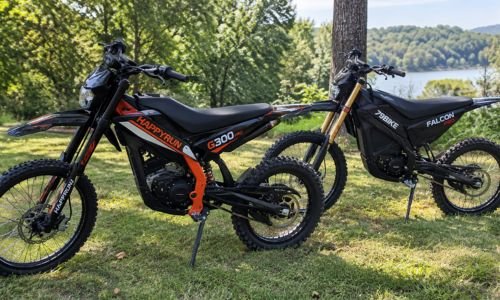
If you’re comparing the Happyrun G300 Pro vs 79Bike Falcon Pro, the decision comes down to a fairly simple trade-off: value versus higher-end performance.
The G300 Pro offers a 6,500W peak motor, 72V 30Ah battery, a claimed top speed of up to 50 mph in off-road mode, and a 350-pound maximum payload. The Falcon Pro raises the performance ceiling with a 10,000W peak mid-mounted motor, 72V 35Ah battery, claimed 56 mph top speed, Fastace suspension, and a lighter 130-pound listed weight.
On specifications alone, the 79Bike Falcon Pro is the more capable machine. But that doesn’t automatically make it the better buy.
The Happyrun G300 Pro costs considerably less based on current manufacturer pricing. For riders who want serious 72V performance without spending close to $4,000, that price difference is difficult to ignore.
Our quick verdict: Choose the G300 Pro for price-to-performance and the Falcon Pro for maximum stock performance and better suspension hardware.
If neither feels quite right, our Best Electric Dirt Bikes in 2026 guide covers more alternatives across different budgets and riding styles.
Before getting into the details, here’s how the two bikes compare using current manufacturer-published specifications.
| Specification | Happyrun G300 Pro | 79Bike Falcon Pro |
|---|---|---|
| Peak Motor Power | 6,500W | 10,000W |
| Battery | 72V 30Ah | 72V 35Ah |
| Nominal Battery Energy | 2,160Wh | 2,520Wh |
| Claimed Top Speed | Up to 50 mph off-road | Up to 56 mph |
| Claimed Range | 70+ miles | Up to 75 miles |
| Charging Time | 5–6 hours | About 3.5 hours |
| Bike Weight | 136.8 lbs | 130 lbs |
| Weight Limit | 350 lbs | 300 lbs |
| Seat Height | 31 in | 83 cm / 32.7 in |
| Frame | High-strength carbon steel | Triple-beam forged aluminum |
| Front Tire | 70/100-19 | 70/100-19 |
| Rear Tire | 70/100-17 | 70/100-19 |
| Front Suspension | Adjustable fork, 80–120mm travel | Fastace 2.0 |
| Rear Suspension | Full suspension | Fastace rear shock |
| Brakes | Hydraulic | Hydraulic disc |
| Front Rotor | 180mm | 203mm |
| Rear Rotor | 203mm | 203mm |
| Display | Color LCD | Dashboard with NFC |
Specifications are based on manufacturer information available at the time of writing. Advertised speed and range are not guaranteed real-world results and may vary with terrain, rider weight, battery charge, weather, tire setup, and riding style.
The table makes the overall positioning clear. The Falcon Pro has more power, more battery capacity, stronger stock suspension specifications, and a slightly higher claimed top speed. The G300 Pro gives up some of that performance but remains surprisingly competitive considering its lower price.
That’s why this comparison shouldn’t simply be about counting which bike wins more rows.
The more useful question is whether the Falcon Pro’s additional performance is worth paying for based on how you actually ride.
Power is the biggest difference between these two electric dirt bikes.
The Happyrun G300 Pro uses a motor rated at 3,000W with a 6,500W peak output. That’s already far beyond what most riders would associate with a conventional electric bicycle and gives the G300 Pro the numbers you’d expect from a performance-focused electric off-road machine.
The Falcon Pro goes considerably further with a 10,000W peak mid-mounted motor. 79Bike also lists maximum torque at 410 Nm.
That’s a 3.5kW difference in published peak output, so the Falcon Pro has the obvious advantage if outright motor performance is your priority.
However, peak watts don’t tell you exactly how a bike will behave on a trail. Controller tuning, gearing, throttle mapping, traction, rider weight, battery state of charge, and terrain all affect acceleration and usable performance. Without instrumented side-by-side testing, it wouldn’t be responsible to claim an exact acceleration difference between the two.
What the specifications do tell us is that the Falcon Pro has considerably more peak power available. That matters most during hard acceleration, steep climbs, and riding situations where you want stronger performance without immediately reaching the limits of the stock powertrain.
The G300 Pro takes a different approach. A 6.5kW peak system is still plenty of power for many recreational riders, especially when the alternative requires a much larger investment.
For maximum stock power, the Falcon Pro wins. For riders asking how much power they actually need for the money, the G300 Pro becomes much more interesting.
HappyRun lists the G300 Pro at a maximum of 50 mph in Offroad Mode, while its City Mode is limited to a listed 28 mph. 79Bike advertises the Falcon Pro at 56 mph maximum speed.
So yes, the Falcon Pro is faster on paper, but a 6 mph difference shouldn’t decide this comparison by itself.
Once an electric dirt bike is capable of around 50 mph, suspension, braking, tires, chassis stability, rider skill, and protective equipment become just as important as the maximum number on the display. For many trail riders, how controllable the bike feels at 20–40 mph will matter more than whether it eventually reaches 50 or 56 mph.
Actual speed can also change with rider weight, battery state, incline, surface conditions, tire pressure, temperature, and wind.
If maximum straight-line speed is the priority, the Falcon Pro has the advantage. If 50 mph is already more than enough for how you plan to ride, the G300 Pro’s lower claimed maximum is unlikely to be its biggest limitation.
This is also why we generally don’t recommend choosing an electric dirt bike based on speed alone. Riders shopping specifically for their first machine may find our Best Electric Dirt Bikes for Beginners guide more useful than simply comparing peak power figures.
Both bikes operate on 72V battery systems, but the Falcon Pro has more capacity.
The G300 Pro uses a 72V 30Ah lithium battery, giving it approximately 2,160Wh of nominal energy. The Falcon Pro uses a 72V 35Ah lithium battery, which works out to approximately 2,520Wh.
That gives the Falcon Pro about 360Wh, or 16.7%, more nominal battery energy based on the published voltage and amp-hour ratings.
HappyRun advertises 70+ miles of range for the G300 Pro, while 79Bike advertises up to 75 miles for the Falcon Pro. Those numbers look close, but maximum advertised range should never be treated as guaranteed trail range.
High-speed riding consumes energy quickly. Aggressive acceleration, steep hills, loose terrain, low tire pressure, rider weight, temperature, and repeated climbing can all reduce how far an electric dirt bike travels on one charge.
For that reason, we would pay more attention to battery capacity than the five-mile difference between the advertised maximum-range figures. The Falcon Pro simply starts with a larger energy reserve.
Charging is another meaningful difference. HappyRun lists approximately 5–6 hours with its 5A charger, whereas 79Bike lists around 3.5 hours for the Falcon Pro. For riders who ride frequently or recharge between sessions, the combination of a larger battery and shorter listed charging time gives the Falcon Pro a useful ownership advantage.
Battery care matters regardless of which model you choose. Proper charging and storage habits can affect long-term battery condition, so it’s worth reading our guide on how to extend electric dirt bike battery life before developing your charging routine.
This is where the comparison becomes more interesting than a simple motor-versus-motor contest.
The G300 Pro uses full suspension with an adjustable aluminum-alloy front fork. HappyRun lists approximately 80–120mm of front travel.
The Falcon Pro comes with a Fastace 2.0 front fork and Fastace rear shock, with 79Bike’s current model specifications listing 200mm of front and 85mm of rear suspension travel.
For riders who plan to spend serious time on rough trails, this is one of the strongest arguments for choosing the Falcon Pro.
A third-party comparison from 96PowerParts also highlights the Falcon Pro’s Fast Ace suspension as one of its major out-of-the-box strengths. That’s important because suspension affects much more than comfort. It influences how well the bike manages repeated bumps, braking loads, rough surfaces, ruts, and changes in terrain.
The G300 Pro still offers full suspension and an adjustable fork, which may be perfectly adequate for recreational trail riding. But the Falcon Pro is clearly positioned as the more performance-oriented stock package.
This also changes the value equation. If you buy a less expensive bike and immediately plan to upgrade the fork, shock, brakes, and other components, the initial saving can shrink quickly. Riders who already know they want stronger stock suspension may find it more logical to pay for the Falcon Pro from the beginning.
Despite having the larger battery and more powerful motor, the Falcon Pro is actually lighter according to the manufacturers’ published figures.
The G300 Pro weighs 136.8 pounds, while the Falcon Pro weighs 130 pounds.
A 6.8-pound difference doesn’t sound enormous, but weight matters when you’re maneuvering through technical sections, recovering the bike on uneven terrain, loading it for transport, or simply moving it around the garage.
Frame construction differs as well. HappyRun lists a high-strength carbon steel frame, while 79Bike specifies a triple-beam forged aluminum frame for the Falcon Pro.
However, the G300 Pro wins an important specification for larger riders: payload capacity. HappyRun lists a maximum payload of 350 pounds, compared with the Falcon Pro’s 300-pound weight limit.
The G300 Pro also has a lower listed seat height at 31 inches, versus approximately 32.7 inches on the Falcon Pro. HappyRun recommends the G300 Pro for riders from 5’1″ to 6’5″.
That doesn’t automatically make it the better bike for every shorter rider because inseam length, suspension sag, and riding position matter too, but the lower seat may make the G300 Pro feel more approachable.
For a broader look at how electric machines differ from conventional off-road bikes in weight, power delivery, maintenance, and riding experience, see our electric off-road motorcycle vs dirt bike comparison.
Both models use hydraulic braking systems, but their rotor setups differ. The G300 Pro uses a 180mm front and 203mm rear rotor, while the Falcon Pro uses 203mm rotors front and rear.
Their wheel configurations are different too. HappyRun uses a 70/100-19 front and 70/100-17 rear setup, while the Falcon Pro runs 70/100-19 tires at both ends.
Tire size alone doesn’t tell you which bike will have more grip. Terrain, compound, tread design, tire pressure, suspension settings, and rider technique all matter. Correct pressure is particularly important off-road because it changes traction, comfort, and how the bike responds over uneven terrain.
The differences continue with the electronics. The G300 Pro keeps things fairly straightforward with a mid-mounted color LCD, half-twist throttle, 2,000-lumen LED front light, integrated taillight with braking indication, and a manufacturer-listed IPX5 water-resistance rating.
The Falcon Pro feels more technology-focused. Its dashboard includes a light sensor that adjusts day and night display modes, while NFC unlocking adds another layer of convenience. The gear selection system also includes a neutral mode, and 79Bike highlights its independently developed FOC control system and electronic braking functionality.
None of these features alone should determine which bike you buy. Together, however, they reinforce the same pattern we’ve seen throughout this comparison: the Falcon Pro asks for more money but also gives you more hardware and technology out of the box.
This may be the most important part of the entire Happyrun G300 Pro vs 79Bike Falcon Pro comparison.
At the time of writing, HappyRun’s official U.S. product page lists the G300 Pro at a sale price of $2,059, down from a displayed regular price of $3,499. 79Bike lists the Falcon Pro at $3,799, down from $3,999.
Promotional prices can change at any time, so these figures should be checked again before buying. But based on those current listed prices, the difference is approximately $1,740.
That’s substantial.
The Falcon Pro gives you more peak power, a larger battery, a higher claimed top speed, Fastace suspension, a lighter listed weight, an aluminum frame, faster advertised charging, larger front brake rotor, and additional electronics.
For an experienced rider who knows those upgrades matter, the premium may be justified.
But suppose your goal is recreational trail riding and you don’t need 10kW of peak output or a 56 mph top speed. In that case, paying roughly $1,700 more becomes harder to justify. The G300 Pro still gives you a 72V system, 6.5kW peak power, hydraulic brakes, full suspension, and a claimed 50 mph maximum off-road speed.
That’s why we see the G300 Pro as the stronger price-to-performance option, while the Falcon Pro is the stronger performance-first option.
If your overall budget is around this level, it’s also worth comparing both against the alternatives in our Best Electric Dirt Bikes Under $5,000 guide before making a final decision.
The easiest way to choose is to stop asking which bike is “better” and start asking which compromises make more sense for you.
The G300 Pro is the more logical choice if you’re trying to maximize performance without pushing your budget toward $4,000. Its 6.5kW peak output and 72V battery already place it well beyond ordinary e-bike performance, and its lower 31-inch seat and 350-pound payload rating may suit riders who don’t fit the Falcon Pro as well.
It makes particular sense if you mainly ride recreational trails, consider a claimed 50 mph more than sufficient, and would rather keep the price difference available for protective gear, transportation, maintenance, or future upgrades.
In other words, you don’t buy the G300 Pro because it beats the Falcon Pro on specifications. You buy it because it gives you a lot of the experience for considerably less money.
The Falcon Pro makes more sense if you’re willing to pay extra for stronger hardware from the factory.
Its 10kW peak motor, 72V 35Ah battery, Fastace suspension, aluminum frame, 56 mph claimed top speed, faster listed charging time, and NFC functionality create a more complete performance package.
This is particularly attractive for riders who know they would otherwise start upgrading a cheaper bike shortly after purchase.
If the Falcon Pro is already high on your list, our dedicated 79Bike Falcon Pro review takes a closer look at the bike beyond this head-to-head comparison.
| If You Care Most About… | Better Choice |
|---|---|
| Lower purchase price | Happyrun G300 Pro |
| Peak motor power | 79Bike Falcon Pro |
| Maximum claimed speed | 79Bike Falcon Pro |
| Battery capacity | 79Bike Falcon Pro |
| Faster charging | 79Bike Falcon Pro |
| Stock suspension | 79Bike Falcon Pro |
| Lower bike weight | 79Bike Falcon Pro |
| Higher payload rating | Happyrun G300 Pro |
| Lower seat height | Happyrun G300 Pro |
| Technology and features | 79Bike Falcon Pro |
| Price-to-performance | Happyrun G300 Pro |
| Maximum stock performance | 79Bike Falcon Pro |
The Falcon Pro wins more individual specification categories, but that doesn’t mean every buyer should spend the extra money.
The G300 Pro’s entire appeal is that it doesn’t have to beat the Falcon Pro everywhere. It simply needs to deliver enough performance at a significantly lower price.
Yes, based on manufacturer claims. 79Bike lists the Falcon Pro at up to 56 mph, while HappyRun lists the G300 Pro at up to 50 mph in Offroad Mode. Actual top speed may vary according to rider weight, battery charge, terrain, temperature, tire setup, and other conditions.
The 79Bike Falcon Pro has the higher published peak-power rating at 10,000W, compared with 6,500W for the Happyrun G300 Pro. Riders focused on maximum stock motor performance should therefore favor the Falcon Pro.
The Falcon Pro has a 72V 35Ah battery, compared with the G300 Pro’s 72V 30Ah battery. That corresponds to approximately 2,520Wh versus 2,160Wh of nominal battery energy.
On published specifications, the 79Bike Falcon Pro has the stronger stock suspension package, using a Fastace 2.0 front fork and Fastace rear shock. The G300 Pro has full suspension with an adjustable aluminum-alloy front fork.
HappyRun lists a 350-pound maximum payload for the G300 Pro, while 79Bike lists a 300-pound weight limit for the Falcon Pro. Riders should always follow the manufacturer’s current limits and setup recommendations.
It can be for performance-focused riders. The additional cost gets you more peak power, a larger battery, higher claimed top speed, Fastace suspension, a lighter listed bike, faster advertised charging, and additional technology. If those upgrades aren’t important to your riding, the G300 Pro offers stronger value.
Neither bike should be chosen simply because it is electric. Both are powerful machines capable of manufacturer-claimed speeds around 50 mph or higher. Less-experienced riders should prioritize manageable power delivery, appropriate rider fit, protective equipment, and a suitable riding environment rather than buying based on maximum speed.
Don’t assume either bike qualifies as a standard street-legal e-bike. High-powered electric dirt bikes can fall outside normal e-bike classifications, and requirements vary by country, state, and local jurisdiction. Check the rules that apply to your location and intended riding area before using either model on public roads.
The 79Bike Falcon Pro is the better-performing electric dirt bike on paper, but the Happyrun G300 Pro may be the better-value purchase.
The Falcon Pro earns its performance advantage with a 10kW peak motor, larger 72V 35Ah battery, Fastace suspension, aluminum frame, 56 mph claimed maximum speed, faster advertised charging, and a lighter listed weight. If you want stronger stock hardware and are comfortable spending more, it’s the more complete machine.
The G300 Pro approaches the market differently. Its 6.5kW peak motor, 72V 30Ah battery, claimed 50 mph off-road speed, full suspension, hydraulic brakes, lower seat, and 350-pound payload rating deliver a surprisingly strong package at a much lower current price.
So the final decision is straightforward:
Choose the Happyrun G300 Pro if you want the most performance for your budget. Choose the 79Bike Falcon Pro if you want the stronger overall performance package and are willing to pay for it.
For most buyers, the smartest choice isn’t automatically the bike with the largest motor. It’s the one whose power, suspension, battery, rider fit, and price match how—and how often—you actually plan to ride.
Specifications and pricing were checked against the current HappyRun G300 Pro and 79Bike Falcon Pro manufacturer product information before publication. Promotional pricing, specifications, and availability can change, so confirm current details before purchasing.
For additional independent context on the Falcon Pro’s position against other performance electric dirt bikes, see 96PowerParts — Clash of Titans 2025: Sur-Ron Light Bee vs 79Bike Falcon vs Talaria Sting Pro vs E-Ride Pro
Electric motocross and electric enduro motorcycles can look very similar, and in some cases they even share the same motor,
Electric enduro motorcycles are becoming an increasingly appealing option for riders who want strong acceleration, precise low-speed control, and less
Electric enduro motorcycles are becoming an increasingly appealing option for riders who want strong acceleration, precise low-speed control, and less
The Talaria XXX Pro and Talaria Sting R MX4 are two popular options for riders looking for a lightweight electric
