Electric Motocross vs Electric Enduro: What’s the Difference?
Electric motocross and electric enduro motorcycles can look very similar, and in some cases they even share the same motor,

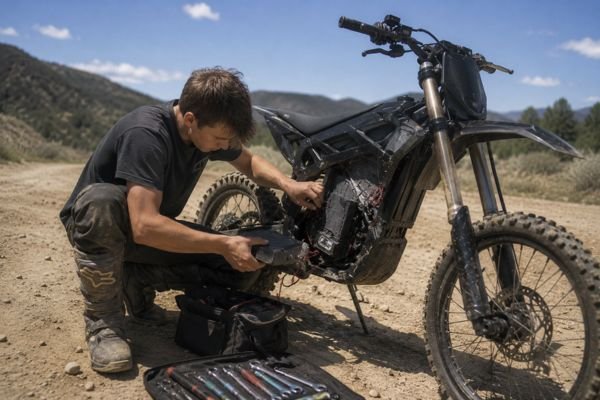
You press the power button.
Nothing happens.
No display.
No lights.
No sound.
Or maybe the display turns on, but the bike refuses to move when you twist the throttle.
It’s one of the most frustrating situations any electric dirt bike owner can experience.
The good news is that a bike that won’t start doesn’t automatically mean you have a dead battery or an expensive repair ahead. In fact, many starting problems are caused by small issues that can be identified—and often fixed—in just a few minutes.
We’ve seen riders assume the worst, only to discover that the real problem was a loose battery connector, an activated kill switch, or a battery that simply wasn’t seated correctly.
Before replacing parts or scheduling a repair, it’s worth taking a systematic approach.
This guide walks you through the most common causes of starting problems, beginning with the simplest checks before moving on to more advanced troubleshooting.
Whether you ride an ALTIS, Sur Ron, Talaria, E Ride Pro, or another electric dirt bike, the diagnostic process is largely the same.
Let’s start with the basics.
If your electric dirt bike won’t start, the problem is usually related to one of these systems:
Fortunately, many of these problems can be identified without specialized tools.
Before reaching for a toolbox, spend two or three minutes checking the obvious.
You’d be surprised how often the solution is something simple.
Use this quick checklist.
| Check | What to Look For |
|---|---|
| Battery | Is it fully installed and locked into place? |
| Battery Charge | Does it have enough charge to power the bike? |
| Power Button | Is the bike actually powered on? |
| Kill Switch | Has it been accidentally switched off? |
| Display | Does the screen light up? |
| Charger | Was the battery fully charged? |
| Connectors | Are there any loose or damaged cables? |
If everything above appears normal, continue with the step-by-step diagnosis below.
Unlike a gas-powered dirt bike, an electric dirt bike doesn’t rely on fuel, spark plugs, or carburetors.
Instead, several electronic systems must communicate correctly before the motor can deliver power.
A simplified starting sequence looks like this:
Battery → Battery Management System (BMS) → Main Controller → Display → Safety Systems → Motor
If any one of these components fails to communicate properly, the bike may refuse to start—even if every other component is working perfectly.
That’s why replacing random parts rarely solves the problem.
Finding the failed step in the sequence is almost always faster and less expensive.
The battery is the heart of every electric dirt bike.
It also happens to be the first place most starting problems originate.
That doesn’t necessarily mean the battery is defective.
In many cases, it’s simply not making a proper connection.
Begin by removing the battery and inspecting it carefully.
Look for anything unusual, including:
Next, reinstall the battery slowly.
Make sure it clicks fully into place.
Many riders push the battery in most of the way but never fully engage the locking mechanism.
The bike appears ready to ride, yet the electrical connection isn’t complete.
If the battery feels loose after installation, stop riding until you identify the cause.
A battery that shifts during riding can interrupt power unexpectedly.
One of the most common service calls isn’t a failed battery—it’s a battery that simply wasn’t fully seated after charging.
Always remove and reinstall it carefully rather than forcing it into position.
A surprising number of riders skip this step.
Seeing the battery on the charger overnight doesn’t always mean it reached a full charge.
If your charger has indicator lights, confirm that charging completed normally.
If your battery includes a charge indicator, verify the remaining battery level before continuing.
Sometimes a charger becomes disconnected during charging, a household breaker trips, or the battery never actually begins charging.
If possible, test the charger with another compatible battery or test the battery on another compatible bike.
Doing so quickly tells you whether the problem is with the battery or somewhere else on the motorcycle.
It sounds obvious.
Yet it’s probably one of the easiest problems to overlook.
Many electric dirt bikes include an emergency kill switch designed to immediately disable the motor.
It’s easy to bump accidentally while transporting the bike, loading it into a truck, or even while cleaning it.
Before assuming a major electrical failure, confirm that the kill switch is in its normal operating position.
Then cycle it off and back on again.
Sometimes simply resetting the switch restores normal operation.
If your display powers on but the bike refuses to respond to throttle input, the kill switch should be one of the very first things you check.
Whenever a customer reports, “The screen turns on, but the bike won’t move,” the kill switch is one of the first items experienced technicians inspect.
It takes only a few seconds to verify and eliminates one of the most common causes of unnecessary service appointments.
If your battery is properly installed, fully charged, and the kill switch isn’t the problem, it’s time to move deeper into the electrical system.
In the next section, we’ll diagnose:
We’ll also explain how to identify the difference between a simple electrical connection problem and a fault that should be handled by an authorized service technician.
If the battery is fully charged but the bike still won’t power on, the next step is checking the battery connections.
Electric dirt bikes rely on solid electrical contact between the battery and the controller. Even a slightly loose connector can interrupt power.
Remove the battery again and inspect the terminals carefully.
Look for:
If the terminals appear dirty, wipe them gently with a clean, dry microfiber cloth.
Never use excessive force or metal tools to clean battery contacts, as this may damage the connectors.
Once everything looks clean, reinstall the battery and make sure it locks firmly into place.
If your bike occasionally starts and occasionally doesn’t, a loose battery connection is one of the first things to investigate.
Intermittent electrical problems are often caused by poor contact rather than a failed battery.
Many riders immediately assume the controller has failed.
Fortunately, the problem is often much simpler.
Most electric dirt bikes include one or more fuses that protect the electrical system.
A blown fuse interrupts power before it reaches the controller or display.
Consult your owner’s manual to locate the fuse.
If the fuse appears damaged, replace it only with another fuse of the same rating.
Installing a larger fuse may protect the bike less effectively and could increase the risk of electrical damage.
If the replacement fuse blows again immediately, stop troubleshooting and contact your dealer.
A repeatedly blown fuse usually indicates another electrical problem that needs further diagnosis.
The display tells you a lot about where the problem may be.
Ask yourself these questions:
If the display remains completely black:
are the most likely areas to inspect.
If the display lights up but the motor won’t respond:
The battery is clearly supplying power.
That shifts attention toward:
This simple observation immediately narrows the list of possible causes.
Many modern electric dirt bikes include a brake safety switch.
When the brake lever is pulled, the controller temporarily disables motor power.
This feature improves safety by preventing accidental acceleration while braking.
However, if a brake sensor sticks or becomes damaged, the bike may believe the brake is permanently applied.
The result?
The display works.
Everything appears normal.
But the motor never responds.
Inspect both brake levers.
Make sure they return smoothly after being released.
If one feels unusually stiff or doesn’t fully return, the brake switch may require adjustment or replacement.
Throttle problems are less common than battery problems, but they do occur.
Look for:
A damaged throttle may prevent the controller from receiving acceleration input.
If your display shows an error code related to the throttle, consult your owner’s manual before replacing any components.
Electric dirt bikes are built for outdoor riding, but they’re not completely waterproof.
After riding through deep water or washing the bike with a pressure washer, moisture can enter connectors or electrical components.
Signs of water intrusion include:
If you suspect water intrusion, allow the bike to dry completely before attempting further troubleshooting.
Avoid repeatedly turning the bike on and off while moisture remains inside the electrical system.
Sometimes the battery itself is working correctly.
Instead, the Battery Management System (BMS) has temporarily shut the battery down to protect it.
This may happen if the battery experiences:
In many cases, allowing the battery to return to normal temperature and then charging it with the manufacturer’s recommended charger restores normal operation.
If the battery repeatedly enters protection mode, the problem should be inspected by an authorized technician.
The controller is often described as the brain of an electric dirt bike.
It manages communication between the battery, throttle, display, and motor.
Although controller failures are less common than many riders think, they can occur due to:
Typical symptoms include:
Controller diagnosis usually requires specialized tools and should not be based on guesswork alone.
If you’ve completed every previous step and the bike still won’t start, the issue may involve internal wiring or the motor itself.
Possible causes include:
These faults are relatively uncommon but generally require professional inspection.
Replacing expensive components without proper diagnosis often creates unnecessary cost and frustration.
When a bike won’t start, it’s easy to panic.
Unfortunately, rushing into repairs often creates new problems.
Here are some of the mistakes technicians see most often.
The battery is expensive—and surprisingly, it’s not always the problem.
Simple issues like loose connectors or an activated kill switch are much more common.
Installing incompatible controllers, throttles, or chargers can create additional electrical problems.
Whenever possible, use manufacturer-approved replacement parts.
If your display shows an error message, don’t ignore it.
Many error codes point directly to the affected system and can significantly reduce troubleshooting time.
Modern electric dirt bikes contain high-voltage electrical systems.
If you’re unsure how to safely diagnose a component, it’s better to stop and seek professional assistance than risk damaging the bike—or injuring yourself.
Now that we’ve worked through the most common causes of starting problems, there’s one final step: deciding whether you can safely fix the issue yourself or whether it’s time to contact your dealer.
In the final part of this guide, we’ll cover:
By now, you’ve worked through the most common reasons an electric dirt bike won’t start. In many cases, the problem turns out to be something simple, such as a loose battery, an activated kill switch, or a blown fuse.
However, not every issue should be repaired at home.
Knowing when to stop troubleshooting is just as important as knowing where to begin.
If the problem involves high-voltage components, internal battery damage, or electronic control systems, professional diagnosis is usually the safest and most cost-effective option.
Many starting issues require only a few minutes to identify and correct.
These commonly include:
If your bike starts normally after correcting one of these issues, perform a short test ride in a safe area before returning to regular use.
Pay attention to any warning lights, unusual noises, or inconsistent throttle response.
Stop troubleshooting and contact your dealer or an authorized service center if you notice any of the following:
Continuing to ride—or repeatedly trying to restart the bike—may make the problem worse.
When in doubt, it’s always better to have the electrical system inspected by a qualified technician.
The easiest repair is the one you never have to make.
A few simple maintenance habits can prevent many of the issues covered in this guide.
After muddy or dusty rides, inspect the battery compartment and clean away debris with a dry, soft cloth.
Always make sure the battery is fully locked into position before riding.
Use the charger recommended by the manufacturer and avoid letting the battery remain completely discharged for long periods.
If you won’t be riding for several weeks, store the battery in a cool, dry place with a moderate charge level.
A quick inspection only takes a minute and can prevent hours of frustration later.
Check:
Making this part of your routine helps catch small problems before they become major repairs.
Electric dirt bikes are built to handle mud and rain, but high-pressure water can force moisture into connectors, switches, and electronic components.
When washing your bike:
A fully charged battery doesn’t always mean power is reaching the bike.
Check that the battery is properly seated, inspect the main fuse, confirm the kill switch is in the correct position, and look for loose electrical connections before assuming the battery has failed.
This usually indicates that the battery is supplying power but another system is preventing the motor from operating.
Possible causes include a brake safety sensor, throttle issue, controller fault, or an activated safety switch.
Yes.
Extremely low temperatures can temporarily reduce battery performance.
If the battery has been stored in freezing conditions, allow it to warm gradually to room temperature before charging or riding.
Yes.
A faulty charger may never fully recharge the battery, even if the charging indicator appears normal.
If you suspect a charging problem, inspect the charger, cable, and charging port for damage.
Not immediately.
Battery failure is only one possible cause.
It’s usually worth checking the battery connection, fuse, kill switch, and display before replacing one of the most expensive components on the bike.
Yes.
Moisture inside connectors or electrical components can interrupt communication between the battery, controller, and motor.
If your bike stopped working after riding in heavy rain or washing it, allow it to dry completely and inspect all accessible connectors.
A quick visual inspection before every ride is recommended.
Checking the battery, controls, wiring, and tires regularly can help prevent many common electrical and mechanical issues.
If your electric dirt bike won’t start, work through the following checklist in order:
| Step | What to Check |
|---|---|
| 1 | Is the battery fully charged? |
| 2 | Is the battery properly installed and locked? |
| 3 | Is the power button turned on? |
| 4 | Is the emergency kill switch activated? |
| 5 | Is the main fuse intact? |
| 6 | Does the display turn on? |
| 7 | Are the battery terminals clean and secure? |
| 8 | Is the brake safety sensor working correctly? |
| 9 | Is the throttle operating normally? |
| 10 | Is there any sign of water damage? |
| 11 | Could the Battery Management System (BMS) be in protection mode? |
| 12 | If none of the above solve the issue, contact your dealer for professional diagnosis. |
Following this sequence helps eliminate the simplest causes first before moving on to more advanced electrical problems.
A bike that won’t start doesn’t always mean an expensive repair is waiting.
In fact, many of the most common starting problems are caused by everyday issues such as a loose battery connection, an activated kill switch, a discharged battery, or a blown fuse. Taking a calm, systematic approach will usually save time, money, and unnecessary frustration.
Instead of replacing parts at random, start with the basics. Confirm the battery is installed correctly, verify it has charge, inspect the electrical connections, and work through each step in order. Troubleshooting one system at a time is almost always more effective than guessing.
If the problem turns out to involve the controller, Battery Management System, or internal wiring, don’t hesitate to contact an authorized dealer or qualified technician. Modern electric dirt bikes rely on sophisticated electrical systems, and accurate diagnosis is often the fastest path to getting back on the trail.
Most importantly, regular maintenance is the best way to avoid starting problems altogether. A few minutes spent inspecting your bike before each ride can prevent hours of downtime later.
Electric motocross and electric enduro motorcycles can look very similar, and in some cases they even share the same motor,

Electric enduro motorcycles are becoming an increasingly appealing option for riders who want strong acceleration, precise low-speed control, and less
Electric enduro motorcycles are becoming an increasingly appealing option for riders who want strong acceleration, precise low-speed control, and less
The Talaria XXX Pro and Talaria Sting R MX4 are two popular options for riders looking for a lightweight electric
