Electric Motocross vs Electric Enduro: What’s the Difference?
Electric motocross and electric enduro motorcycles can look very similar, and in some cases they even share the same motor,

If the battery is the heart of an electric dirt bike, the motor controller is its brain.
The controller is responsible for translating the rider’s throttle input into smooth, controlled acceleration. It sits between the battery and the motor, continuously monitoring data from multiple sensors and deciding exactly how much electrical current should reach the motor.
Without a controller, the battery would simply dump power into the motor, resulting in poor performance and a high risk of damaging the electrical system.
Instead, the controller acts as an intelligent power manager.
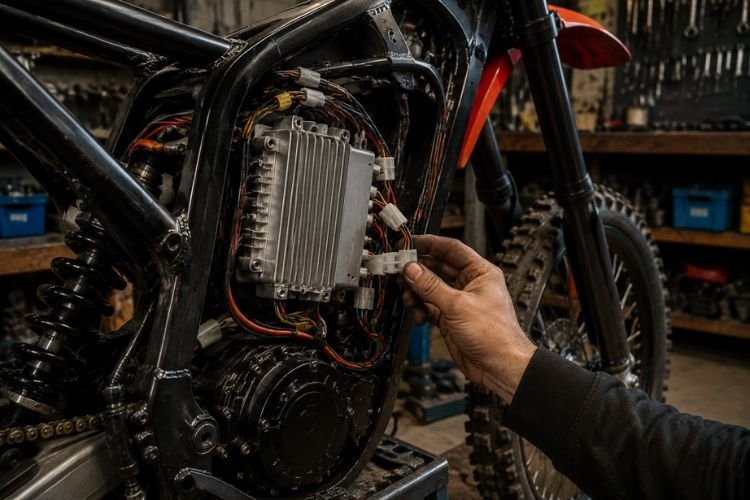
Modern electric dirt bike controllers perform several tasks simultaneously.
They:
All of these calculations happen hundreds or even thousands of times per second.
As a result, acceleration feels smooth rather than abrupt, even though the motor is capable of producing substantial torque almost instantly.
One common misconception is that twisting the throttle automatically gives the motor full power.
In reality, the controller continuously evaluates several factors before determining how much current to deliver.
These include:
Because of these safeguards, two bikes with identical motors can feel very different depending on how their controllers are programmed.
Controller tuning has become one of the biggest factors separating entry-level electric dirt bikes from premium models.
Once the controller delivers electrical current, the motor converts that electrical energy into rotational motion.
Unlike a gasoline engine, which requires combustion, pistons, valves, and crankshafts, an electric motor generates torque using magnetic fields.
As current flows through the motor’s windings, electromagnetic forces cause the rotor to spin.
That spinning motion becomes the torque that ultimately drives the rear wheel.
Because this process doesn’t depend on engine speed building gradually, the motor can begin producing strong torque almost immediately from very low RPM.
That’s why electric dirt bikes feel so responsive when accelerating from a stop.
Most modern electric dirt bikes use brushless DC (BLDC) or permanent magnet synchronous motors (PMSM).
Compared with older brushed motors, they offer several advantages:
Since there are no brushes to wear out, these motors require very little routine maintenance beyond keeping the surrounding electrical system clean and properly connected.
Electric motors are capable of spinning much faster than the rear wheel.
Many motors operate at several thousand RPM, while the rear wheel only needs a fraction of that speed.
If the motor were connected directly to the wheel, acceleration would suffer and the bike would have poor low-speed control.
That’s where the reduction drive comes in.
One of the defining characteristics of an electric dirt bike is its immediate acceleration.
Many first-time riders are surprised by how quickly the bike responds compared with a gasoline dirt bike of similar size.
The reason is torque delivery.
A gasoline engine must first build RPM before reaching its strongest torque range.
During that process, power travels through:
Each stage introduces a slight delay before maximum acceleration becomes available.
An electric motor works differently.
As soon as electrical current reaches the motor, magnetic forces begin producing torque.
Instead of waiting for combustion cycles, the bike responds almost immediately to throttle input.
This gives riders:
It’s important to note, however, that “instant torque” doesn’t mean maximum torque at all times.
The controller carefully regulates output to maintain traction, protect the battery, and prevent excessive heat.
Although the motor produces impressive torque, it also spins at very high speeds.
To make that power usable, electric dirt bikes use a primary reduction drive.
This system reduces motor speed while multiplying the torque sent to the drivetrain.
Think of it as converting fast motor rotation into stronger pulling power at the rear wheel.
Depending on the manufacturer, the reduction drive may use:
Its purpose is always the same: optimize torque before power reaches the final drive.
After leaving the reduction drive, power follows a familiar mechanical path.
Electric Motor
      │
      ▼
Primary Reduction Drive
      │
      ▼
Front Sprocket
      │
      ▼
Drive Chain
      │
      ▼
Rear Sprocket
      │
      ▼
Rear Wheel
Although the power source is completely different from a gasoline bike, the final chain drive remains one of the simplest and most effective ways to transfer torque to the rear wheel.
This is why chain maintenance is still an important part of electric dirt bike ownership.
Some new riders assume that because electric dirt bikes don’t have engines, chain maintenance isn’t important.
In reality, the opposite can be true.
Electric motors deliver torque very quickly, placing significant loads on the chain and sprockets.
An improperly adjusted chain can cause:
Regular inspection and lubrication help ensure smooth power delivery and extend drivetrain life.
Traditional dirt bikes rely on a clutch to disconnect the engine from the transmission during starts and gear changes.
Electric motors don’t have this limitation.
Because they can produce usable torque from extremely low speeds, they don’t need to idle or build RPM before moving the bike.
As a result, most electric dirt bikes eliminate the clutch entirely.
This simplifies riding by allowing the rider to:
For beginners, removing the clutch also shortens the learning curve considerably.
Another common question is whether electric dirt bikes use a traditional transmission.
In most cases, the answer is no.
Instead of shifting through multiple gears, the motor operates across a broad RPM range while the controller continuously adjusts power output.
The drivetrain typically consists of:
This fixed-ratio system is one reason electric dirt bikes deliver such smooth and predictable acceleration.
Some high-performance electric motorcycles use multi-speed transmissions, but they’re still uncommon in the electric dirt bike segment.
Although both types of bikes ultimately spin the rear wheel, they generate and deliver power very differently.
| Feature | Electric Dirt Bike | Gas Dirt Bike |
|---|---|---|
| Power Source | Lithium-ion battery | Gasoline |
| Power Generation | Electric motor | Internal combustion engine |
| Clutch | Usually not required | Required |
| Transmission | Single-speed reduction drive | Multi-speed gearbox |
| Torque Delivery | Immediate and smooth | Builds with engine RPM |
| Routine Maintenance | Lower | Higher |
| Noise Level | Quiet | Loud |
| Moving Parts | Relatively few | Hundreds of internal engine components |
This simpler powertrain is one of the biggest reasons electric dirt bikes have become increasingly popular with recreational riders and trail enthusiasts.
With fewer moving parts, there are fewer components that require regular adjustment or replacement, while the riding experience remains smooth, responsive, and remarkably intuitive
Once the battery is depleted, the charging process essentially reverses the flow of energy.
Instead of electricity moving from the battery to the motor, electrical power flows from the wall outlet through the charger and back into the battery pack.
Although charging seems straightforward, several systems work together to ensure the battery is charged safely and efficiently.
When you plug in an electric dirt bike, the charger converts household alternating current (AC) into direct current (DC), which the battery can store.
The charging process follows this sequence:
Wall Outlet (AC)
        │
        ▼
Battery Charger
        │
Converts AC to DC
        │
        ▼
Battery Management System (BMS)
        │
Monitors Charging Safety
        │
        ▼
Battery Pack
The charger doesn’t simply force electricity into the battery. Instead, it communicates with the Battery Management System (BMS), which constantly monitors charging conditions.
The Battery Management System, or BMS, is one of the most important—and least visible—components on an electric dirt bike.
Think of it as the battery’s built-in safety manager.
Its primary job is to keep every battery cell operating within a safe range.
A modern BMS continuously monitors:
If the BMS detects unsafe conditions, it can reduce charging speed, limit power output, or temporarily disconnect the battery to prevent damage.
Without a BMS, lithium-ion batteries would be far more vulnerable to overheating, overcharging, and premature wear.
Many riders assume every electric vehicle automatically recharges the battery when slowing down.
In reality, regenerative braking depends on the bike’s motor, controller, and software.
Some electric dirt bikes support regenerative braking, while others do not.
When enabled, the electric motor temporarily operates as a generator during deceleration.
Instead of using electricity to create motion, the spinning rear wheel turns the motor, allowing a small amount of energy to flow back into the battery.
Potential benefits include:
However, regenerative braking should not be viewed as a major source of battery charging. During off-road riding, the amount of energy recovered is usually modest compared with the energy consumed during acceleration.
Heat is one of the biggest enemies of electrical performance.
High temperatures can reduce efficiency, limit power output, and shorten the lifespan of electronic components.
To prevent overheating, manufacturers use several cooling strategies.
Many lightweight electric dirt bikes rely on passive air cooling.
As the bike moves, airflow passes over the motor and controller, helping dissipate heat naturally.
Air cooling offers several advantages:
This approach works well for recreational trail riding and moderate power levels.
Higher-performance electric dirt bikes may use liquid cooling for the motor, controller, or both.
A liquid-cooled system circulates coolant through specially designed channels, carrying heat away from critical components before it passes through a radiator.
Compared with air cooling, liquid cooling provides:
Although it adds complexity and weight, it can be beneficial for riders who frequently tackle demanding trails or race conditions.
One advantage of an electric dirt bike is that it has fewer moving parts than a gasoline bike. However, that doesn’t mean problems never occur.
Understanding the most common failure points can help riders diagnose issues more quickly and prevent minor problems from becoming expensive repairs.
Possible symptoms include:
Common causes include aging battery cells, poor storage habits, or prolonged exposure to extreme temperatures.
A faulty controller may cause:
Because the controller manages communication between multiple components, diagnosing controller issues often requires checking wiring connections and onboard diagnostics.
Electronic throttles contain sensors rather than mechanical cables.
If these sensors malfunction, riders may notice:
Replacing a faulty throttle assembly is often simpler than repairing the sensor itself.
Electric motors are generally very reliable, but they are not immune to wear or damage.
Possible issues include:
Routine inspections and avoiding direct high-pressure washing around electrical components help reduce the risk of motor-related problems.
Even though the bike is electric, the final drive still requires regular maintenance.
Over time, riders should inspect for:
Keeping the drivetrain clean and properly lubricated helps maintain smooth power delivery and extends component life.
A common myth is that electric dirt bikes are maintenance-free.
While they eliminate many engine-related service tasks, they still require regular inspections to remain safe and reliable.
Routine maintenance should include:
The absence of engine oil changes doesn’t eliminate the need for preventive maintenance—it simply shifts the focus to the electrical system and chassis.
Most electric dirt bikes use a single-speed reduction drive. The electric motor operates across a wide RPM range, while the controller continuously adjusts power output, eliminating the need for multiple gears in most riding situations.
Most models do not use a traditional multi-speed transmission. Instead, they rely on a fixed reduction ratio that delivers smooth and consistent power to the rear wheel.
Electric motors can generate strong torque from very low RPM. Combined with precise controller programming, this allows the bike to respond almost immediately when the rider twists the throttle.
Charging time depends on battery capacity and charger output. Many recreational models recharge in 3 to 8 hours, while larger battery packs or fast-charging systems may require more or less time.
No. Unlike a gasoline bike that can continue running as long as fuel reaches the engine, an electric dirt bike depends entirely on its battery pack to supply electrical energy to the controller and motor.
Generally, yes.
Electric dirt bikes eliminate maintenance tasks such as oil changes, air filter servicing, spark plug replacement, and valve adjustments. However, riders must still maintain the drivetrain, brakes, suspension, tires, and battery system.
An electric dirt bike may appear mechanically simpler than a gasoline dirt bike, but behind its quiet operation is a carefully engineered system that combines electronics, software, and mechanical components into one highly efficient powertrain.
Every ride begins with a simple twist of the throttle, yet within milliseconds the throttle, controller, battery, motor, reduction drive, and chain work together to convert stored electrical energy into smooth, controlled acceleration. Each component has a specific purpose, and the performance of the entire bike depends on how well those systems communicate with one another.
For most riders, understanding this process offers practical benefits beyond satisfying curiosity. It becomes easier to choose the right bike, recognize early signs of mechanical or electrical problems, and perform routine maintenance that keeps the bike operating safely and efficiently.
As battery technology, motor design, and controller software continue to evolve, electric dirt bikes are becoming lighter, more powerful, and more capable than ever before. While the technology will continue to improve, the basic principle remains the same: efficient electrical power, intelligent control, and instant torque working together to deliver an exciting off-road riding experience.
Once the battery is depleted, the charging process essentially reverses the flow of energy.
Instead of electricity moving from the battery to the motor, electrical power flows from the wall outlet through the charger and back into the battery pack.
Although charging seems straightforward, several systems work together to ensure the battery is charged safely and efficiently.
When you plug in an electric dirt bike, the charger converts household alternating current (AC) into direct current (DC), which the battery can store.
The charging process follows this sequence:
Wall Outlet (AC)
        │
        ▼
Battery Charger
        │
Converts AC to DC
        │
        ▼
Battery Management System (BMS)
        │
Monitors Charging Safety
        │
        ▼
Battery Pack
The charger doesn’t simply force electricity into the battery. Instead, it communicates with the Battery Management System (BMS), which constantly monitors charging conditions.
The Battery Management System, or BMS, is one of the most important—and least visible—components on an electric dirt bike.
Think of it as the battery’s built-in safety manager.
Its primary job is to keep every battery cell operating within a safe range.
A modern BMS continuously monitors:
If the BMS detects unsafe conditions, it can reduce charging speed, limit power output, or temporarily disconnect the battery to prevent damage.
Without a BMS, lithium-ion batteries would be far more vulnerable to overheating, overcharging, and premature wear.
Many riders assume every electric vehicle automatically recharges the battery when slowing down.
In reality, regenerative braking depends on the bike’s motor, controller, and software.
Some electric dirt bikes support regenerative braking, while others do not.
When enabled, the electric motor temporarily operates as a generator during deceleration.
Instead of using electricity to create motion, the spinning rear wheel turns the motor, allowing a small amount of energy to flow back into the battery.
Potential benefits include:
However, regenerative braking should not be viewed as a major source of battery charging. During off-road riding, the amount of energy recovered is usually modest compared with the energy consumed during acceleration.
Heat is one of the biggest enemies of electrical performance.
High temperatures can reduce efficiency, limit power output, and shorten the lifespan of electronic components.
To prevent overheating, manufacturers use several cooling strategies.
Many lightweight electric dirt bikes rely on passive air cooling.
As the bike moves, airflow passes over the motor and controller, helping dissipate heat naturally.
Air cooling offers several advantages:
This approach works well for recreational trail riding and moderate power levels.
Higher-performance electric dirt bikes may use liquid cooling for the motor, controller, or both.
A liquid-cooled system circulates coolant through specially designed channels, carrying heat away from critical components before it passes through a radiator.
Compared with air cooling, liquid cooling provides:
Although it adds complexity and weight, it can be beneficial for riders who frequently tackle demanding trails or race conditions.
One advantage of an electric dirt bike is that it has fewer moving parts than a gasoline bike. However, that doesn’t mean problems never occur.
Understanding the most common failure points can help riders diagnose issues more quickly and prevent minor problems from becoming expensive repairs.
Possible symptoms include:
Common causes include aging battery cells, poor storage habits, or prolonged exposure to extreme temperatures.
A faulty controller may cause:
Because the controller manages communication between multiple components, diagnosing controller issues often requires checking wiring connections and onboard diagnostics.
Electronic throttles contain sensors rather than mechanical cables.
If these sensors malfunction, riders may notice:
Replacing a faulty throttle assembly is often simpler than repairing the sensor itself.
Electric motors are generally very reliable, but they are not immune to wear or damage.
Possible issues include:
Routine inspections and avoiding direct high-pressure washing around electrical components help reduce the risk of motor-related problems.
Even though the bike is electric, the final drive still requires regular maintenance.
Over time, riders should inspect for:
Keeping the drivetrain clean and properly lubricated helps maintain smooth power delivery and extends component life.
A common myth is that electric dirt bikes are maintenance-free.
While they eliminate many engine-related service tasks, they still require regular inspections to remain safe and reliable.
Routine maintenance should include:
The absence of engine oil changes doesn’t eliminate the need for preventive maintenance—it simply shifts the focus to the electrical system and chassis.
Most electric dirt bikes use a single-speed reduction drive. The electric motor operates across a wide RPM range, while the controller continuously adjusts power output, eliminating the need for multiple gears in most riding situations.
Most models do not use a traditional multi-speed transmission. Instead, they rely on a fixed reduction ratio that delivers smooth and consistent power to the rear wheel.
Electric motors can generate strong torque from very low RPM. Combined with precise controller programming, this allows the bike to respond almost immediately when the rider twists the throttle.
Charging time depends on battery capacity and charger output. Many recreational models recharge in 3 to 8 hours, while larger battery packs or fast-charging systems may require more or less time.
No. Unlike a gasoline bike that can continue running as long as fuel reaches the engine, an electric dirt bike depends entirely on its battery pack to supply electrical energy to the controller and motor.
Generally, yes.
Electric dirt bikes eliminate maintenance tasks such as oil changes, air filter servicing, spark plug replacement, and valve adjustments. However, riders must still maintain the drivetrain, brakes, suspension, tires, and battery system.
An electric dirt bike may appear mechanically simpler than a gasoline dirt bike, but behind its quiet operation is a carefully engineered system that combines electronics, software, and mechanical components into one highly efficient powertrain.
Every ride begins with a simple twist of the throttle, yet within milliseconds the throttle, controller, battery, motor, reduction drive, and chain work together to convert stored electrical energy into smooth, controlled acceleration. Each component has a specific purpose, and the performance of the entire bike depends on how well those systems communicate with one another.
For most riders, understanding this process offers practical benefits beyond satisfying curiosity. It becomes easier to choose the right bike, recognize early signs of mechanical or electrical problems, and perform routine maintenance that keeps the bike operating safely and efficiently.
As battery technology, motor design, and controller software continue to evolve, electric dirt bikes are becoming lighter, more powerful, and more capable than ever before. While the technology will continue to improve, the basic principle remains the same: efficient electrical power, intelligent control, and instant torque working together to deliver an exciting off-road riding experience.
Electric motocross and electric enduro motorcycles can look very similar, and in some cases they even share the same motor,
Electric enduro motorcycles are becoming an increasingly appealing option for riders who want strong acceleration, precise low-speed control, and less
Electric enduro motorcycles are becoming an increasingly appealing option for riders who want strong acceleration, precise low-speed control, and less
The Talaria XXX Pro and Talaria Sting R MX4 are two popular options for riders looking for a lightweight electric
