Stark Varg MX vs Stark Varg EX: Key Differences
Electric enduro motorcycles are becoming an increasingly appealing option for riders who want strong acceleration, precise low-speed control, and less

An electric dirt bike for adults can look simple on a specification sheet. Compare motor power, battery capacity, top speed, suspension travel, tire size, and price, then choose the model with the strongest numbers. In practice, that approach can lead to the wrong bike.
Adult electric dirt bikes cover a wide range of machines and intended uses. Some are relatively light recreational bikes for trails and private property. Others are heavier, more powerful off-road machines designed around stronger acceleration, larger impacts, and more demanding terrain. Some products visually resemble electric bicycles, while others are much closer in construction and performance to electric motorcycles. Those differences affect not only how the bike rides, but also how it should be evaluated.
The first question, therefore, should not be “Which electric dirt bike has the most power?” It should be “What kind of riding does this bike need to handle?”
A rider exploring relatively smooth dirt paths has different requirements from someone riding steep loose climbs, repeated bumps, technical trails, or purpose-built off-road areas. Rider size, experience, terrain, speed, carrying and storage requirements, charging access, and local rules can all change what makes sense.
That is especially important when moving from youth-oriented models to an electric dirt bike for adults. An adult bike is not simply a children’s dirt bike with a stronger motor. The chassis, brakes, suspension, wheels, tires, rider triangle, structural loads, thermal demands, and electrical system all need to work at a different scale.
Understanding that complete system is a better way to choose than chasing the largest number in every specification.
Motor specifications naturally attract attention because electric power is one of the defining characteristics of the category. A higher power figure can suggest stronger acceleration and greater performance potential, but power alone tells surprisingly little about whether a dirt bike is appropriate for a particular rider.
Terrain should come first. Smooth hard-packed paths generally place different demands on a bike than loose soil, sand, mud, steep grades, rocks, roots, or repeated bumps. As terrain becomes more demanding, traction, suspension control, braking, ground clearance, wheel strength, tire selection, and chassis stability become increasingly important. More motor power cannot compensate for a tire that cannot find grip or a suspension system that cannot manage the terrain.
Power delivery matters as much as the headline number. Off-road riding often requires the rider to control traction on surfaces that change continuously. A motor that delivers torque abruptly may feel exciting on open ground but become harder to manage when the rear tire is crossing loose dirt or climbing a technical section. A more progressive response can make the bike easier to place and control. Controller tuning, throttle response, riding modes, gearing or final-drive configuration, motor characteristics, and available traction all influence what the rider actually experiences.
This is one reason motor wattage should not be treated as a universal performance score. Rated power and peak power may also be presented differently between manufacturers, making direct comparisons difficult unless the figures are defined consistently. Even when two bikes publish similar power numbers, they can feel very different because of controller programming, total weight, wheel size, gearing, tires, and power-delivery strategy.
Rider fit is just as important. An adult rider needs enough room to move between seated and standing positions, particularly when terrain becomes rough. Seat height is useful, but it does not describe the complete fit. The relationship between the footpegs, seat, and handlebar affects how naturally the rider can shift weight, stand over bumps, control the bike through turns, and remain comfortable during longer sessions. A bike that looks appropriately large can still feel cramped if those contact points are poorly positioned for the rider.
Weight should also be considered early rather than treated as a minor specification. More battery capacity, a larger motor, stronger chassis components, and heavier suspension can all add mass. That may be acceptable when the additional capability is genuinely needed, but weight affects low-speed handling, direction changes, loading the bike for transport, recovering it after a fall, and maneuvering it when the motor is off.
For an adult electric dirt bike, “more” is therefore not automatically better. More power, battery, suspension, and structure may increase capability, but they can also increase weight, complexity, and cost. The goal is not to maximize every specification. It is to create a combination that fits the rider and terrain.
Once the intended riding environment is clear, the electrical and chassis systems become easier to evaluate. Battery capacity is an obvious starting point, but it should be understood as stored energy rather than a guaranteed distance.
Battery energy is commonly expressed in watt-hours. In simplified terms:
Voltage × amp-hours = watt-hours.
That gives buyers a more useful basis for comparing battery capacity than looking at voltage or amp-hours independently. It still does not tell you exactly how far an electric dirt bike will travel. Off-road energy consumption can change substantially with speed, rider weight, terrain, elevation, tire pressure, surface resistance, acceleration, temperature, riding mode, and how aggressively the bike is used.
This is why advertised range deserves context. A long-range estimate achieved under relatively gentle conditions may not represent repeated steep climbs or aggressive trail riding. Adult buyers should think about whether the battery provides enough usable energy for their typical riding session, with reasonable reserve, rather than searching for a single range figure that applies everywhere.
Charging matters as well. Consider where the bike will be stored, where charging will happen, how long the manufacturer specifies for charging, whether the battery can be removed if necessary, and what battery-management and safety information the manufacturer provides. A large battery is less convenient if the bike cannot easily reach the place where it needs to charge.
Suspension has an equally important job. On an off-road machine, it is not simply a comfort feature. The suspension helps manage wheel movement as the tires follow uneven terrain, and it influences how the chassis responds under acceleration, braking, landing, and repeated impacts. Fork and rear-shock quality, available travel, damping behavior, spring setup, adjustability, chassis geometry, rider weight, and intended terrain all matter.
A large suspension-travel number by itself does not prove that a bike will handle rough terrain well. Travel needs to be controlled. A suspension system that moves too easily, rebounds poorly, or is not suited to the rider can make the bike less predictable even if its specification appears impressive. Conversely, riders using relatively mild terrain may not need the same suspension capability as someone regularly encountering larger impacts.
Braking should scale with the same performance envelope. Faster and heavier machines create more energy that must be managed when slowing down. Rotor size, caliper design, pad material, hydraulic or mechanical actuation, tire grip, wheel size, heat management, total vehicle mass, and rider input all contribute to braking performance. Looking at only one of these factors gives an incomplete picture.
This is particularly important with electric dirt bikes because acceleration is easy to market. Braking capacity is less visually exciting, but a bike’s ability to manage speed is just as fundamental as its ability to create it.
The same system-level thinking applies to tires. Off-road tires need to generate traction on the surfaces where the bike will actually be used. Tread pattern, width, construction, pressure, wheel diameter, and compound influence grip and response. A tire intended for loose terrain may behave differently from one optimized for firmer surfaces, and no tread pattern is ideal everywhere.
The strongest adult electric dirt bike is therefore not necessarily the one with the largest motor. A more useful question is whether motor, battery, suspension, brakes, tires, wheels, and chassis have been designed for roughly the same level of performance. When one part of the system greatly exceeds the capability of the others, the specification sheet may look impressive while the complete bike feels less coherent.
The distinction between adult and youth electric dirt bikes goes much deeper than age labels. A youth model is normally designed around a smaller rider, lower body mass, different reach requirements, different control expectations, and a performance level appropriate to its intended users. An adult machine has to account for greater loads and a larger rider while maintaining appropriate control and structural capability.
The rider triangle is one of the clearest differences. On a dirt bike, the relationship between the handlebar, seat, and footpegs determines much of the rider’s physical interaction with the machine. Adult riders need enough space to shift their body forward and backward, stand comfortably when terrain requires it, and operate the controls without feeling compressed. This is why seat height alone should not determine whether a bike is genuinely adult-sized.
Structural requirements change too. A larger rider places different loads through the frame, suspension, wheels, brakes, footpegs, handlebar, and steering assembly. Add higher speeds or rougher terrain and those loads can increase further. A product intended for adults should therefore be evaluated through its complete load and performance design rather than simply through the physical appearance of a larger frame.
Controls also matter. Throttle response that may be manageable for an experienced adult could be inappropriate for a younger or inexperienced rider. Conversely, an adult machine that severely limits response may not deliver the control or capability expected in more demanding terrain. Riding modes and adjustable power delivery can be useful because they allow manufacturers to shape how available performance reaches the rear wheel, although the quality of implementation matters more than simply having multiple modes listed.
This is also where parents and adult riders should avoid assuming that product categories are interchangeable. A youth electric dirt bike should be selected around the child’s size, experience, supervision, riding environment, and manufacturer guidance. An adult model should not be treated as a natural upgrade merely because a younger rider can physically reach the controls.
For adults, the opposite mistake is buying a machine that visually resembles a dirt bike but is too small for comfortable body movement or not designed for the rider’s weight and intended terrain. Compactness can be useful, but a physically smaller machine still needs appropriate ergonomics and load capability.
There is another distinction that matters just as much: an electric dirt bike is not automatically the same thing as a street-legal e-bike.
Products in this category can differ substantially in power, speed, equipment, pedals, vehicle classification, and intended use. Rules for public roads, bicycle paths, trails, parks, and off-road areas vary by jurisdiction. A machine that is appropriate on private property or a designated riding area may not qualify for use on a public bike path simply because it uses an electric motor.
Buyers should therefore check the rules that apply where they actually intend to ride rather than relying on the word “e-bike” in a product name. Manufacturer documentation can explain intended use and equipment, while local transportation, land-management, or motor-vehicle authorities are the appropriate sources for current access and classification requirements.
That legal distinction also helps explain why adult electric dirt bikes should be evaluated differently from ordinary commuter e-bikes. The two may share batteries, motors, displays, controllers, and other electrical technologies, but their chassis priorities can be very different. A commuter is primarily designed around transportation on relatively predictable surfaces. A dirt bike has to manage rider movement, traction changes, repeated impacts, and off-road control.
The electric system may look familiar.
The job of the machine is not.
Once specifications are placed in context, choosing an electric dirt bike becomes less about finding the largest numbers and more about eliminating mismatches.
Start with the riding environment you expect to use most often. If the bike will spend its life on relatively open, mild dirt routes, buying a machine optimized around extreme off-road performance may add weight, cost, and complexity that you rarely use. If the bike will regularly encounter steep grades, loose terrain, rocks, repeated impacts, or higher-speed off-road riding, a lightly built recreational machine may not provide the chassis, suspension, tires, and braking capability the environment demands.
Then consider your own experience. A highly responsive, powerful machine can be enjoyable in experienced hands but unnecessarily difficult for a rider still developing throttle control, braking technique, and off-road body positioning. Manageable power delivery is often more useful than maximum output, particularly while learning how the bike behaves on surfaces where traction changes rapidly.
Fit should be checked as a riding position rather than a number. Sit on the bike if possible. Stand on the pegs. Check whether your knees and arms have room to move. Consider whether the handlebar position feels natural and whether you can shift your weight without fighting the dimensions of the chassis. Confirm the manufacturer’s rider-weight guidance and intended use.
Next, examine whether the bike’s major systems appear balanced. A large battery paired with a modest motor may make sense when riding time matters more than maximum performance. A powerful drive system paired with serious suspension and brakes may suit more demanding use. What should raise questions is a specification sheet that emphasizes dramatic acceleration while providing little useful information about chassis, brakes, suspension, battery management, tires, or intended terrain.
Ownership deserves attention before purchase too. Ask how tires, brake pads, drive components, suspension parts, and other wear items are serviced or replaced. Find out whether replacement parts are available and whether technical documentation exists. Check battery and charger information rather than treating them as accessories. If the bike will be transported regularly, think about total weight and dimensions before discovering that it is difficult to load into your vehicle.
Noise and routine interaction can also influence the ownership experience. Electric dirt bikes remove the exhaust system and fuel handling associated with combustion engines, but they are not mechanically silent. Tires, chains or belts, gears, brakes, suspension, and the electric drive itself can all generate sound. The practical advantage is not that the machine makes no noise, but that the character of its drivetrain and routine preparation can be different.
Finally, do not buy an adult electric dirt bike based on a single specification. Top speed tells you nothing about fit. Motor wattage does not tell you how well the bike finds traction. Battery capacity does not guarantee range. Suspension travel does not guarantee suspension quality. Large brake rotors do not independently guarantee short stopping distances.
The best specification is the one that makes sense in relation to the rest of the machine.
For an adult rider, that means looking for a bike whose power delivery, battery, chassis, suspension, brakes, tires, ergonomics, weight, and intended terrain tell the same story.
When they do, the bike feels coherent rather than assembled around marketing numbers.
Start with intended terrain, rider fit, and experience level. Then evaluate power delivery, battery capacity, suspension, brakes, tires, wheel size, total weight, structural design, replacement parts, and charging. The important question is how well those systems work together rather than which bike has the highest individual specification.
There is no single motor-power figure appropriate for every adult. The right level depends on rider experience, terrain, total bike weight, controller tuning, gearing or drive configuration, and intended use. More power can increase performance potential but can also make traction and throttle control more demanding.
Battery needs depend on ride duration, terrain, elevation, rider weight, speed, temperature, riding mode, and riding style. Watt-hours are useful for comparing stored energy, but they should not be treated as a guaranteed range figure.
Some models can be suitable for beginners, particularly when their size, weight, controls, and power delivery match the rider’s experience. Adjustable riding modes can be useful, but beginners should still consider fit, braking, terrain, protective equipment, training, and manufacturer guidance.
Adult models generally need to accommodate larger riders, greater loads, different ergonomics, and potentially higher performance. The difference involves more than motor output or seat height; frame structure, suspension, brakes, wheels, rider triangle, controls, and intended use all matter.
No. Higher motor output can increase performance potential, but usable off-road performance also depends on traction, controller tuning, tires, chassis geometry, total weight, suspension, and rider skill. Power that cannot be controlled effectively is not automatically useful performance.
Very important when riding genuinely rough terrain. Suspension helps the wheels follow uneven surfaces and manages impacts that would otherwise move through the chassis and rider. The amount of travel matters, but spring behavior, damping, setup, stiffness, rider weight, and terrain are equally important.
Hydraulic systems can provide strong braking with relatively low lever effort and good modulation, but brake performance depends on the complete system, including calipers, pads, rotors, tires, heat, maintenance, and vehicle weight. Brake type should be evaluated as part of the complete bike rather than as an isolated label.
Not necessarily. Electric dirt bikes can fall under different vehicle classifications depending on their design and local law. Rules can also differ between roads, bike lanes, public trails, parks, and private property. Check current requirements with the relevant authority where you plan to ride.
A conventional e-bike is generally designed primarily around transportation or recreational cycling, while an electric dirt bike may prioritize off-road traction, suspension, chassis strength, rider movement, and higher-impact use. Exact classifications and equipment vary significantly between products.
Choosing an electric dirt bike for adults becomes much easier when the search begins with the rider rather than the motor.
Think about where you will ride, how demanding the terrain will be, how much experience you have, and what size and weight of machine you can comfortably control. Once those questions are clear, motor performance and battery capacity have useful context. Suspension can be judged against the terrain it needs to manage. Brakes can be considered against the bike’s speed and mass. Tires can be matched to the surfaces beneath them, and the chassis can be evaluated around the rider who will actually use it.
This is also what separates a genuine adult-oriented machine from a youth model that simply looks similar. Adult electric dirt bikes need to manage adult ergonomics, loads, performance, and control. Those requirements reach through the entire machine.
Specifications still matter. They simply should not be read independently.
A large battery can be valuable, but only if its weight and capacity make sense for the intended ride. Strong motor output can be useful, but only when the chassis, tires, brakes, and rider can control it. Long suspension travel can increase capability, but only when the suspension itself is properly designed and matched to the terrain.
The goal is not to buy the electric dirt bike with the most impressive specification. It is to find the one whose specifications make sense together.
That is the difference between choosing a bike by numbers and choosing one by design.
Electric enduro motorcycles are becoming an increasingly appealing option for riders who want strong acceleration, precise low-speed control, and less
Electric enduro motorcycles are becoming an increasingly appealing option for riders who want strong acceleration, precise low-speed control, and less
The Talaria XXX Pro and Talaria Sting R MX4 are two popular options for riders looking for a lightweight electric
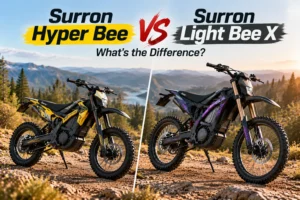
The Surron Hyper Bee and Surron Light Bee X are both high-performance electric dirt bikes, but they are designed for
