Stark Varg MX vs Stark Varg EX: Key Differences
Electric enduro motorcycles are becoming an increasingly appealing option for riders who want strong acceleration, precise low-speed control, and less

Choosing an electric dirt bike can get confusing quickly because specification sheets encourage you to focus on the biggest numbers. One bike advertises more peak power, another claims more torque, another has a larger Ah battery, and another promises a higher top speed. None of those numbers automatically tells you which bike is right for you. The best electric dirt bike is the one that fits your body, experience, terrain, normal riding time, and budget while providing enough performance for the riding you actually plan to do.
Instead of starting with “Which bike has the most power?”, start with four questions: Who will ride it? Where will they ride? How long will a normal ride last? How much performance do they actually need? Once you know those answers, specifications become much more useful because you can use them to eliminate bikes that do not fit your requirements rather than simply looking for the model with the largest numbers.
| What to Check | Why It Matters |
|---|---|
| Rider size and fit | Determines comfort and low-speed control |
| Rider experience | Helps determine manageable performance |
| Terrain | Changes suspension, tire, power, and range requirements |
| Riding time | Helps determine useful battery capacity |
| Motor and controller | Affect power delivery and performance |
| Battery Wh | Helps compare nominal battery energy |
| Bike weight | Affects handling and recovery after a fall |
| Suspension | Affects traction and control on rough terrain |
| Brakes | Need to match bike speed, mass, and intended use |
| Wheels and tires | Affect traction and terrain capability |
| Parts availability | Determines whether the bike can be maintained |
| Warranty and support | Matter when something goes wrong |
| Price | Should match capability you will actually use |
| Legal classification | Helps determine where the bike can be ridden |
The key principle throughout this guide is simple: do not use specifications to find the electric dirt bike with the biggest numbers. Use specifications to eliminate bikes that do not fit your riding.
Before comparing batteries, motors, torque figures, or top speeds, define what you expect the motorcycle to do. A beginner riding relatively easy trails needs a very different bike from an experienced rider climbing steep, rocky singletrack. A motocross rider has different priorities from someone exploring fire roads for several hours, while a teenager moving up from a youth bike may need something completely different from a full-size adult rider.
Experience matters because additional performance is not automatically helpful. A new rider may benefit more from predictable throttle response, manageable weight, suitable ergonomics, strong brakes, and selectable riding modes than from enormous peak power. Many electric dirt bikes simplify basic operation because there is no combustion engine to stall and many models do not require a conventional manual clutch or multi-speed gearbox, but that does not make every electric dirt bike beginner-friendly. A lightweight motorcycle with moderate, controllable power may be much easier to learn on than a heavier high-performance machine capable of producing more wheel torque than a new rider can comfortably use. If you are just starting out, our Best Beginner Electric Dirt Bikes guide is a better place to compare actual beginner-oriented models once you understand these fundamentals.
Terrain should then determine which capabilities move to the top of your list. For casual trails and fire roads, predictable handling, useful range, comfort, reliability, and straightforward maintenance may matter most. Technical riding changes the priorities toward controllable low-speed power, suspension, traction, ground clearance, manageable weight, and geometry because rocks, roots, ledges, climbs, and tight switchbacks rarely reward maximum top speed. Motocross and aggressive riding place much greater demands on the chassis, suspension, brakes, sustained power delivery, and thermal management. Longer recreational rides shift attention toward battery capacity, efficiency, and charging logistics. Think about the riding you actually do most often rather than buying around an extreme use case that may happen once a year. Choose the riding category first, then compare motorcycles.
A motorcycle can look perfect on a specification sheet and still be wrong for you physically. Fit affects how confidently you can stop, balance, turn, climb, descend, and recover from mistakes, and it becomes especially important on technical terrain where you frequently move your body or need to catch the bike at low speed. Seat height is useful, but it should not be considered alone. Two motorcycles with similar published seat heights can feel very different because of seat width, suspension sag, chassis width, footpeg position, handlebar position, wheel size, and weight distribution. Your inseam can also tell you more than total height about how comfortably you can support the motorcycle when stopped.
You do not necessarily need to place both feet completely flat on the ground to ride a dirt bike correctly. Experienced riders regularly use tall motorcycles, but beginners may feel more confident when they can reliably support the bike on uneven terrain. Weight deserves similar attention. Lightweight e-motos can be easier to maneuver, lift, and reposition, while larger motorcycles may provide more battery capacity, stability, full-size ergonomics, or suspension capability. The important question is not whether one motorcycle is lighter on paper, but whether you can comfortably control its weight where you ride.
Imagine dropping the motorcycle halfway up a rocky climb. Can you lift it? Can you turn it around on a narrow trail? Can you hold it when you stop on uneven ground? Can you manage the bike when the front wheel deflects off a rock? Those questions may matter much more than whether the motor is advertised at 12kW or 15kW. Rider weight also affects the total load carried by the motor, suspension, brakes, and tires, so larger riders should check manufacturer load limits where available and pay close attention to chassis size, spring setup, braking performance, and ergonomics. Whenever possible, sit on or test the motorcycle before buying. If you are purchasing online, compare dimensions, seat height, wheel size, bike weight, wheelbase, load ratings, and feedback from riders with similar proportions. A bike that fits well will usually inspire more confidence than a more powerful bike that feels too tall, heavy, cramped, or awkward.
Performance specifications are useful, but this is also where electric dirt bike marketing becomes difficult to compare. Motor output is commonly expressed in watts or kilowatts, with 1,000 watts equal to 1 kilowatt, but you need to know whether the manufacturer is quoting peak or continuous output. A motorcycle advertised as 15kW peak does not necessarily produce 15kW continuously throughout a long climb or riding session. Battery current capability, controller limits, motor design, software, cooling, and thermal protection all influence how much power can actually be delivered and for how long. Two bikes with similar peak-power claims can therefore behave very differently once ridden hard.
Torque numbers require even more caution because manufacturers may quote motor torque, output-shaft torque, or wheel torque. Those figures are not directly comparable without knowing where they were measured and how gearing is involved. Gearing can multiply torque at the wheel while reducing rotational speed, so a motorcycle advertising a very large wheel-torque number is not automatically more powerful than another motorcycle quoting a smaller motor-torque number. Our Electric Dirt Bike Torque vs Horsepower guide explains the relationship between motor torque, wheel torque, gearing, power, and acceleration in more detail.
Top speed should also be treated as a filter rather than the main reason to choose a bike. First ask whether the motorcycle comfortably reaches the speeds your riding requires. If it does, suspension, brakes, tires, range, handling, weight, power delivery, and thermal performance may be more important than gaining another few miles per hour. A motorcycle capable of going faster also needs the chassis and components to control that speed. Power gets attention on the product page; control determines how much of that power you can actually use.
Battery specifications are another area where bigger numbers can mislead buyers. The three figures you will commonly encounter are voltage (V), amp-hours (Ah), and watt-hours (Wh). Voltage describes electrical potential, Ah describes electric charge capacity, and Wh describes energy. When comparing nominal battery energy across motorcycles with different voltages, Wh is usually the more useful starting point. The basic relationship is Wh = V × Ah.
For example, a 72V 30Ah battery has approximately 2,160Wh, or 2.16kWh, of nominal energy, while a 60V 40Ah battery has approximately 2,400Wh, or 2.4kWh. Looking only at Ah makes the second battery appear dramatically larger—40Ah versus 30Ah—but once voltage is included, the nominal-energy difference is only 240Wh. This is why our Electric Dirt Bike Battery Ah vs Wh guide recommends using Wh rather than Ah alone when comparing battery energy across different voltage systems.
Wh still should not become another simplistic ranking metric. Two batteries with the same nominal energy can differ in cell quality, current capability, voltage sag, battery management, thermal behavior, usable energy, physical weight, warranty, and replacement availability. Nor does a certain number of watt-hours guarantee a fixed number of trail miles. Real range changes with bike and rider weight, speed, acceleration, elevation, terrain, mud, sand, temperature, tire setup, motor efficiency, controller tuning, riding mode, wind, and battery condition. Instead of asking which motorcycle advertises the longest maximum range, ask: Can this battery finish my normal ride with a comfortable reserve?
Charging logistics should be considered at the same time. Look at charger power, approximate charge time under manufacturer-specified conditions, whether faster charging is supported, whether the battery can be removed, and whether you have somewhere practical to charge it. If your riding area is far from electricity, these questions can matter more than a modest difference in motor power. Before buying, also look for a replacement battery for the exact model and check its current price and availability. Battery capacity gradually declines with age and use, and our How Long Do Electric Dirt Bikes Last? guide explains why long-term battery condition depends on temperature, storage, use, chemistry, and other factors rather than simply counting years. A good battery choice therefore balances energy, power capability, weight, charging, realistic range, and replacement support.
A powerful motor cannot compensate for a chassis that does not suit your riding. Suspension is a good example. Buyers often compare fork travel because it is easy to put into a specification table, but more travel does not automatically mean better suspension. Spring rate, sag, compression and rebound damping, component quality, geometry, rider weight, terrain, and setup all influence how a motorcycle behaves. Our Electric Dirt Bike Suspension Travel Explained guide goes deeper into this because even rear-wheel travel and shock stroke are not necessarily the same measurement.
For technical riding, suspension needs to help the tires maintain useful contact over rocks, roots, ledges, and uneven ground while keeping the motorcycle predictable. Motocross creates different demands because repeated jumps and larger impacts place much greater loads on the chassis and suspension. Recreational riders may not need race-level components, but they still need suspension appropriate to the motorcycle’s weight, speed, and intended terrain.
Brakes should be evaluated as a complete system as well. The word “hydraulic” by itself tells you very little. Rotor size, calipers, pads, master cylinders, tire grip, bike mass, rider weight, speed, and terrain all affect braking performance. The faster and heavier the motorcycle becomes, the more important this is. Tires are equally easy to overlook. Hardpack, loose soil, mud, sand, rocks, roots, motocross tracks, and mixed terrain all require different compromises, while tire pressure affects traction, handling, comfort, rim protection, and puncture risk. Our Electric Dirt Bike Tire Pressure Guide explains why there is no universal ideal PSI for every bike and trail.
When comparing two motorcycles, do not automatically choose the one with slightly more peak power. If the other bike has suspension, brakes, wheels, tires, and geometry that better match your terrain, it may be the significantly better dirt bike. Motor power tells you what the powertrain can potentially produce; the chassis determines how confidently you can use it.
Electric dirt bikes now range from relatively inexpensive youth and recreational products to premium full-size competition motorcycles, which makes starting with price alone difficult. Our How Much Does an Electric Dirt Bike Cost? guide explains those price categories in more detail, but the more useful buying method is to define the capability you need first and then determine the budget required to get it.
Suppose one motorcycle costs $3,000 and another costs $4,000. The cheaper model is not automatically better value if you immediately need to upgrade its suspension, brakes, tires, or battery to meet your requirements. At the same time, buying a much more expensive competition-focused motorcycle for gentle weekend trails may mean paying thousands of dollars for capability you rarely use. Compare the complete package rather than price per kilowatt.
Long-term support should be part of that comparison. Before buying, check whether you can obtain a replacement battery, charger, controller, brake components, chain and sprockets, bearings, plastics, display, sensors, wheels, tires, and model-specific parts. Some components may use common standards, while others are proprietary. Battery packs, controllers, chargers, displays, and electronics deserve particular attention because substituting them may be difficult if manufacturer support disappears. Read the warranty as well: what is covered, what is excluded, who handles the claim, and whether you need to ship the bike or component somewhere for service are more meaningful questions than warranty length alone.
Ask yourself what happens if the motorcycle stops working six months after purchase, and then look further ahead: can you reasonably expect to maintain it several years from now? Nobody can guarantee future parts supply, but established documentation, available replacement components, active support, dealers, and a healthy aftermarket can reduce uncertainty. This is why How Long Do Electric Dirt Bikes Last? treats repairability and parts availability as part of practical lifespan.
Finally, make sure you can actually use the motorcycle where you intend to ride it. A powerful electric dirt bike does not automatically qualify as a legal e-bike simply because it has an electric motor, and adding headlights or mirrors does not automatically turn an off-road motorcycle into a street-legal vehicle. Classification and operating rules vary by jurisdiction. U.S. riders can use our Are Electric Dirt Bikes Street Legal? U.S. Laws Explained guide as a starting point, but current state and local rules still need to be checked for the specific vehicle and location.
Once you find a bike you like, stop looking at the marketing photos for a few minutes and run through these ten questions:
If you cannot find clear answers to the battery, parts, and warranty questions, that uncertainty should be treated as part of the purchase decision rather than ignored.
| Rider | Prioritize | Don’t Overpay For |
|---|---|---|
| Beginner | Fit, weight, predictable power, brakes | Extreme peak power |
| Casual trail rider | Range, reliability, suspension | Maximum top speed |
| Technical trail rider | Weight, throttle control, suspension, traction | High-speed performance rarely used |
| Motocross rider | Chassis, suspension, sustained power, brakes | Excess range you do not need |
| Long-distance rider | Battery energy, efficiency, charging | Short bursts of peak power |
| Budget buyer | Complete package, reliability, parts support | One headline specification |
| Larger/heavier rider | Fit, load capacity, chassis, suspension | Compact platform that does not fit |
Only after completing this process should you start comparing individual motorcycles. At that point, our Best Electric Dirt Bikes in 2026 guide becomes much more useful because you already know which specifications actually matter for your riding.
Start with rider fit, experience, terrain, and normal ride duration. Then compare bike weight, power delivery, battery Wh, suspension, brakes, wheels, tires, charging, replacement parts, warranty, and price. Do not choose a motorcycle from top speed or peak motor power alone.
There is no universal kW requirement. A beginner riding easy trails needs different performance from an experienced motocross or technical-trail rider. Power delivery, bike weight, gearing, traction, battery output, controller tuning, thermal limits, and riding modes all matter alongside peak motor output.
Choose enough battery energy to complete your normal ride with a useful reserve. Compare watt-hours rather than Ah alone when battery voltages differ. Real range also depends on terrain, speed, elevation, rider weight, temperature, tires, and riding style.
Not automatically. Voltage is only one part of the electrical system. Battery energy and current capability, motor, controller, gearing, cooling, bike weight, and software all affect performance. A 72V bike is not automatically faster or longer-range than every 60V bike.
Spend enough to get the fit, battery capacity, suspension, brakes, performance, and support required for your riding. Paying less can become false economy if immediate upgrades are necessary, while paying more for competition-level performance can be unnecessary for casual riders.
A lighter motorcycle can be easier to maneuver, lift, and control on technical terrain, but lighter is not universally better. Larger bikes may provide more battery capacity, stability, full-size ergonomics, or more capable components. Choose a weight and size appropriate to your body and riding.
Very important for off-road control. Suspension affects traction, comfort, chassis stability, and how the bike responds to bumps and impacts. Do not judge it from travel alone; spring rate, damping, setup, geometry, rider weight, and component quality also matter.
Manageable and predictable performance is generally more useful to a beginner than maximum peak output. A powerful bike may still be suitable when it provides effective riding modes and controllable delivery, but fit, weight, brakes, suspension, and rider skill should come first.
Think about how long and where you normally ride, then evaluate battery energy and manufacturer range information in that context. Leave a reasonable reserve rather than planning every ride around the maximum advertised range because terrain, speed, temperature, elevation, rider weight, and throttle use affect energy consumption.
Some are, many are not, and the answer depends on the vehicle and jurisdiction. A high-powered off-road e-moto does not automatically qualify as an e-bike, while adding lights or mirrors does not automatically make it road legal. Check the current rules that apply to the specific motorcycle and location.
Learning how to choose an electric dirt bike becomes much easier once you stop looking for the model with the biggest numbers. Start with your body, experience, terrain, and normal riding time. Make sure the bike physically fits and that you can comfortably manage its weight. Look at usable power delivery rather than peak kW alone, and be careful when comparing torque figures that may have been measured at different points in the drivetrain.
For the battery, compare Wh rather than Ah alone when voltages differ and think about whether the available energy can comfortably complete your normal ride. Then look beyond the electrical system. Suspension, brakes, wheels, tires, geometry, and chassis quality determine how confidently you can use the motorcycle’s performance, and a bike with slightly less power but much better control may be the better off-road machine.
Finally, think beyond the day you buy it. Find the replacement battery, controller, charger, wear parts, and model-specific components. Read the warranty and understand who will support the motorcycle if something goes wrong. Check the rules for wherever you intend to ride it. The best electric dirt bike is not necessarily the fastest, most powerful, most expensive, or longest-range model. It is the bike that gives you enough performance, range, control, durability, and support for the riding you actually do without making you pay for capabilities you rarely use.
Instead of asking “Which electric dirt bike has the best specs?”, ask “Which electric dirt bike best matches the way I ride?” That is the question that turns a specification comparison into a useful buying decision.
Electric enduro motorcycles are becoming an increasingly appealing option for riders who want strong acceleration, precise low-speed control, and less
Electric enduro motorcycles are becoming an increasingly appealing option for riders who want strong acceleration, precise low-speed control, and less
The Talaria XXX Pro and Talaria Sting R MX4 are two popular options for riders looking for a lightweight electric
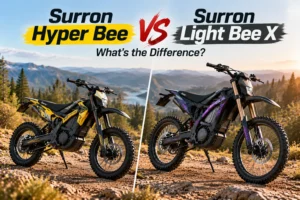
The Surron Hyper Bee and Surron Light Bee X are both high-performance electric dirt bikes, but they are designed for
