Electric Motocross vs Electric Enduro: What’s the Difference?
Electric motocross and electric enduro motorcycles can look very similar, and in some cases they even share the same motor,

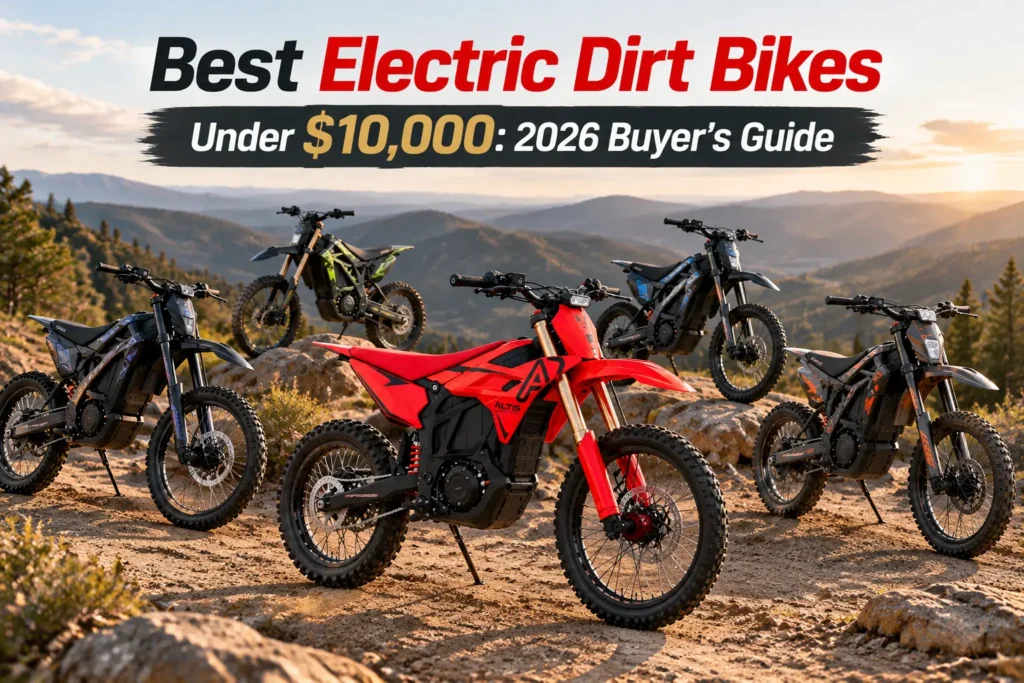
Finding the best electric dirt bikes under $10,000 is easier than it was a few years ago, but choosing the right model has become more complicated. Today’s market includes lightweight electric motorcycles designed for tight trails, high-performance e-motos built around powerful motors and removable batteries, and full-size electric enduro bikes with more substantial suspension and chassis components. Although these machines may share the same broad category, they deliver very different riding experiences.
For most riders, the strongest options to compare are the Surron Light Bee X, Talaria Sting MX5 Pro, E Ride Pro SS 3.0, Rawrr Mantis X Pro, Segway Xaber 300, Altis Sigma, and Talaria Komodo. Each offers a different balance of performance, price, weight, equipment, and ownership support. The 2027 KTM Freeride E is also worth considering near the top of this budget, although its freight charge pushes the advertised base price above $10,000 before taxes.
The important question is not simply which electric dirt bike has the highest peak power. A motorcycle with a powerful motor may be less suitable for tight technical trails than a lighter, more manageable model. A bike with a larger battery may offer more stored energy but can also cost more and weigh more. Meanwhile, established brands may provide better access to replacement parts and technical support than newer manufacturers.
This guide compares the leading options using published specifications and available U.S. pricing. Prices and specifications can change by model year, retailer, and configuration, so confirm the exact version and final delivered price before purchasing.
| Model | Approximate Listed Price | Published Peak Power | Best For |
|---|---|---|---|
| Surron Light Bee X | $4,499–$4,990 | 10 kW | Best overall lightweight e-moto |
| Talaria Sting MX5 Pro | Around $4,990 | 13.4 kW | Balanced performance and trail riding |
| E Ride Pro SS 3.0 | Around $4,699 | 15.8 kW | Strong factory performance |
| Rawrr Mantis X Pro | Around $3,899 | 15 kW | Performance-focused value |
| Segway Xaber 300 | $5,299.99 MSRP | 21 kW | Technology and established-brand ownership |
| Altis Sigma | Around $5,300–$5,900 | 25 kW | High output in a lightweight motorcycle format |
| Talaria Komodo | Around $5,800–$6,000 | 32 kW | High-performance electric off-roading |
| 2027 KTM Freeride E | $9,999 MSRP plus $690 freight | 19.2 kW | Full-size trail and enduro riding |
These prices are indicative online listings rather than guaranteed offers. For example, current retailer listings place the Surron Light Bee X around $4,499–$4,990, while the KTM’s official U.S. page lists a $9,999 base MSRP plus freight.
The Surron Light Bee X remains one of the most recognizable choices for riders entering the adult electric dirt bike market. Its appeal comes from the combination of relatively low weight, responsive electric power, manageable dimensions, and an extensive aftermarket. Rather than being the most powerful motorcycle on this list, the Light Bee X offers a practical balance that works for recreational trail riding, private-property riding, and riders who want room to modify their motorcycle over time.
Current North American specifications list a 72V 35Ah battery, approximately 2.52 kWh of nominal energy, 10 kW maximum power, and a claimed top speed around 50 mph. Retail pricing varies, but current listings put the bike in the mid-$4,000 range.
The Light Bee X makes particular sense for buyers who value the ownership ecosystem as much as the stock specifications. Replacement parts, aftermarket batteries, controllers, suspension components, wheels, and cosmetic upgrades are widely discussed within the Surron community. That can make customization and troubleshooting easier than with a relatively new platform.
Its main limitation is that riders looking for substantially more factory power may find competing models more attractive. Upgrading the motor or controller can also increase the total investment beyond the original purchase price. If you already know you want higher output, a larger battery, or more advanced suspension, compare the cost of a stock alternative against the total price of building a Light Bee.
Best for: Riders who want a proven lightweight electric dirt bike with a broad aftermarket and a well-established community.
The Talaria Sting MX5 Pro is a strong alternative for buyers who want more factory performance without moving into a much larger motorcycle. Talaria competes directly with Surron in the lightweight e-moto category, but its models offer their own combinations of battery capacity, chassis design, suspension, and drivetrain hardware.
Current buying guides list the Sting MX5 Pro around $4,990, with published peak power of approximately 13.4 kW and a claimed top speed approaching 59 mph. Exact figures depend on the model version and market, so buyers should confirm the specification sheet for the motorcycle being sold.
The appeal is the overall package rather than one impressive number. Riders who want a capable off-road motorcycle straight from the factory may prefer Talaria’s equipment and riding characteristics to purchasing a lower-output model and immediately upgrading it. Its established presence in the electric dirt bike market also gives buyers an alternative aftermarket and owner community to research.
However, more power does not automatically make the Sting MX5 Pro the better choice for everyone. Throttle response, weight, ergonomics, suspension setup, and parts availability all influence how a bike feels on the trail. A rider who spends most of the day on tight, technical single-track may value precise power delivery and maneuverability more than maximum speed.
Best for: Riders who want a strong balance of factory performance, trail capability, and price.
The E Ride Pro SS 3.0 is aimed at riders who want substantial performance without spending most of their budget on aftermarket upgrades. Its published specifications include a 72V 50Ah battery, approximately 3.6 kWh of nominal energy, 15.8 kW peak power, and a claimed top speed around 60 mph. Current buying guides list pricing around $4,699, although actual retailer offers and availability may vary.
The larger battery is an important part of the comparison. Compared with a 72V 35Ah battery, a 72V 50Ah pack stores more nominal energy, which can help support longer rides under comparable conditions. It does not guarantee a specific range advantage, however, because speed, terrain, rider weight, temperature, and riding mode all affect consumption.
The SS 3.0 is particularly appealing to experienced riders who want strong acceleration and higher factory output. It can also make financial sense for buyers who would otherwise purchase a lower-powered motorcycle and spend additional money on a controller, battery, or other performance upgrades.
The trade-off is that higher output places greater demands on tires, brakes, suspension, and rider control. Beginners should not choose this model solely because its power rating is higher. They should consider whether its power delivery and chassis suit their experience and intended terrain.
Best for: Experienced trail riders who prioritize stock power and battery capacity.
The Rawrr Mantis X Pro is worth considering if you want strong published performance while keeping the purchase price below $4,000. Current product information lists a 72V 35Ah battery and 15 kW peak power, while 2026 comparison guides place the model around $3,899. Retail prices can vary with promotions and availability.
Its main selling point is the amount of claimed power available at this price. For a rider comparing peak output per dollar, the Mantis X Pro deserves attention alongside more established names. It offers an alternative for buyers who want a performance-oriented lightweight electric motorcycle without automatically choosing Surron or Talaria.
However, the lowest purchase price is not necessarily the lowest long-term cost. Before buying, check whether replacement batteries, chargers, brake components, body panels, controllers, and other model-specific parts are readily available. Confirm the warranty process, where repairs are handled, and how quickly the seller can supply replacement components.
Also consider whether the bike’s power is appropriate for your riding style. A powerful motor is useful when you can control the traction it produces, but it cannot compensate for poor technique, unsuitable tires, or inadequate suspension setup.
Best for: Experienced buyers looking for high published peak power at a relatively accessible price.
The Segway Xaber 300 takes a different approach from the smaller, lightweight e-motos. Segway lists an MSRP of $5,299.99 for the U.S. model, with 21 kW peak power, a 72V 44Ah battery rated at 3.17 kWh, and a listed weight of 187 pounds. The manufacturer classifies the motorcycle as off-road only and notes that participating dealers may add a destination fee.
The Xaber 300’s appeal is not simply its motor output. Its equipment includes adjustable Marzocchi suspension, selectable riding modes, traction-control features, and connected technology. Segway’s established consumer brand and dealer-oriented sales approach may also appeal to buyers who prefer access to a more traditional retail and service experience.
The weight difference matters, though. At 187 pounds, the Xaber 300 is substantially heavier than the lightweight e-moto format many riders associate with the Surron Light Bee X. That can be an advantage for riders seeking a more substantial motorcycle, but it may be a disadvantage for those who prioritize easy maneuverability, transport, or picking up the bike after a fall.
Remember to compare the final purchase price rather than MSRP alone. Destination fees, taxes, setup, and dealer charges can push the total above the initial advertised figure.
Best for: Riders who want higher output, modern electronic features, and an established-brand ownership experience.
The Altis Sigma targets buyers who want substantially more output than a traditional lightweight electric dirt bike. Published specifications list a 97.2V 35Ah battery, approximately 3.402 kWh of nominal energy, 25 kW peak power, and a weight of around 90 kg with the battery installed. Online pricing varies by seller and availability, with current comparison sources placing it roughly in the $5,300–$5,900 range.
That power rating makes the Sigma an interesting choice for experienced riders who want aggressive acceleration and high-performance off-road capability without moving to a premium electric motocross motorcycle that costs well over $10,000.
But the Sigma should not be treated as a universally better version of a Surron. Its higher output and greater mass change the riding experience, and the best choice depends on terrain, skill level, and the rider’s ability to manage the motorcycle. A rider focused on slow technical trails may prefer a lighter bike with predictable low-speed response, while an experienced rider on open terrain may appreciate the additional power.
Because the Sigma is a newer platform than the most established models, it is especially important to investigate local parts supply, warranty coverage, technical documentation, and battery replacement availability before purchasing.
Best for: Experienced riders who want high peak output and are comfortable researching long-term ownership support.
For riders who want to stay within the Talaria family but move beyond the Sting platform, the Talaria Komodo deserves consideration. Current retailer and comparison listings place the Komodo around $5,800–$6,000, with published peak output reaching approximately 32 kW. Exact pricing and equipment should be confirmed with the seller because model availability and specifications can change.
The Komodo is aimed at riders who prioritize performance over the compact, relatively modest output of earlier lightweight e-motos. Its appeal is the opportunity to buy a more powerful factory platform rather than purchasing a smaller motorcycle and upgrading it piece by piece.
That does not mean every rider needs this level of power. High output makes throttle precision, traction, braking, tire selection, and suspension setup even more important. It can also increase battery consumption when used aggressively. Riders who spend most of their time on narrow trails may not use the extra output often enough to justify choosing it over a lighter or less expensive model.
The Komodo is best compared with other high-output electric motorcycles, rather than judged solely against a standard Light Bee X. Look at chassis dimensions, weight, usable battery energy, suspension, braking, and parts support alongside peak power.
Best for: Experienced riders who want a high-output Talaria platform with substantial factory performance.
The 2027 KTM Freeride E is worth mentioning because it brings a more traditional motorcycle manufacturer’s approach to electric off-road riding. KTM lists a U.S. base MSRP of $9,999, with 19.2 kW peak power, a 5.5 kWh interchangeable battery, a claimed top speed of 59 mph, and WP XACT/XPLOR suspension. KTM estimates approximately two to three hours of typical enduro riding, depending on conditions and use.
The Freeride E differs from lightweight Surron-style e-motos in its full-size trail and enduro orientation. It is designed around a conventional motorcycle chassis, substantial suspension travel, and a larger battery. That makes it a relevant choice for riders who want a more traditional off-road motorcycle rather than a compact e-moto that resembles a small motocross bike.
KTM also offers an established dealer network and publishes warranty information for the 2027 model year. Those factors can matter to riders who place a high value on service access and manufacturer support.
There is one important budget detail: the KTM’s $9,999 base MSRP does not mean the motorcycle costs less than $10,000 to purchase. KTM lists another $690 for freight, putting the price at $10,689 before taxes and other charges. It is therefore a near-budget option rather than a strict under-$10,000 delivered choice.
Best for: Riders who want a full-size electric trail motorcycle and can stretch beyond a $10,000 total budget.
The first decision is whether you want a lightweight e-moto or a full-size electric enduro motorcycle. Models such as the Surron Light Bee X, Talaria Sting, and E Ride Pro emphasize compact dimensions and maneuverability. The Segway Xaber 300 and KTM Freeride E move toward a more substantial motorcycle format, with different weights, suspension designs, and riding characteristics. The category is broad enough that a direct comparison based only on motor power can be misleading.
Battery capacity helps determine how much energy the motorcycle stores. A 72V 50Ah battery contains more nominal energy than a 72V 35Ah battery, but the real-world range still depends on riding conditions. When comparing models, look at watt-hours or kilowatt-hours, charging time, whether the battery is removable, replacement cost, and availability. Do not assume that a manufacturer’s maximum-range claim reflects aggressive trail riding.
For tight trails and frequent direction changes, weight and throttle response may matter more than peak output. For faster open trails, hills, or more aggressive riding, higher power and suspension performance may be more valuable. Beginners should prioritize controllable power delivery, suitable ergonomics, predictable brakes, and appropriate protective equipment rather than buying the motorcycle with the biggest number on its specification sheet.
A motorcycle’s real value includes the ability to keep it running. Before buying, check replacement battery prices, charger availability, brake and suspension parts, dealer access, warranty exclusions, and the process for handling repairs. Calculate the delivered price after shipping, destination fees, assembly, taxes, protective gear, and any essential accessories. A motorcycle listed for $5,000 may require additional spending before it is ready for your intended riding.
One of the most common mistakes is choosing by peak power alone. Higher output can be exciting, but it does not automatically mean better suspension, more reliable components, better range, or a more enjoyable riding experience. Another mistake is assuming that all electric dirt bikes are street legal. The Segway Xaber 300, for example, is explicitly listed as off-road only; road registration and access depend on the specific motorcycle and local regulations.
Buyers should also avoid spending the entire budget on the motorcycle itself. A suitable helmet, boots, gloves, goggles, protective clothing, transport equipment, and theft protection all contribute to safe and practical ownership. If the bike needs immediate modifications to meet your expectations, compare the total cost against a model that offers the desired performance and equipment from the factory.
Finally, do not overlook after-sales support. A low purchase price offers little value if a damaged controller or unavailable battery leaves the bike unusable. Check support before paying, particularly when buying a newer brand or a model with proprietary electronics.
What is the best electric dirt bike under $10,000?
The best choice depends on your priorities. The Surron Light Bee X is a strong all-around option for lightweight trail riding and aftermarket support. The E Ride Pro SS 3.0 emphasizes factory performance, the Segway Xaber 300 offers more power and electronic features, and the Talaria Komodo targets riders who want high output.
Can I buy a good electric dirt bike for under $5,000?
Yes. The Surron Light Bee X, Talaria Sting MX5 Pro, E Ride Pro SS 3.0, and Rawrr Mantis X Pro are all worth comparing in this price range, subject to current retailer pricing. Remember to include shipping, setup, taxes, and protective gear in your budget.
Is a 72V electric dirt bike powerful enough for trail riding?
A 72V system can support capable trail-riding performance, but voltage alone does not determine how powerful a motorcycle is. Battery capacity, controller current, motor design, power limits, gearing, weight, and tuning also affect performance.
Is the E Ride Pro SS 3.0 better than the Surron Light Bee X?
The E Ride Pro SS 3.0 publishes higher peak power and a larger battery capacity than the Light Bee X. The Surron retains an advantage in aftermarket depth and platform maturity. The better option depends on whether you prioritize stock performance or long-term customization and parts support.
Is the Segway Xaber 300 worth the extra money?
It may be worth considering if you value higher peak power, adjustable suspension, rider aids, connected features, and a dealer-oriented ownership experience. Its greater weight and destination charges should be considered before comparing it with lighter models.
Can I get a full-size electric dirt bike under $10,000?
Some full-size or near-full-size electric off-road motorcycles have base prices below $10,000. However, the complete purchase price can exceed that limit once freight, dealer fees, and taxes are included. The 2027 KTM Freeride E is a good example: its $9,999 base MSRP rises above $10,000 after the published freight charge.
Are electric dirt bikes under $10,000 street legal?
Not automatically. Many performance-oriented electric dirt bikes are designed for off-road use only. Street legality depends on vehicle certification, equipment, registration eligibility, insurance, licensing, and local regulations. Check the exact model and jurisdiction before riding on public roads.
What should I prioritize: battery range or motor power?
Prioritize the feature that matches your riding. If you regularly ride long routes, battery capacity and access to charging matter greatly. If you ride short, technical trails, weight, throttle control, suspension, and handling may be more important than peak power.
The best electric dirt bikes under $10,000 offer several distinct paths for riders who want electric off-road performance without entering the highest-priced premium segment. The Surron Light Bee X remains a strong all-around choice, while the Talaria Sting MX5 Pro offers a competitive balance of performance and value. The E Ride Pro SS 3.0 and Rawrr Mantis X Pro appeal to buyers looking for strong factory output, and the Segway Xaber 300 and Altis Sigma target riders who want to move into higher-performance territory. The Talaria Komodo is another compelling option for experienced riders seeking a more powerful Talaria platform.
If you want a full-size trail motorcycle, the 2027 KTM Freeride E deserves attention, but its freight charge means it exceeds a strict $10,000 purchase budget before taxes.
Ultimately, the right choice is not necessarily the fastest electric dirt bike or the one with the largest battery. It is the motorcycle that fits your riding style, experience, budget, and expectations for long-term support. Compare the complete specification sheet, verify the current price, research replacement parts, and consider how the bike will perform on the terrain you actually ride.
A smart purchase balances power, battery capacity, weight, suspension, ownership support, and total cost. Under $10,000, there are several worthwhile options, but the best value comes from choosing the right motorcycle for your needs rather than paying for performance you may never use.
Electric motocross and electric enduro motorcycles can look very similar, and in some cases they even share the same motor,
Electric enduro motorcycles are becoming an increasingly appealing option for riders who want strong acceleration, precise low-speed control, and less
Electric enduro motorcycles are becoming an increasingly appealing option for riders who want strong acceleration, precise low-speed control, and less
The Talaria XXX Pro and Talaria Sting R MX4 are two popular options for riders looking for a lightweight electric
