Stark Varg MX vs Stark Varg EX: Key Differences
Electric enduro motorcycles are becoming an increasingly appealing option for riders who want strong acceleration, precise low-speed control, and less

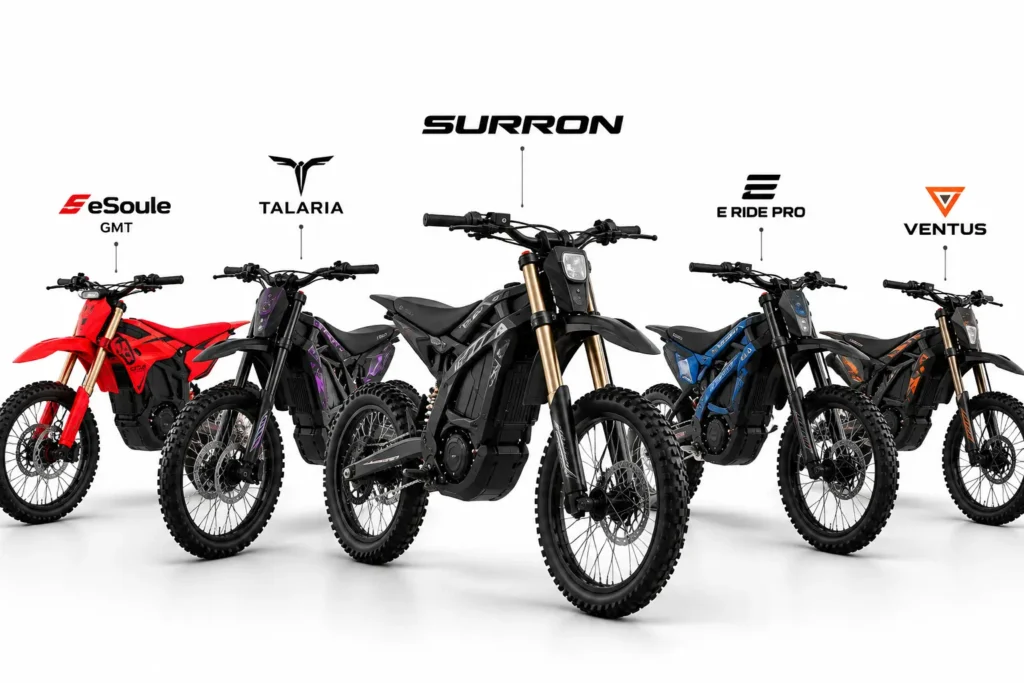
If you want an electric dirt bike like a Surron, you now have far more choices than simply buying another Light Bee-style machine.
The strongest Surron alternatives in 2026 include Talaria, E Ride Pro, 79Bike, Rawrr, Altis, and Segway, but they do not all improve on Surron in the same way. Talaria is one of the closest established rivals, E Ride Pro emphasizes stronger factory performance, 79Bike stays close to the lightweight Surron formula, Rawrr competes aggressively on performance and value, while Altis and Segway move toward larger and more powerful electric motorcycles.
That distinction matters because Surron is still the benchmark many buyers use when they enter the lightweight electric dirt bike market.
Surron’s current North American Light Bee X is listed by the manufacturer with a 72V 35Ah battery, 10kW maximum power, and a claimed 50 mph top speed. More importantly, the Light Bee has had years to develop one of the largest aftermarket and owner communities in the electric dirt bike category. (sur-ron.com)
A good alternative therefore needs to offer more than a larger motor number.
It should give the buyer a meaningful reason to choose it instead of the Light Bee X. That reason might be more battery energy, higher stock power, a larger chassis, better factory suspension, lower price, stronger dealer support, or simply a motorcycle that requires fewer upgrades after purchase.
That is also where current Google results are moving. Recent Surron-alternative guides increasingly organize bikes around why someone would leave the Surron platform, rather than pretending one competitor is universally superior. WattMoto, for example, separates alternatives by rider need, while MotorHabit explicitly notes that the Light Bee still has an unusually deep modification ecosystem even when competing motorcycles may offer better stock value. (wattmoto.com) (motorhabit.com)
That is the approach worth using.
| Electric Dirt Bike | Why Consider It Instead of Surron? | Current Published Power | Battery | Best For |
|---|---|---|---|---|
| Talaria Sting Pro MX | Established rival with larger battery and strong factory setup | 13.44 kW peak | 72V 40Ah, 2.88 kWh | Riders wanting a mature Surron alternative |
| E Ride Pro SS 3.0 | Significantly more stock power and battery energy | 15.8 kW peak | 72V 50Ah, 3.6 kWh | High-performance lightweight e-moto buyers |
| 79Bike Falcon Pro | Similar lightweight formula with competitive pricing and hardware | Up to 10 kW on current main product page | 72V 35Ah | Riders wanting a close Light Bee-style alternative |
| Rawrr Mantis X Pro | Strong power-per-dollar proposition | 15 kW peak | 72V 35Ah | Value-focused performance riders |
| Altis Sigma | Major step up in output and motorcycle size | 25 kW peak | 97.2V 35Ah, 3.402 kWh | Experienced riders wanting much more performance |
| Segway Xaber 300 | Major-brand electronics, dealer presence, suspension and rider aids | 21 kW peak | 72V 44Ah, 3.17 kWh | Riders wanting a larger tech-heavy off-road motorcycle |
These specifications come from current manufacturer pages and should still be verified for the exact market and version before buying. Model specifications change quickly in this category, and even current 79Bike pages, for example, show different Falcon Pro peak-power figures depending on the version or product page. (talaria.cn) (eridepro.com) (79bike.com)
The table also shows why “best Surron alternative” is not one question anymore. Some motorcycles stay close to the Light Bee’s weight and philosophy. Others use the same search term because they appeal to the same buyer but have already moved into a larger performance class.
For most buyers comparing electric dirt bikes like Surron, Talaria is still the most natural first alternative.
The brands compete in the same broad lightweight e-moto category, but Talaria has developed far beyond being a small challenger. Its current Sting Pro MX uses a 72V 40Ah battery with 2,880Wh of nominal energy and a 13.44kW peak-power rating. Talaria also lists a gearbox primary transmission, adjustable suspension, and a 95 km/h claimed maximum speed for the off-road MX version. (talaria.cn)
That makes the current comparison very different from older internet discussions built around early 60V Surron and Talaria models.
Talaria’s appeal is not simply “more power than Surron.” Its more important advantage is that it is now a mature enough platform that buyers can choose it without feeling as though they are gambling on an unknown brand. Talaria has an established owner base, official manuals, current dealer resources, and a substantial aftermarket of its own. (talaria.cn)
Surron still has the advantage in overall Light Bee ecosystem depth. If your plan is to modify almost everything over several years, Surron’s longer history matters. But if you want a strong motorcycle in factory form and prefer Talaria’s chassis, gearbox, battery, and current performance package, it is one of the most credible alternatives available.
E Ride Pro SS 3.0 attacks the decision from another direction.
Instead of leaning mainly on platform history, E Ride Pro gives buyers substantially more performance from the factory. The current official SS 3.0 listing specifies a 72V 50Ah, 3,600Wh swappable battery, 15.8kW peak power, and a claimed 60 mph top speed. (eridepro.com)
The battery comparison is particularly meaningful. The current Light Bee X NA uses a 72V 35Ah battery, while the E Ride Pro SS 3.0 publishes 72V 50Ah. That does not guarantee a particular real-world range advantage because speed, weight, terrain, temperature, and riding style affect consumption, but it does give the E Ride substantially more nominal stored energy.
This leads to one of the biggest decisions in the current lightweight electric motorcycle market:
Do you want to buy a proven platform and develop it, or buy more of the performance you want from the factory?
Surron makes enormous sense for the first buyer.
E Ride Pro increasingly makes sense for the second.
Current three-way comparison content reaches a similar conclusion. Modded Moto describes the Light Bee primarily through its aftermarket advantage, Talaria through strong factory value and trail-oriented hardware, and E Ride Pro through aggressive stock performance. (moddedmotoco.com)
For most shoppers, those three brands form the most important starting point before considering newer or more specialized alternatives.
Not every Surron buyer wants a dramatically bigger motorcycle. Some riders like the Light Bee concept and simply want another version of that idea.
That is where 79Bike Falcon Pro becomes interesting.
The Falcon Pro retains many characteristics that attract buyers to Surron-style electric dirt bikes: a forged aluminum chassis, 19-inch off-road wheels, removable battery, mid-mounted motor, belt-and-chain drivetrain, adjustable suspension, and a relatively manageable overall package.
79Bike’s current main Falcon Pro product page lists a 72V 35Ah LG battery, 10kW peak output, 56 mph claimed top speed, 130-pound weight, and 3.5-hour charge time. (79bike.com)
There is an important research point here. Other 79Bike pages still list an 8.5kW maximum-output figure for Falcon Pro versions, which is exactly why buyers should confirm the specification of the actual motorcycle being sold rather than copying one figure from an older article. (79bikes.com)
That kind of inconsistency is common in a rapidly evolving e-moto market.
The reason to consider the Falcon Pro is therefore not that it “beats Surron” in every category. It is that it stays close to the size and riding concept that made Light Bee attractive while offering another combination of battery, suspension, electronics, pricing, and factory equipment.
Long-term support is where the decision becomes more complicated.
79Bike’s current U.S. sales page states that its warranty support uses remote diagnosis, replacement parts, and approved local technicians, and it also notes that there is currently no U.S. walk-in service center. That is useful information for a buyer because support infrastructure should be considered alongside specifications. (79bikeofficial.com)
Rawrr Mantis X Pro makes a different argument: performance for the money.
Rawrr’s current global official site lists the Mantis X Pro with a 72V 35Ah battery, 15kW peak motor, and 105 km/h claimed top speed. The company also lists tunable ride modes, 220mm hydraulic brake rotors, and adjustable suspension. (rawrrmantis.com)
Those numbers put it well above a stock Light Bee in peak output.
But again, more power is not the same as a better motorcycle.
A 15kW lightweight e-moto places more demands on traction, braking, suspension, rider skill, and thermal management than a lower-output bike. A rider spending most weekends on tight technical trails may care more about throttle precision and weight than whether the motorcycle can reach a much higher claimed top speed.
Rawrr therefore makes the most sense for someone who actively wants stronger factory performance and accepts that the aftermarket and long-term owner knowledge are not yet as deep as the Surron ecosystem.
This is also why newer brands should not be dismissed simply as Surron clones. The best of them are increasingly developing their own chassis, electronics, suspension choices, apps, and power-delivery strategies.
The category is maturing.
Some riders search for bikes like Surron because they like electric off-road motorcycles, not because they necessarily want something with Light Bee dimensions.
For those buyers, Altis Sigma and Segway Xaber 300 deserve a different kind of comparison.
The 2026 Altis Sigma is a major step upward in output. Altis currently specifies a 97.2V 35Ah battery with 3.402kWh of nominal energy, a 25kW peak hairpin motor, 220mm front suspension travel, and a 90kg weight with the battery installed. (altispowersports.com)
That is not merely a faster Light Bee.
The Sigma is physically and electrically more substantial, and the 90kg listed weight is far above what many riders associate with the lightweight Surron experience. The additional performance can be attractive for experienced riders on fast open terrain, but a rider who likes the Light Bee specifically because it is easy to maneuver or recover after a fall may prefer a smaller alternative.
Altis is therefore best understood as a step-up alternative, not a direct copy.
The same applies to the Segway Xaber 300.
Segway currently lists the Xaber 300 with 21kW peak power, a 72V 44Ah / 3.17kWh battery, 187-pound weight, Marzocchi suspension with 220mm front travel, traction control, selectable power modes, GPS/4G location features, and a 60 mph maximum-speed claim in Beast mode. The U.S. store lists it at $5,299.99 and explicitly classifies it as off-road only. (segway.com) (store.segway.com)
The interesting part is not simply the 21kW figure.
Segway brings a different ownership proposition. The Xaber includes rider aids, app-connected electronics, location features, and a consumer brand that already operates through a broad product and dealer ecosystem.
That can matter to a buyer who is uncomfortable ordering a relatively new e-moto brand online and handling most diagnosis remotely.
But at 187 pounds, the Xaber 300 is also much heavier than the classic lightweight e-moto concept.
Someone who wants an electric dirt bike because a Light Bee can be relatively easy to transport and maneuver should think carefully before assuming the larger Segway is automatically a better alternative simply because it has more power.
This is an important pattern across the entire market:
As you move away from Surron toward more power, you often start moving away from the very qualities that made Surron popular.
More battery capacity can mean more weight.
More power can demand more chassis.
More suspension and braking hardware add size.
Eventually, you are no longer choosing between lightweight e-motos. You are choosing between different classes of electric motorcycle.
The first thing to decide is why you do not want the Surron.
That answer should determine the alternative.
If you simply want more peak power, E Ride Pro, Rawrr, Altis, and Segway can all provide substantially higher published output than a current Light Bee X.
If you want a larger battery, compare nominal energy in watt-hours rather than comparing Ah alone. For example, the E Ride Pro SS 3.0’s published 72V 50Ah battery corresponds to 3.6kWh, while the current Surron Light Bee X NA is 72V 35Ah. That is a meaningful capacity difference. (eridepro.com) (sur-ron.com)
If you want a motorcycle that stays close to the familiar Light Bee size, weight should be near the top of your comparison. Altis and Segway may have excellent specifications while still being the wrong answer for someone whose priority is a genuinely lightweight motorcycle.
Suspension should also be compared as more than a travel number. Spring rate, damping, linkage design, rider weight, terrain, and actual component quality influence performance. A longer-travel fork does not automatically make the bike better on technical trails.
The same is true for brakes. As motorcycles move into 15kW, 20kW, and higher territory, braking, chassis stability, tires, and rider skill become increasingly important. Do not select a high-power Surron alternative as though motor output exists independently from the rest of the motorcycle.
Then look beyond the motorcycle completely.
Can you buy a replacement battery?
Can you obtain a charger in two years?
Are controllers, displays, brake parts, bodywork, wheel components, and model-specific hardware actually available?
Is there a local dealer?
How is a warranty claim handled?
Does the manufacturer have clear documentation?
This is where Surron’s age becomes an advantage rather than a weakness.
MotorHabit’s current comparison notes that even though it sells several competing motorcycles, the Light Bee remains the deepest platform in its parts database. WattMoto reaches a similar conclusion, describing Surron’s aftermarket and resale as strengths that current competitors have not completely displaced. (motorhabit.com) (wattmoto.com)
A motorcycle can win every specification column and still be a poor long-term purchase if one proprietary component leaves it unusable for months.
Parts support should therefore be treated as part of performance.
For the rider who wants the closest mature alternative, I would start with Talaria. The brand is established enough to have a meaningful owner base, current dealer resources, official documentation, and a developed aftermarket, while the Sting Pro gives buyers substantially stronger current factory specifications than older Surron-versus-Talaria comparisons suggest.
For someone who wants more stock performance without immediately building a modified bike, E Ride Pro SS 3.0 is one of the most compelling current options. Its 15.8kW published peak output and 3.6kWh battery put it in a different factory-performance position from a standard Light Bee X.
For someone who likes the Light Bee concept itself, rather than simply wanting maximum performance, 79Bike Falcon Pro deserves attention. Its dimensions, battery architecture, weight, and basic layout keep it closer to the compact lightweight e-moto formula.
For power-per-dollar buyers, Rawrr’s Mantis X Pro is increasingly difficult to ignore, but owners should compare the support ecosystem as carefully as they compare peak power.
For experienced riders who want to move above the lightweight category, Altis Sigma offers substantially greater output and a larger motorcycle platform.
And for someone who values mainstream-brand electronics, rider aids, GPS features, dealership availability, and a more substantial chassis, Segway Xaber 300 offers one of the most distinctive alternatives even though it is no longer particularly Light Bee-like in weight.
There is one more option buyers should not overlook:
Buy the Surron.
Looking at alternatives does not automatically mean the Light Bee X has become obsolete.
If your priority is a huge aftermarket, proven modification knowledge, readily available parts, and an established used-bike community, Surron remains extremely difficult to replace. A newer motorcycle may save you money or provide more stock power, but the value of a mature ecosystem becomes much more obvious the first time you need an unusual replacement component.
This is why the best Surron alternative is not necessarily the bike with the largest motor.
It is the bike that improves on the part of Surron that matters most to you without sacrificing the qualities you bought a lightweight electric dirt bike for in the first place.
Talaria Sting models, E Ride Pro SS, 79Bike Falcon Pro, and Rawrr Mantis models are among the closest lightweight electric dirt bikes commonly cross-shopped with a Surron Light Bee. Altis Sigma and Segway Xaber 300 are larger, higher-output alternatives for riders who want to step beyond the traditional Light Bee class.
Talaria is one of the strongest overall alternatives because it combines a mature platform with competitive current specifications and a growing aftermarket. E Ride Pro may be a better choice for buyers who prioritize factory power, while 79Bike is attractive to riders who want something closer to the Light Bee’s lightweight formula.
Neither is universally better. Surron has the deeper aftermarket and longer platform history. Talaria offers competitive factory hardware and current 72V performance options. The better choice depends on whether you value platform maturity, stock specification, rider fit, or modification potential more.
E Ride Pro currently offers substantially more published factory power and battery energy in models such as the SS 3.0, while Surron has the advantage in aftermarket depth, parts knowledge, and platform maturity. Buyers wanting strong stock performance may prefer E Ride Pro; heavy modifiers may still prefer Surron.
Yes, it follows a similar lightweight electric dirt bike concept with a removable 72V battery, aluminum frame, mid-mounted motor, off-road wheels, and a relatively compact chassis. Current 79Bike pages list different peak-power specifications for some Falcon Pro versions, so buyers should verify the exact bike being purchased.
Rawrr publishes substantially higher peak power and top-speed claims for the Mantis X Pro than Surron publishes for the current Light Bee X NA. Real speed depends on rider, battery condition, terrain, gearing, software, and other factors, and higher top speed does not automatically make it a better trail motorcycle.
It competes for some of the same buyers, but the 2026 Sigma is a larger and significantly more powerful motorcycle. Altis lists 25kW peak power and 90kg weight, so it is better viewed as a performance step up than a direct Light Bee replacement. (altispowersports.com)
Yes in the broad sense that both are electric off-road motorcycles, but their sizes and performance are very different. Segway lists the Xaber 300 at 187 pounds with 21kW peak power, making it substantially heavier and more powerful than the classic Light Bee-style lightweight category. (segway.com)
Prices change too quickly to name one permanent cheapest model without checking current dealer offers. More important than advertised price is the delivered price, replacement-parts availability, warranty support, and whether the bike already has the battery, suspension, and power you actually need.
Buy a Surron if aftermarket depth, established owner knowledge, modification potential, and parts availability are major priorities. Consider an alternative if you specifically want more stock power, a larger battery, different ergonomics, stronger factory suspension, better value, or a larger motorcycle platform.
There are now enough electric dirt bikes like Surron that the Light Bee X is no longer the only serious option in the lightweight e-moto market.
But the best alternative depends on what you are trying to improve.
Talaria is one of the strongest choices for riders who want a mature direct competitor with strong factory hardware and an increasingly established ecosystem.
E Ride Pro is particularly compelling when high stock performance and battery capacity matter more than having the oldest and deepest aftermarket.
79Bike Falcon Pro stays closer to the compact Light Bee formula and deserves attention from buyers who want familiar proportions without automatically buying a Surron.
Rawrr Mantis X Pro makes a strong case for performance-focused value.
Altis Sigma is a logical step for experienced riders who have outgrown the traditional lightweight class and want dramatically more power.
Segway Xaber 300 offers another direction entirely, combining high output with Marzocchi suspension, traction control, connected electronics, tracking features, and a more substantial motorcycle platform.
None of those facts make Surron obsolete.
The Light Bee still has something many competitors are trying to build: years of aftermarket development, parts availability, modification knowledge, and owner familiarity.
That matters.
A Surron alternative should therefore earn your money by solving a specific problem. It should give you more of something you actually need, whether that is battery energy, stock performance, chassis size, suspension, value, dealer support, or technology.
Do not replace Surron simply because another motorcycle publishes a larger number.
Choose the alternative that improves the motorcycle for the way you actually ride.
Electric enduro motorcycles are becoming an increasingly appealing option for riders who want strong acceleration, precise low-speed control, and less

Electric enduro motorcycles are becoming an increasingly appealing option for riders who want strong acceleration, precise low-speed control, and less
The Talaria XXX Pro and Talaria Sting R MX4 are two popular options for riders looking for a lightweight electric
The Surron Hyper Bee and Surron Light Bee X are both high-performance electric dirt bikes, but they are designed for
