Electric Motocross vs Electric Enduro: What’s the Difference?
Electric motocross and electric enduro motorcycles can look very similar, and in some cases they even share the same motor,

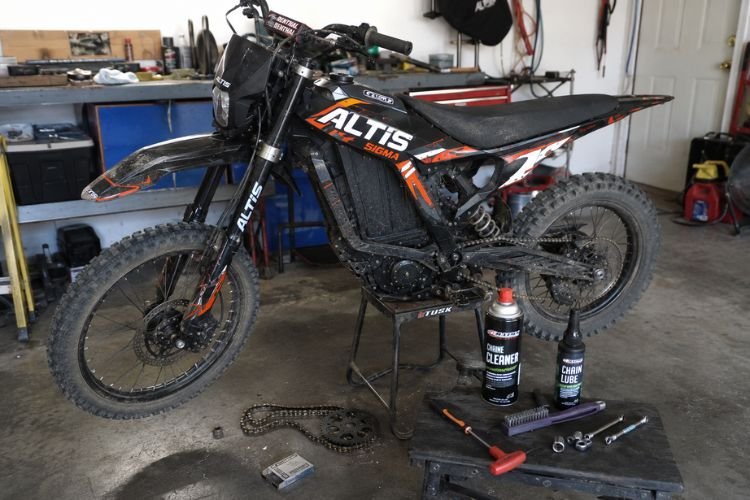
Owning an electric dirt bike doesn’t mean saying goodbye to maintenance.
The Altis Sigma eliminates many of the routine engine services associated with a gas-powered dirt bike, but it is still a high-performance off-road motorcycle. Its chain, reduction gearbox, brakes, suspension, tires, bearings, battery system, and hardware all need regular attention.
And because the Sigma can be ridden hard—through dust, mud, rocks, steep climbs, and high-speed trails—good maintenance isn’t only about making parts last longer.
It’s also about safety and consistent performance. The good news?
Maintaining an Altis Sigma doesn’t need to be complicated. A few minutes before and after your rides, combined with the correct scheduled service, can prevent many of the problems caused by neglected chains, worn brakes, loose hardware, damaged tires, or missed gearbox maintenance.
This Altis Sigma Maintenance Guide covers what owners should inspect, when maintenance becomes important, and which jobs are easy to overlook.
The Sigma requires less combustion-engine maintenance than a traditional gas dirt bike, but it isn’t maintenance-free.
The major areas owners need to monitor include:
According to the currently available Sigma owner’s manual, the maintenance schedule includes an initial motor gear-oil change at 600 km, chain inspection and cleaning at 500 km intervals, and recurring inspections for components including suspension, electrical equipment, tires, and brakes. The manual also specifies that maintenance should be performed based on the applicable mileage/time schedule rather than waiting for something to fail.
| Maintenance Item | What to Do | General Timing |
|---|---|---|
| Tires | Pressure, tread and damage check | Before rides + scheduled inspection |
| Brakes | Check pads, rotors and brake feel | Regularly |
| Chain | Inspect, clean, lubricate and check tension | Every 500 km / as conditions require |
| Gear Oil | Replace/service reduction gear oil | Initial service at 600 km; follow current manual thereafter |
| Suspension | Inspect operation and leaks | Periodically |
| Battery | Check charging behavior and condition | Regularly |
| Electrical System | Check controls and equipment | Scheduled inspection |
| Hardware | Inspect critical fasteners | Regularly, especially after hard riding |
Important: Use this table as a practical overview, not a replacement for the owner’s manual. Model year, configuration, riding conditions, and updated manufacturer recommendations can affect the required service. Always follow the current manual for your specific Sigma.
This is probably the biggest misconception first-time electric dirt bike owners have.
A Sigma doesn’t have the same gasoline engine maintenance routine as a conventional dirt bike.
You don’t have the familiar combination of:
That’s a major advantage.
But look at everything else happening when you ride.
The suspension is constantly compressing and rebounding.
The chain is transferring substantial torque to the rear wheel.
The brake pads are converting speed into heat.
The tires are dealing with rocks, roots, dirt, and hard acceleration.
Bolts and fasteners are being subjected to vibration and impacts.
And the battery and electrical system are managing significant amounts of energy.
In other words:
The motor may be electric, but the bike still lives the life of an off-road motorcycle.
Treat it accordingly.
One of the best maintenance habits costs nothing.
Inspect the bike before you ride.
You don’t need to disassemble anything. You’re simply looking for changes from the last time you rode.
A good pre-ride inspection should cover several critical areas.
Start with the simplest components.
Look at both tires for:
Tire pressure affects much more than comfort.
It influences:
The Sigma manual recommends checking pressure with the tires cold and adjusting it appropriately for rider weight and riding conditions.
Don’t simply copy another rider’s preferred trail pressure without understanding the tradeoffs.
A setup that works for a light rider on soft terrain may not be appropriate for a heavier rider hitting rocks at speed.
Pull both brake levers before moving.
They should feel consistent and predictable.
Look for:
Brake-pad life varies enormously.
A rider using the Sigma on steep technical descents may wear pads much faster than someone riding easy dirt roads.
That’s why brake condition should be inspected, not estimated entirely from mileage.
The Sigma manual specifies a brake-pad wear limit of 2.5 mm and instructs owners to inspect the pad wear indicators and brake discs.
If braking suddenly feels different, investigate it before your next hard ride.
This is one of the most important routine maintenance areas on the Sigma.
Look for:
According to the Sigma owner’s manual, standard chain slack is 10–15 mm, and front-to-rear sprocket alignment needs to be maintained during adjustment. The manual warns that incorrect tension can increase the risk of chain problems and recommends regular inspection.
This is worth taking seriously because high-performance electric motorcycles can place significant torque through the drivetrain.
A neglected chain doesn’t just become noisy.
It can increase wear on other drivetrain components.
Before switching into a ready-to-ride condition, make sure the controls operate normally.
Check:
The throttle should move smoothly and return normally.
Any sticking, damaged control, unexpected warning, or abnormal behavior deserves attention before riding.
Walk around the motorcycle.
Look closely at:
Off-road riding produces impacts and vibration.
Something that was tight several rides ago isn’t guaranteed to remain that way forever.
If you regularly ride jumps, rocks, or rough trails, these checks become even more important.
Here’s the maintenance item many new electric motorcycle owners don’t expect:
Yes, the Altis Sigma uses gear oil.
The bike is electric, but its reduction gearbox still requires lubrication.
This is different from a conventional gas motorcycle engine-oil change. You’re not lubricating pistons, a crankshaft, or a combustion engine.
You’re servicing the reduction gearbox that transfers power through the drivetrain.
According to the currently available owner’s manual, the reducer has an oil capacity of approximately 0.10–0.12 liters. The manual specifies GL-5 75W/90 below -10°C and GL-5 85W/90 above -10°C, and its maintenance schedule calls for the initial motor gear-oil change at 600 km.
That’s an important distinction: Electric motor ≠ no lubricating oil anywhere on the motorcycle.
Inside a reduction gearbox, gears operate under load while transferring the motor’s output to the drivetrain.
Gear oil helps:
Neglecting the manufacturer’s specified gearbox service defeats one of the biggest benefits of preventive maintenance: taking care of an inexpensive service item before it contributes to a much more expensive problem.
This is especially important.
Don’t choose gear oil because: “Someone online said they use it.”
Use the specification required by the manual for your exact bike and operating conditions.
The currently available Sigma manual provides specific viscosity guidance based on ambient temperature, but specifications can change between versions or model years.
Before performing the service, verify:
If you’re unsure, an authorized or qualified service provider is the safer option.
If there is one routine job Sigma owners should learn early, it’s chain care.
The chain operates in one of the dirtiest areas of the motorcycle.
Every off-road ride can expose it to:
Combine contamination with strong electric torque and poor chain maintenance can quickly become noticeable.
The manual’s maintenance schedule calls for chain inspection and cleaning at 500 km intervals. However, riding conditions matter.
If you ride through heavy mud, sand, or wet conditions, don’t blindly wait for the odometer to reach the next scheduled interval.
Inspect it sooner.
This is an important principle for the entire Altis Sigma maintenance schedule:
Mileage is the baseline. Riding conditions determine whether you need additional attention between scheduled services.
Thirty miles through thick mud can be harder on certain components than hundreds of easy miles in clean, dry conditions.
Don’t ignore these warning signs:
Some movement is normal, but obvious changes in chain behavior deserve inspection.
Check the specified slack rather than tightening the chain simply because it looks loose.
Visible contamination or a noticeably dry chain means it’s time for cleaning and appropriate lubrication.
Individual links should articulate correctly.
Stiff or damaged links can indicate wear or contamination.
A new rattling, clicking, or grinding noise shouldn’t automatically be blamed on the motor.
Inspect the chain, sprockets, chain guide, and surrounding drivetrain components first.
The chain and sprockets work as a system.
Maintaining one while ignoring the other doesn’t make sense.
There are really three maintenance clocks running at the same time.
Basic safety inspection:
Tires, brakes, chain, controls, battery status, and obvious loose or damaged components.
Follow the official maintenance schedule for items such as gear oil, chain servicing, suspension inspection, electrical equipment, and other periodic maintenance.
This is the one owners sometimes forget.
If you ride in:
your bike may need attention before the normal mileage interval arrives.
A maintenance schedule is not permission to ignore a motorcycle that is clearly telling you it needs service.
You don’t need to become a professional mechanic to own an Altis Sigma.
You need to become observant.
Learn what the bike normally:
Then changes become easier to recognize.
A slightly loose chain is inexpensive to correct.
Ignoring it until drivetrain components are damaged may not be.
A worn brake pad is a routine consumable.
Ignoring braking changes can become a safety problem.
A loose fastener may take minutes to address.
Losing the component on the trail is a different story.
That’s the real value of preventive maintenance.
Before moving into more detailed servicing, every Sigma owner should be comfortable with these basics:
| Task | Owner Should Know? |
|---|---|
| Inspect tire condition | ✓ |
| Check tire pressure | ✓ |
| Check brake feel | ✓ |
| Inspect brake-pad condition | ✓ |
| Inspect chain condition | ✓ |
| Recognize incorrect chain behavior | ✓ |
| Check visible hardware | ✓ |
| Understand that the gearbox uses gear oil | ✓ |
| Follow the official maintenance schedule | ✓ |
| Recognize new noises or riding changes | ✓ |
You don’t necessarily need to perform every advanced service yourself.
Knowing what needs attention is just as important as knowing how to repair it.
The most important lesson from this Altis Sigma Maintenance Guide is simple:
Electric means lower powertrain maintenance—not zero maintenance.
The Sigma still depends on properly maintained brakes, tires, chain, suspension, gearbox, battery system, and chassis components to perform safely and reliably.
Build three habits from the beginning:
Inspect before riding. Maintain according to the official schedule. Inspect sooner after severe riding conditions.
Do that, and many small maintenance needs can be handled before they become expensive problems.
Once the basic service schedule is understood, the next step is learning how riding conditions change maintenance needs.
This is especially important with the Altis Sigma because a maintenance interval measured only in miles or kilometers doesn’t tell the whole story. A short ride through deep mud, sand, or water can require more attention than several clean, easy trail rides.
Part 2 of this Altis Sigma Maintenance Guide focuses on the components owners interact with most often: the chain and sprockets, brakes, tires, suspension, cleaning, and post-ride inspections.
The goal isn’t to turn every owner into a professional technician. It’s to help you recognize normal wear early and know when routine maintenance becomes professional service.
The drive chain is one of the hardest-working wear components on the Sigma.
Every time you accelerate, torque travels through the drivetrain and ultimately to the rear wheel. Add dust, mud, water, and trail debris, and it’s easy to understand why chain maintenance matters.
The currently available Sigma owner’s manual specifies 10–15 mm of standard chain slack and recommends chain inspection and cleaning every 500 km under its scheduled maintenance guidance. When adjusting the chain, front and rear sprocket alignment also needs to be maintained.
But don’t interpret 500 km as meaning:“I can ignore my chain until the next 500 km.”
If you’ve just spent an afternoon riding through mud or sand, inspect it sooner.
Before reaching for chain cleaner or lubricant, look carefully at the drivetrain.
Check for:
Also rotate the rear wheel and observe the chain through its movement.
If tension changes dramatically at different points, that deserves further inspection.
Cleaning removes abrasive contamination before fresh lubricant is applied.
The objective isn’t to make the chain look showroom-new. It’s to remove dirt and debris that can contribute to wear.
Use products and procedures appropriate for the installed chain and follow the manufacturer’s guidance.
Avoid aggressive cleaning methods that can damage chain components or force contaminants where they shouldn’t go.
Once cleaned, allow the chain to dry appropriately before applying suitable lubricant.
More lubricant isn’t automatically better.
Applying excessive lubricant can attract additional dirt and create a sticky abrasive mixture around the drivetrain.
Apply an appropriate amount according to the chain-product instructions, covering the areas that need lubrication rather than spraying half the motorcycle.
Then wipe away unnecessary excess where appropriate.
This is where owners need to be careful.
A loose chain can cause noise, poor drivetrain behavior, or chain-related problems.
But overtightening it isn’t the solution.
A chain that’s too tight can place unnecessary loads on drivetrain components and interfere with correct suspension movement.
The Sigma manual specifies 10–15 mm chain slack and provides an adjustment procedure involving the rear axle and adjusters while keeping the sprockets aligned.
If you’re not confident performing this adjustment correctly, use a qualified service technician rather than guessing.
Chain maintenance and sprocket maintenance belong together.
Look at the teeth on both sprockets.
You’re checking for:
Installing a fresh chain onto badly worn sprockets—or ignoring a worn chain while focusing only on the sprockets—can shorten component life.
The drivetrain should be evaluated as a system.
Some drivetrain changes are easier to feel than see.
Pay attention if you notice:
Don’t automatically assume a new drivetrain noise means the motor or gearbox is failing.
Start with the simpler external components: chain condition, tension, alignment, sprockets, and chain-guide areas.
The Sigma’s braking system has to manage a powerful electric motorcycle, so brake inspection deserves the same attention as drivetrain maintenance.
According to the owner’s manual, the brake-pad wear limit is 2.5 mm. The manual also instructs owners to inspect front and rear brake-pad wear indicators and brake discs rather than relying purely on mileage.
That’s important because brake wear varies dramatically.
A rider doing long, steep descents can consume brake material much faster than someone riding flowing, relatively flat trails.
Before riding, squeeze the brake levers.
Ask yourself:
Do they feel the same as they did during the previous ride?
Warning signs include:
A sudden change should be investigated before another aggressive ride.
Don’t wait until braking becomes obviously poor.
Inspect pad condition periodically and compare it with the manufacturer’s wear criteria.
Replacement intervals cannot realistically be expressed as:“Change your Sigma brake pads every X miles.”
Terrain and riding technique matter too much.
Instead, replace based on condition and the specified wear limit.
Altis currently sells Sigma-specific replacement brake pads and complete brake components through its official parts catalog, which is useful when confirming model-specific replacement parts.
Altis Powersports Sigma Parts & Accessories
Brake rotors must remain free from contaminants.
Be particularly careful when:
Oil or lubricant on a brake rotor can seriously affect braking performance.
If contamination occurs, don’t simply assume hard braking will “burn it off.” Follow appropriate brake-cleaning and service procedures.
Brake fluid is another component owners sometimes forget because the motorcycle is electric.
The Sigma manual includes brake-fluid inspection procedures and warns that brake fluid can damage painted and plastic surfaces.
Check the system according to the maintenance schedule and manufacturer’s instructions.
If you experience persistent sponginess, leakage, or uncertain brake behavior, brake-system work is an area where professional service is often the better choice.
Brakes are not the place to learn through trial and error.
Tires have an enormous effect on how the Sigma feels.
A rider may assume:“My suspension doesn’t feel right.”or:“The rear end isn’t hooking up anymore.”
when the actual problem is simply a worn or incorrectly inflated tire.
The Sigma manual recommends inspecting tires for cuts, cracks, exposed material, foreign objects, and tread condition. It lists a 2 mm minimum tread depth and says pressure should be checked when the tires are cold.
Off-road tires can become compromised before they’re completely worn out.
Look for:
Rear-tire wear may be particularly noticeable for riders who frequently use the Sigma’s available torque or spend significant time on pavement.
Pressure affects:
Don’t choose tire pressure based solely on what another rider posts online.
Rider weight, terrain, speed, tire construction, and setup all matter.
Follow the manufacturer’s limits and adjust appropriately for your riding situation.
Suspension maintenance is easy to misunderstand because setup and maintenance are two different things.
If the Sigma feels too soft or too firm, that doesn’t automatically mean something is broken.
It may need adjustment for:
Maintenance becomes a concern when you notice physical or functional changes.
The Sigma maintenance schedule calls for suspension-system inspections and specifically includes checking the rear shock absorber for oil leakage.
Inspect the fork and shock areas for:
Then pay attention during the ride.
Possible warning signs include:
If suspension behavior changes significantly without you changing the settings, investigate the cause.
Dirt accumulating around seals can contribute to wear.
After dirty rides, carefully clean the suspension areas using appropriate methods.
Don’t aggressively blast seals with high-pressure water.
That brings us to one of the most important parts of maintaining an electric dirt bike.
Yes, an off-road motorcycle gets dirty.
No, that doesn’t mean every part of it should be attacked with a pressure washer.
The Sigma owner’s manual specifically advises owners to allow hot components to cool before cleaning and warns against high-pressure cleaning because it can damage moving parts and electrical components. It also says not to wash the lithium battery, battery terminals, or the area under the seat with water or detergent.
This deserves emphasis.
High-pressure water can force moisture past seals and into places normal rain or trail splashes may never reach.
After aggressive riding, allow high-temperature components to cool before washing.
Remove loose mud and dirt without forcing debris deeper into bearings, seals, or electrical areas.
Use motorcycle-safe products and follow their instructions.
Do not directly wash the lithium battery or its terminals with water or detergent. Follow the manufacturer’s cleaning instructions.
Cleaning gives you an excellent opportunity to look for:
A clean bike is easier to inspect.
Mud changes the maintenance equation.
After significant mud exposure, inspect:
Chain and sprockets — Mud can carry abrasive grit into the drivetrain.
Brakes — Check for contamination, unusual noise, and normal operation.
Suspension seals — Remove accumulated dirt carefully.
Tires — Look for hidden damage once the mud is removed.
Fasteners and moving components — Make sure heavy buildup isn’t hiding damage.
Electrical areas — Inspect for anything abnormal without unnecessarily disconnecting or opening high-voltage components.
The important rule is:
Don’t park a heavily contaminated bike for weeks and assume you’ll deal with it next time.
Electric dirt bikes require extra judgment around water.
The fact that a motorcycle can handle normal off-road conditions does not mean owners should intentionally submerge electrical components or treat waterproofing as unlimited.
After significant water exposure:
If the motorcycle has been deeply submerged, treat that as a different situation from ordinary rain or puddles and contact qualified support rather than simply charging and riding again.
After jumps, rocky terrain, repeated hill climbs, or aggressive riding, spend a few minutes checking the bike.
| Component | What to Check |
|---|---|
| Tires | Cuts, knobs, pressure, damage |
| Wheels | Visible damage or unusual movement |
| Brakes | Feel, pads, rotors |
| Chain | Dirt, slack, lubrication |
| Sprockets | Wear or damage |
| Suspension | Leaks and abnormal behavior |
| Foot Pegs | Damage or looseness |
| Handlebars | Alignment and mounting |
| Hardware | Critical visible fasteners |
| Battery/Display | Warnings or unusual behavior |
You don’t need to disassemble the motorcycle after every trail session.
The goal is to catch changes while you still remember how the bike behaved during the ride.
Learning routine maintenance is valuable.
But knowing when not to work on something is equally important.
Basic owner maintenance may include tasks such as inspection, cleaning, chain care, and other procedures specifically described for owners in the manual.
Professional or authorized service is the safer choice when dealing with:
The Sigma manual itself advises contacting customer service rather than attempting to solve certain motor and electrical malfunctions independently.
Don’t turn a straightforward repair into an expensive one by experimenting with a system you don’t understand.
Two Altis Sigma owners can ride exactly 500 miles and need different maintenance.
Rides:
The bike may remain relatively clean and experience predictable wear.
Rides:
That bike deserves more frequent inspections.
This is why a good maintenance plan combines:
Manufacturer schedule + mileage + time + riding conditions.
Never use one while ignoring the others.
Good Altis Sigma maintenance isn’t about constantly replacing parts.
It’s about keeping wear components in good condition and identifying small changes early.
The most important practical habits are straightforward:
These habits take far less time—and usually far less money—than repairing damage caused by neglect.
Battery care is one of the most important parts of long-term Altis Sigma ownership. Tires, brake pads, and chains are replaceable wear items, but the battery is a major component of the motorcycle and deserves more careful treatment.
Good battery maintenance isn’t complicated. The basic goal is to avoid unnecessary heat, improper charging, physical damage, and poor long-term storage habits. Combined with regular chassis and drivetrain maintenance, these habits can help keep the Sigma reliable as mileage increases.
The battery doesn’t need traditional mechanical servicing, but that doesn’t mean owners should ignore it. Pay attention to charging behavior, available range, battery warnings, connectors, and anything that changes unexpectedly.
Real-world range naturally varies with speed, terrain, rider weight, temperature, tire setup, elevation, and throttle use. A shorter ride than expected doesn’t automatically mean the battery is deteriorating. What matters more is whether you notice a significant change when comparing similar rides under similar conditions.
If charging suddenly takes much longer than normal, the battery percentage behaves strangely, an error message appears, or available performance changes unexpectedly, investigate the cause rather than continuing to ride and charge as usual.
Use the charging equipment specified for your bike and follow the current Altis instructions for connecting, charging, and disconnecting the system. Avoid improvised chargers, damaged charging equipment, or modifications that haven’t been approved for the battery system.
Temperature matters as well. After a demanding ride, the battery and other electrical components may be warm. Follow the manufacturer’s temperature guidance before charging rather than assuming the bike should always be plugged in immediately after stopping.
The charging area should also be dry, appropriately ventilated, and away from obvious sources of excessive heat or physical damage. Inspect charging cables and connectors periodically. If you notice damaged wiring, unusual heat, discoloration, odor, or abnormal charging behavior, stop using the equipment and have the system inspected.
Lithium-ion batteries generally prefer moderate temperatures. Repeated exposure to excessive heat can accelerate battery aging, which is why storage conditions matter even when the motorcycle isn’t being ridden.
Avoid leaving the Sigma for long periods in extremely hot environments when a cooler storage location is available. Direct summer sun, enclosed hot spaces, and other high-temperature conditions can place unnecessary stress on the battery.
Cold temperatures can also temporarily affect battery performance and available range. This doesn’t necessarily mean permanent battery degradation. Temperature and permanent battery aging are different issues, which is worth remembering when comparing summer and winter range.
For a deeper explanation, owners can also read our guide Does Heat Reduce Battery Life?
If you won’t be riding for an extended period, don’t simply park the bike and forget about it. Follow the current owner’s manual for long-term battery storage, including the recommended state of charge, storage temperature, and inspection or recharge intervals.
Store the motorcycle in a dry environment protected from extreme temperatures and physical damage. Before returning a stored bike to regular riding, inspect the tires, brakes, chain, suspension, battery condition, controls, and visible hardware.
Long-term storage is also a good reason to keep basic maintenance records. Knowing when the gearbox oil, brakes, chain, and other components were last serviced makes it much easier to put the bike back into use safely.
One of the most common mistakes is assuming that electric means maintenance-free. The Sigma eliminates many combustion-engine service requirements, but the chain, reduction gearbox, brakes, suspension, tires, bearings, and chassis still experience normal wear.
Another mistake is ignoring gearbox maintenance. As covered earlier in this guide, the Sigma’s reduction system uses gear oil. Owners should follow the service interval and lubricant specification listed for their particular model rather than treating the drivetrain like a completely sealed, lifetime-maintenance system.
Incorrect chain tension is another avoidable problem. A loose chain shouldn’t simply be tightened as much as possible. Too much tension can also create unnecessary loads. Use the manufacturer’s specified procedure and measurements.
Cleaning technique matters too. High-pressure water shouldn’t be blasted indiscriminately into electrical areas, bearings, seals, battery components, or connectors. The objective is to remove dirt without creating a new problem while cleaning the motorcycle.
Finally, don’t ignore small changes. A new noise, different brake feel, loose component, unusual battery warning, or sudden handling change is easier to investigate early than after it develops into a larger issue.
There isn’t a single annual maintenance number that applies to every owner. Riding style has too much influence on wear.
A recreational rider using clean, moderate trails may spend relatively little on consumables. An aggressive rider using high power on rocky terrain may go through rear tires, brake pads, chains, and other wear components considerably faster.
A useful way to think about costs is by category.
| Maintenance Category | Typical Items | Cost Frequency |
|---|---|---|
| Routine care | Chain cleaner, lubricant, cleaning supplies | Regular |
| Scheduled service | Gear oil and inspections | Periodic |
| Wear components | Tires, brake pads, chain, sprockets | Depends heavily on riding |
| Chassis service | Bearings and suspension service | Longer-term |
| Major electrical components | Battery, motor, controller | Not routine consumables |
The advantage over a gas dirt bike is that owners avoid several combustion-related maintenance jobs. However, saving money on engine maintenance doesn’t mean you should delay spending on tires, brakes, or drivetrain components when they actually need replacement.
Many basic jobs are realistic for an owner who has the correct tools, understands the procedure, and follows the manual. Tire inspections, pre-ride checks, cleaning, chain care, and visual inspections are useful skills for almost every rider to learn.
More complex work requires better judgment. High-voltage electrical faults, internal battery problems, controller issues, structural damage, internal suspension service, and brake problems beyond your technical ability should be handled by qualified professionals.
The best DIY owner isn’t necessarily the person who attempts every repair. It’s the person who understands which jobs can be performed correctly at home and which ones require specialized knowledge.
Maintenance shouldn’t depend entirely on the odometer. Time matters too, particularly for motorcycles that spend part of the year in storage.
At the beginning of your main riding season, perform a more thorough inspection than your normal pre-ride check. Look at tire condition and pressure, brake pads and rotors, chain and sprockets, suspension seals, bearings, controls, battery behavior, electrical connections, and critical hardware. Confirm that scheduled gearbox service is current as well.
During the season, continue routine inspections and adjust maintenance frequency to riding conditions. Mud, water, sand, dust, jumps, and aggressive trail use justify more frequent attention.
At the end of the season, clean and inspect the bike before storage rather than storing it dirty. Follow Altis battery-storage recommendations and record any maintenance that should be completed before the next riding season.
This condensed checklist is useful for owners who want a quick reference.
| Interval | Main Checks |
|---|---|
| Before riding | Tires, brakes, chain, controls, battery status, visible hardware |
| After dirty riding | Chain, sprockets, brakes, suspension seals, tires |
| After hard trail riding | Wheels, suspension, drivetrain, brakes, critical fasteners |
| Scheduled mileage | Gear oil, chain service and manual-specified inspections |
| Periodically | Bearings, suspension, electrical system, brake condition |
| Before long storage | Clean bike, inspect components, prepare battery correctly |
| After storage | Tires, brakes, drivetrain, battery, suspension, controls |
Always use the maintenance schedule for your specific model year as the final authority when a mileage or service specification is required.
Routine maintenance should help prevent problems, but certain symptoms deserve professional diagnosis. Persistent battery or charging errors, controller faults, abnormal motor or gearbox noises, significant suspension leaks, structural damage, electrical faults, or serious brake problems shouldn’t be ignored.
The same applies when you’re simply unsure about a procedure. Paying for correct service is often much cheaper than repairing damage caused by an incorrectly performed repair.
For replacement components, owners can also consult the official Altis Powersports website to verify currently available Sigma parts and support information.
There isn’t one interval for every component. Some items should be checked before every ride, while others follow mileage or time-based intervals in the owner’s manual. Riding conditions can also require earlier maintenance. A bike regularly ridden through mud, sand, water, or aggressive terrain should be inspected more frequently.
The Sigma doesn’t require conventional combustion-engine oil changes, but its reduction gearbox does use gear oil. Owners should follow the specified gearbox oil type, quantity, and service interval for their model.
Use the official maintenance schedule as your baseline, but inspect the chain more frequently when riding in dirty, wet, sandy, or muddy conditions. Clean and lubricate it when condition requires rather than relying exclusively on mileage.
High-pressure cleaning can force water into seals, bearings, and electrical areas. The owner’s guidance warns against high-pressure cleaning and provides specific precautions around the battery and electrical components. Use controlled, appropriate cleaning methods instead.
There’s no reliable universal mileage because brake wear depends heavily on terrain, rider weight, speed, braking technique, and riding intensity. Inspect the pads regularly and replace them according to their actual condition and the manufacturer’s wear specifications.
Battery lifespan depends on charging cycles, temperature, storage conditions, riding habits, and other factors. Mileage alone cannot predict battery lifespan. Proper charging, storage, and temperature management can help reduce unnecessary degradation.
Routine maintenance can be relatively straightforward compared with a gas dirt bike because many combustion-engine service items are eliminated. Tires, brake pads, chains, sprockets, suspension service, and other wear components still create ownership costs, especially for aggressive riders.
You don’t necessarily need to service the motorcycle after every normal ride. A quick inspection is useful, while dirty or aggressive rides deserve additional attention to the chain, brakes, tires, suspension, and hardware. Cleaning the bike also makes damage and wear easier to identify.
The easiest way to maintain the Sigma is to think in three layers. First, perform quick safety checks before riding. Second, follow the official mileage and time-based service schedule. Third, increase maintenance frequency whenever riding conditions become more demanding.
Don’t wait for something to fail before paying attention to it. Tires gradually lose tread. Brake pads become thinner. Chains collect dirt and change tension. Suspension components experience wear. Gear oil requires scheduled service. Batteries respond to temperature, storage, and charging conditions.
Most of these aren’t Altis Sigma problems. They’re normal parts of owning and riding a performance electric dirt bike.
The difference between a well-maintained Sigma and a neglected one often comes down to simple habits performed consistently.
The Altis Sigma Maintenance Guide can ultimately be summarized in one principle: maintain the bike according to both the official service schedule and the way you actually ride it.
Electric power significantly reduces some of the maintenance associated with gas motorcycles, but the Sigma is still a serious off-road machine. Its drivetrain, brakes, tires, suspension, battery, electrical system, and chassis all deserve regular inspection.
You don’t need to spend hours working on the bike after every ride. Five minutes of inspection can often tell you whether something needs attention. After demanding rides, spend a little longer cleaning and checking critical components. When scheduled maintenance arrives, don’t postpone it simply because the motorcycle still feels fine.
Most importantly, learn how your Sigma normally sounds, feels, brakes, handles, and charges. Changes become much easier to identify when you know what normal feels like.
Take care of the motorcycle before problems develop, and you’ll spend less time fixing neglected components and more time doing what the Altis Sigma was built for: riding.
Electric motocross and electric enduro motorcycles can look very similar, and in some cases they even share the same motor,
Electric enduro motorcycles are becoming an increasingly appealing option for riders who want strong acceleration, precise low-speed control, and less

Electric enduro motorcycles are becoming an increasingly appealing option for riders who want strong acceleration, precise low-speed control, and less

The Talaria XXX Pro and Talaria Sting R MX4 are two popular options for riders looking for a lightweight electric
