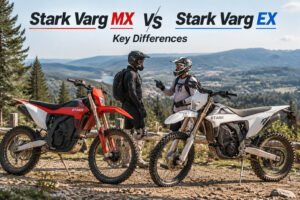
Stark Varg MX vs Stark Varg EX: Key Differences
Electric enduro motorcycles are becoming an increasingly appealing option for riders who want strong acceleration, precise low-speed control, and less
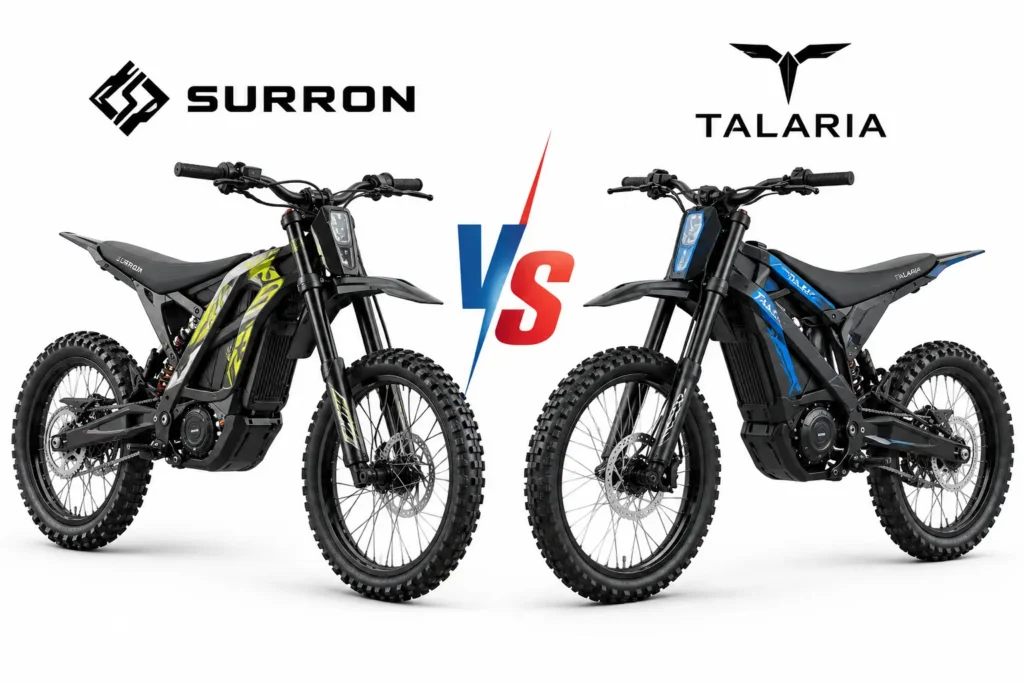
Surron and Talaria are two of the most recognizable brands in the lightweight electric dirt bike market, and at first glance their bikes can look remarkably similar. Both companies build throttle-controlled electric motorcycles with compact aluminum frames, removable lithium-ion batteries, off-road suspension, hydraulic brakes, and performance far beyond a conventional pedal-assist e-bike.
The biggest difference is no longer simply that one is faster than the other.
Surron generally has the more established platform and deeper aftermarket ecosystem, while Talaria often emphasizes larger stock batteries, gearbox-driven models, competitive factory performance, and an increasingly broad range of motorcycles.
For riders comparing the two brands in 2026, the exact models matter more than the logos.
The classic comparison has traditionally been the Surron Light Bee X vs Talaria Sting R, but even that comparison has changed. Surron’s current North American Light Bee X is listed by the manufacturer with a 72V 35Ah battery, 10kW maximum power, and a claimed 50 mph top speed. Talaria’s current Sting R MX uses a 60V 45Ah battery with 2,700Wh of nominal energy, 8kW peak power, and a manufacturer-listed top speed of 85 km/h, or about 53 mph. Surron
Talaria also now offers higher-output models such as its 72V Sting Pro platform, while both manufacturers have expanded beyond the lightweight class. That means statements such as “Talaria has more power” or “Surron has the smaller battery” can become wrong depending on which model and model year is being discussed. Talaria
For a useful Surron vs Talaria comparison, it is better to ask how the two platforms differ in real ownership.
For the models most buyers cross-shop, the differences can be summarized like this.
Best known for: Light Bee X and Ultra Bee
Main advantage: mature aftermarket, parts availability, customization, established platform
Current Light Bee X NA system: 72V 35Ah
Current Light Bee X NA maximum power: 10kW
Current Light Bee X NA claimed top speed: 50 mph
Rider appeal: buyers who value lower weight, customization, community knowledge, and long-term upgrade options
Best known for: Sting R, Sting Pro and xXx platforms
Main advantage: strong factory specifications, larger-battery options, gearbox-driven Sting platforms, expanding model range
Current Sting R MX system: 60V 45Ah, 2,700Wh
Current Sting R MX peak power: 8kW
Current Sting R MX claimed top speed: 85 km/h
Rider appeal: buyers who want strong stock performance and may prefer a more substantial motorcycle without immediately modifying it
Those numbers come from current manufacturer information, but specifications can differ by market and model year. Both Surron and Talaria state that specifications may change, so buyers should always verify the exact motorcycle being sold rather than assuming every Light Bee or Sting uses the same hardware. Surron
That point matters more in 2026 than it did several years ago because both product families are evolving quickly.
One of the biggest mistakes in Surron vs Talaria comparisons is reducing the decision to peak power.
Peak motor output is useful, but it does not tell you everything about acceleration, trail performance, range, or how a motorcycle feels.
Battery voltage, controller current, motor design, gearing, rear-wheel torque, motorcycle weight, traction, software, and thermal limits all affect performance.
The current North American Surron Light Bee X provides a good example. Surron now lists the bike with a 72V 35Ah battery and 10kW maximum power. That makes older comparisons describing every Light Bee X as a 60V machine outdated for the current North American model. Surron also claims 0–31 mph acceleration in 2.5 seconds and a 50 mph maximum speed for this version. Surron
Talaria takes a different approach with the Sting R MX. Its official specification lists a 60V 45Ah battery containing 2,700Wh of nominal energy, an 8kW peak motor, 45Nm of peak motor torque, and 376Nm of rear-wheel torque with the specified 44-tooth sprocket. Talaria lists the complete bike at 69kg, including the battery. Talaria
Those figures demonstrate why voltage alone cannot decide which bike is better.
The Surron uses the higher-voltage electrical architecture in the current North American Light Bee X. The Talaria Sting R carries more nominal battery energy based on its published specification. But neither fact independently tells you which motorcycle will accelerate better on loose dirt, climb a rocky trail more easily, or travel farther during aggressive riding.
There is another mechanical difference that matters to owners: the primary drivetrain.
The Light Bee platform has traditionally become known for its belt-and-chain arrangement, while the Talaria Sting platform uses a gearbox as its primary reduction before sending power through the chain to the rear wheel. Current comparison pages frequently identify this as one of the meaningful engineering differences between the two platforms. WattMoto
Neither design automatically makes one bike superior.
A belt can provide quiet operation and is supported by a huge Light Bee aftermarket. Talaria’s gearbox removes the primary belt from the equation but introduces gearbox-specific maintenance requirements. Buyers should follow the service requirements for the exact model rather than assuming an electric dirt bike has no drivetrain maintenance simply because it does not have a gasoline engine.
This is a better way to understand Surron vs Talaria: they are similar motorcycles built around different platform decisions, rather than identical bikes with different badges.
Battery specifications are one of the first places buyers look, but they are also one of the easiest places to make a misleading comparison.
Amp-hours alone are not enough.
A 45Ah battery does not automatically contain more energy than every 35Ah battery because the voltage also matters. A useful first comparison is nominal watt-hours, calculated approximately as voltage multiplied by amp-hours.
Talaria publishes the Sting R MX battery directly as 60V 45Ah and 2,700Wh. Surron currently describes the North American Light Bee X battery as 72V 35Ah, which corresponds to approximately 2,520Wh using nominal voltage and capacity. Talaria
On paper, that gives the Sting R slightly more nominal battery energy.
That does not mean it will automatically travel farther in every situation.
Range depends on how efficiently the entire motorcycle uses that energy. Rider weight, motorcycle weight, terrain, speed, hills, tire pressure, wheel setup, temperature and throttle use all affect consumption. Manufacturer range tests are also performed under specified conditions that may be very different from technical trail riding.
Talaria, for example, publishes a maximum Sting R MX range of 100km at 25km/h. Surron lists 46.6 miles of maximum range for the current Light Bee X NA under its stated test conditions. Those values should not be compared as though they were guaranteed trail distances because the test methods and riding conditions are not necessarily identical. Talaria
Weight creates another important difference.
Talaria officially lists the Sting R MX at 69kg with the battery installed. The exact weight of a Light Bee X depends on model year and market; Surron’s official site, for example, lists the 2025 Light Bee X at 125.6 pounds while its newer North American configuration has changed other major specifications. Talaria
That is not a minor detail on technical trails.
Extra battery capacity and a more substantial chassis can be valuable, but weight affects how quickly a motorcycle changes direction, how easy it is to catch at low speed, and how difficult it is to pick up after a fall on a hill.
Larger riders may appreciate the more substantial feel of some Talaria platforms. Riders who spend their time on narrow technical single-track may care more about keeping the motorcycle light.
There is no universal winner because battery energy and motorcycle mass are part of the same engineering tradeoff.
A larger battery is useful only if the additional riding time is worth the additional size, mass and cost for the rider using it.
If there is one area where Surron still has a particularly clear advantage, it is platform maturity.
The Light Bee has been on the market long enough to develop a very large ecosystem of replacement and performance parts. Batteries, controllers, motors, suspension components, brakes, wheels, sprockets, seats, foot pegs, protection parts and body components are widely available from both Surron and third-party manufacturers.
Surron itself operates a replacement-parts catalog for the Light Bee and Ultra Bee platforms, including battery, controller, body and chassis components. surron
The aftermarket matters for more than customization.
Electric dirt bikes are mechanical vehicles that eventually need parts. Brake components wear, suspension requires service, wheels can be damaged, controls can break in crashes, chains and sprockets wear, and batteries gradually age.
A mature ecosystem makes it easier to keep a motorcycle operating.
This is one reason several current 2026 Surron vs Talaria comparisons still identify Surron’s aftermarket and owner community as its strongest advantage. eMoto Bykes
Talaria is no longer a niche platform, however.
Its owner base has grown significantly, and parts availability has improved as Sting, Sting R and xXx models have become more common. Talaria also provides model-specific manuals through its official site, including current documentation for Sting, xXx and Komodo platforms. Talaria
That makes the aftermarket difference less absolute than it once was.
If your plan is to leave the motorcycle mostly stock, the size of the modification ecosystem may not matter very much. If your plan is to change the controller, battery, suspension, brakes, wheels and drivetrain over several years, the depth of the Surron ecosystem becomes a stronger reason to choose it.
There is also a hidden cost consideration.
Sometimes a motorcycle with better stock equipment is cheaper to own than purchasing a less-equipped platform and immediately replacing several expensive components. Conversely, a huge aftermarket can make long-term repair easier even if you never build a high-power modified bike.
The right question is therefore not simply, “Which bike has more aftermarket parts?”
Ask:
Do I want a finished stock motorcycle, or do I want a platform I can continue developing?
That question often separates Talaria and Surron buyers more effectively than a top-speed comparison.
This is where Surron vs Talaria becomes much more subjective.
A lightweight electric dirt bike is not judged only by its acceleration on pavement. Off-road performance depends on throttle control, traction, weight distribution, suspension, brakes, wheel and tire setup, chassis geometry and how comfortable the rider feels moving the bike underneath them.
Surron’s Light Bee became popular partly because its compact dimensions and relatively light feel work well for riders who value agility. On tight technical terrain, reducing mass can make direction changes, low-speed balance and recovery after a mistake easier.
Talaria’s Sting platforms tend to feel more substantial. For some riders, particularly larger riders or those coming from conventional dirt bikes, that can be an advantage rather than a disadvantage.
The larger Sting R battery can also be attractive if riding time matters more than minimizing every pound.
But neither brand automatically has better suspension simply because one specification shows more travel.
Fork quality, spring rate, damping, rider weight, sag, rear linkage behavior and setup all influence how the motorcycle handles rocks, roots, braking bumps and jumps. Buyers should evaluate the suspension fitted to the exact model being sold, because suppliers and specifications can change between model years and markets.
Power delivery matters just as much.
A motorcycle with more peak power can still be slower through a difficult trail if its throttle is harder to meter or if the rider cannot use the available torque without spinning the rear tire. On technical terrain, predictable control is often more useful than an additional peak-kW figure.
For this reason, the practical difference is usually something like this:
Choose the Surron Light Bee platform if you place a high value on agility, platform maturity and future customization.
Choose a Talaria Sting if you prefer a more substantial stock bike, want strong factory specifications and appreciate the battery and drivetrain choices Talaria has made.
That is intentionally not a universal verdict.
The better trail bike is the one whose size, weight, suspension and power delivery fit the rider.
For 2026, the answer depends more heavily on the exact model than it did several years ago.
If you are comparing the current North American Surron Light Bee X with a Talaria Sting R MX, the Surron now brings a 72V electrical system and 10kW maximum-power claim, while the Talaria offers a 60V 45Ah battery with 2,700Wh and an 8kW peak-power rating. That is a different comparison from the older 60V Light Bee X versus Sting R articles still circulating online. Surron
But Talaria itself has moved beyond the Sting R.
Its current lineup includes a 72V Sting Pro platform rated at 13.44kW peak power with a 72V 40Ah, 2,880Wh battery. Talaria’s expansion into newer voltage and performance levels is another reason a brand-wide statement such as “Surron is 72V and Talaria is 60V” would be inaccurate. Talaria
The same is true at the larger end of the market. A Surron Ultra Bee should not be compared as though it were merely a more powerful Light Bee, and Talaria now has platforms that extend beyond the classic lightweight Sting category.
So the buying decision should be made in two stages.
First, decide which motorcycle class you need.
If you want a compact lightweight e-moto for trails, recreational riding and customization, compare Light Bee X against the appropriate Sting model.
If you want substantially more power and a larger chassis, move into the next class instead of trying to turn a lightweight bike into something it was never designed to be.
Second, decide what you value after buying it.
Surron makes a strong case for riders who care about aftermarket depth, replacement parts, modification knowledge and a platform with years of market history.
Talaria makes a strong case for riders who want competitive factory hardware and may prefer one of its battery, gearbox or higher-performance configurations without immediately rebuilding the motorcycle.
Neither approach is wrong.
Surron is usually the stronger platform choice. Talaria can be the stronger stock-bike choice.
That is a much more accurate summary than declaring either brand universally better.
No. Talaria and Surron are separate electric motorcycle brands. Their lightweight motorcycles compete in similar categories and can look similar, but they use different platforms, batteries, drivetrains, controllers and model lineups.
Not universally. Talaria often appeals to riders who want strong factory specifications and larger-battery options, while Surron has an advantage in aftermarket depth and long-term platform support. The exact models being compared matter more than the brand names alone.
For current models, published top-speed figures are very close and should not be treated as guaranteed real-world results. Surron currently lists the North American Light Bee X at 50 mph, while Talaria lists the Sting R MX at 85 km/h, approximately 53 mph. Rider weight, battery state, gearing, terrain and other conditions affect actual speed. Surron
It depends on the models. The current Talaria Sting R MX uses a 60V 45Ah, 2,700Wh battery. Surron’s current North American Light Bee X uses a 72V 35Ah battery, which corresponds to about 2,520Wh of nominal energy. Other Surron and Talaria models use different battery systems. Talaria
Both descriptions can be correct depending on model and year. Surron’s official site lists the 2025 Light Bee X with a 60V 40Ah battery, while the current Light Bee X NA is listed with a 72V 35Ah battery. Always check the exact model rather than assuming every Light Bee X has the same electrical system. Surron
Talaria uses multiple voltage architectures. The Sting R MX is currently listed as 60V, while the newer Sting Pro platform uses a 72V system. Other Talaria models use different voltages again. Talaria
Surron remains the stronger choice if modification potential is a major priority, particularly around the Light Bee platform. Its longer market history has created a particularly deep selection of batteries, controllers, suspension, wheels and other aftermarket components. Talaria’s aftermarket is substantial and growing, but Surron remains the benchmark for platform maturity.
Either can work for an appropriately sized and experienced rider, but model size, weight, throttle response and power matter more than the badge. A lighter motorcycle may be easier to manage at low speed, while selectable riding modes can help make power delivery more approachable. Beginners should not assume these motorcycles behave like ordinary pedal-assist e-bikes.
Do not assume either brand is automatically street legal. Legal classification depends on the exact model and applicable federal, state and local rules. Off-road models may not qualify as ordinary electric bicycles simply because sellers or riders call them “e-bikes.”
The difference between Surron and Talaria is not simply that one bike has more power or a larger battery.
They represent two different approaches to the same lightweight electric motorcycle category.
Surron’s biggest strength is its platform. The Light Bee has years of market history, extensive owner knowledge, a very large aftermarket and a deep supply of replacement and performance parts. The current North American Light Bee X has also evolved substantially, with Surron now listing a 72V 35Ah battery and 10kW maximum power. Surron
Talaria’s strength is the competitiveness of its stock motorcycles. The Sting R MX combines an 8kW motor with a 60V 45Ah, 2,700Wh battery and gearbox-based primary reduction, while newer platforms such as the Sting Pro move Talaria into 72V and higher-output territory. Talaria
For riders who want the deepest customization path and an established ownership ecosystem, Surron is difficult to beat.
For riders who care more about the complete factory specification and prefer Talaria’s battery, chassis and drivetrain choices, Talaria can be the better purchase.
The most important lesson is to compare actual models rather than brands in isolation.
A current Light Bee X is not the same motorcycle as a Light Bee X from several years ago. A Sting R is not the same motorcycle as a Sting Pro. And neither company’s larger models should be judged using conclusions drawn from its lightweight platforms.
So when choosing between Surron vs Talaria, start with the rider and terrain, then compare the exact battery, motor, controller, weight, suspension, drivetrain and support ecosystem of the motorcycles you can actually buy.
That produces a much better answer than asking which logo wins.
Electric enduro motorcycles are becoming an increasingly appealing option for riders who want strong acceleration, precise low-speed control, and less
Electric enduro motorcycles are becoming an increasingly appealing option for riders who want strong acceleration, precise low-speed control, and less
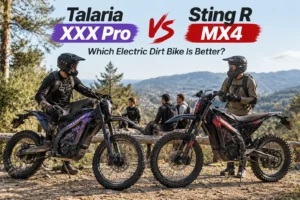
The Talaria XXX Pro and Talaria Sting R MX4 are two popular options for riders looking for a lightweight electric
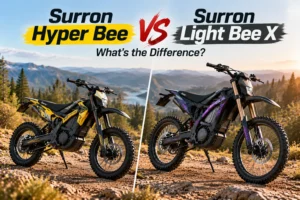
The Surron Hyper Bee and Surron Light Bee X are both high-performance electric dirt bikes, but they are designed for
