Stark Varg MX vs Stark Varg EX: Key Differences
Electric enduro motorcycles are becoming an increasingly appealing option for riders who want strong acceleration, precise low-speed control, and less

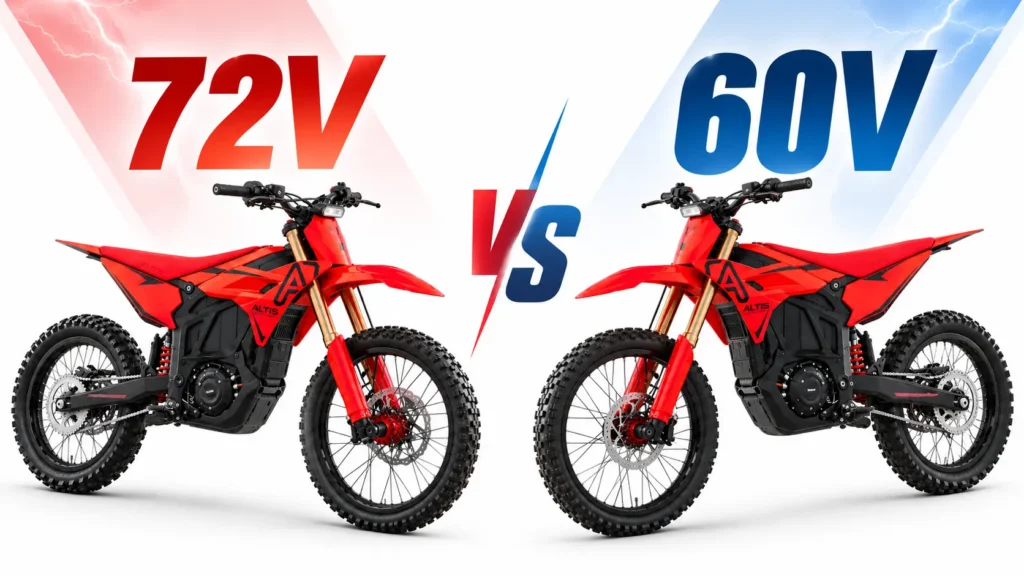
A 72V electric dirt bike uses a battery system with a higher nominal voltage than a 60V electric dirt bike. Because 72V is 20% higher than 60V, a properly designed 72V powertrain can deliver the same electrical power using less current, or it can use that additional voltage as part of a system designed for higher output and stronger high-speed performance.
That is the electrical difference. The riding difference is more complicated.
A 72V electric dirt bike is not automatically faster, more powerful, longer-range, or better than a 60V bike. Battery voltage works together with battery current capability, controller limits, motor design, gearing, software, thermal management, motorcycle weight, tires, and traction. Change any of those variables and two bikes with different voltage labels can perform very differently.
This distinction has become increasingly important as the electric dirt bike market moves toward higher-output motorcycles. Current competitor content increasingly acknowledges that voltage should be evaluated as part of the complete electrical system rather than treated as a simple performance ranking. Cemotoride
The best way to understand 72V vs 60V is therefore not to ask which number is bigger. It is to understand what higher voltage actually allows the engineers to do with the rest of the motorcycle.
The 60V or 72V number normally refers to the battery’s nominal voltage. Nominal voltage is a convenient rating for the battery system, not a statement that the pack remains at exactly that voltage throughout the entire ride. Actual battery voltage changes with state of charge, cell chemistry, load, temperature, and other conditions.
Voltage also should not be confused with battery capacity or motor power. Those are related measurements, but they describe different things.
The basic electrical relationship is:
Power = Voltage × Current
or:
P = V × I
Nidec’s motor engineering reference defines electrical power in exactly this way: wattage is the product of voltage and current. NIDEC CORPORATION
That formula explains much of the interest in 72V systems. Imagine two electric dirt bike powertrains both delivering 6,000 watts of electrical input. In a simplified calculation, a 60V system would need 100 amps because 6,000 divided by 60 equals 100. A 72V system would need about 83.3 amps to deliver the same 6,000 watts.
At 9,000 watts, the difference becomes 150 amps at 60V versus 125 amps at 72V.
These are simplified nominal-voltage examples, not measurements of a real motorcycle under load, but they show why manufacturers increase voltage as performance requirements rise. Higher voltage can reduce the current required for the same electrical power, which can help engineers manage wiring, conductors, battery load, controller design, and some current-related losses.
The reverse is also true. If two systems can safely supply the same current, the higher-voltage system has more theoretical electrical power available. At 100 amps, 60V corresponds to 6,000 watts while 72V corresponds to 7,200 watts.
That still does not mean a 72V sticker automatically creates 20% more real-world motorcycle performance. The battery must be capable of supplying the current, the controller must permit it, the motor must convert the electrical input effectively, and the system must remain within its thermal and mechanical limits.
This is the first rule of comparing 72V vs 60V electric dirt bikes: voltage tells you something important about the electrical architecture, but it does not tell you the complete performance of the motorcycle.
Higher voltage becomes especially interesting when riders begin asking about acceleration and top speed, but these two areas need to be separated.
Acceleration depends heavily on torque at the rear wheel. That means motor design, motor current, controller tuning, gearing, wheel size, motorcycle mass, and traction all matter. A 60V bike with aggressive controller current and suitable gearing can produce very strong low-speed acceleration. A 72V motorcycle can have more theoretical power available but still struggle to use it if the rear tire is already spinning on loose terrain.
This is why technical trail riding often exposes the weakness of specification-sheet comparisons. On dry pavement, additional power may produce a clear acceleration advantage. On rocks, roots, loose climbs, or wet soil, the limiting factor can become tire grip rather than battery voltage.
High-speed operation is different because motor voltage becomes increasingly important as RPM rises.
As an electric motor spins faster, it generates back electromotive force, commonly called back EMF. This voltage rises with motor speed and opposes the voltage the controller is trying to apply. At lower RPM, there is usually enough voltage headroom to regulate motor current effectively. As the motor approaches higher speed, back EMF consumes more of that available voltage headroom, making it increasingly difficult to maintain the same torque.
MathWorks explains that a motor’s base speed is constrained by available stator voltage, current, and back EMF. Once the motor moves above that base-speed region, field-weakening control can extend RPM, but it does so with reduced available torque. MathWorks Texas Instruments describes the same basic limitation: at sufficiently high speed, back EMF reduces the voltage difference available to drive current through the motor, so torque falls unless the control system uses techniques such as field weakening. Texas Instruments
This is one reason a properly engineered 72V powertrain can have an advantage when designers want stronger high-speed performance. The higher DC bus voltage provides more potential voltage headroom before the motor reaches the same voltage limitation.
But again, this is not the same as saying every 72V bike has a higher top speed.
Motor winding design, gearing, wheel diameter, controller programming, field weakening, aerodynamic drag, battery condition, rider weight, and electronic speed limits all influence the final number. A manufacturer may deliberately gear a powerful 72V motorcycle for strong acceleration rather than maximum speed. Another may use aggressive field weakening to reach a higher speed while sacrificing some torque and efficiency in that operating region.
Peak power can also create misleading expectations. A motorcycle capable of briefly producing a large kW number may reduce output when the battery, controller, or motor becomes hot. For long hill climbs, deep sand, or repeated hard riding, sustained power can matter more than the peak number printed on a product page.
The practical takeaway is that 72V gives engineers more options for high-power and high-RPM design, but the final motorcycle still depends on how intelligently the complete system is matched.
Range is probably where the greatest misunderstanding happens.
A 72V battery does not automatically store more energy than a 60V battery. To compare battery energy, voltage needs to be considered together with amp-hours.
The simplified relationship is:
Watt-hours = Volts × Amp-hours
Consider a 60V 40Ah battery. Its nominal energy is approximately 2,400Wh.
A 72V 40Ah battery stores approximately 2,880Wh. Because both batteries have the same Ah rating and the second battery has 20% more nominal voltage, it also contains 20% more nominal energy.
Now change the capacities. A 72V 30Ah battery contains approximately 2,160Wh. The 60V 40Ah battery at 2,400Wh actually contains more nominal energy despite having the lower voltage.
That simple comparison is why buyers should avoid statements such as “72V has better range.” The better starting point is the battery’s Wh rating.
Even watt-hours do not guarantee a particular riding distance. Range is the result of stored energy divided by how quickly the motorcycle consumes that energy. A rider accelerating hard on a powerful 72V motorcycle can use energy much faster than someone riding a lighter 60V bike at moderate speed. Hills, mud, sand, low tire pressure, rider mass, temperature, wind, gearing, and repeated acceleration can all change consumption substantially.
Higher voltage can still offer efficiency advantages within the electrical system. Because the same power can be transferred at lower current, some resistive losses can be reduced. Resistive heating in conductors is strongly affected by current, so decreasing current can help when the comparison is made at the same power level.
That qualification matters.
It would be misleading to conclude that a 72V dirt bike always runs cooler. A manufacturer may use 72V not to deliver the same 6kW more efficiently, but to build a 12kW or 15kW motorcycle. The higher-output bike may still generate considerably more heat because the overall power being processed is much greater.
Battery sag also deserves context. Every real battery has internal resistance, so voltage falls under load. Higher-current operation can make voltage sag more noticeable, but pack construction, cell chemistry, state of charge, temperature, battery age, and BMS limits are just as important as nominal voltage. A strong 60V battery with cells designed for high discharge can behave better under load than a weak 72V pack whose current capability is limited.
The same logic applies to battery weight. A 72V pack is not automatically heavier. Pack weight depends on the total number and type of cells, Wh capacity, enclosure, cooling, busbars, BMS, structural design, and other hardware. Charging speed is not determined by voltage alone either; it depends on charger power, battery limits, temperature, and charging strategy.
So for range and battery quality, voltage should never be evaluated by itself. Compare Wh, battery current capability, pack quality, motorcycle efficiency, and the way you actually ride.
Specifications become more useful when they are translated into riding conditions.
A good 60V electric dirt bike can be an excellent technical-trail motorcycle. Tight single-track does not always reward maximum top-end power. Slow rock sections, switchbacks, roots, steep loose climbs, and narrow wooded trails often place more emphasis on manageable weight, throttle precision, traction, suspension quality, and predictable torque delivery.
In those situations, a lighter and well-tuned 60V bike may be easier to ride quickly than a more powerful 72V motorcycle. Once the tire has reached the limit of available traction, producing more torque does not automatically move the bike forward faster. It may simply produce more wheelspin.
This is also why describing 60V as a “beginner voltage” is misleading. Voltage is an electrical specification, not a rider-skill classification. A high-current 60V powertrain can still produce serious acceleration and require significant riding experience.
A well-designed 72V system becomes more attractive as the riding environment demands more sustained output. Faster open trails, repeated hard acceleration, high-speed sections, deep sand, longer climbs, and heavier riders can all make the additional design headroom useful. The manufacturer can use higher voltage to support strong power without pushing current to the same level that a lower-voltage architecture would require for equivalent electrical output.
That does not mean a 72V motorcycle will automatically be heavier or more difficult to ride, but high-performance models often combine the higher-voltage architecture with larger batteries, stronger motors, more substantial chassis components, and higher overall output. Buyers therefore need to compare the complete motorcycle instead of attributing every difference to voltage.
Cemoto’s current 2026 comparison reaches a similar conclusion: the trail decision depends on power delivery, control, efficiency, and the complete system rather than simply assuming 72V is superior because its nominal voltage is higher. Cemotoride Valtinsu’s current comparison likewise notes that motor, controller, gearing, rider weight, and terrain all shape the result. Valtinsusport
For real-world riding, this leads to a useful distinction. 60V can be completely sufficient when the motorcycle already provides the acceleration, range, and trail control you need. 72V becomes more valuable when your performance requirements start pushing the limits of lower-voltage high-current systems.
Neither statement makes one voltage universally better.
Most riders should begin with the type of motorcycle they need rather than choosing a voltage first.
A 60V electric dirt bike can make excellent sense for recreational riding, technical trails, moderate-to-high performance, and riders who do not need the extreme end of the current lightweight e-moto market. If the motorcycle already provides sufficient acceleration, battery capacity, suspension, and sustained output, paying more simply to get a 72V label may add little practical value.
A 72V electric dirt bike becomes particularly interesting when the rest of the motorcycle is designed around higher performance. Higher voltage can reduce current requirements for the same electrical output and provide additional voltage headroom as motor RPM increases. For bikes designed around substantial peak power, sustained climbs, or higher-speed riding, that can be a logical engineering choice.
But the purchasing decision still has to go beyond voltage.
Compare battery watt-hours. Check whether the published kW figure is peak or continuous. Look at motorcycle weight. Evaluate suspension and brakes. Consider gearing, tire sizes, wheel setup, battery replacement availability, controller limits, cooling, warranty, and parts support.
Price matters as well. If a 72V model costs substantially more than a comparable 60V bike, ask whether you will actually use the additional performance capability. More potential is valuable only when it solves a real riding requirement.
The opposite problem also occurs. Buying a cheaper 60V motorcycle and then replacing the battery, controller, motor, brakes, and suspension to chase 72V-class performance can become much more expensive than purchasing a factory-designed high-output motorcycle in the first place.
This is why the most useful buying rule is simple:
Buy the complete electric dirt bike, not the battery-voltage number.
Voltage should help explain why a motorcycle performs the way it does. It should not be the first and only reason you choose it.
Some electric dirt bike platforms can be converted from 60V to 72V, but the change should never be treated as a simple battery swap.
Higher pack voltage affects the entire electrical system. The controller must tolerate the fully charged voltage of the new battery, not merely its nominal 72V label. The motor must operate safely at the resulting RPM and thermal load. The BMS and charger must match the battery. Displays, DC-DC converters, lighting, capacitors, connectors, contactors, wiring, and other electrical components can all have their own voltage limits.
Motor speed is another concern. Increasing available voltage can allow the motor to operate at higher RPM depending on winding, control strategy, and gearing, but mechanical parts also have limits. Bearings, rotor construction, drivetrain components, tires, gearing, and braking performance still need to be appropriate for the resulting speeds.
Field weakening should not be treated as free speed either. MathWorks explains that field weakening extends motor speed above the normal base-speed region by reducing effective flux, but maximum available torque falls. MathWorks Texas Instruments further notes that field weakening uses current that does not directly produce torque and introduces additional efficiency and thermal considerations. Texas Instruments
For experienced builders who understand the motor, controller, battery, BMS, wiring, and mechanical system, a 72V conversion may be a legitimate project. For the average rider who simply wants 72V performance, purchasing a motorcycle engineered around 72V from the factory is usually the cleaner approach.
The battery, controller, motor, wiring, cooling, gearing, chassis, brakes, and software can then be developed as a matched system rather than a collection of upgraded components.
Not automatically. A 72V system can deliver the same electrical power with less current and can provide useful voltage headroom for higher-power or higher-RPM designs. Real performance still depends on the battery, controller, motor, gearing, weight, traction, and thermal limits.
It can be, but voltage alone does not determine top speed. Motor winding, gearing, wheel diameter, controller programming, available power, field weakening, aerodynamics, and speed limits all influence maximum speed.
Not necessarily. Motor torque is strongly influenced by motor current and motor design, while rear-wheel torque also depends on gearing. A properly designed 60V motorcycle can produce more wheel torque than a particular 72V model.
Only when the complete battery stores more energy and the motorcycle uses that energy efficiently. Compare watt-hours rather than voltage alone. A 60V 40Ah pack contains approximately 2,400Wh, while a 72V 30Ah pack contains approximately 2,160Wh.
At equal electrical power, the higher-voltage system can deliver that power at lower current, which can reduce some current-related losses. Complete motorcycle efficiency still depends on the battery, controller, motor, gearing, speed, temperature, and riding conditions.
Not necessarily. Lower current at the same power can reduce some resistive losses, but many 72V motorcycles use their higher voltage to deliver substantially more total power. A high-output 72V system can still generate significant heat.
Yes. A well-designed 60V electric dirt bike can provide more than enough performance for technical trails. Weight, suspension, throttle control, traction, gearing, and rider skill often matter more than maximum voltage in tight terrain.
Higher voltage can provide more useful voltage headroom as motor speed and back EMF rise, making 72V attractive for high-performance designs. It still does not guarantee a particular top speed.
It can support the high power needed for demanding climbs, but hill-climbing ability also depends on rear-wheel torque, gearing, traction, weight, motor efficiency, battery current capability, and thermal management.
Not unless the complete electrical system is compatible. The controller, motor, charger, BMS, wiring, DC converter, display, and other components may have voltage limits. A 60V-to-72V conversion should be treated as a system-level modification.
The difference between 72V vs 60V electric dirt bikes is important, but voltage is often given more credit than it deserves.
A 72V system operates at 20% higher nominal voltage than a 60V system. For the same electrical power, that higher voltage allows the system to operate at lower current. It can also give engineers more voltage headroom for high-RPM motor operation, which is one reason 72V architectures have become increasingly attractive as lightweight electric dirt bikes move toward higher output.
Those advantages are real.
But they do not mean 72V automatically delivers more torque, faster acceleration, higher top speed, longer range, or better trail performance. A motorcycle’s battery capacity, controller, motor, gearing, software, weight, suspension, tires, brakes, thermal limits, and traction all influence what the rider actually experiences.
Range illustrates the issue perfectly. A 72V battery can contain less energy than a 60V battery if its Ah capacity is sufficiently smaller. That is why watt-hours are more useful than voltage alone when comparing stored energy.
Trail performance follows the same principle. A well-balanced 60V motorcycle can be excellent in technical terrain where traction, weight, throttle precision, and suspension matter more than maximum power. A properly designed 72V machine can make more sense when sustained power, high-speed operation, and greater performance headroom become priorities.
So the correct conclusion is not 72V is better than 60V.
Electric enduro motorcycles are becoming an increasingly appealing option for riders who want strong acceleration, precise low-speed control, and less
Electric enduro motorcycles are becoming an increasingly appealing option for riders who want strong acceleration, precise low-speed control, and less
The Talaria XXX Pro and Talaria Sting R MX4 are two popular options for riders looking for a lightweight electric
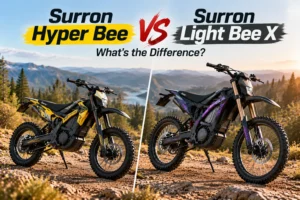
The Surron Hyper Bee and Surron Light Bee X are both high-performance electric dirt bikes, but they are designed for
