Stark Varg MX vs Stark Varg EX: Key Differences
Electric enduro motorcycles are becoming an increasingly appealing option for riders who want strong acceleration, precise low-speed control, and less
If you are asking who makes the best electric bikes for off-road riding, there is no single manufacturer that wins every category.
Surron is one of the strongest choices for a proven lightweight electric dirt bike platform and aftermarket support. Talaria is a major alternative for riders who want strong performance and competitive specifications. E Ride Pro has become an important performance-focused option in the lightweight e-moto category. Stark Future is the standout name for riders looking for full-size, competition-oriented electric motocross performance. Altis and Rawrr are also worth considering for riders who prioritize high-output specifications and value.
The important part is that these companies are not all building the same type of motorcycle.
A Surron Light Bee X and a Stark VARG may both be called electric dirt bikes, but they belong to very different parts of the market. One is a lightweight e-moto platform that became popular for trail riding and customization; the other is a full-size electric motocross motorcycle designed around substantially different performance expectations.
That is why asking which company makes the “best” electric dirt bike requires another question:
Best for what?
For most buyers, brand quality should be judged by more than motor power and top speed. The motorcycle itself matters, but so do battery design, suspension, chassis balance, brakes, replacement parts, dealer support, warranty, aftermarket availability, and whether the company is likely to support the platform several years after you buy it.
Once those factors are considered, the electric dirt bike market becomes much easier to understand.
Here is the simplest way to compare the major brands without pretending that one manufacturer is best for every rider.
| Brand | Best For | Popular Models | Main Strength |
|---|---|---|---|
| Surron | Proven all-around platform | Light Bee X, Ultra Bee | Established ecosystem and aftermarket |
| Talaria | Trail performance and value | Sting R, Sting Pro/MX5 | Strong performance in lightweight e-moto class |
| E Ride Pro | High-performance lightweight e-motos | Pro SS, Pro SR | High output in a relatively lightweight platform |
| Stark Future | Full-size motocross performance | VARG, VARG EX | Competition-oriented electric motorcycle engineering |
| Altis | High-performance alternative | Sigma, Delta | Strong performance-focused specifications |
| Rawrr | Performance for the money | Mantis X, Mantis X Pro | Competitive output and expanding lineup |
This is a much more useful comparison than ranking these brands from one to six.
A rider looking for a highly customizable lightweight trail bike may reasonably choose Surron over Stark. A motocross rider looking for a serious replacement for a full-size gas race bike would probably evaluate those priorities very differently. A buyer focused on maximum performance per dollar may put E Ride Pro, Altis, or Rawrr much higher on the shopping list.
The best manufacturer therefore depends on the category of motorcycle you actually need.
Surron is the obvious place to start because the brand helped establish the modern lightweight electric dirt bike category.
The Light Bee platform became popular because it occupied a useful space between conventional e-bikes and full-size dirt motorcycles. It was relatively light, simple to operate, quiet, easy to modify, and powerful enough to create a riding experience very different from an ordinary pedal-assist bicycle.
That success created something that specifications cannot fully show: an ecosystem.
Years of Light Bee ownership and modification have produced a large market for replacement and upgrade components. Riders can find suspension components, wheels, tires, brakes, controllers, batteries, motors, handlebars, seats, foot pegs, protection parts, and many other accessories for popular Surron platforms.
That matters if you plan to keep a motorcycle for several years.
A newer electric dirt bike may have more peak power than a stock Light Bee X, but the ownership equation changes if replacement parts are difficult to source or the aftermarket is small. Current brand comparisons continue to identify Surron’s mature parts and modification ecosystem as one of its major advantages. Umbra Electric
Surron also offers more than the Light Bee.
The Ultra Bee moves toward a larger, more motorcycle-like off-road platform, while other models expand the brand into different rider and performance categories. That gives buyers room to remain within the Surron ecosystem as their requirements change.
The weakness is that Surron no longer automatically dominates the specification sheet.
The electric dirt bike market has become much more competitive. Talaria, E Ride Pro, Altis, Rawrr, and other manufacturers now offer bikes that can exceed particular Surron models in peak power, battery capacity, or other headline specifications.
But that does not make Surron irrelevant. It changes the reason to buy one.
Surron’s strongest argument today is not that every Surron has the highest performance. It is that popular Surron platforms combine proven market presence with a mature ownership and modification ecosystem.
For riders who care about parts, upgrades, community knowledge, and a well-established platform, that can matter more than winning a peak-kW comparison.
If Surron helped establish the category, Talaria became one of its most important competitors.
Talaria’s Sting family competes directly in the lightweight electric dirt bike market and has become a common alternative for riders who might otherwise buy a Light Bee. Current 2026 comparisons continue to position Surron and Talaria as two benchmark names in this class. VoltRipper
Talaria’s appeal is relatively easy to understand: it combines the compact, lightweight e-moto concept with increasingly competitive battery and performance specifications.
But choosing between Talaria and Surron should not come down to whichever product page shows the larger motor number.
Motor output, battery voltage, battery energy, gearing, motorcycle weight, controller tuning, suspension, brakes, wheel setup, and power delivery all affect how a motorcycle performs on real terrain.
Parts and support matter too.
Surron has the advantage of a particularly mature aftermarket, while Talaria has developed its own substantial owner base and parts ecosystem. For a buyer planning to modify a bike heavily, checking the exact availability of compatible suspension, controllers, batteries, wheels, and replacement parts before buying is more useful than assuming every popular e-moto has the same level of support.
Then there is E Ride Pro, a younger competitor that has become increasingly difficult to ignore.
E Ride Pro’s current lineup focuses heavily on performance in the lightweight electric motorcycle category. The brand’s Pro SS and higher-performance platforms appeal to buyers who want considerably more stock performance rather than purchasing a lower-output motorcycle and immediately beginning an expensive upgrade process.
That creates an interesting buying decision.
A rider could buy an established platform such as a Surron and modify it over time, or buy a newer high-output platform that already includes more of the desired performance from the factory.
Neither strategy is automatically better.
Factory integration has advantages because the battery, motor, controller, chassis, brakes, and software are designed as a complete package. Heavy aftermarket modification can produce impressive results, but increasing electrical output can also place additional demands on the battery, motor, controller, drivetrain, brakes, and chassis.
For that reason, riders interested in Talaria or E Ride Pro should evaluate the complete stock motorcycle, not simply how its peak power compares with a Surron.
For lightweight performance buyers in 2026, these three names belong in the same conversation: Surron for ecosystem maturity, Talaria for a strong all-around alternative, and E Ride Pro for buyers placing greater emphasis on high stock performance.
Stark Future belongs in this discussion, but it should not be treated as another Surron competitor.
The VARG is a different kind of motorcycle.
Instead of starting with the lightweight e-moto formula, Stark approached electric off-road riding from the full-size motocross direction. That changes the chassis, suspension, weight, power requirements, price, and intended rider.
This distinction is important because “electric dirt bike” has become an extremely broad category.
At one end are relatively compact machines that appeal to riders coming from mountain bikes, pit bikes, and lightweight trail motorcycles. At the other end are motorcycles designed to compete much more directly with conventional full-size gas dirt bikes.
Stark is much closer to the second group.
Current 2026 comparisons continue to place the VARG at the premium, competition-focused end of the market, rather than treating it as a direct value competitor to a Light Bee or Sting. Umbra Electric
That is why Stark can reasonably be considered one of the strongest answers to “who makes the best electric dirt bike?” while still being the wrong answer for many buyers.
If your priority is serious motocross performance, a full-size chassis, advanced adjustability, and a motorcycle designed around race-level riding, Stark deserves consideration near the top of the list.
If your priority is a light bike for backyard riding, tight trails, easy transportation, or extensive aftermarket customization, buying a VARG simply because it is more powerful would miss the point.
Price reinforces the distinction. Full-size premium electric motocross motorcycles occupy a significantly higher price class than mainstream lightweight e-motos.
The important lesson is that best performance and best purchase are not the same thing.
Stark demonstrates what is possible at the high-performance end of electric motocross. Surron, Talaria, and E Ride Pro solve different problems at lower weight and price points.
The electric dirt bike market is moving too quickly to treat Surron and Talaria as the only serious choices.
Altis and Rawrr are examples of newer or rapidly expanding brands competing aggressively on performance and value.
Altis has attracted attention with performance-oriented motorcycles such as the Sigma. The appeal is clear: buyers in this part of the market increasingly expect higher-voltage electrical systems, substantial peak output, larger batteries, capable suspension, and stronger stock components rather than purchasing a bike specifically as a starting point for upgrades.
Rawrr follows a similar competitive logic with its Mantis family.
The current Mantis lineup includes several off-road platforms, and Rawrr’s official global site lists the Mantis X Pro at up to 15,000W, illustrating how far performance in this price-sensitive lightweight category has moved. rawrrmantis
These companies can therefore look extremely attractive on paper.
But this is where brand evaluation needs to go beyond the specification sheet.
A motorcycle is a long-term product. Batteries age. Brake pads wear. Suspension eventually needs service. Controllers can fail. Displays can break. Crash damage happens. Chargers get lost. Bearings and drivetrain components wear out.
The question is not simply whether a newer brand can produce an impressive bike today.
The question is whether you will be able to get the parts and support you need several years from now.
That does not mean newer companies should be avoided. It means parts availability should be treated as a performance specification.
Before choosing a newer electric dirt bike brand, check whether replacement batteries, chargers, controllers, displays, brake components, sprockets, suspension parts, bodywork, and other model-specific components can actually be purchased.
Also investigate the dealer and warranty structure.
A bike with slightly better specifications can become a much worse purchase if a proprietary component fails and the motorcycle remains unusable for months.
This is one area where established platforms retain a genuine advantage.
Newer brands have to compete not only with the motorcycle Surron or Talaria sells today, but with the parts ecosystem those brands have accumulated over years.
There is no useful single-brand answer, but there is a useful way to narrow the field.
For a proven lightweight platform and aftermarket ecosystem, start with Surron.
The Light Bee’s long market presence and modification community remain important advantages. Riders who expect to upgrade, repair, personalize, and keep a lightweight e-moto for years should consider the ecosystem as part of the purchase.
For a strong Surron alternative with competitive trail performance, look at Talaria.
Talaria has developed into one of the major names in the same lightweight category and belongs on almost any shortlist that includes a Light Bee.
For high stock performance in a lightweight e-moto, consider E Ride Pro.
It is particularly relevant to buyers who would otherwise purchase a lower-output platform and immediately spend significant money upgrading the powertrain.
For full-size electric motocross, Stark Future is in another class.
The VARG is designed for riders looking for serious full-size dirt-bike performance rather than simply the fastest lightweight e-moto.
For performance-focused alternatives, Altis and Rawrr deserve comparison.
Their appeal is strongest for buyers willing to consider younger platforms in exchange for aggressive specifications and value.
This is also why rankings that declare one brand “best overall” can be misleading.
Imagine two riders.
The first weighs 150 pounds, rides tight wooded trails, transports the bike in a small vehicle, enjoys modifications, and values readily available replacement parts.
The second races motocross and wants a full-size motorcycle capable of replacing a powerful gas bike.
Giving both riders the same “best electric dirt bike” recommendation would make little sense.
The same problem occurs when comparing price.
A cheaper motorcycle is not necessarily better value if the rider immediately replaces its battery, controller, brakes, suspension, wheels, and tires. Conversely, a high-performance premium bike is poor value if the rider never needs the capability they paid for.
The best brand is therefore the one that produces the right complete motorcycle for your riding, with enough support to keep it working.
That is a more useful standard than peak power.
When comparing manufacturers, begin with the motorcycle but finish with the ownership experience.
First, determine whether the company actually makes a bike for your type of riding. Technical trails, motocross tracks, casual recreation, youth riding, and high-speed open terrain require different combinations of weight, geometry, suspension, power, and battery capacity.
Then look at the powertrain as a system.
A large peak-kW number does not guarantee better acceleration everywhere, longer range, or better trail performance. Battery voltage, available current, controller programming, motor design, gearing, thermal management, traction, and motorcycle weight all contribute to the result.
Battery energy matters particularly because range claims are difficult to compare across manufacturers. Terrain, speed, rider weight, temperature, elevation, tire setup, and throttle use can dramatically change energy consumption. Do not assume an advertised maximum range represents the distance you will achieve during aggressive trail riding.
Chassis quality matters just as much.
A fast electric dirt bike needs suspension and brakes capable of controlling its speed and mass. More suspension travel does not automatically mean better suspension, just as a larger brake rotor does not by itself guarantee better braking.
Finally, investigate the company behind the motorcycle.
Can you find replacement batteries? Are chargers available? Are wear parts easy to obtain? Is there a U.S. dealer or distributor? Are warranty terms clear? Can suspension and brakes be serviced without proprietary obstacles? Is there an aftermarket? Does the manufacturer provide useful documentation?
Those questions become increasingly important as the electric dirt bike industry grows.
A specification sheet tells you what the bike is supposed to do when it is new.
The parts and support network tells you whether you will still want to own it several years later.
There is no single best manufacturer for every rider. Surron is a strong choice for an established lightweight platform and aftermarket ecosystem, Talaria is a major all-around competitor, E Ride Pro focuses heavily on high-performance lightweight e-motos, and Stark Future is a leading option at the full-size electric motocross end of the market.
Surron is one of the benchmark brands in the lightweight electric dirt bike category, particularly because of the popularity and aftermarket ecosystem surrounding platforms such as the Light Bee. However, competing brands may offer more stock power or different chassis and battery configurations, so Surron is not automatically the best choice for every rider.
Neither brand is universally better. Talaria can offer very competitive stock specifications, while Surron has the advantage of a particularly mature aftermarket and long-established owner ecosystem. Compare the exact models rather than choosing by brand name alone.
E Ride Pro is particularly attractive to riders looking for strong factory performance in the lightweight e-moto category. Surron remains attractive for its established platform, parts availability, modification ecosystem, and broad owner knowledge. The better choice depends on whether stock performance or platform maturity matters more to you.
Power depends on which class of motorcycle you are comparing. Full-size competition-oriented motorcycles such as Stark Future’s VARG should not be directly compared with lightweight platforms such as a Surron Light Bee. Peak output also does not by itself determine which motorcycle is fastest or best to ride.
Surron and Talaria are two of the most established names to consider for lightweight trail-oriented riding, while E Ride Pro, Altis, and Rawrr offer additional performance-focused alternatives. Rider size, terrain, required range, weight, suspension, and desired power should determine the final choice.
For riders specifically looking for a full-size, competition-oriented electric motocross motorcycle, Stark Future and the VARG deserve serious consideration. Lightweight e-motos occupy a different category and should not be compared solely by peak power.
Surron is generally regarded as one of the strongest platforms for aftermarket support, particularly around the Light Bee family. Its long market presence has resulted in a large selection of performance and replacement components. Current 2026 brand comparisons continue to identify this ecosystem as a key Surron advantage. Umbra Electric
A newer brand can offer excellent performance and value, but check parts availability, battery replacement options, warranty support, dealer coverage, and company stability before buying. These factors can matter more over several years of ownership than a small advantage in peak power.
So, who makes the best electric bikes if your focus is electric dirt bikes?
There is no manufacturer that wins every category.
Surron remains one of the strongest choices for riders who value an established lightweight platform, a large aftermarket, and years of accumulated owner knowledge.
Talaria is one of its most important competitors and deserves consideration from riders looking for a strong combination of lightweight trail performance and modern specifications.
E Ride Pro is particularly interesting for buyers who want substantial stock performance without immediately building a heavily modified bike.
Stark Future operates at a different end of the market. For serious full-size electric motocross performance, the VARG makes Stark one of the most important manufacturers in the category.
Altis and Rawrr demonstrate how quickly the rest of the market is developing, with increasingly aggressive performance and value propositions.
But the brand with the largest motor number is not automatically the company that makes the best electric dirt bike.
A good electric dirt bike needs a balanced battery, motor, controller, chassis, suspension, brakes, tires, and software package. A good electric dirt bike brand needs something more: replacement parts, batteries, technical support, warranty coverage, and enough long-term stability that owners can keep their motorcycles running.
That distinction matters.
If two bikes are close in performance but one has readily available replacement components, strong dealer support, and a mature aftermarket, those advantages can be worth more than a few additional kilowatts on a specification sheet.
Choose the motorcycle for the riding you actually do, then evaluate the company that will have to support it.
Electric enduro motorcycles are becoming an increasingly appealing option for riders who want strong acceleration, precise low-speed control, and less
Electric enduro motorcycles are becoming an increasingly appealing option for riders who want strong acceleration, precise low-speed control, and less
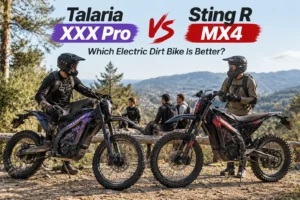
The Talaria XXX Pro and Talaria Sting R MX4 are two popular options for riders looking for a lightweight electric
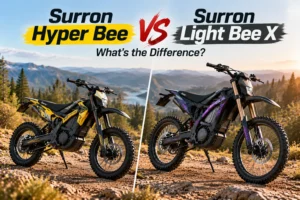
The Surron Hyper Bee and Surron Light Bee X are both high-performance electric dirt bikes, but they are designed for
