Stark Varg MX vs Stark Varg EX: Key Differences
Electric enduro motorcycles are becoming an increasingly appealing option for riders who want strong acceleration, precise low-speed control, and less

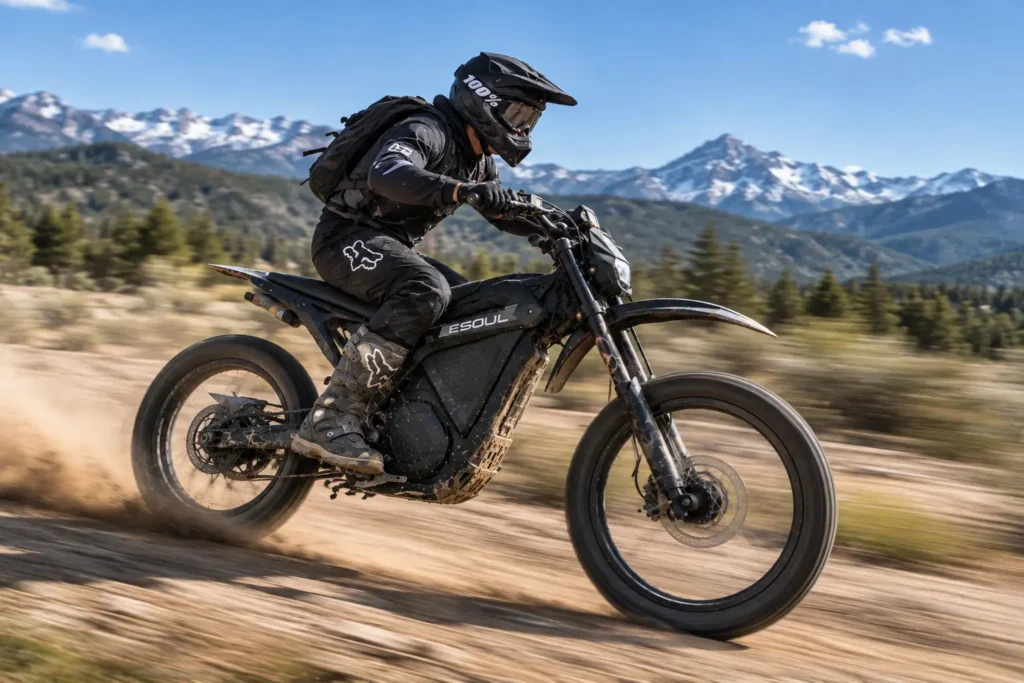
Electric dirt bikes are known for strong acceleration from low speeds. Open the throttle on a powerful electric motorcycle and the response can feel immediate, especially compared with a combustion engine that may need more RPM, clutch work, or the correct gear before reaching its strongest operating range. Keep accelerating, however, and that initial punch usually does not continue unchanged all the way to maximum speed. As the bike gets faster, acceleration becomes weaker, and eventually the motorcycle reaches a point where additional speed is difficult or impossible to achieve.
This does not necessarily mean the motor is failing or that the battery suddenly stops producing power. In many cases, it is a normal result of how electric motors, batteries, controllers, gearing, and vehicle resistance interact at higher speed. As motor RPM increases, back electromotive force rises and the electrical system has less voltage headroom available to continue forcing current through the motor. Because motor torque is closely related to current, the ability to maintain strong torque eventually declines. Depending on the motor and controller, field weakening may extend the usable RPM range, but it comes with its own efficiency, current, and thermal tradeoffs.
At the same time, the motorcycle itself becomes harder to accelerate. Aerodynamic drag increases rapidly with speed, rolling and drivetrain losses continue to consume energy, and the motor may be approaching the upper end of its useful RPM range. Battery voltage sag, controller current limits, thermal protection, state of charge, and gearing can further change how much acceleration remains available.
The result is the familiar electric dirt bike experience: very strong low and mid-speed response followed by progressively weaker acceleration as the bike approaches its maximum speed. Understanding why requires looking at the complete electrical and mechanical system rather than blaming a single component.
An electric motor produces torque by using current flowing through its windings to create magnetic forces. At relatively low motor speeds, the controller generally has substantial voltage headroom available to regulate current, subject to battery, controller, motor, software, and traction limits. This is one reason an electric dirt bike can produce such strong response from low speed without waiting for a combustion engine to reach a particular RPM range.
The situation changes as the motor spins faster. A rotating electric motor generates a voltage that opposes the applied voltage. This is commonly called back electromotive force, or back EMF. The faster the motor turns, the greater this generated voltage becomes under otherwise comparable conditions.
A simplified relationship can be written as:
Motor voltage ≈ back EMF + current × winding resistance
This equation helps explain what happens at high RPM. At low speed, back EMF is relatively small, leaving more effective voltage available to drive current through the motor windings. As RPM rises, back EMF increases. Eventually, the controller approaches the voltage it can supply from the battery system, leaving less voltage difference available to push additional current through the motor.
That matters because current is closely related to electromagnetic torque. Once the system becomes increasingly voltage-limited, maintaining the same high torque becomes difficult. Torque therefore tends to fall as motor speed continues to increase beyond the region where maximum torque can be maintained.
This is why it is misleading to imagine an electric dirt bike producing its maximum torque continuously from zero speed all the way to maximum RPM. A real motor and controller have operating limits. The shape of the torque curve depends on motor design, battery voltage, controller strategy, current limits, motor constants, gearing, temperature, and software.
A simplified electric motor operating envelope is often described as having a lower-speed constant-torque region, followed by a higher-speed region where torque decreases. Power behavior depends on the system design, and some drives use field weakening to extend operation above the motor’s natural base speed.
Field weakening changes the motor’s magnetic operating conditions so it can continue spinning faster after the system begins approaching its voltage limit. This can extend top-end RPM, but it does not provide unlimited free speed. It can require additional current, reduce efficiency, increase heat, and produce less torque than the motor can deliver in its lower-speed operating region.
That is why a motorcycle can continue gaining speed while simultaneously feeling less forceful. The motor is still producing useful power, but the amount of wheel force available for additional acceleration is decreasing.
The motor does not operate independently. The battery and controller determine the electrical conditions available to it, which is why two electric dirt bikes using motors with similar advertised power can behave very differently near their maximum speed.
Battery voltage is particularly important because motor speed capability is closely related to the voltage available to overcome back EMF. This is one reason higher-voltage systems can be useful in high-performance electric motorcycles. However, it would be incorrect to say that an 80V motorcycle is automatically faster than a 72V motorcycle or that increasing voltage alone guarantees better high-speed performance. Motor winding design, controller voltage limits, gearing, tire diameter, field-weakening strategy, battery current capability, software, and mechanical limits all affect the final result.
Battery voltage is also not perfectly constant. The voltage of a lithium-ion pack changes with state of charge and operating load. When the rider demands substantial current, internal resistance causes the terminal voltage to fall temporarily. This is commonly called voltage sag. The amount of sag depends on the battery cells, pack design, state of charge, temperature, current demand, age, and other factors.
This helps explain why some electric dirt bikes feel stronger near a high state of charge and less energetic as the battery becomes depleted. A lower battery voltage gives the controller less voltage headroom at high motor RPM, potentially affecting the speed at which voltage limitation becomes important. The battery management system and controller may also reduce output when electrical, thermal, or state-of-charge limits are approached.
Controller limits matter just as much. The controller regulates current and voltage supplied to the motor and operates within hardware and software limits. At lower motor speed, current limits can be a major factor determining maximum torque. At higher speed, available voltage increasingly becomes the limiting factor. This transition is one reason simply installing a controller capable of enormous current does not guarantee dramatically better top-end acceleration. If the motor is already operating near the available voltage limit, additional current capability alone cannot eliminate the underlying high-RPM constraint.
Gearing then determines how motor torque and motor RPM are translated into wheel torque and vehicle speed. Shorter gearing generally provides more wheel torque for a given motor torque but causes the motor to reach a given RPM at a lower road speed. Taller gearing can increase theoretical vehicle speed at a given motor RPM but reduces torque multiplication at the wheel.
This creates a fundamental tradeoff. Gearing a motorcycle taller does not create additional motor power. If the gearing becomes too tall, the motor may struggle to produce enough wheel force to overcome aerodynamic drag and other resistance at the theoretical maximum speed. The motorcycle can therefore have a calculated gearing-based top speed that it cannot actually reach under real conditions.
The same principle explains why changing sprockets can alter how an electric dirt bike feels without changing its motor. A setup optimized for steep technical trails may prioritize wheel torque and control, while a setup intended for higher speeds may trade some of that wheel torque for additional speed per motor revolution.
The electrical system explains why motor torque changes with RPM, but there is another major reason acceleration becomes weaker at high speed: the motorcycle requires increasingly more power just to keep moving faster.
Aerodynamic drag increases approximately with the square of vehicle speed under a simplified drag model:
Drag force = ½ × air density × drag coefficient × frontal area × speed²
The power required to overcome aerodynamic drag increases even more aggressively because power is force multiplied by speed. Under the same simplified assumptions, aerodynamic power demand therefore rises approximately with the cube of speed.
This has an enormous effect on top-end performance.
Doubling speed does not merely double aerodynamic resistance. The required aerodynamic power can increase dramatically, which is why adding a relatively small amount of maximum speed can require substantially more power once a motorcycle is already moving quickly.
Dirt bikes are particularly challenging aerodynamically. The rider sits relatively upright, handlebars are wide, protective equipment increases frontal area, and the overall shape is not optimized like a fully faired road-racing motorcycle. Rider position, wind direction, body size, clothing, and accessories can therefore influence maximum speed and high-speed acceleration.
Rolling resistance, tire deformation, drivetrain losses, terrain, and elevation changes add further load. On soft dirt, sand, mud, or an incline, significantly more wheel force may be required than on smooth pavement.
This explains an important point about top speed: maximum speed is not simply the RPM at which the motor stops spinning faster. In practical riding, top speed occurs when the wheel can no longer provide enough additional propulsive force or power to overcome the combined resistance acting against the motorcycle, or when an electronic or mechanical speed limit intervenes.
That is also why a bike capable of a certain speed with a light rider on flat pavement may not reach the same speed with a heavier rider, against a headwind, on soft terrain, or while climbing.
If an electric dirt bike feels noticeably weaker after sustained hard riding, the explanation may involve more than normal high-RPM behavior. Temperature can become an important limiting factor.
Electric motors are efficient, but they still generate heat. Current flowing through motor windings creates resistive losses, while the controller and battery also produce heat during high-power operation. Long climbs, deep sand, repeated acceleration, high ambient temperatures, and sustained high-speed riding can increase thermal stress.
Manufacturers manage this through cooling systems, temperature sensors, software limits, and thermal derating. When a motor, controller, or battery approaches a defined temperature limit, the system may intentionally reduce current or power to protect the hardware.
Thermal derating should not automatically be interpreted as a failure. It is often a protection strategy designed to prevent excessive temperature from damaging expensive components.
The rider may experience this as weaker acceleration, reduced peak power, or difficulty maintaining the same performance available earlier in the ride. Once temperatures return to the intended operating range, performance may recover depending on the system design.
State of charge can produce a similar feeling. As battery voltage declines through discharge, less voltage may be available at the controller input. Under high load, voltage sag can further reduce that available voltage. The exact behavior varies greatly between motorcycles because battery chemistry, pack construction, controller programming, and motor design are different.
This is why published peak power should not be treated as a guarantee that the motorcycle will produce the same output at every speed, battery percentage, temperature, and riding condition.
A specification such as 12kW peak power tells you something useful about the system, but it does not describe the entire power curve.
For real riding, the more useful questions are how the bike delivers power across its speed range, how long it can sustain high output, and what happens when the battery and powertrain become hot.
Not necessarily. A gradual reduction in acceleration as an electric dirt bike approaches its maximum speed is normal. The motor is spinning faster, voltage headroom becomes more limited, torque may decrease, aerodynamic power demand rises rapidly, and the bike eventually reaches an equilibrium where it cannot accelerate further.
What deserves more attention is a sudden or unusual loss of performance compared with how the motorcycle normally behaves.
If a bike that previously accelerated strongly to a certain speed suddenly becomes weak much earlier, several areas may need investigation. Battery state of charge, battery temperature, motor or controller temperature, tire pressure, brake drag, drivetrain condition, electrical connections, controller settings, riding mode, software limits, and battery health can all affect performance.
A degraded or damaged battery may exhibit greater voltage sag under load. A hot controller may reduce output. Incorrect tire pressure or dragging brakes increase resistance. Changes to sprockets or tire diameter can alter effective gearing. Aftermarket controllers or motors can also create mismatched systems if the battery cannot safely provide the requested current or voltage.
This is why troubleshooting should start with the complete motorcycle rather than immediately assuming the motor needs replacement.
Compare performance under similar conditions. Use a similar battery state of charge, riding mode, terrain, rider load, and temperature. Check whether the loss happens only after prolonged hard riding or immediately from a cold start. Look for warnings or diagnostic codes and follow the manufacturer’s troubleshooting procedure.
If the motorcycle is operating normally at lower speed but gradually becomes less forceful as it approaches top speed, you may simply be feeling the normal operating characteristics of the powertrain rather than a mechanical problem.
High-speed performance can sometimes be changed, but every modification involves tradeoffs.
Changing gearing is one of the most obvious examples. Taller gearing can increase vehicle speed at a given motor RPM, but it reduces wheel-torque multiplication. Shorter gearing increases wheel torque but makes the motor spin faster for a given road speed. Neither modification creates additional power.
Increasing battery voltage can theoretically change the motor’s high-RPM operating range, but this is not a simple plug-and-play upgrade. The controller, motor insulation, battery management system, charger, wiring, connectors, contactors, display, DC converters, and other electrical components must all be compatible with the voltage involved. Exceeding design limits can damage components and create serious electrical and battery hazards.
Increasing controller current can improve torque in operating regions where current is the limiting factor, but it does not automatically solve voltage limitation at high RPM. More current also increases electrical and thermal stress on the battery, motor, controller, connectors, and wiring.
Field weakening can extend motor RPM on compatible systems, but aggressive settings can reduce efficiency and increase heating. It should not be treated as free additional speed.
Even if more electrical power is available, chassis capability still matters. Tires, brakes, suspension, wheels, bearings, and frame design all need to be appropriate for the resulting speed and performance.
For most riders, the better approach is not asking how to make the motorcycle produce maximum possible top-end power. It is asking whether the existing power curve, gearing, range, and top speed match the terrain they actually ride.
A technical-trail rider may benefit more from strong, predictable low-speed wheel torque than additional maximum speed. A rider using open terrain may place greater value on sustained high-speed performance. Neither setup is universally better because they solve different riding problems.
Electric motors can provide strong torque at lower speeds, but as motor RPM rises, back EMF increases and the system eventually becomes more constrained by available voltage. Motor torque generally decreases in the higher-speed operating region, while aerodynamic resistance also increases rapidly. Together, these effects reduce acceleration as the bike approaches top speed.
Typically, yes, once the drive moves beyond the region where maximum torque can be maintained. The exact torque curve depends on the motor, controller, voltage, current limits, field-weakening strategy, and other system parameters.
Not necessarily. More battery energy, measured in Wh, can increase potential riding time, but energy capacity alone does not determine top speed. Battery voltage, current capability, motor design, controller limits, gearing, software, tire diameter, and aerodynamic resistance also matter.
Higher voltage can provide more voltage headroom for motor operation at higher RPM, but it does not automatically guarantee a higher top speed. The motor, controller, gearing, battery, software, and entire electrical system must be designed for the voltage.
Battery terminal voltage generally declines as state of charge falls, and voltage can drop further under heavy current demand because of internal resistance. Depending on the bike’s controller and battery-management strategy, this can reduce available performance, particularly when the system is already operating near voltage or current limits.
Thermal limits may be involved. The motor, controller, and battery generate heat under load. Some motorcycles intentionally reduce output when temperatures approach defined limits. This thermal derating protects components from excessive heat.
Changing gearing changes the relationship between motor RPM, wheel torque, and road speed. Taller gearing may increase theoretical speed at a given motor RPM but reduces wheel-torque multiplication. If the motor cannot produce enough power to overcome resistance, the motorcycle may never reach the theoretical higher speed.
Not by itself. Gradually weaker acceleration near top speed can be normal. However, an aging or damaged battery can experience greater voltage sag and may contribute to reduced performance. A sudden change from the motorcycle’s normal behavior deserves further investigation.
Electric dirt bikes feel extremely strong at low speed because electric motors can produce substantial torque without waiting for a combustion engine to build RPM. But that does not mean maximum torque continues unchanged all the way to top speed.
As motor RPM increases, back EMF rises. The controller eventually has less voltage headroom available to maintain high current, and motor torque typically begins to decline. Field weakening can extend the operating range on some systems, but it brings efficiency and thermal tradeoffs rather than providing unlimited additional speed.
At the same time, the motorcycle faces rapidly increasing aerodynamic resistance. Battery voltage sag, state of charge, controller limits, gearing, tire diameter, temperature, and thermal protection can further influence how much high-speed performance remains available.
This is why an electric dirt bike can feel explosive from low speed but progressively less forceful as it approaches maximum speed.
The important point is that this behavior is usually not caused by one component. High-speed performance is the result of the complete system: battery voltage, battery current capability, controller, motor design, gearing, wheel size, cooling, software, terrain, and aerodynamic resistance all work together.
That is also why comparing electric dirt bikes from peak power or torque figures alone can be misleading. A motorcycle with a larger advertised kW number does not automatically have stronger high-speed acceleration, better sustained performance, or a higher real-world top speed.
Understanding the complete power curve gives you a much better picture of how an electric dirt bike will actually behave on the trail.
Electric enduro motorcycles are becoming an increasingly appealing option for riders who want strong acceleration, precise low-speed control, and less
Electric enduro motorcycles are becoming an increasingly appealing option for riders who want strong acceleration, precise low-speed control, and less
The Talaria XXX Pro and Talaria Sting R MX4 are two popular options for riders looking for a lightweight electric
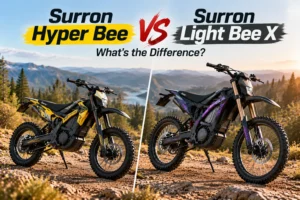
The Surron Hyper Bee and Surron Light Bee X are both high-performance electric dirt bikes, but they are designed for
