Stark Varg MX vs Stark Varg EX: Key Differences
Electric enduro motorcycles are becoming an increasingly appealing option for riders who want strong acceleration, precise low-speed control, and less

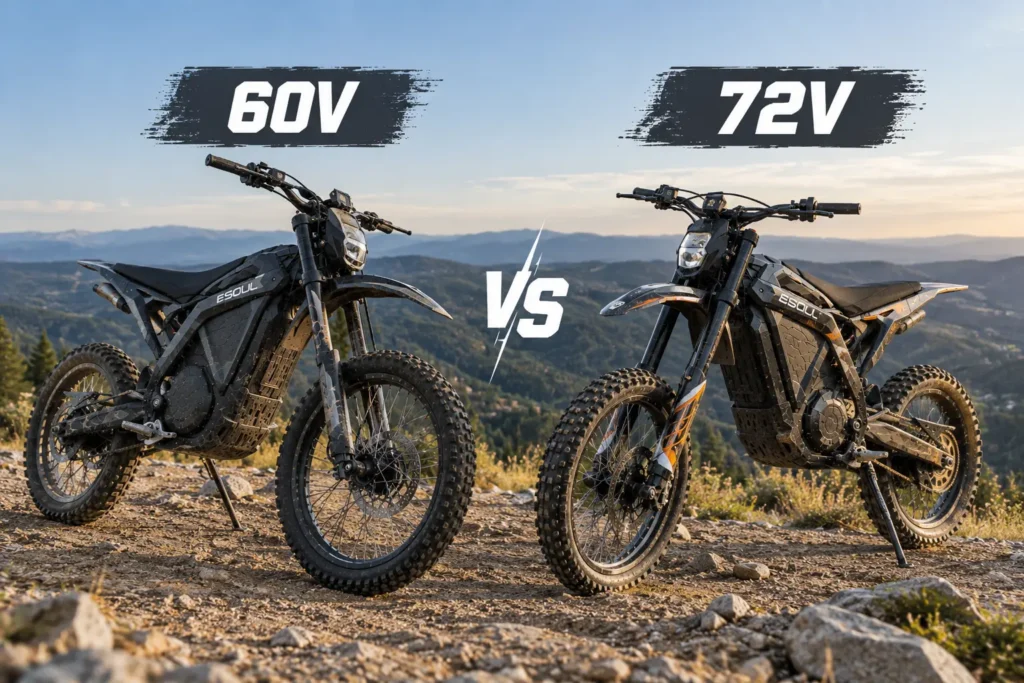
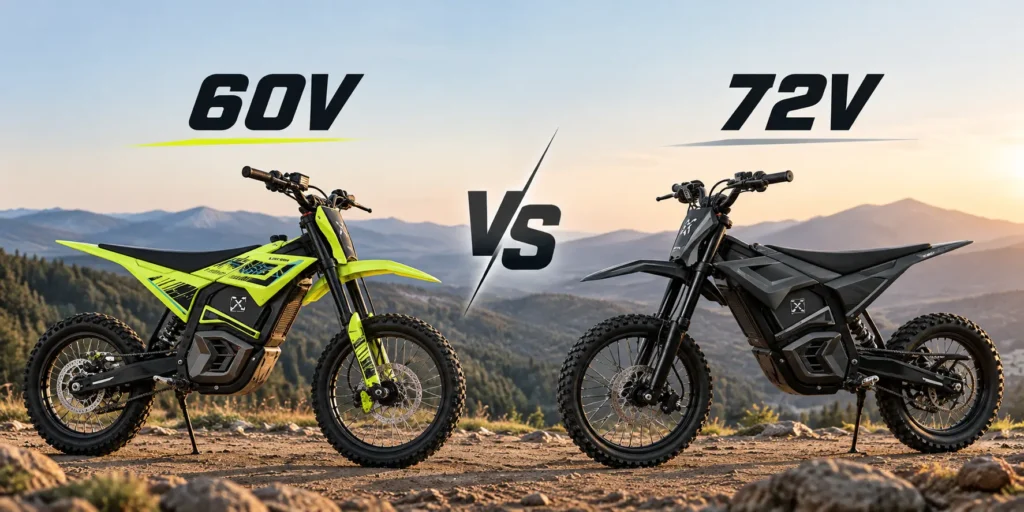
When comparing a 72V vs 60V electric dirt bike, the biggest mistake is assuming that the higher voltage automatically means a faster, more powerful, longer-range bike. A 72V electrical system does provide some important engineering advantages, especially as power demands increase, but voltage is only one part of the powertrain.
A 60V electric dirt bike can still deliver strong acceleration, serious trail performance, and enough speed for many off-road riders. A 72V system becomes increasingly useful when manufacturers want to support higher power levels, reduce the current required for a given electrical power, or provide more voltage headroom at higher motor speeds.
The actual riding experience depends on much more than the number printed on the battery. Motor design, controller limits, battery current capability, battery energy in watt-hours, gearing, wheel size, bike weight, traction, cooling, and software all affect performance.
So which is better? For moderate-performance trail riding, a properly designed 60V system may provide everything a rider needs without chasing higher specifications. For higher-output electric dirt bikes designed around stronger sustained performance and higher speeds, 72V is often the more appropriate electrical architecture. But when comparing two actual bikes, the complete motorcycle matters more than voltage alone.
| Comparison | 60V Electric Dirt Bike | 72V Electric Dirt Bike |
|---|---|---|
| Nominal system voltage | 60V | 72V |
| Current needed at equal electrical power | Higher | Lower |
| High-power system potential | Good | Greater headroom |
| High-RPM potential | Depends on complete system | Can offer more voltage headroom |
| Range | Depends on Wh and efficiency | Depends on Wh and efficiency |
| Heat | Depends on current and system design | Lower current can reduce some resistive losses at equal power |
| Battery weight | Depends on capacity and construction | Depends on capacity and construction |
| Cost | Often lower in comparable designs | Often higher in comparable designs |
| Typical appeal | Balanced trail performance | Higher-performance applications |
| Automatically faster? | No | No |
| Automatically longer range? | No | No |
Voltage is one of the basic specifications of an electric dirt bike’s electrical system. It works together with current to determine electrical power.
The fundamental relationship is simple:
Power (W) = Voltage (V) × Current (A)
This equation explains one of the most important differences between 60V and 72V systems.
Imagine two powertrains that each need 6,000 watts of electrical input. In a simplified calculation that ignores losses and voltage variation, a 60V system would require 100 amps to reach 6,000W. A 72V system would require about 83.3 amps.
At 9,000W, the same relationship becomes 150 amps at 60V and 125 amps at 72V.
The 72V system has not magically created more power. Both examples are delivering the same theoretical electrical power. The difference is that the higher-voltage system can do it with less current.
That becomes increasingly important as electric dirt bikes become more powerful because current creates challenges throughout the electrical system. Batteries, controllers, cables, connectors, and motor windings all have electrical resistance. Resistive heating follows the familiar I²R relationship, meaning current has a strong influence on resistive losses.
This does not mean a 72V dirt bike automatically runs cooler. If a manufacturer uses the higher voltage to build a much more powerful motorcycle, the motor, controller, and battery can still generate substantial heat. It simply means that higher voltage gives engineers another way to achieve a target power level without requiring as much current.
There is another detail worth understanding: 60V and 72V are normally nominal system descriptions, not voltages that remain perfectly fixed throughout the ride. Lithium-ion battery voltage changes with state of charge and drops temporarily under load. The exact operating range depends on cell chemistry and pack configuration.
For a buyer, the practical takeaway is that voltage describes the electrical architecture. It does not serve as a performance rating by itself.
This is where the 72V vs 60V electric dirt bike comparison becomes more complicated.
Higher voltage can be valuable for high-speed motor operation. As an electric motor spins faster, it generates increasing back electromotive force, usually called back EMF, that opposes the applied voltage. As motor RPM rises, available voltage becomes increasingly important. A higher-voltage drive can therefore provide more headroom for operating a properly matched motor at higher rotational speeds.
That helps explain why many high-performance electric motorcycles move toward higher-voltage architectures as their power and speed targets increase.
But this does not mean every 72V bike will be faster than every 60V bike.
Top speed depends on motor design, controller programming, gearing, wheel diameter, available power, aerodynamic drag, electronic speed limits, and other factors. A 60V bike with suitable motor characteristics and gearing can have a higher top speed than a conservatively configured 72V model.
Acceleration is equally complicated. Electric motor torque is strongly related to current and motor design, while the torque that reaches the rear tire also depends on reduction gearing. Motorcycle weight and tire traction then determine how effectively that wheel force can accelerate the bike.
That means voltage alone cannot tell you which bike will launch harder.
This matters particularly on dirt. Once the rear tire reaches the available traction limit, additional wheel torque can create wheelspin instead of faster acceleration. On loose climbs or technical trails, throttle control, tires, suspension, geometry, weight distribution, and rider technique may matter more than having a higher battery voltage.
Peak power specifications also deserve caution. A 72V bike advertised at a high peak kW number may look much stronger on a specification sheet, but peak power does not tell you how long that output can be sustained. Battery temperature, motor temperature, controller temperature, cooling, and software protection can all reduce output during demanding riding.
A useful way to think about the difference is that 72V can provide more electrical headroom for high-performance design, but it does not guarantee better performance on its own.
When comparing actual electric dirt bikes, look at voltage and power together, then consider weight, gearing, motor characteristics, controller limits, cooling, and chassis capability.
Higher voltage does not automatically mean longer range.
For riders concerned about how long an electric dirt bike can run, battery energy is usually more informative than voltage alone. Battery energy is commonly expressed in watt-hours.
The simplified calculation is:
Watt-hours (Wh) = Nominal Voltage (V) × Amp-hours (Ah)
For example:
60V × 40Ah = 2,400Wh
72V × 40Ah = 2,880Wh
If both batteries have the same Ah rating, the 72V battery stores more nominal energy because its voltage is higher.
But change the Ah rating and the comparison changes:
60V × 40Ah = 2,400Wh
72V × 30Ah = 2,160Wh
Now the 60V battery stores more nominal energy despite having the lower voltage.
This is why Ah alone is also a poor way to compare batteries across different voltages. A 30Ah 72V battery and a 30Ah 60V battery do not contain the same nominal energy.
Even Wh cannot tell you exactly how many miles or hours you will ride. It tells you how much nominal energy the battery stores, while real-world range depends on how quickly the motorcycle consumes that energy.
Terrain makes a major difference. Deep sand, mud, repeated climbs, and aggressive acceleration can consume far more energy than steady riding on firm ground. Rider and bike weight, tire choice, tire pressure, temperature, speed, wind, riding mode, and powertrain efficiency also affect consumption.
Higher speed is particularly important because aerodynamic power demand rises rapidly as speed increases. A powerful 72V bike ridden aggressively can therefore drain a large battery surprisingly quickly, while a less powerful 60V bike ridden at moderate trail speeds may deliver more useful riding time for the same rider.
Higher voltage can reduce current for a given electrical power, which can reduce some resistive losses in a properly designed system. But that engineering advantage should not be translated into a blanket claim that 72V always provides more range.
For a useful range comparison, start with Wh, not voltage. Then look at bike efficiency and the conditions under which the manufacturer’s range figure was measured.
Specification sheets are useful, but riders ultimately care about what happens when the bike leaves the garage.
A well-designed 60V electric dirt bike can already provide strong low-speed torque, responsive acceleration, and enough performance for serious recreational trail riding. For tight single-track, forest trails, switchbacks, and technical climbs, additional peak power is not always the most valuable upgrade.
Control matters.
On technical terrain, the rider needs predictable throttle response, manageable weight, useful traction, good suspension, and enough battery capacity to finish the ride. If a bike already produces enough wheel torque to exceed the rear tire’s grip, simply adding more electrical power may not improve climbing performance.
This is why a lower-voltage motorcycle should not automatically be considered an entry-level machine. Voltage and rider skill level are different things.
A 72V architecture becomes more attractive as performance requirements rise. Higher-voltage systems can deliver a given electrical power with less current, and the additional voltage headroom can be useful when a powertrain is designed for stronger high-RPM operation. That makes 72V a logical choice for many performance-focused electric dirt bikes.
The advantage becomes more relevant on open terrain, faster trails, long climbs, and motorcycles designed to sustain relatively high output. But even here, voltage is only useful if the rest of the motorcycle can take advantage of it.
A powerful battery connected to a controller with conservative limits will not deliver the performance implied by the battery voltage. A strong controller paired with a battery that cannot safely supply the requested current creates another limitation. A powerful motor without sufficient cooling may deliver impressive peak performance but reduce output when temperatures rise.
Gearing adds another layer. Shorter gearing increases wheel-torque multiplication but makes the motor spin faster at a given vehicle speed. Taller gearing increases road speed per motor revolution but reduces torque multiplication at the wheel. Manufacturers choose gearing based on the performance they want from the complete motorcycle.
Weight also matters. A heavier high-voltage bike with a large battery may have far more power than a lighter 60V bike, but the lighter machine may still feel easier to place through tight terrain.
This is why there is no universal trail winner between 60V and 72V.
A better question is whether the complete bike has enough power, battery, traction, suspension, and control for the terrain you ride.
Voltage also affects how a motorcycle is engineered and supported over time.
A 72V powertrain requires components designed for its operating voltage. The controller, battery management system, charger, wiring, connectors, switches, displays, converters, and other electrical components must be appropriately rated and compatible.
This can contribute to higher manufacturing cost, particularly when the higher-voltage platform is also designed for more power. However, it would be misleading to say that every 72V bike is more expensive than every 60V bike. Brand positioning, battery size, suspension, brakes, frame design, production volume, and component quality all influence price.
The same caution applies to weight.
A 72V battery is not automatically heavier simply because its voltage is higher. Battery weight depends on cell count, cell chemistry and format, total energy capacity, enclosure design, structural protection, cooling, and other components. A high-capacity 60V battery can weigh more than a lower-capacity 72V battery.
Charging speed is another area where voltage alone tells you very little. Charging time depends on the amount of energy that must be replenished, charger output, battery management limits, cell temperature, and charging strategy. A 72V bike can charge faster or slower than a 60V bike depending on the equipment supplied with it.
Long-term parts support may be more important than any of these specifications.
Before buying an electric dirt bike, check whether the manufacturer or seller provides replacement batteries, chargers, controllers, displays, brake components, suspension parts, and other model-specific hardware. A technically impressive motorcycle can become frustrating to own if replacement electronics are difficult to source several years later.
This is particularly important if you are thinking about modifications.
Converting a 60V electric dirt bike to 72V is not simply a matter of installing a 72V battery. The controller must tolerate the higher pack voltage, and other electrical components may also have voltage limits. Motor characteristics, charger compatibility, BMS operation, wiring, connectors, instrumentation, and accessory circuits all need to be considered.
Likewise, increasing controller current does not create free performance. Higher current increases electrical and thermal stress, and every component between the battery and rear wheel must operate within appropriate limits.
For most riders, a factory-designed 60V or 72V system that already meets the desired performance target is a better ownership proposition than buying a lower-spec bike with the assumption that it can easily be converted later.
For many buyers, the answer becomes clearer once voltage stops being the first filter.
Choose the motorcycle based on what you actually need it to do.
If you ride technical trails, moderate-speed single-track, recreational off-road routes, or terrain where control and maneuverability matter more than maximum output, a good 60V electric dirt bike may already offer more than enough performance. There is little value in paying for additional electrical capability if you rarely use it.
If you ride faster open terrain, demand substantial sustained power, or are shopping among higher-output electric motorcycles, a 72V platform may make more sense. The higher system voltage gives engineers useful electrical headroom as power requirements increase and can reduce the current needed to deliver a given amount of electrical power.
But do not make the decision from voltage alone.
Start with the type of riding you do. Then compare battery energy in Wh, motor power, motorcycle weight, gearing, suspension, brakes, wheel and tire setup, charging time, cooling, warranty, and replacement-parts availability.
If two bikes are close in price, do not automatically choose the 72V model because 72 is a bigger number. Look for what the additional voltage actually delivers. Does the bike have more usable power? More battery energy? Better sustained performance? Better components? Or is the voltage simply a stronger marketing headline?
The same rule works in the opposite direction. Do not reject a 60V bike simply because newer high-performance models use 72V systems. If the 60V motorcycle has the performance, range, handling, and support you need, moving to a higher voltage may add cost without improving your actual riding experience.
The best electric dirt bike is not the one with the highest voltage. It is the one whose complete system best matches the rider and terrain.
Not automatically. A 72V system has higher nominal voltage and requires less current than a 60V system to deliver the same theoretical electrical power. This can be useful for high-performance powertrains, but motor design, controller limits, battery capability, gearing, cooling, weight, and software determine the motorcycle’s actual performance.
A 72V bike can be faster, particularly when the entire powertrain is designed to use the additional voltage, but voltage alone does not determine top speed. Motor RPM capability, gearing, wheel diameter, controller programming, available power, and aerodynamic resistance all matter.
Not necessarily. Motor torque depends heavily on motor design and current, while wheel torque is also affected by gearing. A 60V bike can produce more wheel torque than a 72V bike if the rest of its powertrain is configured differently.
Not simply because it is 72V. Compare battery energy in Wh. A 72V battery can store less energy than a 60V battery if its Ah capacity is sufficiently smaller. Actual riding range also depends on energy consumption.
At the same electrical power, a 72V system requires less current than a 60V system, which can reduce some current-related resistive losses. However, actual operating temperature depends on motor efficiency, controller design, battery resistance, cooling, riding conditions, and total power. A more powerful 72V bike can still run hotter than a lower-output 60V bike.
Not necessarily. Battery weight depends on total energy capacity, cell construction, enclosure, and pack design rather than voltage alone. The complete motorcycle’s frame, motor, suspension, wheels, and other equipment also influence weight.
For many riders, yes. A properly engineered 60V powertrain can provide strong trail performance. Whether it is enough depends on the specific bike and your requirements for speed, acceleration, terrain, range, and rider weight.
You should not assume that a 72V battery is compatible with a 60V motorcycle. The controller and other electronics may not be rated for the higher voltage, and the motor, charger, BMS, wiring, connectors, instrumentation, and accessory systems may also need to be evaluated. Use manufacturer-approved components and specifications.
The most useful lesson from a 72V vs 60V electric dirt bike comparison is that voltage matters, but it does not work alone.
A 72V system has 20% higher nominal voltage than a 60V system. For the same theoretical electrical power, it can operate with less current. That becomes valuable as power levels increase, and higher voltage can also provide additional headroom for appropriately designed motors operating at higher speeds.
Those are genuine engineering advantages. They are not proof that every 72V dirt bike is faster, stronger, more efficient, or longer-range than every 60V bike.
A well-designed 60V electric dirt bike can deliver excellent acceleration and trail performance. A properly engineered 72V platform can push performance further when its battery, controller, motor, cooling system, gearing, and chassis are all designed to use the additional electrical capability.
Range should be compared with battery energy and consumption, not voltage alone. Acceleration requires looking at motor output, gearing, weight, and traction. High-speed performance depends on available power, motor characteristics, gearing, and resistance. Long-term value also depends on component quality, replacement parts, battery availability, and manufacturer support.
So when comparing 60V and 72V electric dirt bikes, do not buy the biggest voltage number on the specification sheet.
Compare the complete motorcycle.
That will tell you far more about how the bike will accelerate, climb, handle, maintain speed, and perform on the trail than the battery voltage alone.
Electric enduro motorcycles are becoming an increasingly appealing option for riders who want strong acceleration, precise low-speed control, and less
Electric enduro motorcycles are becoming an increasingly appealing option for riders who want strong acceleration, precise low-speed control, and less
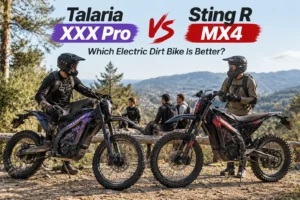
The Talaria XXX Pro and Talaria Sting R MX4 are two popular options for riders looking for a lightweight electric
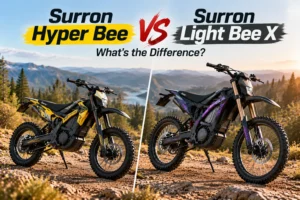
The Surron Hyper Bee and Surron Light Bee X are both high-performance electric dirt bikes, but they are designed for
