Stark Varg MX vs Stark Varg EX: Key Differences
Electric enduro motorcycles are becoming an increasingly appealing option for riders who want strong acceleration, precise low-speed control, and less

A good electric dirt bike is not simply the one with the most power, highest top speed, biggest battery, or highest price. The best bikes combine controllable performance, enough battery capacity for their intended use, capable suspension and brakes, manageable weight, durable construction, and reliable long-term parts support.
More importantly, all of those components need to work together.
A 15kW motor is not much of an advantage if the chassis struggles to control it. A huge battery can improve riding time but may also add weight. Long suspension travel looks impressive on a specification sheet, but travel alone says little about spring rates, damping, setup, or how the bike behaves over repeated impacts. Strong acceleration is useful only when the tires can find traction and the brakes can confidently control the resulting speed.
That is the central idea behind a genuinely good electric dirt bike: balance matters more than any single headline specification.
This is also why two electric dirt bikes with similar advertised specifications can feel completely different on the trail. The quality of the complete motorcycle matters more than winning one column on a comparison chart.
Power gets most of the attention in the electric dirt bike market because it is easy to advertise. Peak kilowatts, torque figures, and top-speed claims create simple comparisons, but none of them independently tells you whether a motorcycle is actually good to ride.
What matters more is how usable that performance is.
Electric motors can produce strong torque from low motor speeds, giving electric dirt bikes the immediate response riders associate with electric powertrains. But maximum motor torque, wheel torque, acceleration, and usable traction are different things. Gearing changes the torque delivered to the rear wheel, motorcycle mass affects acceleration, and the available grip at the tire determines how much wheel force can actually be used.
On a loose technical climb, more power is not always the answer. If the rear tire is already spinning, additional torque may simply create more wheelspin. A well-developed electric dirt bike should make it easy for the rider to meter power, maintain traction, and choose how aggressively the motorcycle responds.
This is where throttle calibration and riding modes become important. A beginner-friendly mode should do more than reduce a headline top-speed number. It should make throttle response predictable enough that the rider can comfortably control the motorcycle at low speed. A performance mode should provide stronger response without turning every small throttle movement into an abrupt change in rear-wheel force.
High-speed performance also needs context. Electric motors do not maintain maximum torque indefinitely as RPM rises. Back EMF increases with motor speed, available voltage becomes increasingly important, and the motor eventually moves beyond the region where maximum torque can be maintained. Battery voltage, controller limits, motor design, field weakening, gearing, temperature, and software all influence the resulting power curve.
For that reason, a good electric dirt bike should not be judged by peak kW alone. Look at how the motorcycle accelerates across the useful speed range, whether power remains predictable as battery charge decreases, and whether the powertrain can sustain the performance required for the terrain.
The best powertrain is not necessarily the strongest one. It is the one that gives the rider enough performance without making the motorcycle harder to control than it needs to be.
A good electric dirt bike also needs a battery that makes sense for its performance level.
Voltage gets a lot of attention because the market now includes 48V, 60V, 72V, and higher-voltage systems. Higher voltage can be useful in high-power designs because the same theoretical electrical power can be delivered with less current. But voltage alone does not tell you how much energy the battery stores or how far the motorcycle can ride.
For battery capacity, watt-hours are usually more useful than Ah when comparing packs with different nominal voltages.
The basic relationship is:
Wh = V × Ah
A 72V 30Ah battery has about 2,160Wh of nominal energy, while a 60V 40Ah battery has about 2,400Wh. The lower-voltage battery in this example actually stores more nominal energy.
This is why a good electric dirt bike should have a battery sized around the bike’s intended use rather than around a marketing number.
A lightweight trail bike does not necessarily need the largest possible battery. Adding battery capacity usually means adding cells, and those cells add mass, volume, and cost. Too little battery creates range anxiety and frequent charging, while an unnecessarily large battery can make a bike heavier and more difficult to handle.
The right balance depends on the rider. Someone riding short technical loops may value low weight more than maximum energy capacity. A rider covering longer trails may willingly accept additional battery mass in exchange for more usable riding time.
Range claims should also be treated carefully. A manufacturer may publish an estimated maximum range, but real off-road riding can be much more demanding than a controlled test. Deep sand, mud, hills, aggressive acceleration, high speed, low tire pressure, rider weight, temperature, and repeated elevation changes can all increase energy consumption.
A good battery system therefore needs more than impressive capacity. It should deliver the current required by the motor and controller, manage temperature appropriately, use a suitable battery management system, and provide predictable performance through the ride.
Charging and ownership matter too. How long does the battery take to charge? Is it removable? Can a replacement battery actually be purchased? What does that replacement cost? Will the manufacturer still support the battery platform several years from now?
These questions may not be as exciting as peak horsepower or top speed, but they can become much more important after the first year of ownership.
One of the clearest signs of an unbalanced electric dirt bike is a powertrain that has developed faster than the chassis around it.
A motorcycle can have impressive acceleration and still be disappointing off-road if its suspension cannot control the bike over rough terrain, its brakes lack confidence, or its tires are poorly matched to the surface.
Suspension is particularly easy to misunderstand because manufacturers often advertise travel as the main measurement of quality. Travel matters, but more travel does not automatically mean better suspension.
Spring rate needs to suit the rider and motorcycle. Compression damping affects how the suspension responds when it moves into its travel. Rebound damping controls how quickly it returns. Sag, chassis geometry, linkage design, fork stiffness, shock quality, and adjustability all influence how the motorcycle behaves.
A good electric dirt bike should remain composed when braking, climbing, landing, or riding repeatedly through rocks and roots. The suspension should help the tires maintain contact with the ground rather than simply provide a large travel number for the specification sheet.
Brakes deserve the same attention.
More motor power and higher speed increase the importance of predictable braking. Rotor size, caliper design, pad compound, hydraulic system quality, tire grip, motorcycle mass, and heat management all affect braking performance. The brake system should make sense for the speed and weight of the bike rather than merely checking a box labeled “hydraulic brakes.”
Tires then determine how effectively acceleration, braking, and steering forces reach the ground. A powerful motorcycle fitted with tires poorly suited to the terrain may struggle to use its performance. Wheel diameter, tire construction, tread pattern, sidewall behavior, and tire pressure all affect traction and handling.
The frame ties everything together. Geometry influences steering, stability, rider position, and weight distribution. A motorcycle intended for tight trails may benefit from different priorities than a bike built for fast open terrain or motocross-style riding.
This is why chassis quality becomes increasingly important as electric dirt bikes become faster.
Power is easy to notice during a short test ride. Chassis balance is what determines whether that power remains useful after the trail becomes difficult.
A good electric dirt bike also needs to fit the person riding it.
Seat height is useful, but it is only one measurement. Seat width, suspension sag, handlebar position, peg position, wheel size, motorcycle width, and overall geometry affect how large or small the bike feels.
Weight deserves particular attention with electric motorcycles because the battery is a significant part of the motorcycle’s mass. A larger battery may provide more riding time, but additional weight affects low-speed control, direction changes, loading and unloading, and how difficult the motorcycle is to recover after a fall.
This is especially important on technical trails.
A bike that feels stable and powerful on an open dirt road may feel much more demanding when the rider needs to make a tight uphill turn, balance over rocks, stop on uneven ground, or pick the motorcycle up on a slope.
Where the weight is located also matters. Two motorcycles with similar total weights can feel different because of battery placement, motor position, frame geometry, and mass distribution.
For beginners, manageable performance and physical fit are often more valuable than having extra power available. An experienced rider may be comfortable managing a heavier and more powerful machine, while a smaller or newer rider may progress faster on something easier to control.
A good electric dirt bike therefore needs to match the rider rather than simply impress them on paper.
If you cannot comfortably manage the bike at low speed, turn it around on difficult terrain, operate the controls naturally, or recover it after a fall, the specification sheet matters much less.
Performance dominates the shopping process, but long-term ownership is where build quality and manufacturer support become much easier to judge.
Electric dirt bikes eliminate many combustion-engine maintenance tasks, but they are not maintenance-free. Tires wear out. Brake pads wear. Chains and sprockets require attention on chain-driven models. Suspension needs service. Bearings, wheels, fasteners, seals, and other mechanical components are still exposed to dirt, impacts, vibration, and water.
The electrical system introduces a different set of long-term considerations. Batteries age. Connectors and wiring need to remain protected. Controllers, displays, chargers, sensors, and other electronics may eventually need troubleshooting or replacement.
That makes parts availability a genuine quality factor.
Before buying a bike, check whether replacement brake components, sprockets, chains, suspension parts, chargers, controllers, displays, and batteries are available. A motorcycle with outstanding specifications can become a poor ownership experience if a proprietary component fails and replacements are difficult to obtain.
Documentation matters for the same reason. A useful owner’s manual, clear maintenance guidance, wiring information where appropriate, parts diagrams, warranty terms, and responsive technical support all make a motorcycle easier to own.
Battery availability deserves special attention because the battery is one of the most expensive and model-specific parts of an electric motorcycle. A good manufacturer or dealer ecosystem should make it reasonably clear how owners can obtain replacement batteries and important electronic components.
Build quality is also more than appearance. Welds, fasteners, cable routing, connector protection, bearing quality, sealing, frame construction, and component mounting all influence durability. A bike that looks impressive in product photography may reveal compromises after repeated exposure to mud, vibration, jumps, and crashes.
This is why the purchase price alone cannot define value.
A cheaper electric dirt bike that needs difficult-to-source proprietary parts may cost more frustration over time than a more expensive platform with stronger aftermarket and manufacturer support.
The easiest way to identify a good electric dirt bike is to stop evaluating each specification independently.
Think of the motorcycle as a system.
The battery has to support the controller. The controller has to work within the motor’s capabilities. The motor needs gearing that suits the intended terrain. The chassis needs to handle the resulting acceleration and speed. The suspension needs to keep the tires connected to the terrain. The brakes need to control the motorcycle’s mass and performance. The battery needs enough energy for the expected riding time without making the bike unnecessarily heavy.
Then the rider has to fit into that entire system.
This is why the biggest number in each category does not automatically create the best motorcycle. Maximum power, maximum battery capacity, maximum suspension travel, maximum tire size, and maximum weight capacity can all look impressive individually while producing a bike that is poorly suited to a particular rider.
A good technical-trail bike may prioritize controllable torque, low-speed balance, manageable weight, traction, suspension quality, and predictable throttle response. A bike designed for faster open terrain may prioritize sustained power, stability, battery capacity, cooling, and stronger high-speed performance. A beginner bike may place more emphasis on fit, predictable controls, adjustable modes, and manageable weight.
Quality depends on how successfully the motorcycle fulfills its intended purpose.
Before deciding whether an electric dirt bike is good, ask a few practical questions. Does the bike fit the rider? Is the power controllable? Is there enough battery energy for a normal ride? Can the suspension handle the terrain? Are the brakes appropriate for the speed and weight? Is the bike manageable when the trail becomes difficult? Can replacement batteries and wear parts be purchased? Is there clear warranty and service support?
If those answers are strong, the motorcycle is probably much more promising than a bike that simply advertises a larger motor or higher top speed.
There is no single ideal power figure. The appropriate output depends on rider experience, motorcycle weight, terrain, gearing, traction, and intended use. Controllable power that matches the chassis is more useful than a large peak-kW figure that the rider cannot effectively use.
Not automatically. Higher voltage can be useful in high-performance electrical systems, but voltage alone does not determine acceleration, range, or top speed. The battery, controller, motor, gearing, cooling, and software need to be evaluated together.
The battery should provide enough energy for the rider’s normal riding session without adding unnecessary weight and cost. Compare battery energy in Wh rather than relying on Ah alone when comparing different voltages.
Look beyond suspension travel. Spring rate, damping, sag, adjustability, fork and shock quality, rider weight, and terrain all affect suspension performance. More travel does not automatically mean better suspension.
Brake requirements depend on the motorcycle’s speed, weight, tires, and intended terrain. Hydraulic systems are common on performance-oriented bikes, but the complete braking system and its suitability for the motorcycle matter more than the label alone.
Very important, particularly for technical riding and newer riders. Weight affects low-speed control, direction changes, transportation, recovery after a fall, and how demanding the motorcycle feels. Weight distribution matters as well as total weight.
Not necessarily. Price can reflect better components, battery capacity, engineering, suspension, and support, but buyers should evaluate the actual motorcycle rather than assuming price guarantees quality.
Check rider fit, manageable weight, usable power, battery energy, expected riding time, suspension, brakes, tires, charging requirements, replacement battery availability, spare parts, warranty, service support, and whether the bike is appropriate for the places where you intend to ride.
What makes a good electric dirt bike is not one specification.
It is how well the entire motorcycle works together.
A strong motor is valuable when its power is controllable. A large battery is valuable when the extra energy justifies its size and weight. Long suspension travel is useful when the suspension is properly designed and set up. High top speed matters only if the chassis, tires, and brakes can confidently support it.
The same principle applies to ownership. A good electric dirt bike should not only perform well when it is new. It should also have replacement batteries, wear parts, service information, and manufacturer or dealer support that make it realistic to keep the motorcycle running.
That is why the best way to judge electric dirt bike quality is to look for balance rather than maximum specifications.
Power, battery, chassis, suspension, brakes, tires, weight, rider fit, durability, and support should all make sense for the same purpose.
When they do, the result is more than a powerful electric motorcycle on paper. It is an electric dirt bike that remains controllable, capable, enjoyable, and practical where it matters most: on the trail.
Electric enduro motorcycles are becoming an increasingly appealing option for riders who want strong acceleration, precise low-speed control, and less
Electric enduro motorcycles are becoming an increasingly appealing option for riders who want strong acceleration, precise low-speed control, and less
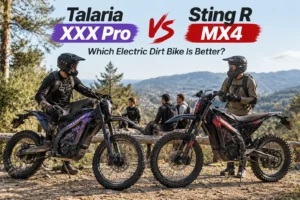
The Talaria XXX Pro and Talaria Sting R MX4 are two popular options for riders looking for a lightweight electric
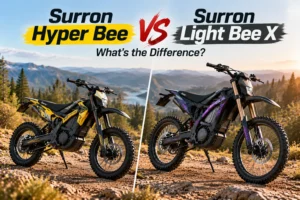
The Surron Hyper Bee and Surron Light Bee X are both high-performance electric dirt bikes, but they are designed for
