Electric Motocross vs Electric Enduro: What’s the Difference?
Electric motocross and electric enduro motorcycles can look very similar, and in some cases they even share the same motor,

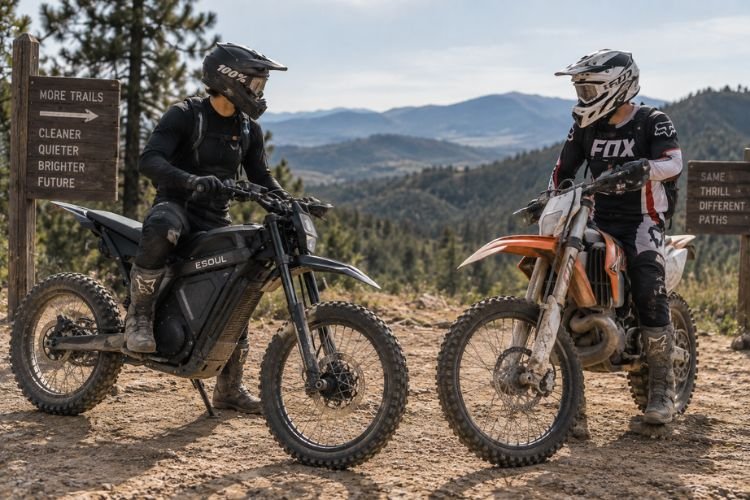
Electric dirt bikes have changed the old assumption that serious off-road motorcycles need gasoline engines. Today’s electric market ranges from lightweight trail-focused e-motos to full-size competition machines, while gas dirt bikes remain the established choice across motocross, enduro, trail riding, and recreational off-road use.
So when comparing an electric dirt bike vs gas dirt bike, which is actually better?
Neither powertrain is better for every rider.
Electric dirt bikes are generally the better fit for riders who value quiet operation, immediate motor response, simple controls, home charging, and fewer routine engine-maintenance requirements. Gas dirt bikes still have a major practical advantage for long riding days, remote trails, rapid refueling, and riders who prefer the traditional interaction of an engine, clutch, and gearbox.
The biggest mistake is trying to decide the winner from one specification.
Electric does not automatically win because it has instant motor torque. Gas does not automatically win because you can refill the tank in minutes. Weight alone does not determine handling, and advertised range does not tell you how useful a bike will be during your normal riding day.
The better question is:
Which powertrain creates fewer compromises for the way you actually ride?
| Category | Electric Dirt Bike | Gas Dirt Bike | General Advantage |
|---|---|---|---|
| Low-speed motor response | Immediate | Engine/RPM dependent | Electric |
| Power control | Motor/controller tuning | Throttle, clutch, gears, engine tuning | Depends |
| Engine stalling | No combustion engine to stall | Possible | Electric |
| Long riding days | Battery/charging dependent | Easy to extend with fuel | Gas |
| Energy replenishment | Requires charging or battery swap | Refuels quickly | Gas |
| Routine engine maintenance | Much lower | More engine-specific service | Electric |
| Tires, brakes, suspension | Still require maintenance | Still require maintenance | Tie |
| Noise | Much quieter | Louder | Electric |
| Handling | Bike-specific | Bike-specific | Depends |
| Beginner operation | Usually simpler | Clutch/gears often required | Electric |
| Remote backcountry riding | Charging can be limiting | Extra fuel is practical | Gas |
| Parts/service ecosystem | Highly brand-dependent | Mature for established brands | Usually Gas |
| Street legality | Vehicle and location dependent | Vehicle and location dependent | Depends |
| Best overall | Depends on rider | Depends on rider | No universal winner |
That table gives the short answer. The more useful answer requires understanding why these differences matter once the bike leaves the spec sheet and reaches the trail.
The most obvious difference between electric and gas dirt bikes is not necessarily how much power they make. It is how that power reaches the rider and rear wheel.
An electric motor can respond immediately to throttle input without waiting for a combustion engine to move through its rpm range. Many electric dirt bikes also use a single-speed reduction rather than a conventional multi-speed motorcycle gearbox, which means the rider can accelerate without shifting through gears. There is no conventional engine idle to manage and no combustion engine to stall halfway up a technical climb.
That creates a very distinctive riding experience. Twist the throttle and the response can feel direct, smooth, and immediate.
Gas dirt bikes approach the same problem differently. Their power delivery depends on engine design, displacement, gearing, rpm, throttle position, and other factors. A traditional motorcycle gearbox allows the rider to choose gearing for the situation, while a clutch gives an experienced rider another tool for controlling power and traction.
This means electric simplicity is not automatically superior to gas-bike control. A skilled rider may deliberately use the clutch and gearbox to keep a gas engine in the desired part of its power delivery, control wheelspin, lift the front wheel, or manage a difficult technical section.
Electric motorcycles can achieve some of that control through motor mapping, controller calibration, riding modes, traction strategies, and in some cases regenerative-braking settings. But the riding technique feels different.
This is where many electric-versus-gas comparisons become too simplistic. The phrase “instant torque” is frequently treated as proof that an electric dirt bike must accelerate harder than a gas bike.
It does not prove that.
Motor torque is only part of the acceleration equation. What matters at the ground is influenced by motor output, reduction ratio, wheel torque, available battery power, controller limits, motor speed, total vehicle mass, wheel and tire dimensions, traction, surface conditions, and software calibration.
A bike advertising a spectacular torque number is therefore not automatically quicker than one with a smaller number—especially when manufacturers may be quoting torque at different points in the drivetrain.
Our Electric Dirt Bike Torque vs Horsepower: What’s More Important? guide explains this distinction in detail, including why motor torque and wheel torque should not be compared as though they were the same specification.
The same caution applies to peak power. A large peak-kW number tells you something about maximum output under specified conditions, but not necessarily how long that output can be sustained. Battery current capability, motor efficiency, controller limits, cooling, temperature, and thermal protection all affect sustained performance.
For motocross, acceleration and controllable power delivery can matter more than simply asking which bike has the higher theoretical top speed. On technical trails, low-speed throttle calibration, traction, weight distribution, and the ability to place the bike accurately may matter more than another few kilowatts of peak output.
So which powertrain wins performance?
Neither, without comparing actual motorcycles.
Electric has a clear advantage in simplicity of power delivery. Gas gives riders a mature combination of engine characteristics, gearing, and clutch control. At the high-performance end, the specific bike matters far more than the fact that one uses a battery and the other uses gasoline.
Range is often presented as the biggest weakness of electric dirt bikes, but that description misses the more important difference.
The real advantage of gasoline is not simply that a gas dirt bike can travel a certain number of miles on one tank.
It is how quickly the rider can add more riding time.
When a gas dirt bike runs low, the rider can stop, add fuel, and continue. Extra gasoline can also be transported relatively easily when the riding situation allows it.
An electric dirt bike works differently. Once the available battery energy is depleted, the rider needs to recharge or replace the battery if the model supports practical battery swapping.
That distinction may be irrelevant—or decisive—depending on how you ride.
Imagine a rider who normally spends 60 to 90 minutes riding local trails before returning home. If the electric dirt bike comfortably completes the entire session with battery capacity remaining, a gas bike’s ability to continue for several more hours has little practical value to that rider. Plugging the electric bike in after the ride may be easier than visiting a gas station, storing fuel, and maintaining a combustion engine.
Now imagine a rider exploring remote trails for most of the day.
The situation changes completely.
A gas rider can carry or return to additional fuel and be moving again quickly. The electric rider needs enough battery energy for the complete route, access to charging, sufficient charging time, or a workable spare-battery strategy.
For this reason, usable riding time is often more meaningful than a universal miles-per-charge comparison.
Electric dirt bike range changes with terrain, speed, rider weight, elevation, temperature, tire pressure, mud, sand, riding mode, acceleration, and many other variables. Gasoline consumption also changes with riding conditions.
That makes broad statements such as “electric dirt bikes get X miles while gas dirt bikes get Y miles” unreliable across an entire category.
Battery capacity itself also needs to be interpreted correctly. A 40Ah battery does not automatically store more energy than a 30Ah battery unless voltage is considered. For cross-voltage comparisons, watt-hours provide a much better starting point.
Our Electric Dirt Bike Battery Ah vs Wh guide explains the relationship:
Wh = V × Ah
A 72V 30Ah pack represents approximately 2,160Wh of nominal energy, while a 60V 40Ah pack represents approximately 2,400Wh. Looking only at the Ah number would hide an important part of the comparison.
Even Wh does not guarantee a particular trail range because the motorcycle’s energy consumption still matters.
This is why buyers should ask:
Will this battery comfortably complete the rides I actually do?
If yes, electric range may barely affect your ownership experience.
If no, the convenience advantage moves strongly toward gas.
For long-distance exploration and remote backcountry riding, gas remains the more practical choice in many situations because rapid energy replenishment is difficult for electric motorcycles to match.
For local trails, tracks, private property, shorter technical sessions, and riders who return to a reliable charging location after each ride, electric becomes much more compelling.
Electric dirt bikes have a genuine maintenance advantage, but saying they are “maintenance-free” is misleading.
The better way to understand the difference is that electric powertrains eliminate many combustion-engine maintenance tasks while introducing a different set of long-term ownership considerations.
Depending on the gas motorcycle, its engine type, and manufacturer maintenance schedule, gas-bike ownership can involve engine oil, oil filters, spark plugs, air-filter maintenance, fuel-system work, coolant on liquid-cooled models, clutch service, valve inspection or adjustment on applicable four-strokes, and eventually internal engine work.
Electric dirt bikes remove many of those engine-specific jobs.
There is no engine oil to change in an electric motor, no spark plug, no gasoline fuel system, and no conventional combustion-engine valve train. Many e-motos also eliminate the traditional manual clutch and multi-speed transmission.
That can substantially simplify routine powertrain ownership.
But both electric and gas dirt bikes still put their chassis through the same hostile off-road environment.
Both can require:
An electric dirt bike also has components that deserve long-term attention: the high-voltage battery, battery management system, controller/inverter, charger, display, wiring, connectors, sensors, and sometimes proprietary software or electronics.
The battery is particularly important because it can represent a substantial portion of the bike’s value.
That creates a different ownership-risk profile.
A gas dirt bike may require more routine mechanical servicing and eventually expensive engine work. An electric dirt bike reduces many of those routine engine requirements, but long-term value depends heavily on battery condition and whether replacement batteries and proprietary electronics remain available.
For that reason, parts support should be treated as a purchasing specification.
Before buying an electric dirt bike, don’t look only at volts, kilowatts, torque, and top speed. Find out whether you can purchase a replacement battery, controller, charger, brake components, plastics, bearings, and other model-specific parts.
The same applies to warranty support and service documentation.
A less powerful bike from a manufacturer with strong long-term support can be a better ownership proposition than a spectacular spec-sheet bike that becomes difficult to repair after a few years.
Operating cost also needs context.
Electricity can be inexpensive relative to gasoline, but energy cost is only one part of total ownership. Purchase price, battery depreciation, replacement parts, tires, suspension work, insurance where applicable, repairs, and resale value all matter.
Gas ownership has its own combination of fuel, fluids, engine maintenance, replacement parts, and potential rebuild costs.
So it is too simplistic to declare electric automatically cheaper over the complete life of every bike.
If your main question is whether the purchase itself makes financial and practical sense, our Are Electric Dirt Bikes Worth It? guide goes deeper into that decision.
The strongest maintenance argument for electric is not that you will never spend money on the motorcycle.
It is that there are fewer routine combustion-engine service tasks between rides.
For riders who would rather charge the bike than maintain an engine, that can be a major advantage.
Electric dirt bikes are sometimes described as heavier than gas dirt bikes because batteries are heavy. Other comparisons claim electric bikes are lighter because popular lightweight e-motos weigh much less than full-size motocross motorcycles.
Both statements can be misleading.
A lightweight e-moto and a full-size 450cc motocross bike are not equivalent vehicles simply because both can be ridden off road.
Weight comparisons only become useful when motorcycles have reasonably similar intended use, performance, dimensions, wheels, suspension, and durability requirements.
Even then, scale weight is only one part of handling.
Where that mass sits in the chassis matters. So do wheelbase, steering geometry, wheel diameter, tires, suspension setup, unsprung mass, center of gravity, rider position, frame stiffness, and power delivery.
This is why electric versus gas alone cannot tell you which bike will corner better or feel easier on technical terrain.
A heavier motorcycle with well-centralized mass and excellent suspension can feel more controlled than a lighter motorcycle with poor geometry and suspension. Likewise, a lightweight e-moto may feel exceptionally agile in tight singletrack but less planted than a full-size motorcycle at higher speeds.
Suspension should therefore be evaluated as part of the complete chassis rather than assumed from the powertrain. Travel numbers alone don’t determine suspension quality either; spring rate, damping, sag, geometry, rider weight, and terrain all affect how the bike behaves.
Noise, however, is one area where the difference is much clearer.
Electric dirt bikes are dramatically quieter because there is no combustion engine and exhaust system. Riders still hear tire noise, chain or belt noise, gears, suspension movement, wind, and the electric motor itself, but the overall sound profile is very different from a gas dirt bike.
That can make electric riding more pleasant around noise-sensitive environments and can make communication between riders easier.
But there is an important legal distinction:
Quiet does not mean permitted.
An electric dirt bike does not automatically gain access to bicycle trails, hiking trails, parks, public land, neighborhoods, or other locations simply because it produces less noise.
Trail access depends on the rules of the land manager and the legal classification of the vehicle.
The same warning applies to street use.
A powerful electric dirt bike is not automatically an e-bike under the law just because it has an electric motor, and installing lights or mirrors does not necessarily make an off-road e-moto road legal.
If road use is part of your buying decision, read our Are Electric Dirt Bikes Street Legal? U.S. Laws Explained guide before choosing a bike.
The riding experience itself is ultimately where personal preference matters most.
Some riders love the mechanical involvement of a gas dirt bike: selecting gears, working the clutch, feeling the engine move through its power delivery, hearing the exhaust, and maintaining the machine.
Others want the exact opposite.
They want to twist the throttle, hear the tires working, concentrate on the terrain, and plug the bike in when the ride is over.
Neither experience is objectively superior.
They are different interpretations of off-road motorcycling.
Once the comparison is moved away from abstract specifications and toward actual riders, the answer becomes much easier.
For beginners, electric dirt bikes often have a meaningful advantage. Many models remove clutch and gear management from the learning process, and there is no combustion engine to stall. Some also provide selectable riding modes that can reduce or reshape power delivery. This allows a new rider to spend more attention on balance, braking, cornering, body position, and throttle control.
That does not mean every electric dirt bike is beginner-friendly. A high-power electric motorcycle can deliver extremely strong acceleration and may be completely inappropriate for an inexperienced rider. Bike size, power, throttle calibration, brakes, suspension, and rider maturity still matter.
For appropriate entry-level choices, see our Best Beginner Electric Dirt Bikes guide.
For recreational trail riding, electric can be an excellent fit when battery range comfortably covers the normal session. Quiet operation, simple controls, immediate response, and reduced engine maintenance all work well for riders who spend a few hours on local trails and return home afterward.
For technical trails, electric power can be particularly interesting. There is no engine to stall during a slow climb, many models don’t require clutch work, and well-calibrated electric power can provide precise low-speed control. Those characteristics can be useful on rocks, roots, switchbacks, ledges, and steep terrain.
But the powertrain still doesn’t make the whole bike. Suspension, weight, geometry, ground clearance, tires, throttle mapping, traction, and battery range remain essential.
If you’re comparing complete models rather than powertrains, our Best Electric Dirt Bikes in 2026 guide covers bikes designed for different riding priorities.
For motocross, there is no longer a useful universal rule that says gas automatically delivers serious performance while electric is only recreational. High-performance electric motorcycles have demonstrated that electric powertrains can be designed for demanding track use.
The decision instead comes down to the specific motorcycle, race rules, charging logistics, riding-session length, suspension, power delivery, thermal performance, parts support, and local competition environment.
Gas still benefits from an extremely mature motocross ecosystem. Parts, tuning knowledge, race support, service expertise, and refueling logistics are deeply established.
Electric offers a different experience with fewer engine-service requirements and highly tunable power delivery, but charging between sessions needs to fit the rider’s schedule.
For long-distance trail and backcountry riding, gas remains difficult to beat.
This is where rapid refueling matters most. A rider far from home does not care that charging is convenient in the garage if there is no useful power source near the trail.
Extra gasoline can extend a riding day quickly. Carrying the equivalent amount of additional usable energy in traction batteries is generally much less convenient.
So the practical pattern is straightforward:
Beginner: Electric often has the advantage.
Short-to-medium recreational trail sessions: Electric can be excellent.
Technical trails: Both can be excellent; electric has unique low-speed advantages.
Motocross: Bike-specific rather than powertrain-specific.
All-day remote/backcountry riding: Gas usually has the practical advantage.
That is a much more useful answer than declaring one powertrain the winner of every category.
After comparing performance, range, maintenance, handling, noise, and real riding situations, the final decision comes down to which compromises matter to you.
Choose an electric dirt bike if your normal rides fit comfortably within its realistic battery range, you have convenient charging, quiet operation matters, you prefer simple controls, and you would rather avoid routine combustion-engine maintenance. Electric is especially compelling for local trail sessions, beginner riding, private-property use where permitted, technical riding, and riders who return to a reliable charging location after each session.
Before buying, make sure the manufacturer has replacement batteries, controllers, chargers, and other important parts available. A powerful motor means very little if the bike becomes difficult to support several years later.
Choose a gas dirt bike if you regularly ride for long periods, travel deep into remote terrain, need to add energy in minutes, or simply prefer a conventional clutch, gearbox, and combustion-engine riding experience. Gas also remains attractive for riders who already have trusted dealers, mechanics, parts suppliers, and established motocross or enduro support nearby.
If you are still unsure, think about the end of your normal riding day.
Does your ride usually finish because you’ve had enough riding for the day?
If an electric dirt bike can comfortably cover that entire session, its battery limitation may have little practical impact on you.
Or does your riding day continue for hours, with multiple fuel stops and long distances far from electricity?
In that case, gas has a major advantage that peak torque, low maintenance, and quiet operation cannot erase.
That leads to the most useful conclusion in the entire electric dirt bike vs gas dirt bike debate:
If your rides end before the battery becomes a limitation, electric becomes extremely compelling. If your riding day depends on repeatedly adding energy as quickly as possible, gas remains the more practical tool.
Electric dirt bikes are better for some riders, not all riders. They generally offer quieter operation, immediate motor response, simpler controls, and fewer routine engine-maintenance requirements. Gas dirt bikes remain better suited to many long-distance and remote riding situations because they can be refueled quickly.
Not automatically. Electric motors can provide immediate response, but acceleration and top speed depend on motor power, wheel torque, gearing, battery output, controller limits, bike weight, traction, aerodynamics, tires, and other factors. The actual motorcycles need to be compared rather than the powertrain types alone.
Electric motors can deliver strong torque from very low motor speeds, but advertised torque figures must be interpreted carefully. Motor torque and wheel torque are not the same measurement, and gear reduction can greatly change torque at the rear wheel. A larger advertised Nm number does not automatically mean one bike accelerates faster.
They generally require fewer routine powertrain maintenance tasks because there is no combustion engine, engine oil, spark plug, or gasoline fuel system. However, tires, brakes, suspension, chains, sprockets, bearings, wheels, and chassis components still require maintenance. Battery and electronic-system support also matter over the long term.
Gas dirt bikes usually have a practical advantage for long or remote riding because refueling takes only a short time and additional fuel can be carried relatively easily. Electric can still work for long sessions when charging or battery swapping is available, but the logistics need to be planned around the specific bike.
Many are easier for beginners to operate because they don’t require clutch and gear management and cannot stall like a combustion engine. However, high-power electric dirt bikes can accelerate extremely quickly, so beginners still need a model appropriate for their size, experience, and skill level.
There is no universal answer. Electric dirt bikes can reduce routine engine maintenance and electricity can be inexpensive, but battery replacement and proprietary electronics can be costly. Gas bikes require fuel and more engine-related maintenance but often benefit from mature parts and repair networks. Total ownership cost depends on the specific motorcycles and how they are used.
Yes. Electric dirt bikes eliminate combustion-engine and exhaust noise, although tires, drivetrain components, the motor, suspension, and wind still create sound. Lower noise does not automatically make an electric dirt bike legal on trails or public roads where motorized vehicles are restricted.
Some electric motorcycles are designed and certified for road use, while many electric dirt bikes are intended for off-road use. Street legality depends on the specific vehicle and jurisdiction. Lights, mirrors, pedals, or an electric motor alone do not automatically make an off-road motorcycle street legal.
Electric dirt bikes are becoming a more capable alternative in several off-road categories, but gas still has important advantages in rapid refueling, remote riding, established service infrastructure, and certain competition environments. The two powertrains are likely to continue serving different rider priorities rather than one instantly making the other obsolete.
So, electric dirt bike vs gas dirt bike: which is better?
For riders who value quiet operation, immediate power delivery, simple controls, home charging, and fewer routine engine-maintenance requirements, electric can be the better choice. It is especially convincing when normal riding sessions comfortably fit within the bike’s available battery range.
For riders who spend long days in remote terrain, need to replenish energy quickly, or prefer the traditional clutch-and-gear riding experience, gas remains extremely practical.
Performance alone doesn’t settle the argument.
Electric’s immediate motor response does not automatically make it faster. Gas-bike gearing and clutch control do not automatically make it better on technical terrain. Weight does not determine handling by itself, and a large advertised range figure means little if it doesn’t reflect how you actually ride.
Ownership is equally nuanced.
Electric removes many combustion-engine maintenance jobs but makes battery health, electronics, replacement parts, and manufacturer support more important. Gas requires more traditional mechanical maintenance but benefits from decades of established service knowledge and parts availability.
The best choice therefore comes down to your actual riding.
Choose electric when its battery comfortably covers your normal session and you value quiet, simple, low-maintenance power delivery. Choose gas when long riding days, remote terrain, rapid refueling, and established service support matter more.
Electric motocross and electric enduro motorcycles can look very similar, and in some cases they even share the same motor,
Electric enduro motorcycles are becoming an increasingly appealing option for riders who want strong acceleration, precise low-speed control, and less
Electric enduro motorcycles are becoming an increasingly appealing option for riders who want strong acceleration, precise low-speed control, and less
The Talaria XXX Pro and Talaria Sting R MX4 are two popular options for riders looking for a lightweight electric
