Stark Varg MX vs Stark Varg EX: Key Differences
Electric enduro motorcycles are becoming an increasingly appealing option for riders who want strong acceleration, precise low-speed control, and less

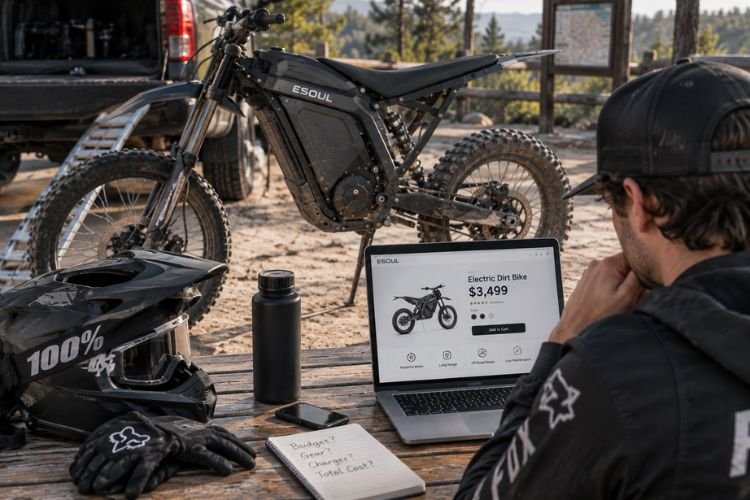
Electric dirt bikes can cost anywhere from a few hundred dollars for small youth and recreational models to more than $10,000 for full-size, high-performance electric motorcycles. That enormous range makes a simple “average electric dirt bike price” surprisingly unhelpful.
For an adult shopping for a capable lightweight trail e-moto, roughly $3,000 to $6,000 is a useful part of the market to compare in 2026. Below that, there are increasingly capable budget models, but build quality, suspension, battery size, fit, and long-term parts support deserve closer attention. Above that range, buyers move toward larger batteries, more powerful electrical systems, stronger chassis components, and eventually full-size performance motorcycles.
At the top of the market, prices can exceed $10,000. Stark Future, for example, currently lists the VARG MX 1.2 at $11,990 in the United States.
So the useful question isn’t simply:
How much does an electric dirt bike cost?
It is:
What kind of electric dirt bike does your budget actually buy—and how much bike do you really need?
| Budget | What You’re Generally Shopping For | Typical Buyer |
|---|---|---|
| Under $1,000 | Youth, mini, recreational, basic off-road models | Kids and casual riders |
| $1,000–$3,000 | Budget adult bikes and lightweight recreational e-motos | Beginners and casual riders |
| $3,000–$5,000 | More serious lightweight trail e-motos | Adult trail riders |
| $5,000–$8,000 | Higher-performance and larger off-road platforms | Experienced riders |
| $8,000–$10,000+ | Premium off-road motorcycles | Aggressive riders |
| $10,000+ | Full-size competition-level electric motorcycles | Motocross and serious performance use |
These are shopping ranges, not rigid definitions. Electric dirt bikes vary dramatically in size and intended use, and a $1,000 youth bike should not be compared directly with a $6,000 adult trail machine simply because both products use the words “electric dirt bike.”
The bottom of the electric dirt bike market is where buyers need to be most careful with terminology.
Under $1,000, many products are designed primarily for children, teenagers, backyard riding, or light recreational use. Smaller wheels, compact frames, lower-capacity batteries, basic suspension, and modest braking systems are common. That does not make these bikes bad products. A properly sized youth bike can be exactly what a young rider needs.
The problem begins when a small recreational bike is compared with a serious adult e-moto purely because both appear under the same search term.
Before buying a cheap electric dirt bike, check rider-height recommendations, maximum rider weight, wheel size, seat height, brake type, suspension, battery specifications, manufacturer age guidance, replacement-parts availability, and intended terrain. Top speed and peak motor wattage should not be your only filters.
Between roughly $1,000 and $3,000, the market becomes much more complicated. You can find adult-sized budget models, mini e-motos, recreational trail bikes, direct-to-consumer products, and higher-spec youth machines within the same general price range.
Some can offer impressive specifications for the money. But this is also where buyers should investigate the details behind those specifications.
A large advertised motor number doesn’t tell you whether the controller and battery can sustain that output. A high claimed top speed doesn’t tell you whether the brakes and suspension are well suited to aggressive trail riding. A large Ah figure doesn’t necessarily mean the battery stores more energy than another pack operating at a different voltage.
Long-term support also becomes important. Ask whether replacement batteries, chargers, controllers, displays, brake components, plastics, and other model-specific parts can actually be purchased.
At roughly $3,000 to $5,000, buyers begin to encounter many of the lightweight e-motos that adult trail riders seriously cross-shop. This is a particularly important price range because the bikes can provide substantial off-road capability without moving into full-size competition-motorcycle pricing.
This is also where spending more can start buying meaningful improvements rather than just bigger marketing numbers: stronger frames, better brakes, larger batteries, more capable suspension, better thermal management, more refined power delivery, and a stronger parts ecosystem.
If this is your budget, our Best Electric Dirt Bikes Under $5,000 in 2026 guide is the logical next step because it compares actual models rather than price categories.
Moving into the $5,000–$8,000 range opens the door to larger and more powerful platforms. Depending on the bike, the extra money may buy a larger battery, stronger motor and controller, higher-spec suspension, larger wheels, stronger brakes, improved chassis components, or a motorcycle that is physically closer to a conventional full-size dirt bike.
But spending $7,000 instead of $4,000 does not automatically mean you will have 75% more fun—or even that you are buying the better bike for your riding.
A beginner riding moderate trails may benefit more from lower weight and manageable power than from an enormous peak-kW figure. Likewise, a technical trail rider may care more about throttle calibration, suspension, traction, geometry, and weight distribution than maximum speed.
At the premium end, electric dirt bikes begin competing with serious conventional motorcycles on both performance and price. Full-size competition machines can exceed $10,000. These bikes should not be judged against a $1,500 recreational e-moto because they are solving a fundamentally different problem.
This is why the electric dirt bike market can look confusing from price alone.
A “$1,000 electric dirt bike” and an “$11,000 electric dirt bike” may share the same broad product label while having very little else in common.
The battery is one of the most important components affecting an electric dirt bike’s price, but battery cost is more complicated than simply comparing amp-hours.
Battery energy depends on voltage and charge capacity:
Wh = V × Ah
For example, a nominal 72V 30Ah battery represents approximately 2,160Wh, or 2.16kWh, while a nominal 60V 40Ah battery represents approximately 2,400Wh, or 2.4kWh.
The 40Ah number looks much larger, but the actual difference in nominal energy is only 240Wh.
This is why buyers comparing different voltage systems should pay close attention to watt-hours rather than using Ah alone. Our Electric Dirt Bike Battery Ah vs Wh guide explains this in much more detail.
Capacity isn’t the only thing you are paying for. Battery-cell selection, discharge capability, pack construction, battery management, enclosure design, connectors, thermal strategy, water and dust protection, warranty, and replacement availability can all matter.
Motor and controller performance also affect price.
Higher-performance motorcycles need more than a motor with a large peak-kW number. The battery needs to deliver the required current, the controller needs to manage it, wiring and connectors need to handle the electrical load, and the motor and controller need to manage the resulting heat.
This is why comparing electric dirt bikes by peak power alone can be misleading. Our Electric Dirt Bike Torque vs Horsepower guide explains how power, motor torque, wheel torque, gearing, and motor speed relate to real riding performance.
Suspension is another major separator between inexpensive recreational bikes and serious off-road machines.
A basic fork and shock may be perfectly adequate for low-speed recreational riding. As speed, bike mass, rider mass, jumps, rocks, roots, and braking loads increase, suspension quality becomes much more important.
More suspension travel alone does not guarantee better suspension. Spring rates, damping, adjustability, geometry, chassis design, and rider setup all matter.
The same principle applies to brakes, wheels, tires, bearings, and frame construction. A motorcycle capable of sustained high-speed off-road riding needs components designed around greater loads than a small backyard bike.
Then there is something that rarely appears prominently on a spec sheet:
support.
Two electric dirt bikes can have similar battery and motor specifications while carrying very different prices because one manufacturer has stronger warranty support, replacement batteries, controllers, plastics, documentation, dealers, service options, and aftermarket parts.
That can be worth paying for.
When you buy an electric dirt bike, you are not only buying today’s performance specifications. You are also buying tomorrow’s parts availability.
A $2,000 bike that cannot be repaired after a proprietary component fails can ultimately provide worse value than a more expensive model supported for years.
The advertised price or MSRP is only the beginning of your electric dirt bike budget.
Depending on where and how you buy, you may also need to account for shipping or freight, sales tax, dealer or assembly charges where applicable, riding gear, transportation equipment, maintenance supplies, replacement wear parts, and possibly insurance or registration for bikes and uses where those requirements apply.
This is why buyers should compare the delivered or out-the-door price, not only the number shown at the top of a product page.
Protective equipment is particularly easy for first-time riders to overlook. A new rider may still need a suitable helmet, boots, gloves, goggles, knee protection, and additional body protection appropriate to the type of riding.
Charging itself is relatively easy to estimate.
A basic theoretical calculation is:
Battery energy in kWh × electricity price per kWh = electricity cost
For example, if a battery stores 2.5kWh of nominal energy and electricity costs $0.20 per kWh:
2.5 × $0.20 = $0.50
That represents 50 cents for 2.5kWh of electricity. It is only an illustrative calculation rather than a guaranteed full-charge cost because charging losses, usable battery capacity, electricity tariffs, and charging behavior vary.
Maintenance also needs to be budgeted realistically.
Electric dirt bikes eliminate many combustion-engine service items. There is no engine oil, spark plug, gasoline fuel system, or conventional engine valve train to service. Many e-motos also eliminate a traditional manual clutch and multi-speed gearbox.
But “less maintenance” does not mean “no maintenance.”
Tires wear. Brake pads wear. Chains and sprockets need attention. Suspension needs servicing. Wheel and steering bearings can wear. Wheels, spokes, seals, fasteners, and chassis components need inspection.
And eventually, battery condition can become a major ownership consideration.
This is where I would avoid relying on a generic statement such as “an electric dirt bike battery costs $X to replace.” Battery prices vary enormously with voltage, capacity, manufacturer, cell type, pack construction, and model.
Instead, do something more useful before you buy the bike:
Search for the exact replacement battery.
If you’re considering a particular model, find out whether a genuine replacement battery is available today, what it currently costs, what its warranty covers, and whether replacing it requires dealer programming or specialized procedures.
Do the same for the charger and controller.
Battery longevity also depends on temperature, storage, charging behavior, chemistry, cycle use, discharge loads, and battery management. Our How to Extend Electric Dirt Bike Battery Life guide covers practical habits that can help you take better care of the pack you already own.
The real ownership-cost equation therefore looks more like:
Bike + delivery/tax + riding gear + charging + maintenance + wear parts + eventual major repairs or battery replacement
That is far more useful than judging a motorcycle from MSRP alone.
The answer depends less on how much money you have and more on what you expect the bike to do.
A first-time adult rider should resist two opposite mistakes: buying the cheapest bike possible and buying far more performance than they can use.
Instead, spend enough to get a motorcycle that fits your body, has appropriate brakes and suspension, provides enough battery capacity for your normal riding session, and comes from a manufacturer or seller capable of supporting it.
For beginners, predictable power delivery and manageable weight may matter more than peak speed. Our Best Beginner Electric Dirt Bikes guide focuses specifically on first-time riders.
For a weekend trail rider, the $3,000–$5,000 range deserves particularly close attention. This is where many riders can find lightweight e-motos with meaningful trail capability without paying for full-size competition performance.
A buyer in this category should prioritize battery capacity, suspension, brakes, wheel and tire setup, realistic range, replacement parts, and overall fit before chasing the highest advertised top speed.
For a technical trail rider, priorities change again.
Suspension quality, controllable low-speed power, traction, geometry, ground clearance, weight, tire choice, thermal performance, and enough battery capacity to complete the route can all be more important than headline speed.
For aggressive riding or motocross, spending considerably more can make sense because you are asking much more from the chassis, suspension, braking system, motor, controller, battery, and thermal system.
The current Stark VARG MX 1.2 illustrates how far the premium end of the category has moved. Its current U.S. list price is $11,990, putting a full-size electric motocross machine into an entirely different purchasing category from lightweight recreational e-motos.
For children and young riders, price should come after fit and safety-related considerations.
A child’s electric dirt bike should be selected around the manufacturer’s rider guidance, physical dimensions, power and speed controls where provided, braking performance, and the rider’s actual ability. Buying an oversized or excessively powerful bike simply because a child can “grow into it” can create unnecessary difficulty.
The common principle across all of these categories is simple:
Pay for capability you will actually use.
If your normal riding never pushes a mid-range trail bike beyond its battery, suspension, or power capabilities, spending thousands more on a competition-oriented motorcycle may provide little practical value.
On the other hand, buying a cheap recreational bike for aggressive adult trail riding can be false economy if you immediately need better suspension, brakes, tires, battery capacity, and other upgrades.
The best budget sits where the bike meets your real requirements without forcing you to immediately replace half of it.
Price and quality are related, but not perfectly.
A more expensive electric dirt bike often gives the manufacturer a larger component budget. That can mean a better battery, stronger controller, more capable motor, higher-quality suspension, stronger brakes, better wheels and tires, improved chassis construction, or better support.
But the relationship is not linear.
| Feature | Budget Bike | Mid-Range Bike | Premium Bike |
|---|---|---|---|
| Intended use | Casual/recreational | Regular trail riding | Aggressive/competition |
| Battery | Smaller/basic | More useful trail capacity | High-capacity/high-output |
| Motor/controller | Moderate output | Strong trail performance | High-performance system |
| Suspension | Basic | More capable | High-spec/competition focused |
| Brakes | Basic to moderate | Stronger off-road setup | Performance focused |
| Chassis | Recreational | Trail oriented | Larger/full-size or competition |
| Parts support | Varies widely | Important differentiator | Critical despite high price |
| Best buyer | Casual rider | Regular enthusiast | Demanding rider |
The important word here is generally.
A high price does not guarantee good suspension, reliable electronics, or strong customer support. Likewise, lower-priced bikes can offer excellent value when the manufacturer concentrates its budget on the components riders actually use.
This is why specifications need context.
Imagine one bike costs $3,500 and another costs $5,500. The more expensive bike has significantly more peak power, but both provide enough range and performance for your normal trail riding.
If the $3,500 bike fits you better, has adequate suspension, strong brakes, and readily available parts, the cheaper bike may provide better value.
Conversely, if you immediately plan to replace the cheaper bike’s suspension, brakes, battery, controller, and wheels, buying the more capable platform from the beginning may make more financial sense.
This is also why our Best Electric Dirt Bikes Under $5,000 guide evaluates complete bikes rather than assuming the highest-power model offers the best value.
Cheap isn’t automatically bad.
Expensive isn’t automatically worth it.
Value is the relationship between price and the capability you actually need.
Buying used can reduce the entry price considerably, but electric dirt bikes introduce several checks that are particularly important because the battery is such a valuable component.
Cosmetic condition alone tells you very little about battery health.
Ask about the bike’s age, charging habits, storage conditions, original charger, battery condition, and whether the battery or electrical system has been modified. Inspect the battery enclosure and connectors for visible damage. Check that the bike charges correctly and that the display or diagnostic system does not show unexplained errors.
Modifications deserve extra attention.
Electric dirt bikes are commonly modified with aftermarket controllers, batteries, motors, gearing, displays, and wiring. A well-designed modification can improve a bike, but poorly matched electrical components can create reliability, thermal, or safety problems.
A higher-output controller connected to the original battery, for example, does not automatically mean the battery is designed to provide every current level the new controller can request.
Also check whether replacement components remain available for that exact model.
A used bike can look like a bargain until you discover that its battery is deteriorating and a compatible replacement is unavailable.
Ownership documentation matters too. Where applicable, check the VIN or other identifying information, proof of ownership, and any documents needed for the way you intend to use or register the motorcycle.
Used electric dirt bikes can offer excellent value, particularly when the model has a strong parts ecosystem and the battery is in good condition. But the discount needs to compensate you for the additional uncertainty.
Electric dirt bike prices range from a few hundred dollars for small youth and recreational models to more than $10,000 for premium full-size electric motorcycles. For adult lightweight trail e-motos, roughly $3,000–$6,000 is a useful part of the current market to compare, although capable bikes exist both below and above that range.
For an adult looking for a capable trail-focused electric dirt bike, a budget of roughly $3,000–$6,000 opens up many more serious options. “Good” still depends on intended use: a beginner, technical trail rider, and motocross racer need very different motorcycles.
Battery packs, motors, controllers, suspension, brakes, wheels, frames, thermal management, electronics, development, warranty support, and replacement-parts infrastructure all contribute to cost. High-performance models also need components capable of handling greater speed, weight, and off-road loads.
Yes. The sub-$5,000 category includes a number of adult-focused lightweight e-motos and trail-oriented bikes. Buyers should compare battery energy, suspension, brakes, fit, realistic range, power delivery, warranty, and parts availability rather than choosing by top speed alone.
It depends on battery energy, electricity rates, and charging losses. As a simple example, 2.5kWh multiplied by $0.20 per kWh equals $0.50 for 2.5kWh of electricity. Actual energy drawn from the wall can be higher because charging is not perfectly efficient.
There is no reliable universal replacement price because electric dirt bike batteries vary greatly in voltage, energy capacity, cells, construction, BMS, enclosure, and manufacturer. Check the current replacement-battery price for the exact model you intend to buy.
They can be, particularly for youth, beginners, and casual recreational use. The important question is whether the bike’s brakes, suspension, battery, frame, size, and support match the rider and intended terrain. A cheap bike becomes poor value if it immediately requires expensive upgrades or cannot be repaired.
It can be if its capability matches your riding. Around this price, buyers can expect to compare serious lightweight trail e-motos rather than basic recreational products. However, a $5,000 bike is not automatically better value than a $3,500 bike if you don’t need its additional capability.
It depends on the motorcycles being compared and how they are used. Electric dirt bikes generally eliminate many routine combustion-engine maintenance tasks and electricity can be inexpensive, while gas bikes offer rapid refueling and mature service networks. Purchase price, battery replacement, fuel, maintenance, repairs, parts, and resale value all affect total ownership cost.
A used bike can offer good value if its battery is healthy, the electrical system has not been poorly modified, replacement parts remain available, and ownership documentation is clear. Battery condition deserves particular attention because replacing a pack can represent a substantial expense.
So, how much does an electric dirt bike cost?
The market is too broad for one average price to be genuinely useful. Small youth and recreational electric dirt bikes can cost under $1,000, while serious adult trail bikes move into the thousands and premium full-size competition motorcycles can exceed $10,000.
For many adult riders shopping for a capable lightweight trail e-moto in 2026, roughly $3,000–$6,000 is a useful comparison range. That is not a minimum requirement or a guarantee of quality. It is simply where buyers can compare many more purpose-built adult trail options.
More important than the price itself is what the money buys.
Look at battery energy rather than Ah alone. Compare suspension and brakes with the terrain and speeds you expect to ride. Check the complete electrical system rather than focusing only on peak motor power. Find out what a replacement battery costs. Verify that controllers, chargers, plastics, wear parts, and other components are actually available.
And remember that MSRP is not your complete budget.
Protective gear, shipping, tax, maintenance, wear parts, charging, transportation, and eventual major component replacement can all affect the true cost of owning the bike.
The cheapest electric dirt bike is therefore not automatically the best value, and the most expensive bike is not automatically the smartest purchase.
The right amount to spend is the lowest budget that gets you the fit, range, performance, suspension, brakes, and long-term support your riding actually requires—without paying thousands more for capability you will rarely use.
Once you know that budget, the next step becomes much easier: stop comparing every electric dirt bike on the market and compare only the bikes that fit both your riding and your price range.
Electric enduro motorcycles are becoming an increasingly appealing option for riders who want strong acceleration, precise low-speed control, and less
Electric enduro motorcycles are becoming an increasingly appealing option for riders who want strong acceleration, precise low-speed control, and less
The Talaria XXX Pro and Talaria Sting R MX4 are two popular options for riders looking for a lightweight electric
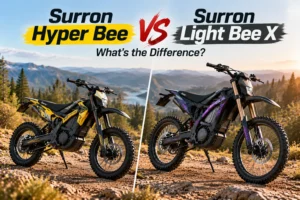
The Surron Hyper Bee and Surron Light Bee X are both high-performance electric dirt bikes, but they are designed for
