Electric Motocross vs Electric Enduro: What’s the Difference?
Electric motocross and electric enduro motorcycles can look very similar, and in some cases they even share the same motor,

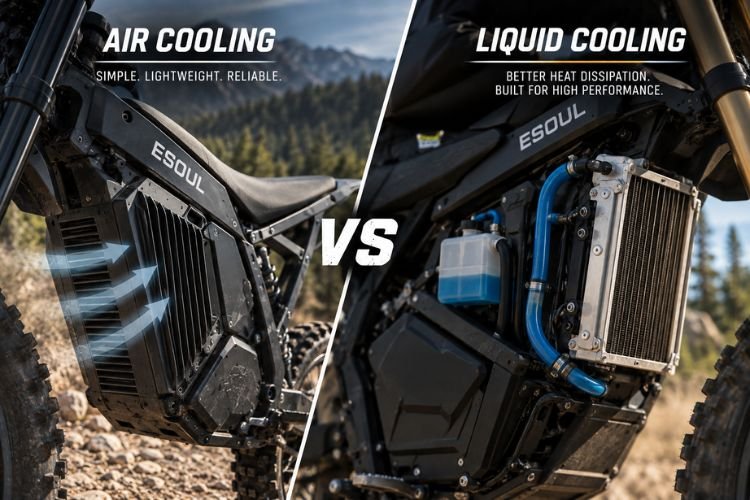
Electric dirt bikes don’t have hot combustion chambers, exhaust headers, or engine oil circulating through a gasoline engine, but that doesn’t mean heat has disappeared. The battery, electric motor, inverter or motor controller, wiring, and other power electronics all generate heat while the bike is working.
That heat becomes especially important when an electric dirt bike is ridden hard for extended periods. Long climbs, deep sand, repeated acceleration, motocross sessions, high ambient temperatures, and sustained high-power riding can put considerably more thermal stress on the powertrain than a short recreational ride.
Manufacturers therefore need a way to move heat away from critical components. Two terms you’ll commonly encounter are air cooling and liquid cooling.
The simple explanation is that air-cooled systems use airflow and heat-conducting surfaces to reject heat, while liquid-cooled systems circulate coolant through or around heat-producing components and transfer that heat to another part of the cooling system, typically a radiator or heat exchanger.
But the important question for electric dirt bike buyers isn’t simply:
“Is liquid cooling better than air cooling?”
A better question is:
“Can this bike’s thermal-management system keep its motor, controller, and battery within their intended temperature ranges during the type of riding I actually do?”
That is what determines whether the cooling system is appropriate.
Electric motors are highly efficient compared with combustion engines, but they are not 100% efficient. Some electrical energy is converted into heat rather than useful mechanical output. The same is true of batteries, controllers/inverters, cables, connectors, and other electrical components.
As power demand and current increase, managing that heat becomes increasingly important.
The motor can generate heat in its windings, magnetic components, bearings, and surrounding structure. The controller or inverter contains power electronics that switch large electrical currents and also produce heat. The battery generates internal heat during charging and discharging, with high current demand and environmental conditions affecting thermal behavior.
These components do not necessarily share one cooling system. A bike might use an air-cooled motor, a controller mounted to a heat-sinking structure, and a battery that relies primarily on passive thermal management. Another design might use liquid cooling around the motor and inverter while managing the battery differently.
That is why the phrase “liquid-cooled electric dirt bike” is incomplete unless the manufacturer explains what is actually liquid cooled.
Is it the motor?
The inverter?
Both?
The battery?
A complete powertrain?
This distinction matters when comparing specification sheets.
Thermal management also affects performance because electric powertrains have temperature limits. When a component approaches a protective threshold, the control system may reduce available power to prevent temperatures from continuing to rise.
This is commonly called thermal derating.
Derating is not necessarily evidence that something has failed. It can be an intentional protection strategy. For example, Zero Motorcycles explains in its owner documentation that its thermal strategy can reduce power or sustainable speed when a passively air-cooled powertrain approaches its thermal limits during sustained high-power operation.
So when riders say a bike “gets slower when hot,” the important question is not simply whether it uses air or liquid cooling. The real issue is how much heat the system generates, how quickly it can reject that heat, what temperature limits are programmed, and what riding conditions caused those limits to be reached.
Air cooling is the simpler approach conceptually. Heat generated inside a component is conducted through its materials into an outer housing, fins, heat sink, frame structure, or another exposed surface. Heat then moves from that surface into the surrounding air.
Some systems rely largely on passive airflow, meaning they do not need a coolant pump or radiator. Vehicle movement helps increase airflow around exposed surfaces. Other designs may use forced airflow from a fan, although “air-cooled” does not automatically tell you whether a system is passive or fan-assisted.
The major advantage is simplicity.
Without a conventional liquid circuit, manufacturers can eliminate coolant hoses, pumps, radiators, reservoirs, fittings, and coolant itself. That can reduce weight, packaging complexity, leak points, and cooling-system maintenance.
Air cooling also demonstrates why you should not assume it is only suitable for inexpensive or low-performance vehicles. Zero Motorcycles currently uses enhanced passively air-cooled permanent-magnet motors on several electric motorcycles. Its engineering approach relies on motor design, thermal efficiency, housing design, and heat rejection rather than a conventional liquid-cooling loop.
For electric dirt bikes, simplicity can be particularly attractive. Off-road motorcycles encounter mud, dust, rocks, branches, crashes, vibration, and pressure washing. Fewer exposed cooling components can mean fewer parts that need protection.
However, passive air cooling has limitations.
The rate at which heat can be rejected depends heavily on the temperature difference between the component and surrounding air, the available surface area, airflow, material conductivity, and overall design. When ambient temperature is high or the bike is producing heat faster than the system can reject it, component temperature can continue to rise.
Low vehicle speed can also make thermal management challenging in some designs because there may be less natural airflow. That can matter on steep technical climbs where the motor is working hard while the bike itself is moving relatively slowly.
But again, the correct conclusion is not:
Air cooling = overheating.
A well-designed air-cooled powertrain can provide strong sustained performance within its intended operating envelope. Cooling requirements depend on how much heat the system produces in the first place and how effectively the entire bike is designed to move that heat away.
Liquid cooling adds another heat-transfer medium to the system.
Instead of relying primarily on heat moving directly from the component to surrounding air, coolant circulates through cooling passages or jackets associated with heat-producing components. The heated coolant then travels through the system, where the heat can be transferred to a radiator or other heat exchanger and ultimately released to the surrounding air.
A typical liquid-cooling system may include:
Exact designs vary considerably.
The major advantage is greater control over where and how heat is moved.
A manufacturer can take heat away from a compact high-output motor or inverter and transport it to a radiator with a larger effective heat-rejection area. This becomes increasingly valuable as power density and sustained thermal load rise.
A useful real-world example is the Stark VARG. Stark says its high-output motor uses a water-cooled aluminum casing, with the inverter integrated into the motor case partly to reduce mass and simplify cooling. This is an example of liquid cooling being integrated into the powertrain architecture rather than simply bolted on as an accessory.
Liquid cooling can therefore be particularly attractive for high-output motorcycles expected to deliver substantial power repeatedly, such as motocross or aggressive enduro machines.
But liquid cooling also introduces trade-offs.
The bike now has additional components. Pumps can fail. Hoses and fittings can be damaged. Coolant can leak. Radiators need airflow and physical protection, especially in off-road environments. Additional hardware can add weight, cost, packaging requirements, and maintenance.
This does not make liquid cooling unreliable. Modern cooling systems can be extremely robust. It simply means that the additional thermal capacity comes with additional engineering complexity.
That gives us a more useful comparison:
| Factor | Air Cooling | Liquid Cooling |
|---|---|---|
| System complexity | Lower | Higher |
| Coolant required | No | Yes |
| Pump/radiator required | Usually no for passive systems | Typically part of the system |
| Weight potential | Usually lower | Usually higher |
| Leak risk | No liquid circuit to leak | Coolant circuit introduces leak points |
| Maintenance | Generally simpler | Cooling system may require inspection/service |
| Packaging | Simpler | More components to package |
| Heat transfer control | More dependent on direct heat rejection | Can move heat to a dedicated heat exchanger |
| Sustained high thermal load | Design-dependent | Can offer advantages at high sustained loads |
| Off-road damage concerns | Fewer cooling-system components | Radiator/hoses require protection |
| Best choice | Depends on complete design | Depends on complete design |
The final row is important.
Cooling architecture alone does not tell you which bike is better.
If two electric dirt bikes have similar peak power, it is tempting to choose the liquid-cooled one because it sounds more advanced.
That is not a reliable buying method.
Peak power tells you how much output a powertrain may produce under specified conditions. It does not tell you how much heat the system generates, how efficiently the motor operates across its usable range, how long peak output can be sustained, how the controller is calibrated, or how effectively the bike rejects heat.
This is why continuous or sustained performance matters when evaluating cooling.
Imagine two hypothetical 20kW electric dirt bikes. Bike A is air cooled and Bike B is liquid cooled. From those two facts alone, we cannot say which one will maintain more power for longer.
Bike A might have a highly efficient motor, large heat-sinking surfaces, conservative controller tuning, and excellent airflow. Bike B might use liquid cooling because its motor is more compact or operates at a higher thermal load.
Cooling architecture is part of the engineering solution, not a performance score.
For casual trail riding, a properly engineered air-cooled system can make excellent sense. The rider gets fewer components, lower complexity, and potentially lower weight. If the bike spends much of its life below its thermal limits, carrying a pump, radiator, hoses, and coolant may provide little practical benefit.
For technical trail riding, the answer becomes more nuanced. Low-speed climbing can demand substantial motor torque while providing limited natural airflow. That can challenge some passive systems. On the other hand, technical riding often includes pauses, lower average power, and traction-limited sections, so the thermal load depends heavily on the trail and rider.
For motocross, hard enduro, deep sand, repeated hill climbs, and sustained high-output riding, thermal capacity becomes more important. A properly designed liquid-cooled powertrain can have an advantage because it can move heat away from concentrated high-load components and reject it through a dedicated heat exchanger.
Ambient temperature matters too. A cooling system operating in cool weather has a different thermal environment from one being ridden hard on a hot summer day.
The rider should therefore ask:
How long can this bike deliver the performance I need under my riding conditions before thermal management reduces output?
That question is far more useful than simply asking whether the bike has a radiator.
One of the biggest mistakes in discussions about electric dirt bike cooling systems is treating the powertrain as a single hot object.
It is not.
The motor, controller/inverter, and battery have different thermal characteristics and may require different cooling strategies.
The motor converts electrical energy into mechanical power. Under heavy load, losses inside the motor become heat. Motor temperature can become particularly important during sustained high-current riding, long climbs, sand, or situations where the bike demands substantial torque for an extended period.
The controller or inverter regulates power from the battery to the motor. Its switching devices also generate heat. Manufacturers can use aluminum housings, heat sinks, airflow, integration with other structures, or liquid cooling to manage that temperature.
Stark’s VARG illustrates an integrated approach: the manufacturer places the inverter in the motor case and uses a water-cooled motor casing, allowing the thermal system and packaging strategy to work together.
Battery cooling is different again.
Lithium-ion cells have temperature ranges in which they perform and age best, and high discharge or charge rates generate heat. But not every electric motorcycle requires an actively liquid-cooled battery.
A battery pack can use passive conduction through its enclosure and chassis, heat-sinking structures, thermal interface materials, or other methods. Zero, for example, describes aluminum heat-sink housings and thermal-transfer interfaces for some of its current battery packs while retaining passively air-cooled motors.
The Stark VARG provides another interesting example: its motor casing is water cooled, while Stark describes the battery’s magnesium case and direct cell-to-case arrangement as part of its cooling approach.
So a bike can use different thermal-management technologies for different components.
That is why a buyer should never read “liquid cooled” and assume the entire battery, controller, and motor all share an automotive-style cooling loop.
Check the manufacturer’s actual engineering description.
This also connects directly with battery performance. As discussed in our electric dirt bike battery Ah vs Wh guide, battery energy capacity and power capability are different specifications. A large-Wh battery may have plenty of stored energy, but sustained high-power riding still depends on the pack’s current capability and thermal management.
Thermal derating is probably the most important real-world consequence of cooling performance.
Electric motors, batteries, and power electronics have operating temperature limits. Rather than allowing temperatures to rise indefinitely, the vehicle’s control system can reduce current or power when temperature thresholds are approached.
For the rider, this may feel like:
Once temperatures return to an acceptable range, normal performance may return depending on the system.
This is fundamentally different from saying the motor has “failed.”
Thermal protection exists to help prevent components from being operated beyond their intended limits.
Zero Motorcycles provides a useful documented example. Its owner information explains that sustained high-power or high-rpm use can reach the thermal limits of its passively air-cooled powertrain, at which point its thermal strategy can reduce available speed or power until the system can maintain an acceptable thermal state.
This reveals an important specification-sheet problem.
Suppose Bike A advertises 12kW peak power and Bike B advertises 10kW peak power.
Bike A looks faster on paper.
But if Bike A can only sustain its highest output briefly under demanding conditions while Bike B can maintain a larger percentage of its output for longer, the riding experience may be different from what the peak numbers suggest.
Cooling therefore becomes closely connected to the difference between peak performance and sustained performance.
The same principle applies to climbing. Electric motors can produce strong torque at low speed, but a long, steep climb can create substantial thermal stress because the motor may be operating under heavy load for an extended period. Deep sand can do something similar because rolling resistance increases and the motor must continuously work harder.
This is why thermal performance should be considered alongside motor power, battery current capability, gearing, bike weight, and terrain—not as a separate marketing feature.
Most buyers do not need to become thermal engineers. They simply need to ask better questions when reading a specification sheet or review.
Start by identifying what is cooled and how. “Liquid cooled” is not enough. Determine whether the manufacturer is talking about the motor, inverter/controller, battery, or multiple components. If a bike is air cooled, determine whether the design is passive or uses forced airflow.
Next, look beyond peak power. If the manufacturer provides continuous power, sustained performance, temperature limits, thermal-protection behavior, or detailed technical documentation, those figures can tell you more about real riding than a single peak-kW number.
Consider your terrain. A rider doing relaxed forest trails has different cooling needs from someone racing motocross, repeatedly climbing steep grades, riding through deep sand, or operating in extreme heat.
Also consider maintenance and vulnerability. An air-cooled motor may offer an appealing level of mechanical simplicity. A liquid-cooled system may offer strong thermal-management capability but adds coolant-related components that need inspection and protection.
If you’re evaluating a used bike, inspect liquid-cooled systems for signs of leakage, damaged radiators, crushed fins, deteriorated hoses, or previous crash damage. On an air-cooled system, inspect cooling surfaces and make sure mud, debris, aftermarket covers, or modifications are not interfering with intended heat rejection.
Most importantly, avoid modifying the thermal system casually.
Changing controller current, increasing power, enclosing heat-sinking surfaces, relocating components, bypassing temperature protections, or fitting incompatible aftermarket parts can change the thermal load substantially.
A controller upgrade that produces more peak power can also create more heat in the battery, motor, wiring, and connectors. Cooling upgrades therefore need to be considered as part of the whole electrical system, not as a way to justify unsafe power increases.
When choosing between two bikes, use this practical order:
First: Does the bike provide enough performance for your riding?
Second: Can it sustain that performance under your expected terrain and temperature?
Third: How does its thermal protection behave when limits are reached?
Fourth: What maintenance and physical protection does the cooling system require?
Fifth: Does the additional cooling complexity provide a benefit you will actually use?
If those questions are answered well, whether the bike is technically “air cooled” or “liquid cooled” becomes much less important.
Yes. Electric motors, controllers/inverters, and batteries generate heat during operation even though there is no combustion engine. Manufacturers use passive heat rejection, airflow, heat sinks, liquid cooling, thermal interfaces, and electronic thermal protection in different combinations to keep components within intended operating ranges.
Not automatically. Liquid cooling can provide strong heat-transfer capability for high-output and sustained-load applications, while air cooling can reduce weight, complexity, maintenance, and leak points. The better system is the one correctly engineered for the bike’s power level and intended use.
An air-cooled powertrain can reach its thermal limits during sufficiently demanding operation. A properly designed bike should monitor temperature and may reduce power when necessary. Liquid-cooled systems can also reach thermal limits if heat generation exceeds their cooling capacity.
Thermal derating is an intentional reduction in available power or current when the motor, battery, controller, or another monitored component approaches a temperature limit. It helps protect the powertrain rather than allowing temperature to continue increasing unchecked.
Not by itself. Cooling does not create motor power. However, an effective thermal-management system can help a powertrain maintain performance when sustained riding would otherwise push components toward thermal limits. Actual speed and acceleration still depend on motor, battery, controller, gearing, traction, and software.
Not necessarily. Battery thermal management depends on pack design, cell chemistry, current demand, charging rate, enclosure design, operating conditions, and manufacturer engineering. Some electric motorcycles use passive or conductive battery cooling rather than an active liquid circuit.
It can be. A well-designed air-cooled system can offer low complexity and weight, which are valuable off road. But demanding low-speed climbs, deep sand, hot weather, and sustained high-power riding can increase thermal stress. Evaluate the complete bike rather than cooling type alone.
Liquid-cooling systems may require inspection of coolant, hoses, fittings, pumps, radiators, and other components according to the manufacturer’s maintenance schedule. Requirements vary significantly between bikes, so use the exact service manual rather than a generic interval.
One possible cause is thermal derating, especially when the motor, controller, or battery is under sustained heavy load. Battery state of charge, voltage sag, controller limits, traction, faults, and other issues can also reduce performance, so power loss should not automatically be diagnosed as overheating.
Technically complex custom systems are possible in some applications, but this is not a simple universal upgrade. Cooling changes can affect electrical safety, sealing, reliability, packaging, and manufacturer protections. For most riders, using manufacturer-supported components and power levels is the safer approach.
When comparing electric dirt bike cooling systems, air vs liquid cooling is not simply a contest between basic and advanced technology.
Air cooling offers genuine advantages: simplicity, lower component count, no coolant circuit, potentially lower weight, and less cooling-system maintenance. A well-engineered air-cooled motor can deliver substantial performance, which is why established electric motorcycle manufacturers continue to use passive air cooling successfully.
Liquid cooling offers a different advantage. It allows engineers to move heat away from compact, high-output components and reject it through a dedicated cooling circuit. That can be particularly useful when a bike needs to sustain high power during motocross, aggressive enduro riding, long climbs, deep sand, or other thermally demanding conditions.
But a radiator alone does not make one electric dirt bike better than another.
The real measure of cooling performance is thermal stability under the riding conditions the bike was designed to handle.
Before buying, find out what is actually cooled, how the motor and controller manage temperature, whether the battery uses a separate thermal strategy, and what happens when the system reaches its thermal limits.
Then compare that information with your riding.
For casual trails and lighter-duty use, a simple, well-engineered air-cooled system may be exactly what you want.
For sustained high-output competition or demanding full-size electric dirt bike performance, a carefully integrated liquid-cooling system may provide meaningful thermal advantages.
Ultimately, the best cooling system is not the one with the most hardware.
It is the one that keeps the powertrain within its intended temperature range while delivering the sustained performance, reliability, weight, and maintenance characteristics your riding actually requires.
Electric motocross and electric enduro motorcycles can look very similar, and in some cases they even share the same motor,

Electric enduro motorcycles are becoming an increasingly appealing option for riders who want strong acceleration, precise low-speed control, and less

Electric enduro motorcycles are becoming an increasingly appealing option for riders who want strong acceleration, precise low-speed control, and less
The Talaria XXX Pro and Talaria Sting R MX4 are two popular options for riders looking for a lightweight electric
