Electric Motocross vs Electric Enduro: What’s the Difference?
Electric motocross and electric enduro motorcycles can look very similar, and in some cases they even share the same motor,

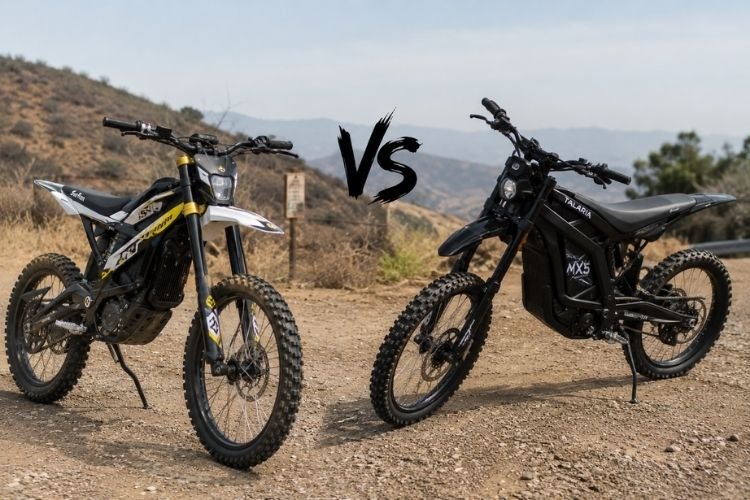
Choosing between the Sur Ron Ultra Bee vs Talaria MX5 is more complicated than comparing peak power or top speed. Both are serious electric dirt bikes, but they approach performance from two noticeably different directions.
The Talaria Sting MX5 is closer to the lightweight e-moto formula that made this category popular in the first place. It combines strong electric performance with relatively compact dimensions, making it attractive to riders who want something quick, agile, easy to transport, and entertaining on mixed terrain.
The Sur Ron Ultra Bee takes a bigger step toward a traditional dirt bike. Its larger chassis, more substantial suspension platform, and motorcycle-like proportions make it better suited to riders who want their electric bike to feel closer to a conventional off-road motorcycle.
That difference matters more than a few horsepower.
A lighter bike can be easier to maneuver through tight trails, easier to recover after a mistake, and much easier to load into a truck. A larger chassis can provide more stability, rider room, and confidence when speeds rise and terrain becomes rough.
So the real question isn’t simply:Which bike is faster? It’s: Do you want the lighter, more playful character of the Talaria MX5, or the larger, more dirt-bike-like platform of the Sur Ron Ultra Bee?
That’s the question we’ll answer throughout this comparison.
If you want the shortest possible answer, choose the Talaria MX5 if lightweight handling, compact size, easier transportation, and strong performance for the money matter most. Choose the Sur Ron Ultra Bee if you want a larger motorcycle platform, more traditional dirt-bike ergonomics, and a chassis better suited to riders pushing into serious off-road terrain.
Neither bike wins every category.
The MX5 makes a compelling case for riders moving up from smaller e-motos or anyone who wants plenty of electric performance without moving to a substantially larger motorcycle. Its size is part of its appeal rather than something Talaria needs to apologize for.
The Ultra Bee makes more sense when the rider wants the electric equivalent of moving toward a conventional dirt-bike experience. Its larger dimensions and chassis can feel more natural to riders coming from motorcycles, particularly when riding faster and rougher terrain.
Our early recommendation looks like this:
| Rider Priority | Better Fit |
|---|---|
| Lightweight, playful handling | Talaria MX5 |
| Larger dirt-bike feel | Sur Ron Ultra Bee |
| Easier transportation | Talaria MX5 |
| Tight recreational trails | Talaria MX5 |
| Larger-rider ergonomics | Sur Ron Ultra Bee |
| Rougher, faster off-road riding | Sur Ron Ultra Bee |
| Compact e-moto experience | Talaria MX5 |
| Motorcycle-like platform | Sur Ron Ultra Bee |
This distinction will become more important as we look at power, battery capacity, suspension, and handling.
Specifications for electric dirt bikes can vary by model year, market, distributor, and configuration. For that reason, buyers should verify the exact current version before ordering rather than assuming an older YouTube review or dealer listing represents every 2026 bike.
More importantly, specifications should be used to explain the riding experience—not replace it.
| Category | Talaria Sting MX5 | Sur Ron Ultra Bee |
|---|---|---|
| Bike Category | Lightweight/high-performance e-moto | Mid-size electric dirt bike |
| Electrical Platform | 72V-class | 74V-class |
| Peak Power | Around 13.4 kW class* | Around 12.5 kW class* |
| Battery | Approx. 72V 40Ah class* | Approx. 74V 55Ah class* |
| Character | Compact and playful | Larger and more motorcycle-like |
| Handling Priority | Agility | Stability/capability |
| Best Terrain | Mixed recreational/trail | More demanding off-road riding |
| Transportation | Easier | More demanding |
| Best Buyer | E-moto rider wanting performance | Rider wanting a bigger dirt-bike platform |
*Specifications can differ by market and model year. Verify current manufacturer/distributor specifications before publication or purchase.
One thing immediately stands out: peak power alone doesn’t tell you which bike is faster or better.
The MX5 can have a very competitive peak-output figure while carrying less motorcycle underneath the rider. The Ultra Bee combines strong output with a larger battery and more substantial chassis.
That creates two very different riding experiences even when the numbers on a specification table appear relatively close.
This is the most important thing to understand before buying either bike.
The Talaria MX5 and Sur Ron Ultra Bee overlap enough in performance and price consideration that shoppers naturally compare them. But physically, they aren’t simply two versions of the same idea.
The Talaria MX5 remains closer to the lightweight e-moto category.
That means compact dimensions, relatively low mass, and a riding character that rewards quick direction changes. Riders coming from mountain bikes, smaller electric dirt bikes, or previous Talaria-style platforms may find it immediately familiar.
The Ultra Bee moves further toward conventional off-road motorcycle territory.
Its larger physical platform changes the experience. The bike feels more substantial underneath the rider and provides the type of proportions that can be more comfortable for larger riders or people accustomed to traditional dirt bikes.
Neither approach is automatically superior.
Consider two riders.
Rider A spends weekends exploring relatively tight trails, occasionally transports the bike in a truck or van, likes jumping between dirt and casual recreational riding, and values a motorcycle that’s easy to move around the garage.
Rider B is coming from a gasoline dirt bike, rides rough terrain at higher speeds, wants more room to move around the chassis, and doesn’t mind dealing with a larger motorcycle.
Even before discussing maximum power, Rider A is probably better aligned with the MX5 while Rider B is more naturally aligned with the Ultra Bee.
This is why buying based on a specification sheet alone can lead to the wrong decision.
The electric dirt bike industry is moving toward bigger batteries and increasingly powerful motors. That progress is exciting, but every performance upgrade comes with engineering tradeoffs.
Battery capacity is a good example.
More battery cells can store more energy, which can increase range and support stronger sustained performance. But cells have mass. A larger battery therefore adds weight unless improvements in cell technology or the rest of the motorcycle offset it.
Weight affects almost everything.
It influences acceleration, braking, suspension workload, direction changes, transport, and how difficult the bike is to recover when things go wrong.
This is why the MX5’s more compact approach has real value.
On tighter trails, a lighter motorcycle requires less physical effort to change direction. If the front wheel starts heading toward the wrong line, the rider has less mass to correct. If the motorcycle tips over on an awkward hill, getting it upright can be easier.
That doesn’t appear on a horsepower chart.
But after three hours of trail riding, it matters.
For buyers specifically attracted to this lighter e-moto philosophy, this is also where a natural product decision begins: if you want the MX5 because of its combination of strong performance and compact dimensions, moving to the Ultra Bee isn’t necessarily an “upgrade”—it’s moving into a different type of motorcycle.
The Ultra Bee answers the same engineering problem differently.
Instead of trying to stay as close as possible to lightweight e-moto dimensions, it provides a more substantial chassis designed around riders who want a motorcycle-like off-road experience.
The advantage becomes clearer as speed and terrain difficulty increase.
When a motorcycle hits bumps, rocks, braking holes, or jump landings, the suspension and chassis need to control the forces involved while keeping the tires connected to the ground. A platform designed around more serious off-road riding can provide greater stability and rider confidence in those conditions.
Physical size also affects ergonomics.
A taller or heavier rider may feel cramped on smaller e-motos. A larger cockpit gives the rider more room to move forward and backward, stand comfortably on the pegs, and use body position to influence traction.
For someone coming directly from a conventional dirt bike, this can make the Ultra Bee feel more natural.
The tradeoff is predictable: you have more motorcycle to manage.
That matters when loading it into a vehicle, turning around on a narrow trail, maneuvering at walking speed, or picking it up after a crash.
So the Ultra Bee’s larger chassis is both one of its biggest strengths and one of the clearest reasons some riders should choose the MX5 instead.
Power figures receive enormous attention in electric dirt bike comparisons, but they need context.
The Talaria MX5 operates in roughly the 13.4 kW peak-output class, while commonly published Ultra Bee specifications place it around the 12.5 kW class, depending on exact model-year and market configuration.
Looking at those figures alone could lead someone to conclude that the MX5 simply wins the performance comparison.
That’s too simplistic.
Acceleration depends on much more than peak motor output. Motorcycle weight, rider weight, gearing, controller calibration, battery voltage under load, tire traction, and how long peak output can be sustained all influence what the rider actually feels.
Peak power is also different from continuous power.
A motor and controller may be capable of delivering a high output for a short period, but sustained hard riding creates heat in the motor, battery, controller, and electrical connections. Thermal management therefore matters when performance is repeatedly demanded rather than used for one short acceleration run.
This is why a single kW figure should never determine which bike you buy.
The MX5’s combination of strong peak output and lower overall mass gives it an excellent power-to-weight story.
Power-to-weight matters because the motor isn’t accelerating horsepower—it is accelerating mass.
Imagine applying similar force to two objects of different weights. Everything else being equal, the lighter object accelerates more easily.
Electric motorcycles are more complicated than that simple example, but the underlying principle still applies.
The Talaria’s relatively light package can make acceleration feel immediate and lively, particularly from lower speeds. It fits the personality of the bike: responsive, compact, and playful.
The Ultra Bee also delivers strong electric torque, but the sensation is attached to a more substantial chassis. Rather than feeling like an extremely powerful lightweight e-moto, it feels closer to a proper dirt motorcycle being driven by an electric powertrain.
Which sensation is better comes down to preference.
For quick recreational riding, tight trails, and riders who enjoy a lively bike, the MX5 has a strong argument.
For riders who want strong acceleration combined with a larger chassis and more planted feel, the Ultra Bee may be more satisfying.
Top-speed discussions require the same caution as power figures.
Real-world maximum speed can vary with battery state of charge, rider weight, tire choice, terrain, wind, temperature, gearing, electronic restrictions, and model configuration.
GPS speed and dashboard-indicated speed may also differ.
Rather than obsessing over a few mph, buyers should consider how frequently they expect to ride near maximum speed.
If most of your riding happens on tighter trails, the difference between two theoretical top-speed figures may have almost no practical value. Acceleration, throttle control, traction, suspension, and handling will affect your experience much more frequently.
If you spend substantial time on fast open terrain, stability becomes increasingly important—and that begins to favor the larger physical philosophy of the Ultra Bee.
Sustained high-speed riding also has another consequence that is often overlooked:
battery consumption rises rapidly as speed increases.
At higher speeds, aerodynamic drag becomes a major source of resistance. Neither motorcycle has the aerodynamic bodywork of a road-focused machine, so pushing rider and bike through the air continuously requires substantial energy.
That means “which is faster?” and “which has better range?” cannot be treated as completely separate questions.
This is where the comparison becomes more useful.
The Talaria MX5 can feel faster than its size suggests because strong electric output is packaged into a relatively light motorcycle. Immediate throttle response and low mass make acceleration events feel energetic.
The Ultra Bee feels more substantial and planted. Its performance exists inside a larger motorcycle platform, which can inspire more confidence as terrain becomes rough and speeds rise.
So we wouldn’t describe this simply as:
MX5 = faster
or
Ultra Bee = faster.
A better description is:
MX5 = lighter, more energetic performance.
Ultra Bee = larger, more motorcycle-like performance.
That difference is likely to influence your buying decision far more than a small top-speed advantage under one particular test condition.
After comparing the basic architecture and performance philosophy, we can already separate the buyers fairly clearly.
Lean toward the Talaria MX5 if you value low weight, compact dimensions, easier transportation, playful handling, and strong factory performance without moving into a larger motorcycle class.
Lean toward the Sur Ron Ultra Bee if you are comfortable with more size and weight in exchange for a more substantial chassis, roomier ergonomics, and a riding experience closer to a conventional dirt bike.
For shoppers already interested in purchasing, this is a good point to compare the current Talaria MX5 and Sur Ron Ultra Bee product configurations available from E-SOUL rather than comparing old specification sheets from different model years. Battery configuration, included equipment, pricing, and availability can affect which represents better value at the time you buy.
The first major lesson from the Sur Ron Ultra Bee vs Talaria MX5 comparison is that choosing between them based purely on peak power is a mistake.
The Talaria MX5’s appeal comes from combining serious electric performance with a lighter and more compact e-moto platform. That can make it easier to maneuver, transport, recover on technical terrain, and enjoy at lower or moderate speeds.
The Sur Ron Ultra Bee offers something different. Its larger chassis moves closer to a conventional dirt motorcycle, providing a more substantial riding position and a platform better aligned with riders who prioritize stability, rough-terrain capability, and traditional motorcycle proportions.
Neither philosophy is universally better.
Part 1 established the biggest difference between these bikes: the Talaria MX5 packages serious electric performance into a relatively compact e-moto, while the Sur Ron Ultra Bee moves closer to the dimensions and behavior of a traditional dirt bike.
That difference becomes even more important once we leave the spec sheet.
Battery capacity affects more than range. Weight changes more than acceleration. Suspension matters differently on a smooth fire road than it does through repeated rocks and braking bumps. If you’re deciding which bike to buy, these real-world differences are much more useful than simply awarding a point to whichever model has the bigger number.
The Ultra Bee’s larger battery system gives it an obvious advantage in stored energy compared with the more compact battery package used by the MX5. That matters if your rides are long enough to use the additional capacity.
But battery comparisons need context.
A larger battery stores more energy, yet the motorcycle carrying that battery may also be heavier. Rider weight, speed, elevation, terrain, tire pressure, temperature, and throttle behavior all affect consumption.
This is why advertised range should never be treated as a guaranteed number.
For example, a rider cruising moderate forest roads may achieve much better efficiency than someone repeatedly accelerating hard up steep, loose climbs. Sustained high speed can also consume energy surprisingly quickly because aerodynamic drag rises rapidly with speed.
The practical distinction is simpler.
The Ultra Bee makes more sense if longer riding sessions and additional energy capacity are important to you. The MX5 makes more sense if your rides already fit comfortably within its battery capacity and you would rather avoid carrying the additional size and mass of a larger platform.
More battery is valuable when you use it. If you regularly return home with 50% remaining, carrying substantially more capacity may not improve your experience very much.
If we had to choose one factor buyers underestimate most, it would be weight.
A few extra pounds don’t sound dramatic on a product page. On a trail, those pounds need to be accelerated, stopped, turned, supported by the suspension, and occasionally picked up off the ground.
This is where the MX5 makes one of its strongest arguments.
Its more compact platform is easier to manage through tight terrain. Quick direction changes require less physical effort, and correcting a bad line can feel more natural. Smaller riders may also appreciate having less motorcycle underneath them.
Then imagine dropping the bike halfway up an awkward hill.
Peak horsepower suddenly becomes irrelevant.
You need to stop, position yourself, lift the motorcycle, turn it toward a usable line, and start again. A lighter bike can make that entire process less exhausting.
The Ultra Bee trades some of this agility for a more substantial feel. At higher speeds, that can become an advantage. The larger chassis feels more aligned with traditional off-road motorcycle behavior, particularly when the trail becomes open, rough, and fast.
So this category doesn’t have one universal winner:
Tight, playful terrain → MX5
Fast, rough terrain → Ultra Bee
Suspension is one of the clearest reasons not to compare these motorcycles using power alone.
A suspension system has to control the mass of the motorcycle while allowing the wheels to follow uneven terrain. When riding speeds increase, the energy involved in impacts increases dramatically.
On smoother trails and recreational terrain, the MX5’s lighter platform works in its favor. There is simply less mass for the suspension to control, and the bike’s agility can make it extremely entertaining.
As terrain becomes rougher, the Ultra Bee’s more motorcycle-oriented chassis begins to make a stronger argument.
Repeated rocks, braking bumps, larger compressions, faster descents, and jump landings place greater demands on suspension travel, damping control, chassis geometry, and rider position. A platform built closer to conventional dirt-bike dimensions gives the rider more room to work with the motorcycle.
That doesn’t mean an Ultra Bee automatically has perfect suspension for every rider.
Suspension setup still matters.
Rider weight, speed, sag, compression, rebound, terrain, and personal preference can dramatically change how either motorcycle feels. Before replacing expensive components, riders should first make sure the stock suspension is correctly adjusted for their weight and riding style.
Braking performance is another area where motorcycle class matters.
Brakes convert kinetic energy into heat. The faster and heavier the motorcycle-and-rider combination becomes, the more energy the braking system needs to manage.
The MX5 benefits from having less motorcycle to slow down. For normal recreational riding, that contributes to its responsive feel.
The Ultra Bee carries more mass, but its braking system exists within a larger motorcycle platform designed around more substantial off-road performance.
In real-world riding, however, tire grip frequently determines stopping performance before brake power becomes the only limitation.
An extremely powerful brake cannot produce maximum deceleration if the front tire immediately loses traction on loose dirt.
This is why tires, suspension, rider technique, surface conditions, and brake setup all work together.
For either bike, riders who increase power or speed through modifications should also reconsider braking capability. Building a motorcycle that accelerates much harder without improving its ability to stop is poor performance engineering.
This is one of the easiest categories to call.
The Talaria MX5 has the stronger argument for tight recreational trails.
Lower mass and compact dimensions make a difference when constantly changing direction. On narrow wooded trails, switchbacks, and slower technical sections, the rider doesn’t need a large chassis or enormous battery capacity to have fun.
The MX5 can feel more like something you’re playing with rather than something you’re managing.
This also helps riders who aren’t particularly large or strong. When a foot goes down unexpectedly or the bike begins leaning farther than intended, less mass can make recovery easier.
The Ultra Bee remains completely capable in tight terrain, but its advantages aren’t being fully used there. You are carrying the size and weight of the larger platform without necessarily benefiting from its increased stability and motorcycle-like proportions.
If 80% of your riding consists of tight trails and casual exploration, this should weigh heavily in favor of the MX5.
Reverse the terrain and the answer begins to change.
As speed increases, stability becomes more important. The motorcycle encounters bumps with greater energy, the suspension works harder, and small rider inputs can produce larger consequences.
This is where the Ultra Bee’s larger chassis becomes more valuable.
A rider coming from conventional dirt bikes may also feel more comfortable standing and moving around a larger platform. That additional room becomes useful when using body position aggressively through rough terrain.
The MX5 can still be ridden fast, but eventually you begin asking a compact e-moto to behave like a larger dirt motorcycle.
That is an important boundary for buyers to recognize.
If your goal from day one is high-speed off-road riding, it can make more sense to buy the motorcycle designed closer to that purpose rather than modifying the smaller platform until it approximates one.
Steep climbs are a good example of why peak kilowatts don’t automatically determine the better off-road bike.
The motor needs enough torque to maintain momentum, but the rear tire also needs enough grip to transfer that torque into the ground.
Once the tire spins, additional motor output can become counterproductive.
The MX5’s lower weight can help in technical climbing because the motor has less motorcycle mass to move uphill. The lighter chassis can also be easier to reposition if the rider stops halfway up.
The Ultra Bee provides a more substantial platform and can feel more planted, particularly for experienced motorcycle riders.
Which works better depends heavily on the climb.
A narrow, awkward, low-speed climb may favor the MX5’s agility.
A faster, rougher climb where stability and chassis control matter more may favor the Ultra Bee.
Throttle technique, tires, body position, and momentum can influence the outcome more than a small difference in peak power.
This is where buyers need to be realistic about intended use.
A lightweight motorcycle can feel excellent in the air because less mass is being moved. But landing forces still need to travel through the wheels, suspension, frame, and rider.
Occasional recreational jumps are very different from repeatedly riding a motocross-style track or hitting larger features at speed.
For riders progressing toward genuinely aggressive off-road riding, the Ultra Bee’s larger motorcycle platform becomes more appropriate.
The MX5 can be modified extensively, and there is a strong aftermarket around high-performance e-motos. But suspension upgrades, wheels, brakes, tires, and other chassis modifications can quickly become expensive.
This brings us back to an important buying principle:
Don’t buy the lighter bike simply because it’s cheaper if you already know you’re going to spend thousands turning it into the larger bike you actually wanted.
On the other hand, don’t buy an Ultra Bee just because it looks more serious if your actual riding never requires that capability.
For many beginners, the MX5 is the easier recommendation.
Its compact dimensions and lower weight reduce the physical intimidation factor. There is less motorcycle to catch at low speed, and maneuvering around a driveway, garage, or beginner riding area can feel easier.
Electric power also eliminates traditional clutch and gearbox management on both bikes, allowing riders to concentrate on throttle control, braking, body position, and balance.
The Ultra Bee’s larger chassis isn’t inherently difficult to ride, but beginners need to consider physical confidence as well as motor performance.
Power can be controlled.
Weight cannot be electronically removed when the motorcycle starts falling toward the ground.
For taller riders or people with previous motorcycle experience, however, the Ultra Bee’s larger ergonomics may actually feel more natural.
So our beginner recommendation would be:
Smaller/newer rider → MX5
Larger rider or motorcycle-experienced beginner → consider Ultra Bee
At this stage, the comparison is becoming much clearer.
| Riding Situation | Better Fit | Why |
|---|---|---|
| Tight wooded trails | MX5 | Lower weight and agility |
| Casual recreational riding | MX5 | Compact and easy to manage |
| Smaller rider | MX5 | Less physical motorcycle to control |
| Frequent transportation | MX5 | Easier loading and storage |
| Rough high-speed trails | Ultra Bee | Larger, more stable platform |
| Larger/taller rider | Ultra Bee | More motorcycle-like ergonomics |
| Aggressive off-road riding | Ultra Bee | Chassis better aligned with harder use |
| Traditional dirt-bike rider | Ultra Bee | Familiar physical proportions |
| Technical low-speed riding | Depends | MX5 agility vs Ultra Bee stability |
| Long riding sessions | Ultra Bee advantage | Larger energy capacity can matter |
This is also where product selection becomes easier.
A buyer choosing the Talaria MX5 isn’t necessarily sacrificing an Ultra Bee. They may deliberately be choosing lower weight and compact dimensions.
Likewise, someone choosing the Sur Ron Ultra Bee isn’t simply paying for a larger version of the same idea. They are moving toward a more substantial off-road motorcycle platform.
By this point, the choice between the Sur Ron Ultra Bee and Talaria MX5 should not come down to which motorcycle wins the most categories. It should come down to how much of each bike’s capability you will actually use.
Pricing can vary significantly by dealer, market, shipping costs, promotions, and model-year configuration, so current prices should always be checked before buying. More importantly, the cheapest purchase price does not necessarily produce the lowest ownership cost.
The Talaria MX5 can offer stronger value for riders who specifically want a lightweight, high-performance e-moto. You get serious performance without paying for—or carrying—the larger motorcycle platform of the Ultra Bee.
The Sur Ron Ultra Bee can justify its higher position for riders who would otherwise spend heavily modifying a smaller bike to improve suspension, brakes, ergonomics, wheels, or off-road capability.
That distinction matters.
Imagine buying an MX5 because it costs less, then immediately planning major suspension, wheel, brake, and chassis-related upgrades because you want to ride increasingly aggressive terrain. At some point, the lower initial purchase price stops being an advantage.
On the other hand, buying an Ultra Bee for casual neighborhood riding and easy forest trails may mean paying for capability you rarely use.
Value isn’t about buying the cheapest bike. It’s about buying the bike that needs the fewest expensive changes to do what you want it to do.
Both motorcycles benefit from one of the major advantages of electric drivetrains: fewer traditional engine-related service requirements.
There is no engine oil to change, no spark plug, no fuel system, and no conventional gasoline engine requiring valve adjustments. But “less maintenance” should never be confused with “maintenance-free.”
Electric dirt bikes still have wheels, bearings, brakes, suspension components, chains, sprockets, tires, fasteners, electrical connectors, controllers, motors, and high-voltage battery systems.
How the motorcycle is ridden also matters enormously.
A lightly ridden stock bike used on moderate trails lives a very different life from a heavily modified bike repeatedly subjected to jumps, mud, deep water, hard impacts, and sustained high-current riding.
This is why isolated owner reports should be treated carefully. One failed component posted on a forum does not automatically establish a widespread design defect.
When evaluating either motorcycle, distinguish between normal wear, poor maintenance, modification-related failures, crash damage, and genuine recurring problems.
For long-term ownership, keeping the bike reasonably close to its intended operating envelope generally reduces risk.
Routine ownership is relatively straightforward on both platforms.
Typical maintenance includes checking tire pressure and tread, monitoring brake-pad and rotor wear, cleaning and lubricating the chain, inspecting sprockets, checking wheel and steering bearings, inspecting suspension components, checking spoke tension where applicable, and making sure critical fasteners remain properly torqued.
Battery care matters too.
Avoid leaving a lithium-ion battery completely discharged for extended periods, follow the manufacturer’s charging recommendations, and avoid unnecessary exposure to extreme heat. If the motorcycle has been ridden hard and the battery is very hot, allowing temperatures to normalize before charging can also be sensible depending on manufacturer guidance.
The Ultra Bee’s larger motorcycle platform may eventually involve somewhat more motorcycle-sized consumables and components, while the MX5’s lighter design can reduce loads in certain areas. But riding style can easily overwhelm those differences.
An aggressive MX5 rider can consume tires, brake pads, chains, and bearings faster than a relaxed Ultra Bee owner.
The rider often determines maintenance cost as much as the motorcycle does.
Both platforms can be modified, but buyers should decide why they want modifications before spending money.
There is nothing wrong with customizing a motorcycle because building it is part of the hobby.
The problem starts when modifications are being used to correct a purchasing decision.
If you buy an MX5 and immediately want substantially more suspension capability, larger-bike ergonomics, stronger brakes, different wheels, and a more planted chassis, you may have actually wanted an Ultra Bee-class motorcycle.
Similarly, buying an Ultra Bee and then trying to remove weight and make it feel as compact and playful as an MX5 works against the reason the larger platform exists.
Power modifications deserve additional caution.
Increasing controller output or changing the battery and motor configuration can increase stress throughout the system. More acceleration can increase demands on tires, brakes, drivetrain components, battery connections, and thermal management.
A balanced motorcycle is usually more useful than a dyno number.
Before modifying either bike, ask:
What problem am I actually trying to solve?
If you cannot answer that question, ride the stock motorcycle longer before ordering parts.
For riders focused on recreational riding, agility, easier transportation, and strong performance in a compact package, the Talaria MX5 may provide the better value.
For riders who want a more substantial off-road platform and expect to push into rougher, faster terrain, the Ultra Bee may provide better long-term value, even if the initial cost is higher.
Here’s the buying logic in simpler terms:
| Priority | Better Choice |
|---|---|
| Lower-cost entry into serious performance | Talaria MX5 |
| Lightweight handling | Talaria MX5 |
| Easier transportation | Talaria MX5 |
| Compact e-moto character | Talaria MX5 |
| Larger dirt-bike feel | Ultra Bee |
| Rougher terrain | Ultra Bee |
| More room for larger riders | Ultra Bee |
| Aggressive off-road progression | Ultra Bee |
| Minimal need for major chassis upgrades | Depends on intended riding |
Don’t automatically choose the MX5 because it costs less, and don’t automatically choose the Ultra Bee because it’s larger.
Buy for the riding you expect to do—not the riding you imagine doing once a year.
The Talaria MX5 is the stronger choice for riders who want performance without giving up the advantages of a lightweight e-moto.
It makes particular sense for riders moving up from smaller electric platforms. The additional performance is meaningful, but the motorcycle still retains the compact, playful personality that attracts many people to this category.
It is also easier to recommend when transportation matters. If you’re regularly loading your bike, working with limited garage space, or riding trails where you occasionally need to physically move the motorcycle around obstacles, lower weight becomes an everyday benefit.
The ideal MX5 buyer is someone who can say:
“I want a fast, capable electric bike, but I specifically don’t want something as large as a traditional dirt bike.”
That’s not settling for less motorcycle. It’s choosing the right amount of motorcycle.
The MX5 is especially worth considering if you:
If that describes your riding, the Talaria Sting MX5 available from E-SOUL is the more natural product to investigate first.
The Ultra Bee is aimed at a different rider.
It makes more sense if you have conventional motorcycle experience, want more physical room, ride faster and rougher terrain, or simply prefer the planted behavior of a larger off-road platform.
For these buyers, the Ultra Bee’s extra size isn’t a disadvantage that needs to be tolerated. It’s part of what they’re buying.
The ideal Ultra Bee buyer can say:
“I want an electric dirt bike that feels closer to a real off-road motorcycle than a lightweight e-moto.”
The Ultra Bee is particularly compelling if you:
If those priorities match your riding, the Sur Ron Ultra Bee available from E-SOUL deserves the closer look.
There are also riders for whom neither motorcycle is ideal.
If you need extremely long backcountry range with rapid energy replenishment, a gasoline dirt bike may still be easier to manage. Carrying additional fuel is considerably simpler than carrying another large traction battery, and refueling takes minutes.
At the other end of the spectrum, riders who mainly want casual low-speed transportation may not need the performance or off-road capability of either bike.
And if your goal is full-size competition-level electric motocross or enduro riding, a machine such as the Stark VARG or VARG EX belongs to another category entirely.
Understanding motorcycle class prevents expensive buying mistakes.
| Model | Pros | Cons |
|---|---|---|
| Talaria MX5 | Lighter, compact, agile, easier to transport, strong power-to-weight feel, excellent recreational versatility | Less substantial than Ultra Bee for aggressive terrain, smaller ergonomics may not suit everyone, major upgrades can reduce its value advantage |
| Sur Ron Ultra Bee | Larger chassis, motorcycle-like ergonomics, strong rough-terrain potential, planted feel, better fit for riders moving from dirt bikes | Heavier, harder to transport, less playful in tight terrain, additional capability may be unnecessary for casual riders |
The important point is that many of these “cons” are simply the opposite side of each motorcycle’s design philosophy.
The MX5 is smaller because compactness is one of its advantages.
The Ultra Bee is heavier because it is a more substantial motorcycle.
That is why there is no meaningful winner without first defining the rider.
Not for everyone. The Ultra Bee is better suited to riders wanting a larger, more dirt-bike-like platform for rougher and faster terrain. The Talaria MX5 is often the better choice for riders who prioritize lower weight, compact dimensions, agility, and easier transportation.
Peak power and top-speed figures alone don’t provide a reliable answer. Acceleration and maximum speed depend on motorcycle weight, gearing, battery state, controller calibration, rider weight, tires, terrain, and market-specific configuration. The MX5’s strong power-to-weight ratio can make it feel extremely lively, while the Ultra Bee delivers its performance through a larger, more planted chassis.
The Ultra Bee’s larger energy capacity gives it an advantage for riders who need longer riding sessions, but real-world range depends heavily on speed, elevation, terrain, temperature, rider weight, tire pressure, and throttle use. Buyers should compare battery energy in watt-hours rather than relying only on advertised mileage.
For tight and slower recreational trails, the MX5’s lower weight and compact dimensions are major advantages. For faster, rougher, more demanding off-road terrain, the Ultra Bee’s larger chassis becomes more valuable.
It can be, particularly for riders who are comfortable with its performance and receive proper instruction. Its lower weight can make low-speed handling and recovery easier than a larger motorcycle. However, it remains a powerful motorized vehicle and should not be treated like an ordinary bicycle.
It can work for larger riders or beginners who already have some motorcycle experience, but its additional size and weight require more physical confidence. New riders should use appropriate riding modes where available, learn progressive throttle control, and wear proper protective equipment.
The Talaria MX5. Its smaller and lighter platform generally makes loading, unloading, storage, and transport easier. Always verify the actual motorcycle weight against the rated capacity of your hitch carrier, rack, ramp, or trailer.
The Ultra Bee will generally make more sense for riders who prefer larger motorcycle ergonomics. Rider fit is personal, however, so seat height alone shouldn’t determine the decision. Peg position, handlebar location, standing posture, and overall cockpit space also matter.
Do not assume either motorcycle is automatically street legal simply because it has electric propulsion or resembles an e-bike. Classification and equipment requirements vary by state and local jurisdiction in the United States. Check your state DMV and relevant local regulations before riding on public roads.
After comparing power, battery capacity, range, weight, handling, suspension, braking, trail performance, maintenance, and value, our conclusion is straightforward:
Buy the Talaria MX5 if you want a lightweight, powerful, playful e-moto. Buy the Sur Ron Ultra Bee if you want a larger electric motorcycle that feels closer to a conventional dirt bike.
The MX5 is especially compelling because it doesn’t need to beat the Ultra Bee at being a larger motorcycle.
That’s not its job.
Its strength is delivering enough performance to be seriously entertaining while retaining the agility, manageable dimensions, and everyday convenience that made lightweight electric motorcycles appealing in the first place.
The Ultra Bee becomes the better choice when your priorities move toward higher-speed off-road riding, rough terrain, larger rider ergonomics, and a more substantial chassis.
For many buyers, the decision can therefore be reduced to one question:
Do you want less motorcycle to manage, or more motorcycle to work with?
Choose the MX5 if the answer is less weight, more agility.
Choose the Ultra Bee if the answer is more chassis, more dirt-bike feel.
Most importantly, don’t let a small difference in peak kilowatts make the decision for you. Power is only one part of motorcycle performance. The bike that best matches your terrain, body size, transportation needs, skill level, and riding style is the bike that will provide the most value after the excitement of the specification sheet wears off.
Electric motocross and electric enduro motorcycles can look very similar, and in some cases they even share the same motor,
Electric enduro motorcycles are becoming an increasingly appealing option for riders who want strong acceleration, precise low-speed control, and less

Electric enduro motorcycles are becoming an increasingly appealing option for riders who want strong acceleration, precise low-speed control, and less
The Talaria XXX Pro and Talaria Sting R MX4 are two popular options for riders looking for a lightweight electric
