Electric Motocross vs Electric Enduro: What’s the Difference?
Electric motocross and electric enduro motorcycles can look very similar, and in some cases they even share the same motor,
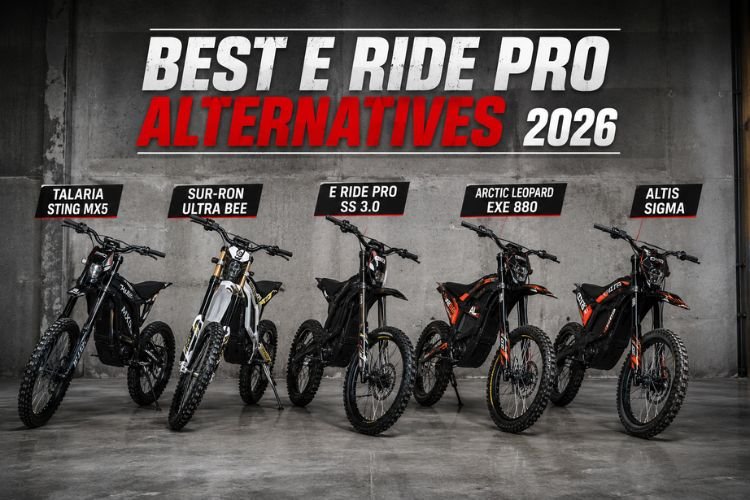
E Ride Pro helped raise expectations for what a lightweight electric dirt bike could deliver from the factory. Instead of buying a lower-powered e-moto and immediately planning a battery and controller upgrade, riders could get a high-voltage platform, serious acceleration, and motorcycle-level speed in a relatively compact package. That formula remains attractive in 2026, but E Ride Pro is no longer competing in an empty market.
Talaria has moved deeper into the high-performance category with the MX5 Sting Pro. Altis has attracted performance-focused riders with the Sigma. Sur Ron still offers both the exceptionally well-supported Light Bee X and the larger Ultra Bee, while newer alternatives target riders who prioritize battery capacity, value, or different chassis characteristics.
That makes choosing between them more complicated than comparing peak kilowatts. The Best E Ride Pro Alternatives 2026 are alternatives for different reasons. Some offer a more established aftermarket, some provide a lighter and more customizable platform, and others make more sense for riders who actually need a larger motorcycle rather than an increasingly powerful lightweight e-moto.
This guide focuses on those differences. Instead of asking which bike has the biggest number on its specification sheet, we’ll look at which E Ride Pro alternative makes the most sense for the way you actually ride.
Before looking at each motorcycle in detail, it helps to understand why it belongs on the list. An alternative doesn’t need to beat E Ride Pro in every category. It needs to offer a meaningful reason for a particular rider to choose it instead.
| Model | Best For | Why Consider It | Main Tradeoff |
|---|---|---|---|
| Talaria MX5 Sting Pro | Best Overall Alternative | Strong 72V package and established platform | More weight than some lightweight e-motos |
| Altis Sigma | Performance-Focused Riders | Very strong factory performance | Can be excessive for newer riders |
| Sur Ron Light Bee X | Customization | Huge aftermarket and low weight | Much lower stock performance |
| Sur Ron Ultra Bee | Riders Wanting a Bigger Bike | More substantial chassis and motorcycle feel | Significantly heavier |
| Arctic Leopard EXE 880 | Battery-Focused Riders | Large-battery philosophy and trail potential | Smaller ownership ecosystem |
| Rawrr Mantis X | Value-Conscious Riders | Accessible route into capable electric off-road riding | Less mature aftermarket |
| E Ride Pro itself | Riders Wanting Factory Performance | Still a strong benchmark in its category | Not automatically best for every rider |
The final row is intentional. Looking for an alternative doesn’t necessarily mean you should avoid E Ride Pro. In some cases, after comparing the competition, an E Ride Pro may still be the motorcycle that best matches the buyer.
E Ride Pro’s biggest contribution to the lightweight electric dirt bike market was helping move high-performance hardware closer to the factory floor. Older e-moto ownership often followed a predictable path: buy the motorcycle, enjoy it for a while, then begin researching a controller, higher-voltage battery, brakes, suspension, wheels, and other upgrades. Eventually, the “affordable” motorcycle could contain thousands of dollars in aftermarket parts.
Higher-output factory platforms changed that calculation. Riders could spend more upfront but potentially avoid an immediate electrical rebuild. E Ride Pro became part of that shift, and competitors have responded with increasingly capable stock motorcycles.
So why buy something else?
One reason is platform maturity. Sur Ron and Talaria have large owner communities and extensive accumulated knowledge. Replacement components, troubleshooting information, aftermarket upgrades, and setup advice can be easier to find. For someone planning to keep a motorcycle for years, that ecosystem has real financial value.
Another reason is weight and handling. A rider spending most of the day on narrow technical trails may prefer a lighter motorcycle even if it produces less peak power. Conversely, someone who is tall, rides faster terrain, or wants more conventional dirt-bike ergonomics may be better served by stepping up to something like the Ultra Bee rather than pushing a compact platform further.
Battery priorities matter too. A rider concerned primarily with long trail sessions may evaluate battery energy and efficiency more heavily than acceleration. Another rider may rarely travel far enough for maximum range to matter and instead prioritize low weight.
This is why there isn’t one universal “E Ride Pro killer.” There are simply motorcycles that solve different problems better.
Peak power is useful, but it has become one of the most overused numbers in electric dirt bike marketing. A higher peak-kilowatt figure doesn’t automatically mean a motorcycle will be faster everywhere or better to ride.
Peak output tells you how much power a system can deliver under particular conditions for a limited period. Trail riding involves much more than that. Throttle calibration, continuous output, battery voltage, controller behavior, motor temperature, gearing, traction, battery state of charge, and power reduction under heat can all influence real performance.
Battery specifications deserve the same caution. Amp-hours alone aren’t enough when comparing packs operating at different voltages. Watt-hours or kilowatt-hours give a more useful picture of total stored energy, although even a larger battery doesn’t guarantee better real-world range. Weight, motor efficiency, tires, speed, terrain, elevation, and riding style still matter.
For a meaningful comparison, consider the complete package: power, battery energy, usable range, weight, chassis, suspension, brakes, ergonomics, parts availability, dealer support, aftermarket depth, and total ownership cost.
That is the standard we’ll use throughout this guide.
If someone asked for one motorcycle to put at the top of an E Ride Pro comparison list, the Talaria MX5 Sting Pro would be difficult to ignore.
The MX5 represents Talaria’s move beyond the 60V performance level associated with the MX4 Sting R. Its widely sold configuration uses a 72V 40Ah battery and is commonly listed at around 13.4 kW peak output. That puts it firmly into the modern high-performance lightweight e-moto category rather than simply making it a slightly updated MX4.
But the electrical specifications aren’t the only reason it works as an E Ride Pro alternative. Talaria already has an established platform, a large rider community, familiar gearbox-based drivetrain architecture, and a healthy aftermarket. Those factors make the MX5 attractive to buyers who want modern factory performance without moving to a completely unfamiliar ownership ecosystem.
The MX5 also received stronger braking hardware to support the additional performance. That is important because a higher-output controller and battery aren’t especially useful if the rest of the chassis still feels designed for a much slower motorcycle.
The strongest reason is balance.
The MX5 doesn’t need to win every maximum-performance comparison to make sense. It offers a combination of strong 72V performance, compact handling, established Talaria knowledge, gearbox durability, aftermarket availability, and enough factory hardware that many riders don’t need to immediately rebuild it.
For someone coming from an MX3, MX4, or another Talaria, staying within the same broader platform can also feel familiar. Maintenance philosophy, community knowledge, and many aspects of the riding experience aren’t completely new.
The gearbox is another point of differentiation. Talaria uses a reduction gearbox rather than the belt-primary arrangement associated with some competing lightweight platforms. The gearbox requires periodic lubricant service, so it isn’t maintenance-free, but some off-road riders prefer the robust mechanical design and absence of a primary belt.
As discussed in our detailed Talaria MX5 buying guide, one of the MX5’s biggest advantages is that it can remain largely stock. Riders may eventually change tires, ergonomics, protection, or suspension setup, but there is less pressure to immediately purchase an expensive battery and controller simply to get exciting performance.
This is where model-specific comparisons become important.
E Ride Pro has continued to develop its lineup around aggressive factory performance, so buyers shouldn’t compare a current MX5 against an old E Ride Pro specification chart and assume the result applies to every model. An E Ride Pro SS and a higher-performance E Ride Pro model aren’t necessarily the same buying proposition.
Depending on the exact E Ride Pro version being considered, riders may find stronger headline performance or other hardware advantages on the E Ride side. Current pricing can also change the value calculation considerably.
The right way to decide is to compare the exact two motorcycles available from dealers today, including battery configuration, output, brakes, suspension, warranty, and delivered price.
Choose the MX5 because its complete platform fits you—not because one specification happens to look better in isolation.
For a trail-focused rider who wants strong performance but also values an established Talaria ecosystem, the MX5 is one of the safest alternatives to consider. It feels like a logical evolution of the lightweight e-moto formula rather than a completely different category of motorcycle.
E Ride Pro remains attractive to buyers who prioritize aggressive factory output and prefer its particular combination of battery, controller, chassis, and equipment. Dealer location matters as well. A good E Ride Pro dealer ten miles away may be more valuable than buying a theoretically preferable Talaria from a seller that provides little after-sales support.
This illustrates an important theme that applies throughout this guide: once performance reaches this level, support and fit begin to matter more than small specification differences.
Both motorcycles are fast enough that most trail riders won’t spend much time using maximum speed. What they will notice every ride is throttle response, weight, ergonomics, suspension, braking, and whether replacement parts are easy to obtain.
The Altis Sigma belongs near the top of this list because it targets exactly the type of rider who might otherwise be attracted to E Ride Pro: someone who wants serious factory performance and doesn’t want to immediately build a high-output electrical system themselves.
The Sigma has gained attention by pushing the lightweight electric dirt bike concept toward increasingly motorcycle-like performance. That makes it very different from recommending a stock Sur Ron Light Bee X as an alternative. With the Sigma, performance itself is one of the primary reasons to consider the bike.
This matters because buyers in this segment are no longer satisfied by hearing that a motorcycle can become fast after thousands of dollars in upgrades. Increasingly, they want the motor, battery, controller, brakes, and chassis to arrive from the factory as a coherent package.
The Sigma is therefore most relevant to experienced riders who already know they want substantial power.
A specification-table comparison between Altis Sigma and E Ride Pro can quickly become outdated because model years, firmware, configurations, and E Ride Pro variants change. Rather than declaring a permanent winner from one peak-power number, it is more useful to compare the riding priorities behind each platform.
The Sigma makes a particularly strong case for buyers who put factory performance near the top of the list. Its appeal is less about being an inexpensive beginner e-moto and more about giving performance-oriented riders a machine with serious capability before modifications begin.
E Ride Pro competes with a similar philosophy, which is why dealer support, actual purchase price, battery specification, suspension setup, braking, ergonomics, and real-world performance become important tie-breakers.
For many riders, the fastest bike on paper isn’t necessarily the fastest bike through a technical trail. Power that constantly overwhelms rear-wheel traction doesn’t create useful speed. A controllable throttle, balanced chassis, good tires, and suspension that keeps the wheel connected to the terrain can matter just as much.
The Sigma makes the most sense for someone who already has experience with powered two-wheel vehicles and wants a high-performance electric platform without beginning with a lower-output machine.
It is also a logical choice for riders who know that buying a lower-powered e-moto will lead immediately to expensive upgrades. Starting with a stronger factory system can reduce the need to replace major electrical components later.
On the other hand, a beginner who primarily wants to learn trail riding may gain very little from choosing the most aggressive option available. Lower weight, predictable response, and manageable power can build skills more effectively than maximum acceleration.
That is why “best performance alternative” shouldn’t be confused with “best alternative for everyone.”
These two bikes illustrate how quickly the word “best” becomes subjective.
The Sigma is particularly compelling for performance-focused buyers. The MX5 answers with Talaria’s established platform, gearbox architecture, broad familiarity, and a very balanced combination of power and lightweight handling.
A rider who wants the most aggressive factory experience may naturally lean toward the Sigma. Someone who wants strong performance but places more value on platform familiarity and aftermarket depth may prefer the MX5.
Neither choice should be made without considering parts and service. A motorcycle that performs brilliantly when new still needs brake pads, tires, bearings, controls, drivetrain parts, and potentially proprietary electrical components years later.
This is one reason our broader Altis Sigma ownership and maintenance coverage matters alongside top-speed testing. Performance gets someone interested in a motorcycle; ownership determines whether they remain happy with it.
At first glance, putting the Sur Ron Light Bee X next to modern high-performance E Ride Pro models seems strange. Stock power is not its advantage, and anyone choosing purely from a peak-output table is unlikely to pick the Light Bee X.
But that misses what makes the Sur Ron platform important.
The Light Bee X remains one of the strongest choices for riders who value low weight, huge aftermarket support, parts availability, community knowledge, and almost unlimited customization. It helped create the modern lightweight e-moto category, and years of aftermarket development have produced an ecosystem newer platforms can’t instantly reproduce.
You can find suspension components, brakes, wheels, batteries, controllers, motors, seats, pegs, bars, protection, bodywork, lighting, drivetrain components, and countless smaller accessories. More importantly, thousands of owners have already documented installations, setup combinations, failures, fixes, and compatibility questions.
That accumulated knowledge has real value.
Choose the Light Bee X if you value the platform itself more than maximum stock performance.
A lighter motorcycle can be extremely enjoyable on tight trails. It is easier to maneuver, easier to recover after a fall, easier to load into a vehicle, and less physically demanding when the terrain requires frequent corrections. More power doesn’t eliminate those advantages.
The Light Bee also makes sense for someone who genuinely enjoys modifying motorcycles. Some buyers don’t want a finished product—they want a platform. Choosing the controller, battery, suspension, wheel setup, brakes, and ergonomics is part of the hobby.
In that situation, the Light Bee X remains exceptionally compelling.
The problem is cost. If your goal from day one is to make a Light Bee X perform like a modern high-output 72V e-moto, you need to calculate the complete build cost. A battery and controller alone can dramatically change the economics, and increased performance may encourage further brake, drivetrain, wheel, and suspension upgrades.
At that point, starting with an E Ride Pro, MX5, Sigma, or another stronger factory platform may be financially smarter.
This is one of the most important buying distinctions in the electric dirt bike market.
A stock Light Bee X can be excellent because it is light and approachable. A heavily modified Light Bee can be extraordinarily fast. Those are two different products separated by significant time and money.
E Ride Pro and newer competitors reduce the distance between purchasing and performance. For riders who simply want to unbox a fast motorcycle and ride it, that is a major advantage.
The Sur Ron takes the opposite approach. Its value is partly the enormous freedom to decide what the motorcycle becomes.
Neither philosophy is wrong.
The important thing is knowing which one you’re paying for.
Yes, but for different reasons than several years ago.
It is increasingly difficult to recommend a stock Light Bee X as the obvious choice for someone whose number-one priority is maximum performance per dollar. Newer factory bikes have moved the benchmark considerably.
But maximum performance isn’t the only reason to buy an electric dirt bike.
For riders who value lightness, proven platform knowledge, parts availability, easy customization, and an enormous aftermarket, the Light Bee X remains relevant. A mature platform doesn’t become useless simply because a newer motorcycle has more kilowatts.
In fact, as electric dirt bikes become increasingly powerful and heavier, the simplicity of a genuinely lightweight machine may become more attractive to some riders rather than less.
Part 1 covered three of the most obvious ways to move away from an E Ride Pro: choose the balanced 72V Talaria MX5, move toward factory performance with the Altis Sigma, or sacrifice stock output for the enormous aftermarket and low weight of the Sur Ron Light Bee X. But not every rider looking for an E Ride Pro alternative actually needs another motorcycle from exactly the same lightweight category.
Some riders discover that they want a larger chassis and more conventional dirt-bike ergonomics. Others care more about battery capacity and longer trail sessions than outright acceleration, while value-conscious buyers may prefer to spend less and accept lower stock performance. Those priorities bring several very different motorcycles into the conversation.
The Sur Ron Ultra Bee is not a direct E Ride Pro equivalent, and that’s precisely why it deserves a place here. Instead of trying to extract more and more performance from a compact Light Bee-style chassis, the Ultra Bee moves toward a more substantial electric dirt motorcycle with greater chassis size, more motorcycle-like ergonomics, and hardware designed around more serious off-road riding.
For some E Ride Pro shoppers, that is exactly the progression they actually need.
A common mistake in the electric dirt bike market is assuming that more power is always the next upgrade. A rider starts with a lightweight e-moto, becomes comfortable with it, and begins comparing higher-output controllers and batteries. But if the real limitations are cramped ergonomics, suspension capability, wheel setup, braking, or high-speed chassis stability, adding another few kilowatts may not solve the underlying problem.
The Ultra Bee addresses that issue by changing the motorcycle around the powertrain rather than simply increasing output. Its larger format generally feels more planted at speed and gives adult riders more room to move when standing. Suspension and braking are also closer to what riders expect from a serious off-road motorcycle than the bicycle-derived components historically associated with lightweight e-motos.
This comparison is really about agility versus chassis capability.
An E Ride Pro-style lightweight platform is easier to maneuver in tight terrain. Less mass makes quick direction changes easier, reduces the physical effort required when correcting mistakes, and makes the bike less intimidating to lift after a fall. Transport can also be easier, which matters to riders carrying bikes in vans, trucks, hitch carriers, or smaller trailers.
The Ultra Bee asks the rider to accept additional weight in exchange for a more substantial motorcycle. That can be a good trade on faster trails, rough terrain, larger jumps, and riding situations where stability matters more than minimum mass. Taller or heavier adult riders may also prefer the additional room.
This is why the Ultra Bee shouldn’t automatically be called “better” simply because it is bigger. On extremely tight single-track, a lighter E Ride Pro may be more enjoyable. On fast, rough terrain, the Ultra Bee’s chassis can make much more sense.
As covered in our full Sur Ron Ultra Bee Review, the platform’s other major strength is maturity. Sur Ron has a large international owner community, and the Ultra Bee now benefits from substantial aftermarket development. Wheels, suspension components, protection, controls, drivetrain parts, bodywork, and performance upgrades are widely discussed and increasingly easy to source.
Choose the Ultra Bee if you have reached the point where compact e-moto ergonomics feel like the limitation. If you are constantly trying to make a lightweight platform feel like a full-size dirt bike, moving to a larger chassis can be more sensible than continuing to modify the smaller motorcycle.
It is particularly appealing to taller riders, experienced dirt-bike riders moving to electric, and riders spending more time on fast trails or rough open terrain. The established parts and aftermarket ecosystem also makes it attractive for long-term ownership.
Skip it if lightweight maneuverability is the main reason you enjoy electric dirt bikes. The additional size and mass don’t disappear simply because the Ultra Bee has an electric motor.
The Arctic Leopard EXE 880 approaches the buying decision from another direction. Instead of making minimum weight its defining characteristic, the EXE 880 emphasizes a large-battery, substantial electric motorcycle philosophy.
That makes it interesting to riders whose biggest frustration with high-performance electric dirt bikes isn’t insufficient acceleration but range anxiety.
Battery capacity has become increasingly important as electric dirt bikes have become faster. More power can encourage more aggressive riding, and aggressive riding consumes more energy. A motorcycle capable of impressive acceleration isn’t particularly useful on a long trail day if the rider constantly worries about preserving battery percentage.
The EXE 880 therefore deserves attention from riders who value longer sessions and substantial energy storage, although exact battery, power, weight, and equipment specifications should always be verified for the model year and market being purchased. Arctic Leopard motorcycles can appear with differing distributor specifications, making it especially important not to assume every online listing describes the same configuration.
The biggest difference is philosophy.
E Ride Pro has become closely associated with bringing strong performance into the lightweight e-moto space. The EXE 880 leans more heavily toward a substantial battery and motorcycle-like trail platform. That means the comparison shouldn’t be reduced to which one has the larger advertised peak-power number.
Battery capacity can be extremely valuable for riders who regularly cover distance, but energy storage comes with weight. More cells require physical space and mass, and that changes how a motorcycle feels in tight terrain. A bike that offers excellent range on flowing trails may require more effort when navigating repeated switchbacks, lifting the rear end, or recovering from a fall.
The E Ride Pro approach can therefore make more sense for riders prioritizing agility and power-to-weight feel, while the EXE 880 becomes interesting when battery capacity and longer trail sessions move higher on the priority list.
Our detailed Arctic Leopard EXE 880 Review explores this tradeoff more deeply, but the most important buying advice is simple: verify the exact battery specification, actual delivered weight, warranty, and replacement-parts support before ordering.
It is ownership support.
Arctic Leopard doesn’t yet have the same mature North American aftermarket and owner knowledge base associated with Sur Ron. That doesn’t make the motorcycle unreliable or difficult to own by definition, but it changes what a careful buyer should investigate.
Ask the seller whether replacement batteries, controllers, displays, chargers, plastics, and model-specific drivetrain components are stocked. Find out who handles warranty diagnosis and whether parts are available domestically or need to be shipped internationally.
This matters because an electric motorcycle is more than a motor and battery. Tires, brake pads, chains, sprockets, bearings, suspension components, controls, and crash-damaged parts eventually need attention.
A strong dealer can make a newer platform much easier to own. Weak support can make even impressive hardware frustrating.
The EXE 880 makes the strongest case for riders who routinely take longer trail rides and are willing to accept additional mass in exchange for battery capacity and a more substantial motorcycle feel.
It may also appeal to buyers who aren’t committed to the ultra-light e-moto concept and instead want something that moves further toward electric enduro territory.
Riders who spend most of their time on extremely tight technical trails should think carefully about weight. Likewise, buyers who prioritize an enormous aftermarket may find Sur Ron or Talaria easier to support.
For the right use case, though, battery capacity can be more valuable than another small increase in peak output.
Not everyone shopping for an E Ride Pro alternative is looking for something faster.
Some buyers arrive at E Ride Pro because they want a capable electric dirt bike, then realize they don’t actually need maximum factory output. If the motorcycle will be used primarily for recreational trail riding, learning, exploration, or moderate-speed off-road riding, paying for performance that remains unused can reduce value rather than increase it.
This is where a machine such as the Rawrr Mantis X can enter the conversation.
Rawrr has targeted riders who want a capable electric off-road platform without necessarily paying for the highest-output option in the category. The Mantis X therefore needs to be judged on performance per dollar and suitability, not on whether it wins a drag race against the most expensive bikes in this guide.
That distinction matters. “Best value” doesn’t mean “cheapest.” A cheap motorcycle that immediately needs expensive upgrades isn’t necessarily good value. A value-oriented alternative should provide enough battery, chassis capability, braking, suspension, and performance for its intended rider without creating an immediate list of mandatory modifications.
E Ride Pro is the more natural choice for a rider who already knows high factory output is a priority. If strong acceleration and substantial performance headroom are central to the purchase, saving money on a lower-output motorcycle may simply delay the eventual upgrade.
The Mantis X makes more sense for someone who looks at the performance available from modern high-powered e-motos and thinks, “I probably don’t need all of that.”
That can include newer riders, recreational trail riders, and owners who prioritize manageable power over headline figures. A less aggressive motorcycle can also make it easier to concentrate on line choice, braking, balance, and throttle technique rather than constantly managing rear-wheel spin.
Price needs to be evaluated at the time of purchase because promotions and dealer pricing change. Buyers should compare the delivered price rather than MSRP alone, including shipping, assembly, taxes where applicable, and any components they already know they will replace.
This is a surprisingly common mistake.
A buyer saves money by choosing a lower-cost electric dirt bike, then immediately purchases a controller, battery, suspension, brakes, wheels, and other performance components. By the end, the project may cost more than simply buying the higher-performance motorcycle in the first place.
The Mantis X makes the most sense when its stock capability is already close to what you need.
If your first requirement is dramatically more power, buy the bike that provides that power from the factory. If your actual riding rarely requires it, keeping the purchase simpler can save a considerable amount of money.
Our comparison of Rawrr Mantis X vs Altis Delta follows the same principle: specification differences matter, but the better motorcycle depends on the rider’s real use case.
Range is one of the most difficult categories to rank because manufacturers don’t necessarily test under identical conditions. A maximum range achieved at a low constant speed shouldn’t be compared directly with another motorcycle tested under aggressive off-road conditions.
Battery energy provides a useful starting point, but it still isn’t enough. Motorcycle weight, motor efficiency, controller calibration, tires, gearing, temperature, elevation, rider weight, speed, and terrain all affect consumption.
The EXE 880’s battery-focused design makes it especially interesting for riders prioritizing energy capacity, but that doesn’t mean it will automatically travel the farthest in every real-world scenario. Likewise, a lighter motorcycle with a smaller battery may use less energy under some conditions.
The most reliable approach is to look for independent tests conducted under riding conditions similar to your own. A rider spending hours on steep, loose trails needs different data from someone cruising relatively flat fire roads at moderate speed.
If range is your number-one concern, don’t ask only “Which battery is biggest?” Ask “How much energy does this motorcycle use during the kind of riding I actually do?”
For tight terrain, weight becomes increasingly important.
The Sur Ron Light Bee X remains particularly attractive because low mass makes it easy to change direction, catch after a mistake, pivot, and recover. A modern higher-output lightweight platform such as the Talaria MX5 can add significantly more performance while remaining manageable compared with larger motorcycles.
The Ultra Bee and EXE 880 become less obvious choices if the trail consists of extremely tight switchbacks, repeated technical obstacles, and situations where the rider physically moves the motorcycle. Their additional mass can provide stability, but stability isn’t always the priority at walking speed.
This is also why peak power matters less on technical trails than many buyers expect. If traction is limited and the trail never opens enough to use maximum output, a lighter bike with predictable throttle response can be faster and less tiring than a much more powerful motorcycle.
The priorities reverse as terrain opens up.
Higher speeds make chassis stability, suspension quality, braking, ergonomics, and heat management increasingly important. A motorcycle that feels wonderfully playful at 20 mph can become nervous when repeatedly pushed much faster over rough terrain.
This is where the Ultra Bee’s larger chassis becomes particularly attractive. The EXE 880’s substantial construction and battery-focused philosophy may also suit longer, faster trail sessions. Performance-focused machines such as the Altis Sigma remain compelling when acceleration and speed are high priorities.
The important lesson is that the fastest motor doesn’t automatically create the best high-speed motorcycle. The entire chassis has to manage the performance.
Rider height can’t be judged from seat height alone. Standing ergonomics matter much more off-road. The relationship between handlebars, footpegs, seat, steering position, and chassis length determines whether a motorcycle feels comfortable.
Larger motorcycles such as the Ultra Bee naturally deserve attention from taller riders because they provide a more substantial cockpit. Compact lightweight e-motos can still be adjusted with bars, risers, seats, and pegs, but there is a point where modifications are being used to fight the basic dimensions of the chassis.
A tall rider who constantly feels cramped on lightweight platforms should test a larger motorcycle before spending money trying to make a compact bike feel full-size.
Conversely, shorter riders shouldn’t assume a larger bike is automatically better simply because it has more serious off-road hardware. Being able to comfortably manage the motorcycle at low speed matters.
This depends on the rider, but the modern factory-performance bikes have a clear advantage over older upgrade-heavy platforms.
The Talaria MX5 arrives with enough electrical performance for many riders to leave the battery and controller alone. The Altis Sigma similarly targets riders who want substantial factory capability. Larger platforms such as the Ultra Bee provide a more complete chassis starting point for riders who would otherwise spend heavily trying to make a smaller e-moto behave like a conventional dirt bike.
The Light Bee X sits at the opposite end. It can be ridden stock and enjoyed exactly as it comes, but riders chasing modern high-output performance will need significant modifications.
That doesn’t make the Sur Ron poor value. It simply means buyers should decide whether they want a finished performance package or a platform to build.
Parts availability is difficult to make exciting, which is probably why it receives less attention than top speed. But after a year of ownership, it can matter far more.
Tires and chains are relatively easy to source. Proprietary battery connectors, displays, controllers, chargers, body panels, sensors, and model-specific hardware can be different. A motorcycle with excellent specifications becomes inconvenient if one small proprietary component leaves it unusable for weeks.
Sur Ron and Talaria benefit from mature ecosystems. E Ride Pro has also developed a substantial presence as its owner base has grown. Newer or less widely distributed brands need to be evaluated dealer by dealer and region by region.
Before buying any alternative, ask three practical questions: Who fixes it? Who stocks the parts? How quickly can I get them?
Those answers belong in the purchase decision alongside power and range.
This may be the central engineering tradeoff in electric dirt bikes.
More battery energy generally requires more cells, and more cells add weight. Riders understandably want maximum range and minimum mass simultaneously, but physics makes that difficult.
A large battery is valuable when your rides regularly approach the range limits of smaller packs. In that case, carrying the additional mass throughout the ride may be worthwhile because it prevents range from becoming the limiting factor.
If your normal ride uses only half of a smaller battery, carrying substantially more battery every mile may provide little practical benefit. A lighter motorcycle may be more enjoyable instead.
The right battery is therefore not necessarily the biggest one.
It is the one that comfortably covers your typical ride with a reasonable reserve.
After comparing the Talaria MX5 Sting Pro, Altis Sigma, Sur Ron Light Bee X, Sur Ron Ultra Bee, Arctic Leopard EXE 880, and Rawrr Mantis X, one thing becomes clear: there is no single electric dirt bike that replaces E Ride Pro for every rider. The best choice depends on whether you prioritize factory performance, low weight, range, aftermarket support, full-size ergonomics, or value.
That is especially true in 2026. The electric dirt bike market has moved beyond the point where one impressive battery voltage or peak-power figure can define the best motorcycle. Buyers now have enough genuinely capable options that chassis design, parts support, battery capacity, maintenance, dealer network, and the cost of future upgrades deserve just as much attention.
For most buyers, the easiest way to choose isn’t to rank every motorcycle from fastest to slowest. Start by identifying what you want to improve compared with an E Ride Pro. If you want an established 72V platform with strong performance, the Talaria MX5 makes sense. If outright factory performance is the priority, the Altis Sigma deserves attention. If low weight and customization matter more, the Sur Ron Light Bee X remains difficult to replace. Riders wanting a more substantial motorcycle should look closely at the Ultra Bee, while battery-focused riders may find the Arctic Leopard EXE 880 more interesting.
Here is the practical breakdown:
| Rider Priority | Our Pick | Main Reason |
|---|---|---|
| Best Overall Alternative | Talaria MX5 Sting Pro | Balanced performance and established platform |
| Best for Factory Performance | Altis Sigma | High-output factory package |
| Best for Customization | Sur Ron Light Bee X | Massive aftermarket |
| Best for Low-Weight Fun | Sur Ron Light Bee X | Lightweight, playful chassis |
| Best Step Up to a Bigger Bike | Sur Ron Ultra Bee | More substantial motorcycle platform |
| Best for Battery-Focused Riding | Arctic Leopard EXE 880 | Large-battery philosophy |
| Best Value-Oriented Choice | Rawrr Mantis X | Capability without chasing maximum output |
| Best for Taller Riders | Sur Ron Ultra Bee | Larger cockpit and chassis |
| Best for Riders Who Don’t Want Major Power Upgrades | Talaria MX5 / Altis Sigma | Strong stock electrical systems |
| Best Established Ecosystem | Sur Ron | Parts, knowledge, and aftermarket depth |
This table shouldn’t be interpreted as saying one model universally has the best range, reliability, or performance under every configuration. Model years and specifications change, and actual dealer support varies by region. It is better viewed as a shortcut to deciding which motorcycles deserve a closer look based on your priorities.
The Talaria MX5 earns our overall recommendation because it doesn’t depend on dominating a single category. Instead, it combines several things buyers actually use: a 72V architecture, strong factory output, compact handling, improved brakes, Talaria’s gearbox-based drivetrain, and an already well-developed Sting community.
That balance is important. A motorcycle with more power may exist, and a lighter motorcycle certainly exists, but the MX5 offers enough performance that many riders won’t immediately feel pressure to replace the battery and controller. At the same time, it remains closer to the lightweight e-moto category than something like an Ultra Bee.
This makes it particularly attractive for riders upgrading from an MX4, stock Light Bee X, or lower-powered e-moto. The step in performance is meaningful without forcing the buyer into a substantially larger motorcycle.
The MX5 isn’t automatically better than every E Ride Pro model. Depending on the exact E Ride Pro version and current pricing, E Ride may offer stronger factory performance or other hardware advantages. But for someone who values the combination of performance, platform maturity, parts availability, and a broad aftermarket, the MX5 is one of the easiest alternatives to recommend.
For riders who begin the shopping process with performance near the top of the list, the Altis Sigma is a more natural alternative.
The Sigma’s appeal comes from giving the rider a high-performance factory platform rather than expecting them to create one through aftermarket battery and controller upgrades. This is increasingly important because a “cheap” e-moto can become very expensive once a serious electrical build begins.
Performance alone, however, shouldn’t determine the purchase. High output only becomes useful when the tires can generate traction, the suspension controls the chassis, and the brakes can repeatedly manage the speed. Rider experience matters as well. A beginner doesn’t automatically learn faster because the motorcycle has more available power.
For experienced riders who know they will quickly outgrow lower-output platforms, starting with a Sigma can make much more financial sense than buying a cheaper motorcycle and rebuilding the powertrain.
The Light Bee X demonstrates why specification sheets don’t tell the entire story.
Its stock performance is no longer class-leading compared with newer high-voltage e-motos. If your only goal is maximum factory output for the money, there are stronger choices.
Yet the Light Bee X remains one of the easiest electric dirt bikes to customize. Years of aftermarket development mean owners can choose from an enormous range of batteries, controllers, suspension, wheels, brakes, motors, seats, pegs, handlebars, protection, bodywork, and drivetrain components.
More importantly, there is an enormous amount of community knowledge surrounding those upgrades. Someone has probably already attempted the modification you’re considering, documented the installation, identified compatibility issues, and explained the result.
That maturity is difficult for newer platforms to replicate quickly.
The Light Bee X therefore remains an excellent alternative for riders who want their electric dirt bike to become a long-term project. If you want maximum performance straight out of the box, choose differently. If building the motorcycle is part of the experience, the Sur Ron remains highly relevant in 2026.
Some riders shouldn’t buy another lightweight e-moto at all.
If you are tall, regularly ride rough terrain at higher speeds, or find yourself repeatedly upgrading a compact motorcycle’s suspension, wheels, brakes, and ergonomics, the underlying chassis may be the real limitation.
The Ultra Bee solves that problem by moving into a larger category. It feels more substantial, provides more room for adult riders, and offers a platform better suited to riders who want something closer to a conventional dirt motorcycle.
The price is weight. An Ultra Bee won’t feel as easy to flick through tight terrain as a Light Bee X, and picking it up on a difficult slope requires more effort. Transport can also become more demanding.
But riders who keep trying to make lightweight e-motos feel bigger should seriously consider starting with the bigger motorcycle.
The Arctic Leopard EXE 880 deserves attention for a different reason: battery capacity and longer-session potential.
This can matter enormously because high-performance electric dirt bikes encourage aggressive riding, and aggressive riding consumes energy quickly. Riders who regularly approach the usable range of smaller batteries may benefit more from additional energy storage than from additional peak power.
The tradeoff is mass. Battery cells have weight, and a larger energy reserve can make a motorcycle more demanding on very tight technical terrain.
The other consideration is ownership support. Arctic Leopard doesn’t yet benefit from an ecosystem as mature as Sur Ron’s. Before buying, confirm who provides warranty support and whether proprietary components such as the battery, charger, controller, display, and bodywork can be sourced reasonably.
With good dealer support, the EXE 880 can be a compelling option for riders whose trail days are limited more by battery capacity than by motor performance.
The Rawrr Mantis X represents an important reminder that the best E Ride Pro alternative doesn’t necessarily need more power.
If your normal riding consists of moderate trail speeds, learning, exploration, and recreational off-road use, paying for extreme performance can be unnecessary. A lower-cost motorcycle that already satisfies your needs can provide better real-world value.
The Mantis X makes the most sense when you intend to use it relatively close to stock. If you buy it because it costs less and then immediately decide to install a much more expensive battery, controller, suspension, brakes, and wheels, the value advantage can disappear quickly.
This rule applies to every motorcycle in the guide: buy the platform that already solves most of your requirements. Upgrades are most economical when they fine-tune a good match, not when they attempt to transform the wrong motorcycle into something else.
Beginners should resist the assumption that the highest-output motorcycle is the best long-term purchase because they can “grow into it.”
There is some truth to buying enough capability for future progression, but early riding skills are built around throttle control, balance, braking, line choice, body position, and cornering. None of those skills requires maximum peak power.
A lighter and more manageable platform can therefore make a better learning tool. The Sur Ron Light Bee X remains appealing in this respect because of its low weight and approachable character, while value-focused alternatives can also make sense depending on rider size and experience.
The Talaria MX5 can work for riders with previous mountain-bike, e-bike, scooter, or motorcycle experience, particularly when using less aggressive power settings. However, a completely new rider should treat its performance seriously.
Electric motorcycles remove the clutch and manual gearbox from the learning process. They do not remove the consequences of poor throttle control at motorcycle speeds.
Experienced riders can approach the decision differently because they are more likely to understand which limitations actually matter.
Someone coming from gas dirt bikes may prefer the Ultra Bee because the larger chassis and ergonomics feel familiar. A rider experienced with lightweight e-motos may prefer the MX5 or Sigma because they preserve much of the compact character while providing substantially stronger performance.
The important question is whether your experience has taught you to value power or chassis more.
If the bike feels good but constantly runs out of performance, a higher-output lightweight platform makes sense. If the motor is already fast enough but the chassis feels cramped or unsettled, buying an even more powerful compact bike may solve the wrong problem.
“Trail riding” covers everything from narrow woodland single-track to fast desert routes, so there is no universal winner.
For tight trails, lighter platforms generally make more sense. The Light Bee X remains exceptionally manageable, while the MX5 adds substantially more performance without moving all the way into a larger motorcycle class.
For faster and rougher trails, the Ultra Bee becomes more attractive because its chassis can provide additional stability and room. Riders covering longer distances may place more value on battery-focused platforms such as the EXE 880.
The best trail bike is therefore determined partly by the trail itself.
A 20-minute test ride on pavement won’t tell you everything you need to know. Whenever possible, evaluate how a motorcycle behaves in terrain resembling where you actually ride.
Modern electric dirt bikes have reached the point where many riders have more peak power available than they can regularly use on a trail. Range remains a more persistent limitation because every ride eventually depends on the energy remaining in the battery.
That doesn’t mean buyers should automatically choose the largest battery. Additional capacity adds mass, and carrying energy you rarely use can make the motorcycle less agile throughout the entire ride.
Think about your current riding rather than an imaginary maximum adventure. If a typical ride consumes only 40–50% of the battery, adding significant weight for much more capacity may not improve your experience. If you repeatedly return with less than 10%, battery energy deserves greater priority.
The ideal setup has enough capacity to complete your normal ride with a sensible reserve without carrying substantially more battery than you need.
This may be the biggest philosophical choice in 2026.
Modern E Ride Pro models, the Talaria MX5, Altis Sigma, and other newer high-output platforms are increasingly designed for riders who want serious performance immediately. Buy the bike, set it up, and ride.
The Light Bee X represents the traditional build-your-own approach. Its enormous aftermarket allows an owner to decide exactly how much power, battery, suspension, braking, and wheel capability they want.
Building can produce an exceptional motorcycle, but calculate the complete cost before starting. Battery and controller upgrades can represent a major investment, and higher power can expose weaknesses in tires, brakes, suspension, and drivetrain components.
If you already know you want a high-performance 72V-class machine, factory integration can be both simpler and less expensive.
Yes. The existence of good alternatives doesn’t make E Ride Pro a poor choice.
In fact, some people reading this guide will compare every alternative and conclude that E Ride Pro still provides the combination they want. That is a perfectly reasonable outcome.
E Ride Pro remains relevant because it helped normalize strong factory performance in a lightweight electric dirt bike. Riders who want serious acceleration without immediately performing a battery-and-controller conversion have a clear reason to consider the platform.
The important change in 2026 is that buyers have alternatives.
Talaria can compete with an established 72V Sting platform. Altis targets performance-focused riders. Sur Ron provides unmatched platform maturity and a choice between lightweight and larger motorcycles. Arctic Leopard explores a battery-focused direction, while value-oriented alternatives serve riders who don’t need maximum performance.
E Ride Pro no longer needs to be the only answer to be a good answer.
Before paying a deposit, verify the exact model year and configuration. Electric dirt bike specifications can change quickly, and older dealer pages, reviews, and comparison charts may remain online long after a product has been updated.
Confirm battery voltage and capacity, motor output, controller configuration, charger, weight, wheel sizes, suspension, brakes, warranty terms, and what is actually included in the purchase price. More importantly, ask about replacement parts.
Find out whether the dealer can supply a battery, charger, controller, display, brake components, body panels, bearings, drivetrain parts, and crash-damaged hardware. Ask how warranty diagnosis works and who pays for labor or shipping when applicable.
A five-minute conversation about parts support can tell you more about long-term ownership than another hour of top-speed videos.
Electric motocross and electric enduro motorcycles can look very similar, and in some cases they even share the same motor,
Electric enduro motorcycles are becoming an increasingly appealing option for riders who want strong acceleration, precise low-speed control, and less
Electric enduro motorcycles are becoming an increasingly appealing option for riders who want strong acceleration, precise low-speed control, and less
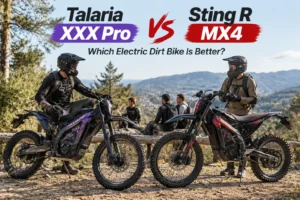
The Talaria XXX Pro and Talaria Sting R MX4 are two popular options for riders looking for a lightweight electric
