Electric Motocross vs Electric Enduro: What’s the Difference?
Electric motocross and electric enduro motorcycles can look very similar, and in some cases they even share the same motor,

The Altis Sigma arrived in the lightweight electric dirt bike market with the kind of specifications that immediately attract attention. High-voltage architecture, more than 20 kW of peak power in earlier production versions, motorcycle-style brakes, a gear-driven powertrain, and 70+ mph performance put it well beyond the traditional idea of a lightweight recreational e-bike.
But impressive numbers don’t automatically make a great electric dirt bike.
Once you move beyond the spec sheet, the more important questions are about how the Sigma actually rides. Is the power controllable? Does its weight become a problem on technical trails? How good are the stock suspension and brakes? What kind of range should owners realistically expect? And perhaps most importantly, is the Altis Sigma worth buying when there are now so many high-performance electric dirt bikes competing for the same rider?
That’s what this Altis Sigma Review is designed to answer. Rather than judging the bike by peak power alone, we’ll look at performance, battery and range, handling, suspension, braking, build quality, maintenance, known ownership considerations, and where the Sigma fits compared with alternatives.
There is also an important model-year issue. The Sigma platform has evolved since its introduction, so older reviews and current specifications shouldn’t always be mixed together. Where specifications differ, we’ll identify the model year rather than presenting every Sigma as the same motorcycle.
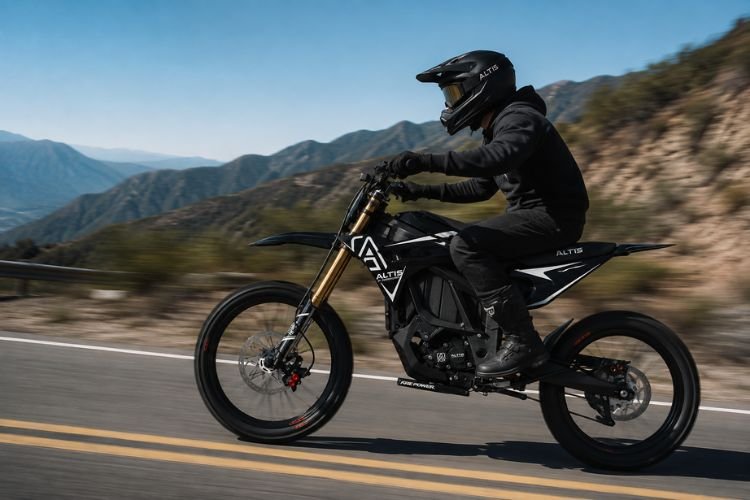
The Altis Sigma is best understood as a high-performance e-moto rather than an ordinary e-bike. Its biggest strengths are abundant power, strong high-speed performance, substantial motorcycle-style components, and a drivetrain designed around the demands of a powerful electric off-road machine.
Independent testing supports much of that performance story. RiderGuide reported an indicated 115 km/h, or about 71.5 mph, during testing of an earlier Sigma and praised its throttle calibration and braking hardware. Electric Cycle Rider’s production-bike test also found the power smooth and abundant, particularly toward the top end.
The Sigma isn’t perfect, however. Its roughly 185-pound class weight makes it substantially more physical than lighter e-motos, and reviewers haven’t agreed on every aspect of the chassis. RiderGuide liked the suspension during its trail test, while Electric Cycle Rider’s riders criticized the standard bike’s front suspension for being too soft during aggressive off-road riding and jumps. Electric Cycle Rider also found the weight more noticeable in tight, technical terrain.
That disagreement is actually useful. It suggests that the Sigma’s chassis may work very well for one type of rider while feeling less suited to another.
| Category | Review Takeaway |
|---|---|
| Power | Extremely strong for this class |
| Acceleration | Smooth, fast and controllable |
| Top Speed | 70+ mph territory for earlier standard versions |
| Range | Strong potential, but highly riding-dependent |
| Handling | Stable, but heavier than many lightweight e-motos |
| Suspension | Capable, though aggressive riders may want firmer setup |
| Brakes | Strong motorcycle-style hardware |
| Build Quality | Solid and substantial |
| Beginner Friendly | Better for riders with previous two-wheel experience |
| Maintenance | Simpler than gas in some areas, but not maintenance-free |
| Overall | Performance-focused bike with real strengths and meaningful tradeoffs |
For riders who prioritize maximum agility and a very lightweight feel, the Sigma may not be the obvious winner. For riders who value power, stability, substantial components, and high-speed capability, it becomes much more compelling.
The Altis Sigma sits in the increasingly competitive space between lightweight e-motos and more traditional electric dirt motorcycles. It isn’t simply a Sur Ron-style platform with a larger controller installed. The design uses a high-voltage battery system, hairpin motor technology, a reduction gearbox, substantial braking hardware, and a chassis intended to cope with significantly more stock power than the early generation of lightweight electric dirt bikes.
That distinction matters because the category itself has changed. Riders used to buy relatively low-powered machines and immediately begin upgrading batteries, controllers, brakes, suspension, and drivetrains. The Sigma takes a different approach: provide much of that performance from the factory.
RiderGuide highlighted this point in its test, noting that the motorcycle-style brakes, suspension, wheels, gearbox, and overall component package reduced the immediate need to replace the kinds of mountain-bike-derived components commonly found on older lightweight e-motos.
That makes the Sigma particularly interesting for riders who don’t want their first step after purchasing a new electric dirt bike to be a long list of upgrades.
One challenge when researching the Altis Sigma online is that specifications have changed over time. Prototype information, early production specifications, 2025 bikes, Sigma MX configurations, and later versions can appear together in search results.
For example, Electric Cycle Rider’s March 2025 production-bike review listed a 97.2V 35Ah Samsung 50S battery, approximately 3.4 kWh of capacity, 22 kW peak power, 185-pound weight, 840 mm seat height, and more than 70 mph top speed for the 2025 Sigma. The standard model used 19-inch wheels front and rear, while the MX paired a 19-inch front with a 16-inch rear.
That’s why shoppers should verify the exact model year and configuration before comparing specifications, ordering parts, or deciding that one review contradicts another.
| Specification | 2025 Production Reference |
|---|---|
| Battery | 97.2V 35Ah Samsung 50S |
| Battery Capacity | Approx. 3.4 kWh |
| Peak Power | 22 kW |
| Top Speed | 70+ mph |
| Weight | Approx. 185 lb |
| Seat Height | 840 mm |
| Ground Clearance | 300 mm |
| Standard Wheels | 19 in front / 19 in rear |
| MX Wheels | 19 in front / 16 in rear |
| Standard Torque | 533 Nm with 39T sprocket |
| MX Torque | 601 Nm with 44T sprocket |
| Front Brake Rotor | 260 mm |
| Rear Brake Rotor | 220 mm |
These figures are useful as a reference for the 2025 production bike, but they shouldn’t automatically be applied to every later Sigma.
Performance is the easiest part of the Sigma to notice and probably the main reason many riders start researching the bike.
A 22 kW-class electric powertrain in a motorcycle weighing around 185 pounds creates a very different experience from a conventional Class 1, 2, or 3 e-bike. Even compared with earlier lightweight electric dirt bikes, the Sigma operates at a much higher performance level.
What makes the power delivery particularly interesting isn’t simply the peak number. Both RiderGuide and Electric Cycle Rider highlighted its controllability. RiderGuide specifically praised the throttle curve, while Electric Cycle Rider described the production bike’s power delivery as smooth rather than excessively abrupt.
That’s important because huge peak power isn’t particularly useful if small throttle movements constantly upset traction.
On loose terrain, riders need to meter power rather than simply access it. The Sigma’s ability to deliver substantial performance without making every throttle input feel like an on/off switch is one of the more important characteristics to consider.
Yes. There isn’t much ambiguity here.
During RiderGuide’s test, the display reached 115 km/h, approximately 71.5 mph, although the reviewer correctly pointed out that speedometers can overstate actual road speed. Electric Cycle Rider also lists the 2025 production bike at more than 70 mph.
That places the Sigma firmly into motorcycle-level speed rather than conventional e-bike territory.
But top speed shouldn’t be confused with useful trail speed. On technical off-road terrain, traction, braking, suspension, rider skill, and throttle control become limiting factors long before a 70+ mph maximum matters.
For most owners, the Sigma’s acceleration and midrange power will therefore be more noticeable than its absolute maximum speed.
We cover gearing, GPS versus display speed, wheel configuration, battery state of charge, and model-year differences separately in our Altis Sigma Top Speed Test. For this review, the important takeaway is simpler: lack of performance is unlikely to be the reason someone outgrows the Sigma.
A strong electric powertrain changes how the motorcycle feels even when you aren’t traveling particularly fast. Electric torque is available without waiting for a conventional combustion engine to build through its rev range, which gives the Sigma strong response when exiting corners or accelerating in open terrain.
Interestingly, Electric Cycle Rider found the production Sigma’s throttle ramp relatively mellow despite the large amount of available power. Their testers saw this as a mixed characteristic: smooth delivery makes the motorcycle easier to control, but riders wanting an extremely sharp response for stunts or aggressive off-road use may prefer different gearing or power delivery.
That’s a much more useful observation than simply saying “the Sigma is powerful.”
For many riders, smooth power is a benefit. Technical terrain often rewards precise throttle control more than maximum aggression. A rider who can use 70 percent of available power effectively may be faster and more confident than someone fighting an overly abrupt 100 percent.
This is where the review becomes more nuanced.
The Sigma’s weight contributes to stability, particularly at higher speeds, but it also separates the bike from lighter and more flickable e-motos. At approximately 185 pounds for the referenced 2025 production version, it isn’t impossibly heavy, but riders moving from a Light Bee-style machine are likely to notice the additional mass.
Electric Cycle Rider’s testers found that weight particularly noticeable in tight turns and technical sections. In its later 2025 multi-bike comparison, the publication again described the Sigma as heavy for the lightweight e-moto group and less ideal in technical terrain than some lighter competitors.
RiderGuide’s experience was somewhat more positive. Its tester reported getting used to the additional weight quickly and praised the bike on faster trail riding.
These aren’t necessarily contradictory conclusions.
A bike can feel stable and confidence-inspiring on faster, flowing terrain while simultaneously requiring more effort on tight technical trails. That’s why the type of riding you do matters so much when evaluating the Sigma.
Weight is one of the most important characteristics to understand before buying.
A heavier platform can feel planted at speed and substantial underneath the rider. It can also contribute to the impression that the motorcycle is built to handle its power rather than feeling like a lightweight bicycle chassis overwhelmed by a huge motor.
The disadvantage appears when you need rapid direction changes, low-speed corrections, or physical maneuverability. Tight single-track, repeated jumps, awkward stops, and picking up the motorcycle after a fall all make mass more noticeable.
Electric Cycle Rider’s 2025 comparison listed the Sigma at 185 pounds, heavier than several other lightweight electric dirt bikes included in the same test group.
So if your definition of the ideal e-moto is light, flickable and bicycle-like, the Sigma deserves a test ride before buying.
If you prefer stable, substantial and motorcycle-like, the same weight may bother you much less.
Suspension is probably one of the areas where rider preference and terrain have produced the most interesting differences in published reviews.
RiderGuide came away impressed with the suspension during trail riding and described the bike’s overall component quality positively. Electric Cycle Rider’s production-bike testers were more critical. During aggressive riding, they found the front suspension too soft, with noticeable dive during cornering and insufficient support during jumps and rougher sections.
This tells prospective buyers something important: don’t evaluate suspension solely by the component list.
Rider weight, speed, terrain, setup, and riding style can dramatically change the experience. A setup that works well for fast recreational trails may feel under-supported to an aggressive rider repeatedly hitting jumps and whoops.
Before immediately budgeting for replacement suspension, however, riders should first make sure the stock setup is adjusted correctly for their weight and use. Tire pressure and riding position can also influence how the front end feels.
For aggressive motocross-style use, suspension setup deserves particular attention during a test ride.
Wheel configuration changes the character of the motorcycle.
The referenced 2025 standard Sigma uses a 19-inch front and 19-inch rear setup, while the MX uses a 19-inch front and 16-inch rear. The MX also uses gearing that increases wheel torque compared with the standard configuration. Electric Cycle Rider reported 533 Nm with the standard 39T sprocket and 601 Nm with the MX’s 44T setup.
For riders focused heavily on dirt, the smaller rear wheel can provide a more traditional off-road tire choice and different traction characteristics. RiderGuide’s tester specifically noted that he would have preferred the 16-inch rear configuration for more technical trail riding.
The standard 19/19 configuration makes more sense for riders who value higher-speed riding and the familiar lightweight e-moto wheel format.
Neither version is universally better. The right choice depends on whether your riding priorities lean toward open speed or technical off-road control.
A motorcycle with this much performance needs brakes that match it.
This is an area where the Sigma generally makes a strong impression. The 2025 production specifications include a 260 mm front rotor and 220 mm rear rotor, along with regenerative braking functionality.
RiderGuide was particularly positive about the braking hardware, describing the system as proper motorcycle-style equipment and reporting no noticeable brake fade during its test ride.
That’s significant because high-performance lightweight e-motos have historically been criticized for pairing increasing motor power with components derived from mountain bikes.
The Sigma moves farther away from that approach.
Of course, brake performance isn’t permanent. Pad wear, rotor condition, contamination, fluid condition, rider weight, and long descents can all change how the system performs over time. Strong stock brakes still require inspection and maintenance.
This is another area where specifications alone can’t provide the answer.
Published testers have generally found the Sigma to feel substantial and well built. Electric Cycle Rider described the production bike as solid with a premium appearance, while RiderGuide praised the wheels, suspension, brakes, gearbox, and overall component quality.
There have also been criticisms. Electric Cycle Rider noted rear-area clanking during its test that the team couldn’t immediately identify, and its later multi-bike comparison mentioned chain slap and linkage noise. Those observations didn’t prevent the motorcycle from operating, but they’re worth including in a serious ownership review rather than pretending every detail is perfect.
This is exactly why build quality should be evaluated over time.
A motorcycle can look excellent when new. What matters to an owner is whether fasteners remain secure, bearings stay tight, plastics hold up, drivetrain noise remains normal, suspension seals stay healthy, and electrical systems continue operating consistently after repeated off-road use.
We’ll return to those questions in the reliability and ownership sections.
Power and top speed may be what first attract riders to the Altis Sigma, but battery performance, range, ergonomics, reliability, and maintenance determine whether the bike remains enjoyable after the first few rides. This is also where comparing specification sheets becomes less useful. Two riders can own the same Sigma and report very different range, tire life, or suspension impressions simply because they ride differently.
For a buyer, the better question isn’t whether the Sigma produces impressive numbers. Part 1 already established that it does. The question now is whether the complete ownership experience supports that level of performance.
The 2025 production Sigma uses a 97.2V 35Ah Samsung 50S battery pack, giving it approximately 3.4 kWh of nominal energy capacity. That is a substantial battery for a relatively compact electric dirt bike, but battery capacity alone doesn’t tell you how far the motorcycle will travel on a charge.
Electric Cycle Rider lists the 2025 Sigma with a claimed range of approximately 50 to 60 miles, depending on riding conditions. That’s useful as a manufacturer-style reference point, but it shouldn’t be interpreted as a guaranteed trail range for every rider. Aggressive off-road riding can produce dramatically different energy consumption from steady riding at moderate speeds.
This distinction is particularly important on the Sigma because the bike gives riders access to a lot of power. Hard acceleration, sustained high speeds, repeated hill climbs, soft terrain, and a heavier rider can all increase energy consumption. Temperature, tire pressure, wheel setup, and elevation also influence the final result.
So when someone asks, “What is the real-world range of the Altis Sigma?”, the most accurate answer isn’t one fixed number. The useful answer depends on how the motorcycle is ridden.
A rider cruising smoothly on relatively flat terrain can expect a very different result from someone repeatedly using high power on steep trails. That’s why range comparisons should always include context.
Imagine two Sigma owners starting with the same battery percentage. One spends the ride maintaining moderate speeds on flowing trails. The other repeatedly accelerates hard, climbs steep hills, and uses higher speeds whenever terrain opens up. Even if both riders cover similar distances, their remaining battery percentages may be very different.
This doesn’t mean published range figures are meaningless. They provide a reference point. But for ownership planning, your own repeated rides are much more valuable.
After several rides, owners usually begin learning how much battery their normal route consumes. That information eventually becomes more useful than asking whether another rider achieved a particular mileage figure.
For longer rides, leaving an energy reserve is sensible. Arriving back with some battery remaining is far better than planning every trip around a theoretical maximum.
Yes, and the effect becomes increasingly important as speed rises.
At higher speeds, aerodynamic drag increases significantly. The motor therefore needs more energy simply to maintain speed. Aggressive acceleration adds another demand because repeatedly accelerating the combined mass of the bike and rider consumes energy.
This creates an interesting contradiction in high-performance electric motorcycles: the Sigma’s power makes high-speed riding easy, but consistently using that performance is one of the fastest ways to reduce range.
For many riders, the best balance comes from using strong power when it provides a real benefit while riding more efficiently between demanding sections.
You don’t need to ride slowly all the time to preserve range. You simply need to understand that maximum performance and maximum range cannot occur simultaneously.
Battery state of charge isn’t only a question of how many miles remain.
An electric powertrain operates within voltage, current, temperature, and battery-management limits. As battery conditions change throughout a ride, available performance may not feel identical under every circumstance.
This is particularly relevant when comparing acceleration or top-speed tests. A run performed with a high battery state of charge shouldn’t automatically be compared with another performed much later in the battery cycle.
Owners are better served by paying attention to consistency. If the Sigma behaves predictably at similar battery percentages and temperatures, that’s more useful than expecting identical performance from 100% down to the final portion of every charge.
If performance suddenly changes far more than expected or the motorcycle displays battery or controller warnings, that’s when further inspection becomes appropriate.
Charging is one of the biggest lifestyle differences between an electric dirt bike and a gas motorcycle.
With gasoline, refueling takes minutes. With an electric motorcycle, charging becomes something you plan around riding. For many owners, that isn’t difficult once it becomes part of the routine, but it does require a different mindset.
The battery system is also too valuable to treat charging casually. Owners should use the charging equipment specified for the motorcycle and follow the current Altis instructions regarding charging sequence, temperature, storage, and electrical safety.
Avoid damaged connectors, questionable third-party charging solutions, or charging equipment that isn’t designed for the system. If the charger, battery, or connector behaves abnormally, becomes unusually hot, produces an unusual odor, or triggers warnings, stop and investigate rather than repeatedly attempting to charge.
Good battery habits aren’t exciting, but they’re an important part of long-term electric motorcycle ownership.
Temperature deserves more attention than it usually receives in electric dirt bike reviews.
Lithium-ion batteries generally perform best within an appropriate temperature range. Cold conditions can temporarily reduce available performance and range, while repeated exposure to excessive heat can contribute to accelerated battery aging.
This means a winter ride and a warm-weather ride shouldn’t automatically be expected to produce identical range.
Storage matters too. Leaving a battery in an extremely hot environment for extended periods can be very different from simply riding on a warm day. Owners who won’t use the motorcycle for an extended period should follow the manufacturer’s recommendations for storage temperature and battery state of charge.
Battery degradation is a long-term process, so a short review cannot responsibly tell you exactly how many years an individual Sigma battery will last. Usage cycles, temperature, charging habits, storage, and riding conditions all influence that answer.
Ergonomics are easy to overlook when shopping online because they’re difficult to represent with numbers.
Seat height, handlebar position, peg placement, rider triangle, and motorcycle width all influence whether a bike feels natural. RiderGuide noted that the Sigma’s seat is relatively firm, while also finding the overall riding position comfortable during its test.
For off-road riding, seated comfort isn’t the only consideration. Riders spend significant time standing, particularly on rough terrain. The relationship between the bars, pegs, and controls therefore matters just as much as seat padding.
This is another reason rider height alone can’t determine fit. Two people of the same height can have different inseams, arm lengths, riding experience, and preferences.
If possible, sit on or test ride the Sigma before buying. A specification chart can tell you seat height. It can’t tell you whether the motorcycle feels natural underneath you.
The Sigma’s motorcycle-like dimensions may appeal to riders who find smaller lightweight e-motos cramped, but fit remains personal.
Taller riders should pay particular attention to standing position. If you feel excessively folded at the knees or have to bend too far forward while standing, bar position and other ergonomic adjustments may help.
Shorter riders face the opposite issue. The motorcycle’s mass matters more when stopping on uneven terrain if getting both feet comfortably to the ground is difficult.
Weight and seat height therefore need to be considered together.
A heavier motorcycle that fits your body well can sometimes feel easier to manage than a lighter motorcycle with awkward ergonomics.
This is where a responsible review needs to be careful.
The Sigma is still a relatively young platform compared with motorcycles that have accumulated many years of owner data. That means it’s premature to make sweeping statements such as “the Sigma will easily last ten years” or “the battery will definitely last X miles.”
Reliability needs time and mileage.
What can be evaluated is how the main systems behave as owners accumulate miles: battery consistency, motor operation, gearbox behavior, chain and sprocket wear, suspension, brakes, bearings, electronics, fasteners, and charging equipment.
The Sigma also deserves to be judged according to how it is used. A bike ridden gently on clean trails isn’t experiencing the same mechanical stress as one repeatedly jumped, ridden through mud, or subjected to maximum-power acceleration.
This is why our Altis Sigma After 1,000 Miles discussion is more useful for long-term ownership questions than a first-ride review. Mileage begins revealing patterns that simply can’t appear during a short test.
No serious review should hide potential drawbacks. At the same time, isolated owner complaints shouldn’t automatically be presented as universal defects.
One commonly discussed characteristic is drivetrain noise. Electric Cycle Rider noted chain slap and linkage-related noise in its testing, while its production review mentioned clanking from the rear area that the testers couldn’t immediately identify. That doesn’t mean every Sigma develops a drivetrain problem, but it does make chain condition, tension, alignment, and rear suspension hardware worth monitoring.
Weight is another consideration rather than a defect. At roughly 185 pounds for the referenced 2025 configuration, the Sigma is heavier than several lightweight e-moto competitors. Riders moving from lighter machines may notice that mass most in tight technical terrain or when physically moving the motorcycle.
Suspension setup has also received mixed feedback. As discussed in Part 1, some testers have been happy with the chassis, while more aggressive riders have found the front suspension too soft. That makes rider weight and intended terrain particularly important.
Finally, buyers should consider service and parts access before purchasing any relatively new electric motorcycle platform. Performance is only one part of ownership. Replacement components, technical information, warranty support, and service options become much more important after something wears or breaks.
Not necessarily.
Chain noise can occur for several reasons, and an electric motorcycle makes drivetrain sounds particularly easy to hear because there’s no combustion engine masking them.
What matters is whether the sound is normal for the drivetrain or accompanied by excessive slack, unusual wear, damaged components, poor alignment, or recurring adjustment problems.
Owners should follow the specified chain-tension procedure rather than simply tightening the chain until the noise disappears. An overly tight chain can create its own problems by placing unnecessary loads on drivetrain and suspension components.
If chain behavior changes suddenly or requires unusually frequent adjustment, inspect the system rather than treating the symptom alone.
The Sigma eliminates many traditional combustion-engine maintenance jobs, but the motorcycle itself still lives a difficult life.
Dirt, water, vibration, impacts, braking forces, suspension movement, and high drivetrain torque don’t disappear because the motor is electric.
Owners still need to inspect and maintain tires, brake pads and rotors, the chain and sprockets, suspension components, bearings, wheels, controls, fasteners, and electrical connections.
The Sigma’s reduction gearbox is another important point. Unlike an electric drivetrain that owners might assume requires no lubricant service at all, the reduction system uses gear oil and should be maintained according to the manufacturer’s schedule.
This is why we describe the Sigma as lower in combustion-related maintenance, not maintenance-free.
For detailed service intervals and inspection procedures, our Altis Sigma Maintenance Guide covers the subject separately.
There’s no single annual maintenance budget that applies to every Sigma owner.
Tires can last a relatively long time for one rider and disappear quickly for another. The same applies to brake pads, chains, and sprockets.
Aggressive acceleration increases rear-tire and drivetrain wear. Long descents increase brake wear. Mud, water, and sand increase cleaning and inspection requirements. Hard landings and rough terrain increase the demands placed on wheels, bearings, and suspension.
Electricity itself is usually not the most significant ownership expense. Consumable motorcycle components are more likely to determine routine costs.
Major electrical components such as the battery, motor, and controller are different. They aren’t ordinary consumables in the same way as brake pads or tires, but replacement can be expensive if required outside warranty coverage.
That’s another reason warranty and parts availability deserve consideration before buying.
This depends heavily on what “beginner” means.
A rider new to the Sigma but experienced with dirt bikes, motorcycles, mountain bikes, or high-powered e-motos may adapt relatively quickly.
Someone who has never ridden a powered two-wheel vehicle is in a very different situation.
The Sigma’s smooth throttle delivery can make its performance easier to control than the peak-power number might suggest, but smooth doesn’t mean slow. The motorcycle has enough acceleration and speed to punish poor throttle control or bad judgment.
A complete beginner should prioritize low-speed control, braking, body position, turning, and throttle discipline rather than trying to access full performance immediately.
Our Altis Sigma for Beginners guide explores that question in greater depth, but the short answer is that the Sigma can be manageable for the right new rider while still offering far more performance than a beginner actually needs.
For some riders, yes. For others, no.
If your typical ride fits comfortably within the battery’s usable range and you have convenient charging access, electric power can be extremely appealing. Instant torque, quiet operation, and reduced combustion-engine maintenance all make the ownership experience different from a gas motorcycle.
The limitation appears when riding duration and rapid refueling matter more.
A gas dirt bike can be refueled in minutes. An electric motorcycle requires charging, which can become restrictive during long riding days unless charging infrastructure and downtime fit your plans.
There are also differences in weight, sound, power delivery, and maintenance that make the two experiences difficult to compare purely by specifications.
The Sigma doesn’t need to replace every gas dirt bike to be successful. It needs to work better for the rider whose priorities align with electric power.
This is an important ownership consideration.
A high-powered motorcycle capable of speeds far beyond conventional e-bike classifications shouldn’t automatically be treated as a street-legal electric bicycle.
Registration, insurance, licensing, equipment requirements, and where the motorcycle may legally operate vary by jurisdiction. Rules can also differ between public roads, OHV areas, private property, bike paths, and recreational trails.
Buyers should check the applicable local regulations before purchasing if public-road use is part of the plan.
This isn’t unique to Altis. It’s an important issue across the increasingly powerful electric dirt bike category.
Once the excitement around acceleration settles down, ownership becomes surprisingly ordinary in some ways.
You charge the bike. You check tires. You inspect the chain. You monitor brake wear. You clean dirt away after messy rides. You listen for anything unusual and periodically perform scheduled maintenance.
The electric drivetrain simplifies certain routines, but the motorcycle still rewards owners who pay attention.
One advantage is that the quieter powertrain makes it easier to hear mechanical changes. A new chain sound, rubbing brake, loose component, or suspension noise can be more noticeable without an engine and exhaust covering it up.
Over time, learning what your Sigma normally sounds and feels like becomes one of the most useful maintenance tools you have.
By this point, the Altis Sigma is easier to understand as a complete motorcycle rather than simply a headline-grabbing electric dirt bike. Its biggest strengths are obvious: strong power, high-speed capability, substantial hardware, and a platform that feels closer to a serious off-road motorcycle than a lightweight recreational e-moto. Its tradeoffs are just as important: weight, range variability, suspension preferences, maintenance expectations, and the reality that not every rider needs this much performance.
That makes the final buying decision much more interesting than asking whether the Sigma is “good.” The better question is whether it is good for the way you actually ride.
A balanced review should make the tradeoffs easy to see.
| Pros | Cons |
|---|---|
| Strong stock power and acceleration | Heavier than many lightweight e-moto competitors |
| 70+ mph performance on earlier standard versions | Real-world range drops with aggressive riding |
| Smooth throttle delivery | Suspension setup may not suit every rider |
| Motorcycle-style brakes and chassis components | More bike than complete beginners need |
| High-voltage battery platform | Still requires chain, gearbox, brake and suspension maintenance |
| Good high-speed stability | Tight technical terrain may highlight the extra weight |
| Less combustion-related maintenance than a gas dirt bike | Charging is slower than refueling |
| Plenty of performance headroom | Street legality varies by location |
The Sigma’s strengths are most valuable to riders who want a substantial, high-performance machine without immediately planning a long list of major upgrades. Its weaknesses are mostly about fit and use case rather than one obvious fatal flaw.
For a performance-focused rider, the Sigma makes a strong case because much of what owners often upgrade on lighter platforms is already built into the package. The battery system, braking hardware, drivetrain, motor output, and chassis are all designed around higher stock performance.
That matters because a cheaper bike can become expensive quickly if the owner immediately adds a controller, battery, suspension, brakes, wheels, and drivetrain parts to reach the performance level they actually wanted.
The Sigma therefore makes the most sense when you value complete factory capability.
It becomes less compelling if your priorities are lower weight, a huge aftermarket ecosystem, maximum range, or the lowest possible purchase price. In those cases, another platform may suit you better even if its headline specifications are lower.
The Sigma is a particularly strong fit for riders who already understand what they want from a high-performance electric dirt bike. Someone upgrading from a Sur Ron Light Bee X, Talaria-style platform, mountain bike, e-bike, or gas dirt bike may appreciate having more power and a more substantial chassis without moving all the way into a much larger motorcycle.
It also makes sense for riders who prefer open trails, faster terrain, hill climbs, and performance-focused riding where the Sigma’s power and stability can actually be used.
The ideal buyer is someone who wants to ride rather than spend the first several months replacing major components.
A complete beginner with very little two-wheel experience may find the Sigma physically and electronically more demanding than necessary. A lighter and less powerful bike can make basic throttle control, braking, balance, and slow-speed maneuvering easier to learn.
Riders who spend most of their time on very tight technical single-track may also prefer something lighter and more flickable. Likewise, someone focused primarily on urban commuting or long-distance road use should think carefully about whether an off-road-focused electric motorcycle is the right tool.
The Sigma is also not the obvious choice for riders who love endless customization. It can certainly be modified, but platforms such as the Sur Ron Light Bee X have much larger mature aftermarket ecosystems.
The Light Bee X remains one of the most important comparison points because it helped define the lightweight electric dirt bike category.
The two bikes, however, now serve different priorities.
The Sur Ron is lighter, easier to customize, and supported by a huge aftermarket. It appeals to riders who enjoy building their own setup over time.
The Sigma offers much stronger stock performance and more motorcycle-style hardware from the beginning. It feels less like a blank canvas and more like a complete high-performance package.
If you value light weight and customization, the Sur Ron remains compelling.
If you value stock power and factory capability, the Sigma has a clearer advantage.
The Ultra Bee is a more relevant comparison for riders who want something more substantial than a Light Bee-style platform.
Both bikes move closer to a true motorcycle feel, but they approach the category differently. The Ultra Bee has a more established ecosystem and traditional dirt-bike character, while the Sigma emphasizes a very high power-to-weight experience and headline electric performance.
If you prioritize outright stock performance and a compact high-output platform, the Sigma may be more attractive. If you value a more mature model ecosystem, broader recognition, and a platform that feels closer to a conventional dirt motorcycle, the Ultra Bee remains a strong alternative.
E Ride Pro is another important competitor because it targets riders who want serious stock performance without immediately modifying the bike.
The comparison becomes more model-year dependent because both brands continue to update their lineups. That makes it risky to reduce the decision to one permanent top-speed or power number.
The broader difference is ownership style. The Sigma emphasizes a very substantial, high-voltage, motorcycle-like package, while E Ride Pro has built a strong reputation around powerful, relatively compact e-motos with growing U.S. dealer support.
For a buyer, dealer access, parts availability, local service, wheel setup, riding style, and ergonomics may matter more than a small difference in peak output.
Talaria generally appeals to riders looking for a balance of performance, value, and approachable handling. The Sigma operates at a higher performance ceiling and feels like a more serious step toward motorcycle territory.
A rider moving from Talaria to Sigma is likely to notice more than just extra speed. The difference includes weight, power delivery, braking demands, chassis feel, and overall ownership responsibility.
Talaria can make more sense for riders who want an easier entry point or a lighter trail machine.
The Sigma makes more sense for riders intentionally seeking a higher-performance platform.
| Bike | Best For | Main Advantage |
|---|---|---|
| Altis Sigma | High-performance riders | Strong stock power and substantial chassis |
| Sur Ron Light Bee X | Customizers and lighter riders | Huge aftermarket and low weight |
| Sur Ron Ultra Bee | Motorcycle-style trail riders | Mature platform and traditional dirt-bike feel |
| E Ride Pro | High-performance e-moto buyers | Strong factory performance |
| Talaria | Value and balanced trail use | Approachable handling and broad appeal |
No single bike wins every category. That is exactly why a good review should focus on rider fit rather than declaring one universal winner.
The Sigma is still young enough that long-term reliability should be discussed carefully. It does not yet have the same multi-year fleet history as older platforms, so claims about lifetime durability should be treated cautiously.
What we can say is that the major ownership areas are now becoming clearer. Owners need to pay attention to chain condition, gearbox service, brakes, tires, suspension, battery care, bearings, fasteners, and electronics. Higher-mileage owner reports are useful, but they remain anecdotal rather than statistically conclusive.
The practical takeaway is that the Sigma should be treated like a performance motorcycle, not a maintenance-free appliance.
For a deeper look at wear and long-term ownership, our Altis Sigma After 1,000 Miles guide covers the subject separately.
Maintenance is easier than many gas dirt bikes in some respects, but not trivial.
There is no traditional combustion-engine service routine, yet the Sigma still has a reduction gearbox, chain drive, brakes, tires, suspension, electrical systems, and chassis components that need inspection and scheduled service.
Owners who understand this tend to have much more realistic expectations.
If you want the full service breakdown, our Altis Sigma Maintenance Guide covers gear oil, chain care, brakes, suspension, battery charging, cleaning, and routine inspections.
It can be, but only for the right type of beginner.
A rider coming from mountain biking, e-bikes, lighter e-motos, motorcycles, or dirt bikes may adapt quickly. A complete beginner with no meaningful two-wheel experience may benefit from something lighter and less powerful first.
The Sigma’s throttle can be smooth, but smooth power is still powerful.
New riders should focus on control, braking, body position, and progressive learning rather than maximum performance.
Our Altis Sigma for Beginners guide goes into much more detail on this question.
Electric motocross and electric enduro motorcycles can look very similar, and in some cases they even share the same motor,
Electric enduro motorcycles are becoming an increasingly appealing option for riders who want strong acceleration, precise low-speed control, and less
Electric enduro motorcycles are becoming an increasingly appealing option for riders who want strong acceleration, precise low-speed control, and less
The Talaria XXX Pro and Talaria Sting R MX4 are two popular options for riders looking for a lightweight electric
