Stark Varg MX vs Stark Varg EX: Key Differences
Electric enduro motorcycles are becoming an increasingly appealing option for riders who want strong acceleration, precise low-speed control, and less

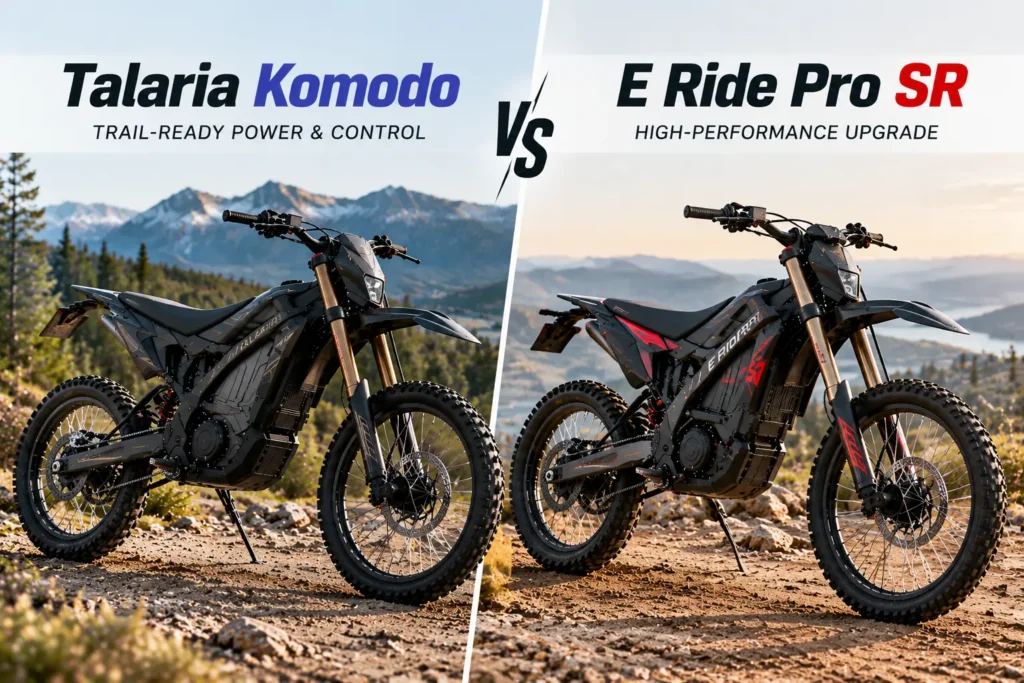
The Talaria Komodo and E Ride Pro SR are two high-performance electric dirt bikes designed for riders who want serious acceleration, capable suspension, and more performance than smaller lightweight e-motos can provide. Both offer powerful electric drivetrains and removable lithium-ion batteries, but they approach performance differently. The Talaria Komodo emphasizes higher peak power, a larger battery, and a full-size off-road layout, while the E Ride Pro SR combines substantial power with a lighter chassis and a lower seat height.
On paper, the Komodo produces up to 32 kW of peak power, compared with 25 kW for the E Ride Pro SR. However, the SR has a higher published rated power of 10 kW, compared with 8.6 kW for the Komodo. The difference matters because peak power describes maximum short-term output, while rated power represents a different operating specification. Neither figure alone determines which motorcycle will accelerate faster throughout a ride or perform better on a difficult trail.
Battery capacity, weight, suspension, wheel size, and ergonomics make the comparison more interesting. The Komodo has a 4.374 kWh battery and weighs approximately 216 pounds, while the SR has a 3.6 kWh battery and weighs around 183 pounds. The Komodo also uses a 21-inch front wheel and a 35.8-inch seat height, compared with the SR’s standard 19-inch front wheel and 32.7-inch seat height. These differences influence how the bikes fit different riders and respond to different types of terrain. (Talaria; E Ride Pro)
So, which one should you buy? The Talaria Komodo is worth prioritizing if you want greater peak output, a larger battery, and a taller, more substantial motorcycle. The E Ride Pro SR may be the better fit if you prefer a lighter bike, a lower seat, and strong factory performance in a more compact package. The right choice depends on your experience, preferred terrain, budget, and the way you actually ride.
The most useful starting point is a direct comparison of manufacturer-published specifications. The figures below refer to the Talaria Komodo MX and the E Ride Pro SR with the standard 19-inch front and 18-inch rear wheel configuration. Specifications can vary by model year, market, and configuration, so verify the exact motorcycle before ordering.
| Specification | Talaria Komodo MX | E Ride Pro SR |
|---|---|---|
| Peak motor power | 32 kW | 25 kW |
| Rated motor power | 8.6 kW | 10 kW |
| Battery | 97.2V, 45Ah | 72V, 50Ah |
| Nominal battery energy | 4.374 kWh | 3.6 kWh |
| Claimed top speed | Approximately 65 mph | Up to 70 mph |
| Published acceleration | 0–50 km/h in 1.8 seconds | 0–30 mph in 1.8 seconds |
| Published weight | 216 lb | 183 lb |
| Seat height | 35.8 in | 32.7 in |
| Front/rear wheel size | 21 in / 18 in | 19 in / 18 in |
| Front suspension travel | 250 mm | Verify the current configuration |
| Claimed range | 71.5 miles at 28 mph | 62+ miles at 25 mph; 93+ miles at 15 mph |
| Charging claim | 10% to 80% in 1 hour | 20% to 90% in 3.5 hours |
| U.S. listed price | Varies by seller; approximately $5,600–$6,500 in listings reviewed | $5,199 plus $300 shipping on the official product page |
Sources: Talaria Komodo MX specifications, E Ride Pro SR specifications and pricing, and Talaria U.S. dealer listings.
The comparison reveals an important distinction: the Komodo has more peak power and greater nominal battery energy, but the SR is lighter and has a higher rated-power figure. Their claimed top speeds also come from manufacturer specifications rather than a shared independent test. The published range and charging figures use different test conditions and battery-percentage intervals, so they should not be interpreted as perfectly equivalent measurements.
Power is one of the biggest reasons riders consider the Talaria Komodo. Its 32 kW peak rating is approximately 28% higher than the E Ride Pro SR’s 25 kW peak rating. That additional peak output gives the Komodo an attractive specification for riders who want strong acceleration and substantial performance reserves when climbing hills or riding open off-road terrain.
However, peak power does not tell the entire story. The Komodo’s rated power is 8.6 kW, while the SR’s rated power is 10 kW. These figures describe different operating specifications and should not be treated as interchangeable with maximum output. They also do not independently establish how much power either motorcycle will sustain under every combination of temperature, battery charge, controller settings, and riding conditions.
Weight further complicates the comparison. The Komodo weighs approximately 216 pounds, while the SR weighs around 183 pounds. The SR is therefore about 33 pounds lighter, which can make a difference in acceleration, maneuverability, and the effort required to reposition the motorcycle. The Komodo’s greater peak output may be attractive for short bursts of acceleration, but it does not guarantee a win in every real-world performance test.
The published acceleration figures are close: Talaria claims 0–50 km/h in 1.8 seconds, while E Ride Pro claims 0–30 mph in 1.8 seconds. These are similar but not identical tests, and they should not be used as proof that the motorcycles accelerate at exactly the same rate. A controlled, independent comparison using the same rider, battery conditions, surface, and measurement method would be needed to establish a meaningful winner.
Top speed also requires context. Talaria lists approximately 105 km/h, or 65 mph, for the Komodo MX, while E Ride Pro advertises up to 70 mph for the SR. These are manufacturer claims, not guarantees of speed on every trail. Rider weight, tire choice, battery charge, gearing, riding mode, and terrain can all affect the result.
For riders who value maximum advertised power, the Komodo has the advantage. For those who want a lighter motorcycle with substantial factory performance, the SR remains highly competitive. Neither should be selected solely by comparing peak kilowatts.
Battery capacity is another major difference between the two motorcycles. The Talaria Komodo uses a 97.2V, 45Ah battery rated at 4,374Wh, or approximately 4.37 kWh. The E Ride Pro SR uses a 72V, 50Ah battery rated at 3,600Wh, or 3.6 kWh. Despite the SR having a higher amp-hour rating, the Komodo stores more nominal energy because its battery operates at a higher voltage.
This is why amp-hours should never be used alone to compare batteries from different voltage systems. Watt-hours provide a more useful estimate of stored energy, calculated by multiplying nominal voltage by amp-hours. The Komodo’s battery contains approximately 21.5% more nominal energy than the SR’s, although that does not mean it will travel 21.5% farther in every situation.
Talaria claims a maximum range of 115 km, approximately 71.5 miles, at 45 km/h, or about 28 mph. E Ride Pro publishes a range of more than 62 miles at 25 mph and more than 93 miles at 15 mph. Because the manufacturers use different test speeds, the advertised numbers cannot establish which bike has better efficiency or longer range under identical conditions. (Talaria; E Ride Pro)
Actual range can be much shorter during aggressive off-road riding. Repeated acceleration, steep climbs, loose dirt, mud, sand, heavier riders, cold weather, and frequent high-power operation can all increase energy consumption. A bike ridden slowly on relatively smooth ground may cover considerably more distance than the same model ridden hard on technical trails.
Charging time is another consideration. Talaria advertises charging from 10% to 80% in one hour with its fast-charging setup. E Ride Pro lists approximately 3.5 hours for charging from 20% to 90%. Because the charging intervals and conditions differ, these figures are not directly comparable. Before buying, verify which charger is included with the specific motorcycle and whether any advertised fast-charging performance requires additional equipment.
For longer riding sessions, the Komodo’s larger battery is an advantage on paper. However, riders should consider charging access, battery replacement cost, and the distance they actually cover during a typical ride. A larger battery is useful only when its extra capacity justifies the associated price and weight.
Weight and ergonomics may be more important to some riders than the difference in peak power. The Talaria Komodo weighs approximately 216 pounds and has a seat height of about 35.8 inches. The E Ride Pro SR weighs around 183 pounds and has a seat height of approximately 32.7 inches. This makes the SR about 33 pounds lighter, with a seat that sits roughly 3.1 inches lower.
That difference can affect how confidently a rider can manage the motorcycle at low speeds. A lower seat may make it easier for some riders to reach the ground at a stop, while a lighter chassis can reduce the effort required to move the bike through tight sections or recover it after a fall. Rider inseam, suspension sag, boot thickness, and riding technique still matter, so seat height alone does not determine fit.
The Komodo’s larger dimensions may be more appealing to taller riders or those accustomed to conventional full-size dirt bikes. Its taller seat, longer wheelbase, and 21-inch front wheel contribute to a more substantial off-road motorcycle layout. The larger front wheel can help the bike roll over certain obstacles, although tire choice, geometry, suspension setup, and rider technique also influence performance.
The SR’s lighter weight and lower seat height may make it feel more manageable in tight trails, frequent direction changes, and low-speed maneuvers. These are potential advantages rather than a guarantee that every rider will prefer it. Suspension setup, handlebar position, tire pressure, and riding experience can significantly affect how either motorcycle feels.
Consider your usual terrain before deciding. Open trails and faster off-road routes may suit a larger chassis, while narrow wooded trails can reward a lighter, more compact motorcycle. If possible, sit on both models or arrange a supervised test ride before purchasing. A bike that feels comfortable and controllable is often a better choice than one that simply has the larger specification sheet.
The Talaria Komodo is designed around a more conventional full-size off-road layout. It uses a 21-inch front wheel and an 18-inch rear wheel, along with an adjustable front fork offering 250 mm of travel and a linked rear shock listed with 90 mm of travel. The manufacturer also specifies hydraulic disc brakes and 315 mm of ground clearance. These features make the Komodo worth considering for riders who want a motorcycle designed for demanding off-road use. (Talaria Komodo MX specifications)
The E Ride Pro SR uses a more compact wheel configuration, with a 19-inch front and 18-inch rear wheel in its standard configuration. The official page lists adjustable sport suspension but does not provide a directly comparable front travel figure in the same specification section. It is therefore better to compare the exact suspension hardware and settings of the units being sold rather than inventing a precise travel comparison.
The larger front wheel on the Komodo can be beneficial when riding over roots, ruts, and uneven ground, but wheel size does not automatically make one bike better in every trail condition. The rider’s weight, suspension spring rate, damping, tire selection, and chassis geometry all contribute to how a motorcycle handles rough terrain. A properly adjusted SR can still perform well on challenging trails, while an incorrectly set-up Komodo may feel harsh or difficult to control.
Braking is equally important. Both motorcycles use hydraulic disc brakes, but brake feel and stopping performance depend on rotor size, caliper design, tire grip, rider input, and surface conditions. At higher speeds, suitable tires and correctly maintained brakes are essential regardless of the motor’s advertised power.
Neither bike should be judged only by its maximum speed or suspension travel. If you ride technical trails, prioritize controllable throttle response, low-speed balance, tire traction, and manageable weight. If you ride faster and more open terrain, chassis stability, suspension adjustment, and braking performance become increasingly important.
Price can influence the decision as much as performance. E Ride Pro’s official U.S. product page lists the SR at $5,199, with an additional $300 shipping charge. The total before tax is therefore $5,499 at the listed rate. The page also lists a one-year warranty, although buyers should read the current warranty terms and confirm how coverage applies to batteries, electrical components, and wear items. (E Ride Pro official SR listing)
Talaria does not publish a single universal U.S. retail price on its international Komodo specification page. U.S. dealer listings reviewed for this comparison show prices varying from roughly $5,600 to $6,500, depending on the seller and the included charges. These are retailer prices rather than a guaranteed manufacturer MSRP, so confirm the final amount, shipping, taxes, and warranty coverage with the seller before buying.
The purchase price is only one part of ownership. Both motorcycles require routine inspection of tires, brakes, chain, sprockets, fasteners, bearings, suspension, and electrical connections. Electric drivetrains eliminate combustion-engine tasks such as oil changes and spark-plug replacement, but they do not eliminate maintenance.
Battery replacement deserves special attention because the battery is one of the most expensive components in an electric motorcycle. Before choosing either model, ask about replacement battery cost, availability, expected service support, and the warranty process. Also check whether local shops can service the bike and how easily you can obtain model-specific parts.
The Komodo’s larger battery may justify a higher purchase price for riders who need its additional stored energy and full-size chassis. The SR may offer better practical value for someone who prioritizes lower weight and strong performance without needing the Komodo’s larger battery. The better investment depends on the riding you actually do, not just the difference between the sticker prices.
The Talaria Komodo is a strong choice for experienced riders who want high peak power, a larger battery, a taller seat, and a more conventional off-road motorcycle layout. Its 21-inch front wheel and longer-travel front suspension make it especially interesting for riders who prefer full-size dirt-bike proportions. The extra weight and taller seat, however, should be considered carefully if you spend most of your time on narrow, technical trails.
The E Ride Pro SR is worth prioritizing if you want a lighter motorcycle with a lower seat and substantial factory performance. Its 183-pound published weight may make it easier to maneuver, and its smaller front wheel and more compact proportions may suit riders who value agility. It still has significant power, so a lighter chassis should not be confused with a beginner-friendly motorcycle by default.
For beginners, the priority should be controllability rather than maximum output. Both motorcycles can accelerate rapidly and require appropriate protective equipment, training, and a suitable off-road riding environment. New riders should learn throttle control and braking in a controlled area before attempting steep climbs, technical terrain, or high-speed riding.
Your body size and riding position also matter. Taller riders may appreciate the Komodo’s higher seat, while some shorter riders may find the SR easier to manage. But fit is personal, and the only reliable way to assess it is to try the motorcycle or carefully evaluate its dimensions against your needs.
Ultimately, choose the Komodo if its larger battery, peak power, and full-size geometry offer real advantages for your riding. Choose the SR if lower weight, a lower seat, and a more compact feel are higher priorities. The better bike is the one that matches your terrain, experience, and budget while remaining manageable throughout an entire ride.
Neither is universally better. The Komodo offers higher peak power, a larger battery, and a taller full-size off-road layout. The SR is lighter, has a lower seat, and publishes a higher rated motor-power figure. The best choice depends on whether you prioritize peak output and battery capacity or weight and maneuverability.
Talaria lists the Komodo MX at approximately 65 mph, while E Ride Pro advertises up to 70 mph for the SR. These are manufacturer claims, not results from a shared independent test. Actual speed depends on battery charge, rider weight, terrain, riding mode, and other conditions.
Yes, in terms of published peak power. The Komodo is rated at 32 kW peak, compared with 25 kW peak for the SR. However, the Komodo’s published rated power is 8.6 kW, while the SR lists 10 kW rated power. Peak and rated power describe different operating specifications and should not be compared as if they were the same measurement.
The Komodo has the larger nominal battery, at approximately 4.37 kWh compared with 3.6 kWh for the SR. Talaria claims 115 km at 45 km/h, while E Ride Pro publishes more than 62 miles at 25 mph and more than 93 miles at 15 mph. Because the manufacturers use different test speeds, these claims do not establish a definitive range winner under identical conditions.
Yes. The Komodo’s published weight is approximately 216 pounds, compared with 183 pounds for the SR. The difference is about 33 pounds, which can affect low-speed maneuverability, lifting, transport, and recovery after a fall.
The SR may appeal to riders who prioritize lower weight and a lower seat, particularly on tight trails with frequent direction changes. The Komodo’s larger front wheel, ground clearance, and full-size layout may appeal to riders who prefer a more substantial off-road motorcycle. Suspension setup, tires, rider skill, and terrain can change the result.
The E Ride Pro SR is listed at $5,199 plus $300 shipping on the official U.S. product page. Talaria Komodo dealer listings reviewed for this comparison range from approximately $5,600 to $6,500, depending on the seller and included charges. Prices and availability can change, so verify the final delivered price before ordering.
Not automatically. Both are marketed primarily as off-road electric motorcycles in the configurations discussed here. Street legality depends on the exact vehicle version, certification, required equipment, registration eligibility, and local laws. Adding lights or mirrors does not automatically make an off-road motorcycle eligible for public-road use.
The Talaria Komodo vs E Ride Pro SR comparison comes down to two different approaches to high-performance electric dirt biking. The Komodo prioritizes higher peak power, a larger battery, and full-size off-road dimensions. The SR delivers strong factory performance in a lighter package with a lower seat height and a more compact feel.
Choose the Talaria Komodo if you want its 32 kW peak output, 4.374 kWh battery, 21-inch front wheel, and taller riding position. It is particularly appealing to experienced riders who prefer a larger motorcycle and can make use of its additional battery capacity.
Choose the E Ride Pro SR if you value a lower weight, a lower seat, and a 25 kW peak motor with 10 kW rated power. It may be the more practical choice for riders who prioritize maneuverability and want high performance without the Komodo’s additional weight.
Before purchasing, compare the exact model configuration, warranty, parts availability, charging equipment, and final delivered price. Consider your riding terrain and experience rather than choosing solely by peak power or top speed.
The Talaria Komodo is the stronger choice on peak power and battery capacity, while the E Ride Pro SR is the lighter and more compact alternative. The better motorcycle is the one that fits your riding style, physical comfort, and long-term ownership needs.
Electric enduro motorcycles are becoming an increasingly appealing option for riders who want strong acceleration, precise low-speed control, and less

Electric enduro motorcycles are becoming an increasingly appealing option for riders who want strong acceleration, precise low-speed control, and less
The Talaria XXX Pro and Talaria Sting R MX4 are two popular options for riders looking for a lightweight electric

The Surron Hyper Bee and Surron Light Bee X are both high-performance electric dirt bikes, but they are designed for
