Electric Motocross vs Electric Enduro: What’s the Difference?
Electric motocross and electric enduro motorcycles can look very similar, and in some cases they even share the same motor,

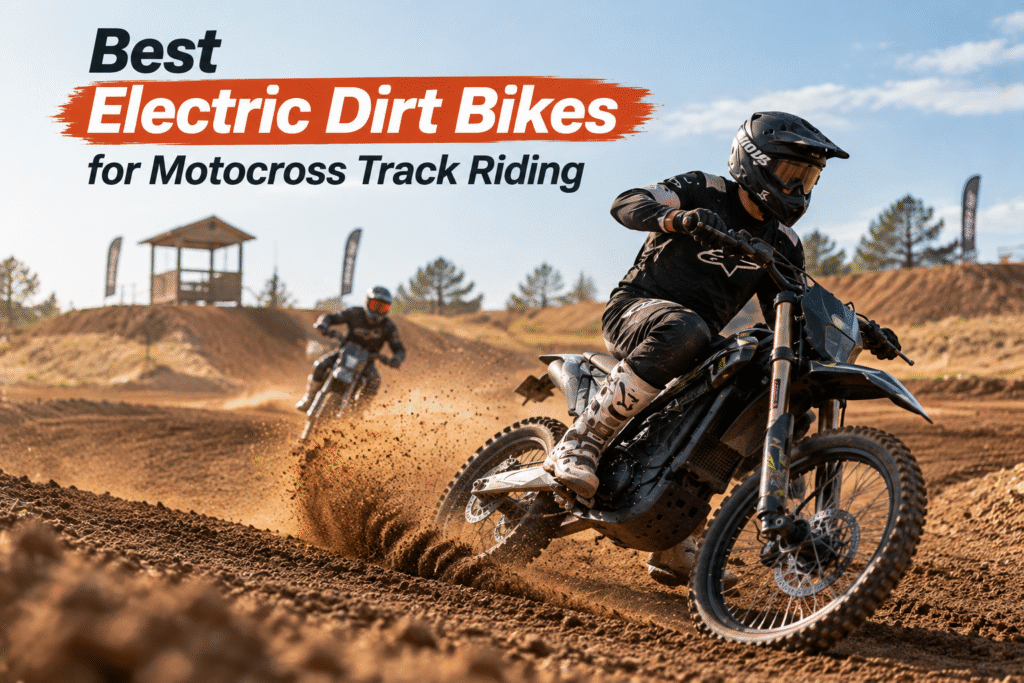
The best electric dirt bike for trail riding is not automatically the best bike for a motocross track. Motocross places unusually high loads on a motorcycle: repeated jump landings, deep braking bumps, hard acceleration, rutted corners, short straights, and lap after lap of suspension and brake abuse. A bike that feels fast and agile on a trail can quickly expose weak suspension, wheels, brakes, or chassis components when ridden aggressively on a real MX circuit.
For serious adult motocross riding in 2026, the Stark VARG MX 1.2 remains the clearest benchmark. It is a purpose-built full-size electric motocross motorcycle rather than a lightweight trail e-moto adapted for track use. Stark lists up to 80 hp, a 7.2 kWh battery, 310 mm of KYB front suspension travel, 303 mm of rear-wheel travel, full-size 21-inch front wheel options, and configurable power delivery from 10 to 80 hp. It is engineered around motocross rather than simply being powerful enough to ride on a motocross track.
That does not mean every rider needs a VARG. Models such as the Talaria Komodo MX, Surron Ultra Bee X HP, and E Ride Pro SR offer strong performance at lower weight and often much lower cost. They can be excellent for practice tracks, private MX courses, smaller jumps, and recreational laps. But they should not automatically be described as direct replacements for a dedicated race-bred motocross motorcycle.
There is also a new generation of compact motorcycles such as the Dust Moto Hightail attempting to bridge that gap. Its preliminary specifications combine full motorcycle wheels, substantial suspension travel, 32 kW peak power, and a 235-pound chassis, although it remains a preorder product and its manufacturer explicitly says current data are preliminary.
This guide therefore ranks electric dirt bikes according to how suitable the complete motorcycle is for motocross track riding, not simply which one has the biggest motor.
Motor power matters, but motocross exposes the limitations of the chassis long before many riders reach the maximum output of a modern electric motor.
The first priority is suspension. A motocross fork needs enough travel, spring support, damping control, and bottoming resistance to deal with repeated landings and braking bumps. The rear shock has to keep the tire connected to the ground under acceleration while remaining controlled when the motorcycle lands from a jump. More travel is useful only when the spring rate, damping, linkage progression, and rider weight are matched properly.
A trail-oriented fork that feels comfortable over roots and rocks can be too soft for aggressive MX riding. Under hard braking it may dive deeply, changing steering geometry just before the motorcycle enters a corner. On jump landings it may use its travel too quickly. This is one reason a 25 or 30 kW e-moto should not automatically be considered more track-ready than a motorcycle with less peak power but a properly developed MX chassis.
Wheel construction is equally important. Full-size motocross motorcycles normally use a 21-inch front wheel and often a 19-inch rear wheel, while enduro bikes commonly use a 21/18 configuration. A 19-inch MX rear allows a lower-profile tire and creates a different response under acceleration and cornering. An 18-inch rear can still work very well for recreational motocross, but the distinction matters for riders chasing conventional race-bike handling.
Braking becomes another major factor. A motocross bike repeatedly accelerates and decelerates over relatively short distances. Rotor size, pad compound, caliper stiffness, hydraulic condition, fork support, and front-tire traction all influence how consistently the bike stops over a full session.
Battery and thermal performance are the electric-specific part of the equation. A battery may provide impressive range at 25 mph yet behave very differently during repeated full-throttle acceleration on a motocross track. Track riding produces high current demand, and the motor, inverter, battery, and connectors all need to manage heat without excessive performance reduction. Manufacturer cruising-range figures are therefore far less useful for motocross than information about session duration and sustained performance.
Stark illustrates this distinction well. Its VARG MX range information is based on actual motocross riding scenarios rather than relying only on a low-speed mileage figure, and the company says the current 7.2 kWh pack is designed to complete a full MXGP heat depending on rider ability and track conditions.
Finally, rider fit matters. Full-size motocross bikes are tall, physically demanding machines. A lighter mid-size e-moto may allow a developing rider to build cornering and jumping skills more confidently even if it cannot match a race-spec motorcycle over large jumps. The best track bike is therefore the one whose power, weight, suspension, ergonomics, and durability match both the rider and the track.
| Model | Peak Power | Battery | Weight | Wheels | Best Use |
|---|---|---|---|---|---|
| Stark VARG MX 1.2 | Up to 80 hp | 7.2 kWh | 260 lb | 21/19 or 21/18 | Serious adult motocross and racing |
| Talaria Komodo MX | 32 kW | 4.374 kWh | 216 lb | 21/18 | High-performance recreational MX |
| Dust Moto Hightail | 32 kW preliminary | 4.4 kWh | 235 lb | 21/18 | Promising compact moto / private tracks |
| Surron Ultra Bee X HP | 24.5 kW | Approx. 4.44 kWh | Approx. 195 lb | Off-road configuration | Lightweight recreational track riding |
| E Ride Pro SR | 25 kW | 3.6 kWh | 183 lb | 19/18 or 19/16 | Compact tracks and aggressive play riding |
| KTM SX-E 5 | 5 kW | 907 Wh | Youth platform | 12/10 | Junior motocross training and racing |
These motorcycles do not occupy the same physical class. That is intentional. The purpose of the comparison is to show what is currently available for different riders rather than pretend that a 183-pound e-moto and a full-size VARG should be judged by the same expectations.
The KTM is also specifically a youth motocross motorcycle, not an adult alternative. KTM describes its current SX-E 5 as a genuine competition-oriented electric mini-crosser designed as an alternative to a 50cc gas motocross bike.
If the question is simply, “What electric motorcycle should an experienced adult choose for actual motocross riding?” the Stark VARG MX 1.2 is currently the strongest answer.
It was designed as a motocross motorcycle from the beginning. Stark’s current U.S. specifications list 60 hp and 80 hp configurations, with rider-adjustable power from 10 to 80 hp. The motorcycle uses a 420V, 7.2 kWh battery, KYB suspension, Brembo brakes, and a full-size steel chassis. The current U.S. list price is $11,990.
Its suspension is particularly important. The 48 mm KYB closed-cartridge fork provides 310 mm of travel, while the rear suspension offers 303 mm of wheel travel with high- and low-speed compression adjustment. Stark also offers different suspension settings matched to rider weight and speed.
That is exactly the type of equipment that separates a true motocross motorcycle from a fast recreational e-moto.
The VARG also allows power and regenerative braking to be tuned through configurable curves. That may sound like a technology feature, but on a motocross track it has a practical purpose. An experienced rider can use a sharper power map on a track with good traction or soften the initial response on hard-pack conditions where abrupt torque makes the rear tire spin.
Maximum power is therefore not an all-or-nothing setting.
The 7.2 kWh battery is another major advantage. Stark states that the updated MX 1.2 battery increased capacity by 20% and can cover a full MXGP heat depending on track and rider conditions. Charging is listed at approximately two hours on 240V and 3.5 hours on 120V.
There are still compromises. At approximately 260 pounds, the VARG is not an ultralight e-moto, and the $11,990 entry price puts it firmly in premium motorcycle territory. Charging access also matters during long track days. A gas bike can be refueled in minutes, while an electric motorcycle needs access to suitable electrical power or enough battery capacity to complete the planned sessions.
But if the objective is genuine motocross rather than simply riding an electric bike around an MX track, the VARG MX 1.2 is the reference point.
The Talaria Komodo MX is one of the most interesting alternatives for riders who want significantly more motorcycle than a traditional Surron-style e-moto but are not ready to move to a full-size VARG.
Talaria publishes 32 kW peak power, 754 Nm of rear-wheel torque, a 97.2V 45Ah battery with 4.374 kWh of nominal energy, a 21-inch front and 18-inch rear wheel, 250 mm of front suspension travel, and a total weight of approximately 98 kg, or 216 pounds.
On paper, those specifications make it extremely attractive for track use. It has a proper large-wheel off-road layout, substantial power, a closed-cartridge fork, linkage rear suspension, and much more battery capacity than most lightweight e-motos.
However, this is where a professional track guide needs to go beyond the specification table.
Talaria positions the Komodo as a high-performance electric dirt bike for free riding and varied off-road terrain rather than as a dedicated motocross race motorcycle. Independent track-oriented reporting from GritShift has also raised concerns about the stock setup when the bike is ridden aggressively on motocross terrain, including soft fork behavior and wheel durability during large jumps. That does not mean every Komodo will experience those issues, but it is relevant for riders planning repeated race-style use.
For recreational motocross, smaller jumps, private tracks, and riders who want serious power without VARG pricing, the Komodo is compelling. Its 216-pound weight also makes it substantially lighter than the VARG.
For hard race use, however, buyers should approach the suspension and wheel package honestly. A high peak-power figure does not guarantee that the rest of the motorcycle is ready for repeated big-jump abuse without setup work.
That distinction makes the Komodo one of the best high-performance track-play options, but not a direct substitute for the VARG MX 1.2 in serious motocross competition.
The Dust Moto Hightail deserves attention because its design philosophy sits between the lightweight e-moto category and the traditional full-size motorcycle.
Dust’s preliminary specifications list 32 kW peak power, a 4.4 kWh swappable battery, 235-pound weight, 21-inch front and 18-inch rear wheels, 260 mm of front suspension travel, 285 mm at the rear, a 260 mm front brake rotor, and a conventional 55.1-inch wheelbase.
That package is more motorcycle-like than the typical Light Bee-style platform. The Hightail also uses a linkage rear suspension and adjustable damping, while Dust specifically promotes backyard tracks, side hits, and aggressive recreational riding as part of the bike’s intended character.
Its swappable battery is particularly interesting for track days. Instead of waiting for the motorcycle to charge between sessions, an owner could theoretically rotate batteries if additional packs and suitable charging infrastructure are available.
There is one major reason it cannot yet rank above proven bikes in this guide: the Hightail is still listed as a preorder product, and Dust marks its technical data as preliminary.
That means we do not yet have the same mature ownership history, broad track experience, or finalized production specifications available for established models. It would be premature to call it a proven VARG competitor.
Still, the concept makes sense. A 235-pound motorcycle with a 21/18 setup, 32 kW of output, substantial suspension, and a removable 4.4 kWh battery could become a strong choice for riders who want something lighter and more playful than a full-size race bike without dropping all the way into lightweight e-moto territory.
For 2026 buyers, treat it as a model to watch rather than an unquestioned recommendation.
The 2026 Surron Ultra Bee X HP occupies a useful middle ground. It is larger and much more powerful than a Light Bee X but remains lighter and more manageable than most full-size electric motorcycles.
Surron’s current U.S. specifications list 24.5 kW maximum power, a 74V 60Ah battery, a claimed 59 mph top speed, and approximately 195 pounds of weight in current published specifications.
For a rider who spends weekends at a private motocross track but also wants to ride trails and general off-road terrain, that versatility is attractive.
The Ultra Bee’s lower mass can make it easier to change direction, recover from mistakes, and handle at lower speed. It also offers enough power for fast acceleration without immediately requiring the rider to manage the mass and performance of an 80 hp full-size VARG.
The compromise is the same one that applies to the Komodo: the Ultra Bee is not primarily a competition motocross platform.
A serious rider repeatedly landing large jumps will eventually care more about fork and shock control, wheels, brake consistency, frame behavior, and component durability than about the headline 24.5 kW number. Riders who intend to use an Ultra Bee mainly for MX should therefore budget for careful suspension setup and inspect wheels, spokes, tires, brakes, and fasteners frequently.
Where the Ultra Bee makes the most sense is recreational track riding. Smaller and medium jumps, corner practice, private tracks, mixed trail-and-track use, and riders who want a versatile motorcycle rather than a dedicated race machine all suit it well.
It is a much better motocross starting point than a smaller Light Bee X, but it should still be viewed as a versatile electric off-road motorcycle rather than a direct VARG replacement.
At approximately 183 pounds, the E Ride Pro SR is considerably lighter than the Komodo, Ultra Bee, Dust Hightail, and VARG. At the same time, E Ride Pro publishes 25 kW peak power, 10 kW rated output, a 3.6 kWh battery, and a claimed 70 mph maximum speed.
That power-to-weight combination makes the SR extremely interesting for tight tracks, smaller private circuits, jump lines, and riders who prefer lightweight e-moto handling.
The SR can be configured with 19/18-inch or 19/16-inch wheels, depending on the selected version. Those dimensions contribute to its compact feel compared with a full-size 21-inch-front motocross motorcycle.
That same compactness is also the main limitation.
A motorcycle that feels exceptionally agile on a tight track can feel less settled when jumps become larger and speeds rise. Wheel diameter, suspension length, wheelbase, and chassis proportions influence how confidently the bike handles rough high-speed sections and repeated landings.
E Ride Pro describes the SR as an off-road e-moto for demanding trails and rugged terrain rather than specifically as a motocross race bike.
For riders coming from Surron or Talaria lightweight platforms, the SR therefore makes sense as a major performance step without jumping straight to a 260-pound full-size MX motorcycle. It can be genuinely entertaining on a track, particularly when the circuit is tighter and less dominated by large jumps.
For professional-style motocross, however, its compact chassis and sport suspension should not be confused with the purpose-built full-size components found on a VARG.
The SR is best understood as a very powerful lightweight track-play motorcycle, not a miniature 450-class motocross bike.
Adult riders should not compare the KTM SX-E 5 with the bikes above. It belongs in this guide because it is one of the clearest examples of a manufacturer building a genuine electric motocross motorcycle specifically for younger racers.
KTM describes the current SX-E 5 as a “bona fide” motocross platform and an electric alternative to a 50cc gas-powered competition bike. The latest announced model produces 5 kW peak power and uses a 907 Wh battery. KTM says the battery can provide roughly 30 minutes of full-throttle racing depending on conditions, while charging from zero to 80% takes approximately 45 minutes.
More important than the motor figure is the chassis.
The bike uses a 35 mm WP XACT air fork with 205 mm of travel and an adjustable WP XACT rear shock providing 193 mm. Seat height can be adjusted between approximately 24.9 and 26.8 inches, allowing the motorcycle to adapt as a young rider grows. Six ride modes allow power delivery to be matched to ability, and the selected mode can be locked so younger riders cannot independently switch to a more aggressive setting.
The latest 2027 model is already published by KTM during late 2026, with a U.S. base MSRP of $5,799 plus $425 freight. Buyers specifically shopping a 2026 unit should verify remaining inventory and model-year differences rather than assuming every SX-E 5 has the latest battery and chassis specification.
For an appropriately sized junior rider, this is a much more sensible track motorcycle than putting a child on an adult high-powered e-moto simply because an electronic mode can reduce the output.
Fit, suspension, brake control, and rider ergonomics matter more than maximum power.
The first question should be how serious the track riding will be.
If the goal is racing, large jumps, fast lap times, and repeated full-session riding, choose a motorcycle that was engineered around motocross from the start. At present, the VARG MX 1.2 stands clearly above most alternatives because its suspension, chassis, brakes, battery, power management, and wheel configurations were all developed for MX rather than general off-road use.
If the objective is recreational track riding, a Komodo, Ultra Bee, or E Ride Pro SR may make more sense. They cost less, weigh less, and can be easier to manage. On smaller private tracks, their lighter mass may actually make them more entertaining than a full-size motorcycle.
Suspension should receive more attention than top speed. A 70 mph specification has very little relevance if the track’s longest straight only allows 45 mph before the next corner. The motorcycle still has to survive the jump immediately afterward.
Rider weight must be matched to suspension spring rate and damping. Sag should be set correctly before making conclusions about whether the bike handles well. Tire pressure and tire construction also need to suit the track surface. Hard-pack, sand, mud, and intermediate soil can require very different setups.
Battery planning is equally important.
A cruising-range claim such as “70 miles at 25 mph” tells you almost nothing about motocross duration. Repeated hard acceleration, deep soil, jumps, wheelspin, and heavy riders can dramatically increase energy use.
For track days, think in sessions, not miles.
Ask whether one charge can complete the number of laps you normally ride before resting. Then consider whether the battery can be charged during the break and what power is available at the track. A 240V electrical connection can make a major difference for a motorcycle such as the VARG, while a removable or swappable battery may offer another solution on models designed for it.
Thermal consistency matters as well. Peak power is the maximum the system can produce, not necessarily what it can sustain continuously during a hot, demanding session. Battery temperature, motor cooling, inverter cooling, and controller protection can all influence repeated-lap performance.
Finally, check the track’s rules before buying a motorcycle specifically for MX use. Not every motocross facility accepts every type of e-moto. Some tracks classify full-size motorcycles differently from lightweight electric machines, while organized competition may impose separate class, wheel-size, or power rules.
The motorcycle may be physically capable of riding the track and still not be eligible for the race class you want to enter.
For experienced adult riders who want a true full-size motocross motorcycle, the Stark VARG MX 1.2 is currently the strongest all-around choice. It combines up to 80 hp with a 7.2 kWh battery, KYB motocross suspension, full-size wheels, Brembo brakes, and motocross-specific chassis development.
A Surron can be fun on a motocross track, but the model matters. The Light Bee X is a lightweight e-moto and is not comparable to a full-size motocross race bike. The 2026 Ultra Bee X HP is a much stronger recreational track option because it offers 24.5 kW and a larger chassis. Serious jumping may still justify suspension, wheel, and brake setup beyond the stock configuration.
The Komodo MX has many useful track-oriented characteristics, including 32 kW peak power, 21/18-inch wheels, 250 mm of front suspension travel, and a 216-pound chassis. It can be a very capable recreational track bike, but independent aggressive riding reports have identified areas such as suspension and wheel durability that serious jump-focused riders should evaluate.
There is no minimum number that makes a motorcycle suitable for motocross. Suspension, chassis, tires, rider fit, and power delivery matter just as much. A controlled 15 or 20 kW motorcycle with good suspension can be easier to ride quickly than a 30 kW bike with an underdamped chassis. The Stark VARG reinforces this point by allowing its power to be adjusted from 10 to 80 hp rather than forcing the rider to use maximum output.
It depends heavily on rider speed, track surface, soil depth, jump frequency, rider weight, and power settings. Motocross consumes energy much faster than low-speed cruising, so mileage claims are poor predictors. Stark says its 7.2 kWh VARG MX 1.2 battery can complete a full MXGP heat depending on rider and track conditions, while KTM estimates approximately 30 minutes of full-throttle racing from the youth SX-E 5 under suitable conditions.
E Ride Pro markets the SR as a high-performance off-road e-moto rather than a dedicated competition motocross motorcycle. Its 25 kW peak power and 183-pound weight make it exciting for track riding, but its compact wheel and chassis dimensions differ substantially from a full-size MX machine such as the VARG.
It can be, but it may be more motorcycle than a casual rider needs. The VARG’s main value is the complete MX package: suspension, chassis, power adjustability, brakes, and battery capacity. Riders using only small private tracks may find a lighter Ultra Bee, Komodo, or E Ride Pro easier and less expensive to own.
Policies vary. Some tracks allow electric motorcycles freely, while others have rules regarding motorcycle size, rider class, practice sessions, or competition eligibility. Check the specific track and sanctioning organization before purchasing a motorcycle for organized racing.
They eliminate many combustion-engine maintenance tasks, including engine-oil changes, spark plugs, air-fuel tuning, exhaust servicing, and some engine rebuild work. They still require serious motocross maintenance. Tires, chains, sprockets, brake pads, wheel bearings, spokes, suspension, steering bearings, fasteners, coolant where applicable, and electrical connections all require attention.
It can be for the right rider. Lightweight e-motos are easier to maneuver and can be extremely enjoyable on small tracks. Full-size MX bikes provide better stability, suspension capacity, ergonomics, and durability for high-speed laps and large jumps. The correct choice depends on rider size, skill, track layout, and how aggressively the motorcycle will be used.
The best electric dirt bikes for motocross track riding are not necessarily the models with the highest top speeds or the most impressive peak-power figures.
Motocross is a chassis test.
A motorcycle has to accelerate hard, brake repeatedly, maintain traction through ruts, absorb braking bumps, land jumps, and continue doing all of that consistently for an entire session. Suspension quality, wheel strength, brake performance, geometry, battery capacity, thermal management, and rider fit therefore matter at least as much as motor output.
For serious adult motocross, the Stark VARG MX 1.2 is currently the benchmark. It is the one motorcycle in this group that was developed from the start as a full-size high-performance electric motocross machine rather than as a versatile off-road e-moto.
The Talaria Komodo MX is one of the most interesting alternatives for riders who want substantial power, full-size wheels, and lower weight, but aggressive MX use may justify suspension and wheel upgrades. The Surron Ultra Bee X HP offers a versatile middle ground for riders who mix track and trail use, while the E Ride Pro SR provides an unusually powerful lightweight platform for smaller tracks and recreational sessions.
The Dust Moto Hightail may eventually become one of the most interesting motorcycles in this space because it combines a 21/18 wheel package, 32 kW preliminary output, substantial suspension, and a swappable battery. For now, its preorder status and preliminary specifications mean it should be treated as a promising upcoming option rather than a proven recommendation.
For younger racers, the KTM SX-E 5 demonstrates how an electric motocross motorcycle should be designed around the rider rather than simply having adult-bike power electronically restricted. Its adjustable ergonomics, WP suspension, multiple power modes, and genuine competition focus make it the appropriate type of platform for junior track development.
The final choice should start with one question:
Are you buying an electric dirt bike that happens to be fun on a motocross track, or are you buying an electric motocross motorcycle specifically to ride the track hard?
For recreational sessions, several lighter e-motos can work extremely well.
For serious motocross, buy the chassis first and the peak-power number second.
Electric motocross and electric enduro motorcycles can look very similar, and in some cases they even share the same motor,
Electric enduro motorcycles are becoming an increasingly appealing option for riders who want strong acceleration, precise low-speed control, and less
Electric enduro motorcycles are becoming an increasingly appealing option for riders who want strong acceleration, precise low-speed control, and less
The Talaria XXX Pro and Talaria Sting R MX4 are two popular options for riders looking for a lightweight electric
