Stark Varg MX vs Stark Varg EX: Key Differences
Electric enduro motorcycles are becoming an increasingly appealing option for riders who want strong acceleration, precise low-speed control, and less

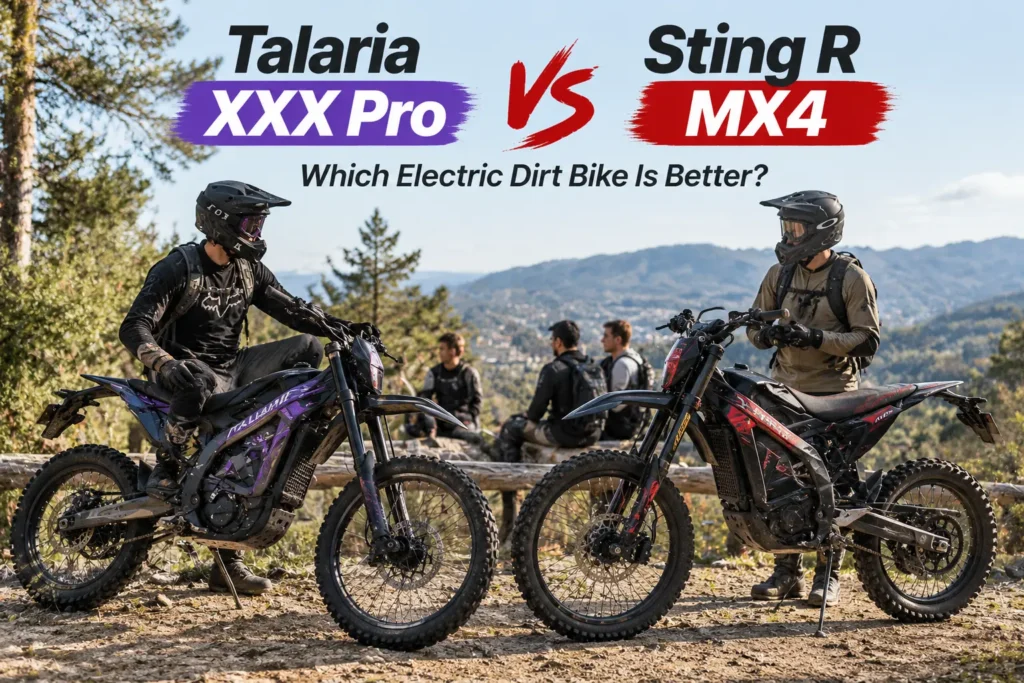
The Talaria XXX Pro and Talaria Sting R MX4 are two popular options for riders looking for a lightweight electric dirt bike with strong acceleration, hydraulic brakes, and capable off-road performance. Both share Talaria’s electric powertrain technology, but they differ in size, battery capacity, suspension design, drivetrain, and overall riding character. The XXX Pro focuses on a compact, lightweight package, while the Sting R MX4 offers a larger chassis and a more substantial off-road setup.
For the 2026 model year, it is important to compare the Talaria XXX Pro MX, rather than assuming the original XXX has identical equipment. The updated XXX Pro MX introduces a linkage-style rear suspension, knobby off-road tires, and other changes intended to improve its trail capability. The Sting R MX4 still offers a larger 60V 45Ah battery, higher published peak power, and a gearbox-based primary drivetrain. These differences make the decision more nuanced than simply choosing the more powerful motorcycle. (Talaria official specifications, Sting R MX4 specifications, REV Rides comparison)
The XXX Pro MX is particularly appealing to riders who prioritize lower weight, compact dimensions, and maneuverability on tighter trails. The Sting R MX4 is generally the stronger choice for riders who want more peak power, a larger battery, and a more traditional dirt-bike layout. Neither is automatically better for everyone. Your height, riding experience, terrain, budget, and plans for future upgrades should all influence the decision.
The following comparison uses the current Talaria XXX Pro MX and Sting R MX4 specifications as the main reference. Manufacturer figures and U.S. retailer listings sometimes differ, particularly for weight, top speed, and model configuration. Confirm the exact version being sold before making a purchase.
| Specification | Talaria XXX Pro MX | Talaria Sting R MX4 |
|---|---|---|
| Nominal voltage | 60V | 60V |
| Peak motor power | 6 kW | 8 kW |
| Battery | 60V 40Ah maximum capacity | 60V 45Ah |
| Nominal battery energy | Approximately 2.4 kWh | Approximately 2.7 kWh |
| Manufacturer-listed top speed | 75 km/h, approximately 47 mph | 85 km/h, approximately 53 mph |
| Manufacturer-claimed range | Up to 100 km at 25 km/h | Up to 100 km at 25 km/h |
| Approximate weight | 123–125 lb in U.S. listings | Approximately 145–152 lb, depending on specification |
| Seat height | Approximately 31.5–31.9 in | Approximately 33.1–33.5 in |
| Front/rear wheel size | 19 in / 17 in | 19 in / 19 in |
| Primary drivetrain | Belt reduction | Gearbox |
| Rear suspension | Linkage-style suspension on the 2026 Pro MX | Linkage-style suspension |
| Brakes | Hydraulic disc brakes, 220 mm rotors on the 2026 Pro MX | Hydraulic disc brakes, upgraded 220 mm rotors |
| Typical U.S. price | Around $3,750 in the listing reviewed | Roughly $3,800–$4,800 across listings and configurations |
Sources: Talaria’s official model specifications and U.S. retailer listings. The 2026 XXX Pro MX listing reviewed by REV Rides showed $3,749.99 but was marked sold out, while MX4 prices vary by seller and trim. These are indicative listing prices, not guaranteed offers or uniform manufacturer MSRPs. 【turn224601view1】【turn224601view2】【turn643101view0】【turn380779search6】
The figures reveal the main trade-off. The MX4 offers approximately 33% more published peak motor power and about 12.5% more nominal battery energy. The XXX Pro MX, meanwhile, is around 20 pounds lighter in commonly published U.S. specifications and has a lower seat. That difference can be noticeable when turning, moving the bike through tight sections, or recovering it after a fall.
The Sting R MX4 has the advantage in published motor output. Talaria lists 8 kW of peak power for the MX4, compared with 6 kW for the XXX Pro MX. That extra output gives the MX4 greater performance potential, particularly when accelerating out of corners, climbing hills, or riding faster sections of an off-road trail.
However, peak power does not tell the whole story. The rider’s weight, battery charge, controller settings, tire traction, gearing, and riding conditions all affect how the motorcycle feels. A lighter bike can feel responsive and playful even when it has a lower power rating. For riders who spend most of their time on narrow trails, the XXX Pro MX’s lower weight can be more useful than the MX4’s additional power.
The manufacturer’s published top speeds also favor the MX4, at approximately 85 km/h compared with 75 km/h for the XXX Pro MX. Some U.S. retailer listings advertise different figures for the XXX Pro MX, including speeds above the manufacturer’s published figure. This variation can reflect regional configurations, gearing, software settings, and the way specifications are reported. For a fair comparison, verify the exact model and treat advertised maximum speed as a reference rather than a guaranteed real-world result.
For experienced riders who want stronger acceleration and more speed on open trails, the Sting R MX4 is the more capable stock platform. For riders who prefer a lighter motorcycle and do not need the additional power, the XXX Pro MX can still deliver an engaging off-road experience without the larger bike’s extra mass.
Neither model should be treated as a beginner’s toy. Both can accelerate quickly, and riders need appropriate protective equipment, sound throttle control, and a suitable off-road environment. A rider who is still developing basic skills should prioritize manageable power delivery and proper fit over maximum speed.
Battery capacity is another important difference between the two Talaria models. The XXX Pro MX uses a 60V battery rated at up to 40Ah, equivalent to approximately 2.4 kWh of nominal energy. The Sting R MX4 uses a 60V 45Ah battery rated at approximately 2.7 kWh. The MX4 therefore stores about 12.5% more nominal energy, giving it a larger energy reserve on paper.
Both official specification pages list a maximum range of approximately 100 km at 25 km/h, or about 62 miles at 15.5 mph. This does not mean that both bikes will travel 62 miles during typical off-road riding. The claimed figures are associated with relatively low, steady test speeds, while real trails involve acceleration, braking, climbing, and changes in terrain. 【turn224601view1】【turn224601view2】
Actual range depends on rider weight, riding style, tire pressure, temperature, battery condition, and the amount of time spent using high power. A rider traveling slowly over relatively smooth ground may achieve much greater range than someone riding aggressively on steep, loose, or technical trails.
The way the batteries are installed is also worth considering. The XXX Pro MX uses a compact battery arrangement, but removing the battery is less convenient than a simple quick-swap design. REV Rides describes a removal process that involves removing the rear wheel and releasing the rear suspension mechanism. The MX4’s battery is designed to be removed and replaced more readily, which is useful for riders who have access to a second charged pack and want to extend their riding sessions. 【turn643101view0】
If you usually ride short loops, the XXX Pro MX’s battery may be sufficient. If you regularly ride longer routes, use high power, or value the option of swapping batteries, the Sting R MX4’s larger pack and more convenient removal arrangement are meaningful advantages. Before purchasing, check the replacement battery price and availability, along with the manufacturer’s charging instructions and warranty terms.
Weight and ergonomics are among the most noticeable differences between these motorcycles. The 2026 XXX Pro MX is commonly listed at approximately 125 pounds with a seat height of 31.5 inches. The Sting R MX4 is commonly listed at approximately 145 pounds in U.S. retailer specifications, although some technical sources report a higher figure depending on how weight is measured and which configuration is supplied.
The XXX Pro MX’s lighter chassis can make it easier to maneuver through tight corners, move around a garage, and recover after a low-speed mistake. Its lower seat height may also suit riders who prefer a compact riding position. These benefits are particularly noticeable on narrow trails where the rider frequently changes direction or needs to reposition the motorcycle.
The MX4 has a taller seat, larger rear wheel, and more substantial frame dimensions. Taller riders may find it more comfortable when standing on the foot pegs, while riders who prefer a more conventional dirt-bike riding position may appreciate its proportions. The extra weight is not necessarily a disadvantage while riding, but it can become more noticeable when lifting the motorcycle or moving it through a difficult section.
Rider height alone should not determine the choice. Inseam length, arm reach, riding boots, suspension sag, and experience all influence comfort. A shorter rider may prefer the XXX Pro MX’s lower seat, while a taller rider may feel cramped on it. However, a lighter motorcycle is not automatically the safer choice if the rider cannot control its power or does not fit its intended load limits.
If possible, sit on both motorcycles before buying. Check the reach to the handlebars, the position of the foot pegs, and whether you can control the bike comfortably while standing. The right fit can make a greater difference to riding enjoyment than a small change in advertised top speed.
One of the most important updates to the 2026 Talaria XXX Pro MX is its rear suspension. The original XXX was known for a more basic rear suspension arrangement, which led some riders to consider it less suitable for rough trails. The 2026 Pro MX uses a redesigned linkage system with approximately 160 mm of rear suspension travel, alongside an updated 19-inch front and 17-inch rear knobby-tire setup. This makes the newer version more trail-focused than the original XXX configuration. 【turn643101view0】
The Sting R MX4 also uses linkage-style rear suspension and a 19-inch front and 19-inch rear wheel setup. Its larger rear wheel and more substantial chassis make it attractive to riders who want a conventional off-road motorcycle layout. The wheel-size difference affects geometry, tire options, and how the bikes respond to obstacles, although suspension setup and rider technique remain just as important.
The XXX Pro MX’s compact dimensions can be an advantage on tight, technical trails where quick direction changes and manageable weight matter. The MX4’s larger wheel setup and stronger powertrain may be better suited to riders who regularly encounter rougher terrain, faster trails, or climbs that demand more sustained output. These are general tendencies rather than absolute rules: tire choice, suspension settings, rider weight, and trail conditions can change the result considerably.
Both models use hydraulic disc brakes, and the 2026 XXX Pro MX and MX4 specifications include 220 mm brake rotors. Good braking performance depends on more than rotor diameter, so riders should also consider brake feel, pad condition, tire grip, and maintenance. A motorcycle with more power needs predictable braking and a rider who understands how to manage traction on dirt.
The key distinction is that the updated XXX Pro MX should not be judged solely by reviews of the original XXX. Its linkage suspension and off-road tires address some of the earlier model’s limitations. Even so, the MX4 remains the more substantial platform for riders who want greater stock power, a larger battery, and traditional dirt-bike proportions.
The drivetrain is one of the less obvious differences between the XXX Pro MX and Sting R MX4, but it matters over the long term. The XXX Pro MX uses a belt as its primary reduction drive, followed by a chain. The Sting R MX4 uses a gearbox for primary reduction and a chain for the final drive. Both arrangements transfer motor power to the rear wheel, but they require different maintenance considerations. 【turn224601view1】【turn224601view2】
A belt-driven system can offer a relatively simple and quiet primary drive, but belts need inspection and may require replacement if they wear, become damaged, or are exposed to unsuitable operating conditions. Riders should follow the manufacturer’s guidance on belt inspection, alignment, and replacement intervals rather than assuming a belt is maintenance-free.
The MX4’s gearbox-based system avoids the same primary belt arrangement. However, a gearbox introduces its own maintenance requirements, including checking the specified lubricant and following the manufacturer’s recommended oil-change schedule. The final chain and sprockets still need regular cleaning, lubrication, adjustment, and inspection.
Neither system is automatically maintenance-free or universally superior. Your choice should reflect the riding conditions, the manufacturer’s maintenance instructions, and the availability of replacement parts. Mud, dust, water, heavy loads, and aggressive riding can all increase wear.
Before buying either bike, confirm which drivetrain parts are available from your dealer and how warranty claims are handled. Also consider whether you intend to modify the controller, motor, or battery. Electrical and drivetrain modifications can affect reliability and may limit warranty coverage, so it is worth understanding the consequences before making changes.
The XXX Pro MX is positioned as the more compact option, but its price advantage over the MX4 depends on the seller, model year, and current availability. The 2026 XXX Pro MX was listed at $3,749.99 on REV Rides when reviewed, although the page showed the model as sold out. U.S. listings for the Sting R MX4 vary by trim and seller, with some advertised prices around $3,800 to $4,800. These are retailer prices rather than a single official U.S. MSRP, so buyers should verify the current delivered price before ordering. 【turn643101view0】【turn380779search6】
A small difference in purchase price may not justify choosing a motorcycle that does not suit your riding. If the XXX Pro MX’s smaller chassis and lower weight fit your needs, it can be an attractive option. If you want more peak power, a larger battery, and easier battery swapping, the MX4’s additional cost may be worthwhile.
Ownership costs extend beyond the initial purchase. Both motorcycles require routine attention to tires, brake pads, chains, sprockets, bearings, suspension, fasteners, and electrical connections. Battery replacement can also be a significant expense, so check the price and availability of a replacement pack before buying.
Warranty coverage and local support deserve equal attention. Confirm whether the seller provides service, how replacement parts are shipped, and whether the warranty remains valid after modifications. A motorcycle with readily available parts and clear service support may offer better long-term value than one with a slightly lower purchase price but limited support.
The Talaria XXX Pro MX is the better fit for riders who value low weight, compact dimensions, and maneuverability. It is especially appealing for tight trails, smaller riding areas, and riders who want a lighter electric dirt bike without stepping up to the MX4’s larger chassis. The 2026 suspension update also makes it a more credible off-road option than the original XXX, provided you compare the correct version.
The Sting R MX4 is the stronger choice for riders who want higher peak power, a larger battery, a more traditional dirt-bike layout, and a convenient removable battery. It may suit taller riders and those who regularly ride rougher trails or want more performance from the stock motorcycle.
For beginners, the priority should be manageable power, proper fit, and the ability to control the motorcycle safely. Both bikes can accelerate quickly, so neither should be chosen simply because it looks smaller or has a lower price. Protective gear, progressive training, and a suitable off-road riding environment are essential.
Ultimately, choose the XXX Pro MX if you prefer a lighter and more compact motorcycle. Choose the Sting R MX4 if you want the additional performance and battery capacity of a larger platform. The best purchase is the bike that suits your terrain, experience, and long-term ownership plans.
Neither is universally better. The XXX Pro MX is lighter and more compact, while the Sting R MX4 offers higher peak power, a larger battery, and a larger rear wheel. The XXX Pro MX is attractive for maneuverability, while the MX4 is generally better for riders who want a more substantial off-road motorcycle.
Talaria’s published specifications list approximately 75 km/h for the XXX Pro MX and 85 km/h for the Sting R MX4. Some U.S. retailer listings report different figures for particular versions. Actual speed depends on configuration, gearing, battery charge, rider weight, and riding conditions.
The Sting R MX4 is listed at 8 kW peak power, compared with 6 kW for the XXX Pro MX. This gives the MX4 a higher published maximum-power rating, although actual acceleration also depends on weight, controller settings, battery condition, and traction.
Both official model pages claim approximately 100 km at 25 km/h under specified test conditions. The MX4 has a larger nominal battery, at 2.7 kWh compared with approximately 2.4 kWh for the XXX Pro MX. Actual range can differ substantially depending on speed, terrain, rider weight, and riding style.
Yes, the 2026 XXX Pro MX is more trail-focused than the original XXX configuration. It features linkage-style rear suspension, approximately 160 mm of rear travel, and 19-inch front and 17-inch rear knobby tires. However, the MX4 remains a more substantial platform for riders who prioritize higher power and a larger wheel setup.
It can be worth the additional cost if you need its higher peak power, larger battery, and more traditional dirt-bike layout. If you mainly ride tight trails and prioritize lower weight, the XXX Pro MX may provide better practical value. Compare current delivered prices and warranty terms before deciding.
Yes, but the battery removal process is less convenient than a quick-swap system. The current U.S. retailer documentation describes removing the rear wheel and releasing the rear suspension mechanism to access the battery. The MX4 is designed for more convenient battery removal and replacement. Confirm the procedure for your exact model before purchasing.
Not automatically. The off-road configurations discussed here are not guaranteed to be eligible for public-road use. Street legality depends on the exact model, vehicle certification, required equipment, registration eligibility, and local laws. Adding lights or a pedal kit does not automatically make an off-road motorcycle road legal.
The Talaria XXX Pro vs Sting R MX4 comparison comes down to compact agility versus greater stock performance. The 2026 XXX Pro MX offers a lighter chassis, lower seat, and updated linkage suspension that makes it more capable on trails than the original XXX. The Sting R MX4 delivers 8 kW of peak power, a 2.7 kWh battery, and a larger rear wheel, making it a stronger option for riders who want a more substantial off-road platform.
For riders who prioritize maneuverability and a compact riding position, the XXX Pro MX is a compelling choice. For riders who want higher power, more battery capacity, and a more conventional dirt-bike feel, the Sting R MX4 is generally the better fit.
Before buying, verify the exact model year, battery configuration, suspension setup, weight, warranty, and final price. Do not rely on older XXX reviews when evaluating the 2026 Pro MX, because the updated suspension and wheel package change the comparison.
Choose the Talaria XXX Pro MX for a lighter, more compact ride. Choose the Sting R MX4 for higher peak power, a larger battery, and a more substantial off-road platform.
Electric enduro motorcycles are becoming an increasingly appealing option for riders who want strong acceleration, precise low-speed control, and less
Electric enduro motorcycles are becoming an increasingly appealing option for riders who want strong acceleration, precise low-speed control, and less
The Surron Hyper Bee and Surron Light Bee X are both high-performance electric dirt bikes, but they are designed for
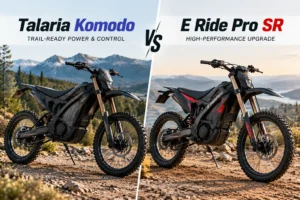
The Talaria Komodo and E Ride Pro SR are two high-performance electric dirt bikes designed for riders who want serious
