Stark Varg MX vs Stark Varg EX: Key Differences
Electric enduro motorcycles are becoming an increasingly appealing option for riders who want strong acceleration, precise low-speed control, and less
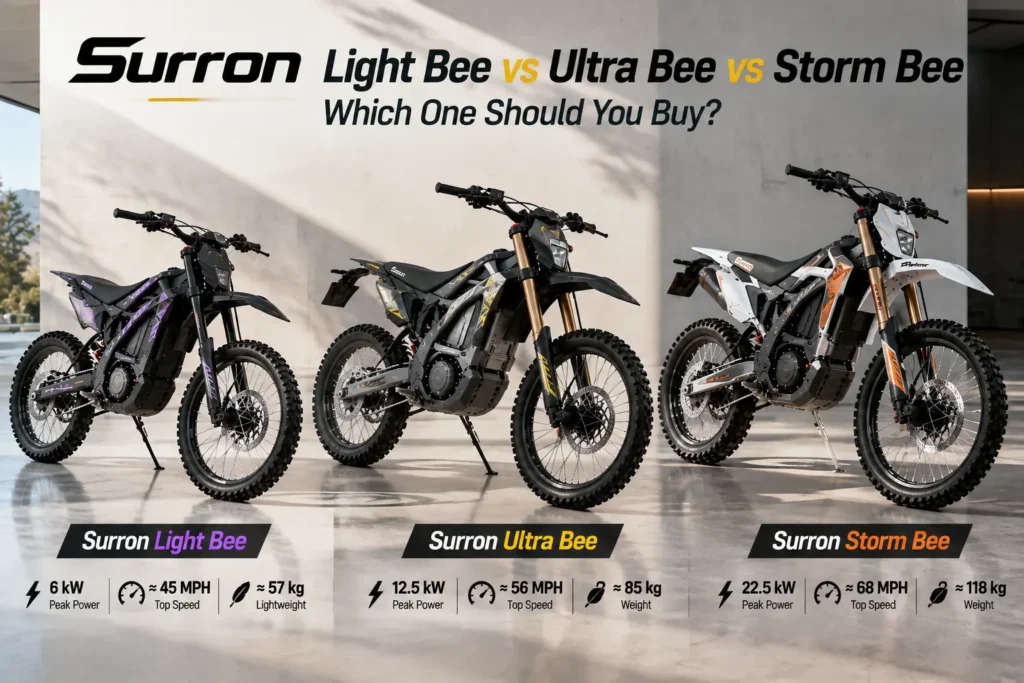
Choosing between the Surron Light Bee, Ultra Bee, and Storm Bee is not simply a decision about which electric dirt bike has the most power. These three motorcycles serve different purposes, and the right choice depends on how you ride, how much experience you have, what type of terrain you prefer, and how much motorcycle you actually need.
The Surron Light Bee X is the compact, lightweight option known for its agility and extensive aftermarket. The Surron Ultra Bee moves into a larger, more capable trail and enduro category, with stronger suspension, more substantial ergonomics, and considerably higher performance in its newer HP versions. The Surron Storm Bee takes a different approach, using a full-size motorcycle platform designed for riders who want a more traditional electric enduro or motocross experience.
The differences become particularly important when comparing current models. The 2026 Light Bee X is listed with 10 kW of maximum power and a 72V 35Ah battery, while the 2026 Ultra Bee HP X reaches 24.5 kW with a 74V 60Ah battery. The Storm Bee’s published specifications include 22.5 kW of maximum power and a 104V 55Ah battery. These figures show that the Ultra Bee HP is not simply a slightly upgraded version of the older standard Ultra Bee. Model year and configuration matter when comparing specifications.
For most buyers, the real decision is whether a lighter motorcycle offers enough capability, whether a larger chassis improves the riding experience, or whether a full-size electric motorcycle is worth the additional cost and weight.
Although all three motorcycles belong to the Surron electric off-road lineup, they are designed around different priorities. The Light Bee focuses on low weight and maneuverability. The Ultra Bee balances stronger performance with a more substantial chassis. The Storm Bee is aimed at riders who want the dimensions, wheel setup, and overall presence of a full-size off-road motorcycle.
This distinction is more useful than comparing motor power alone. A motorcycle that produces more power can accelerate harder, but its weight, suspension geometry, tire grip, and braking system determine how effectively that power can be used on a trail. More power is not automatically an advantage when navigating tight switchbacks, lifting the bike out of a rut, or riding slowly over technical obstacles.
The three models also differ in ergonomics. The Light Bee has a published seat height of approximately 32.7 inches, compared with about 35.8 inches for the Ultra Bee HP X and 37 inches for the Storm Bee. Those differences can influence rider confidence, standing position, ground reach, and maneuverability, although inseam length and riding technique matter more than height alone.
The following comparison uses the current published Light Bee X 10kW MY26, Ultra Bee HP X 24.5kW MY26, and Storm Bee specifications as its main reference. Older Light Bee and Ultra Bee models have different power and battery configurations, so these numbers should not be applied automatically to used motorcycles or other regional versions.
| Specification | Surron Light Bee X MY26 | Surron Ultra Bee HP X MY26 | Surron Storm Bee |
|---|---|---|---|
| Category | Lightweight electric dirt bike | High-performance trail/enduro e-moto | Full-size electric enduro/motocross |
| Maximum power | 10 kW | 24.5 kW in Turbo mode | 22.5 kW |
| Battery | 72V 35Ah | 74V 60Ah | 104V 55Ah on the published specification |
| Nominal battery energy | About 2.52 kWh | About 4.44 kWh | About 5.72 kWh |
| Claimed top speed | 50 mph | 59 mph | 68.3 mph |
| Published weight | 59 kg / 130 lb | 88.5 kg / 195 lb | Published figures vary; approximately 279 lb with battery in one specification |
| Seat height | About 32.7 in | About 35.8 in | About 37 in |
| Front suspension travel | 200 mm | 240 mm | Full-size adjustable suspension; verify exact version |
| Front/rear wheel sizes | 19/18 in | 19/18 in | 21/18 in |
| Typical U.S. listing range | Roughly $4,000–$5,000 | Roughly $6,000–$7,200 | Roughly $7,000–$9,000 or more |
| Best suited to | Agility and technical recreational riding | Riders seeking more performance and trail capability | Experienced riders wanting a full-size motorcycle |
Specifications are based on manufacturer-published information and current U.S. retailer listings. Prices are indicative rather than guaranteed offers. Storm Bee weight and battery information can vary between published versions, so buyers should verify the exact unit before ordering.
The Surron Light Bee X remains one of the most recognizable lightweight electric dirt bikes because it combines a compact chassis with responsive acceleration and a well-established aftermarket. Its main advantage is not that it has the highest output in the lineup, but that its relatively low weight makes the motorcycle easier to maneuver, transport, and recover when a ride does not go as planned.
The current Light Bee X 10kW MY26 uses a 72V 35Ah lithium-ion battery with approximately 2.5 kWh of nominal energy. Surron lists maximum power at 10 kW, a claimed top speed of 50 mph, a curb weight of 59 kg, and a seat height of 830 mm. The motorcycle also uses 19-inch front and 18-inch rear off-road wheels, a forged aluminum frame, a 200 mm front fork, and hydraulic brakes with four-piston calipers.
That combination makes the Light Bee particularly attractive on narrow trails, wooded property, and routes with frequent changes of direction. A lighter motorcycle requires less effort to reposition at low speed and can be easier to lift after a fall. These benefits become more noticeable when the trail includes tight turns, uneven ground, or obstacles that require the rider to move the motorcycle around rather than simply ride over them.
The Light Bee’s compact dimensions can also help riders who do not feel comfortable on a tall, full-size dirt bike. Its lower seat makes it easier for many riders to establish a stable starting position, although fit still depends on inseam, suspension sag, and riding experience. Taller adults may find the stock cockpit cramped during long rides, particularly when standing on the pegs. Bar risers, a different seat, or other ergonomic changes can help, but they cannot completely transform a lightweight chassis into a full-size motorcycle.
Another reason to choose the Light Bee is its aftermarket ecosystem. The platform has been around for years, and riders can find extensive information about suspension upgrades, tires, handlebars, foot pegs, controllers, batteries, and replacement components. This makes it attractive to owners who enjoy gradually modifying a motorcycle to match their preferences.
However, aftermarket availability can also encourage unnecessary spending. A stock Light Bee may already be more capable than a new rider can comfortably use. It is often better to learn the bike first, identify specific limitations, and upgrade only when a component genuinely needs improvement.
The main limitation is its chassis and suspension capability relative to the larger models. The Light Bee can handle challenging off-road riding when appropriately set up, but its compact proportions and shorter suspension travel make it less suitable than the Ultra Bee or Storm Bee for some high-speed, rough-terrain applications. Riders who regularly encounter large bumps, aggressive jumps, or long stretches of fast, uneven terrain may benefit from a more substantial platform.
Battery capacity is another consideration. The 72V 35Ah pack stores about 2.52 kWh of nominal energy, which is sufficient for many recreational sessions but less than the newer Ultra Bee HP and the published Storm Bee battery configuration. Actual range depends heavily on speed, terrain, rider weight, temperature, and throttle use.
Choose the Light Bee X if maneuverability, relatively low weight, customization, and a lower purchase price matter more to you than having the largest chassis or highest power output.
The Surron Ultra Bee occupies the middle ground in the lineup’s physical size, but its performance can vary substantially depending on the model year and trim. The older standard Ultra Bee is commonly listed with 12.5 kW of maximum power and a 74V 55Ah battery. The newer Ultra Bee HP versions move into a much higher performance category, with the 2026 HP X listed at 24.5 kW in Turbo mode and a 74V 60Ah battery. These versions should not be treated as mechanically or electrically identical.
The current Ultra Bee HP X is listed at approximately 195 pounds, with a seat height of 35.8 inches and 240 mm of front suspension travel. Its 19-inch front and 18-inch rear wheels retain familiar off-road dimensions, while the larger chassis and suspension package make it better suited to riders who want a more substantial motorcycle for faster trails and demanding terrain.
One of the biggest advantages of the Ultra Bee is its balance between capability and maneuverability. Compared with the Light Bee, it provides more room for adult riders, greater suspension travel, a larger battery, and a chassis designed for higher performance. It can feel more composed on rough trails, especially when the rider encounters repeated bumps or needs to maintain speed over uneven ground.
The Ultra Bee HP also includes multiple riding modes, adjustable throttle response, regenerative braking settings, and electronic assistance features such as wheelie control and traction-related systems on the current MY26 specification. These features can help riders tailor the motorcycle’s behavior to different conditions, but they do not replace good technique or make high power inherently safe.
The battery is a meaningful part of the upgrade. A 74V 60Ah pack stores approximately 4.44 kWh of nominal energy, compared with about 2.52 kWh in the current Light Bee X. That gives the Ultra Bee HP a larger energy reserve on paper, but real-world range does not scale perfectly with battery capacity. A heavier motorcycle with substantially more available power can consume energy quickly when ridden aggressively.
The Ultra Bee also requires more physical effort than the Light Bee when moving it by hand, loading it, or recovering it from a difficult position. Its greater mass is not necessarily a disadvantage while riding, but it matters when the rider gets stuck on a steep section or needs to lift the bike over an obstacle.
Riders should also compare the exact Ultra Bee version being sold. A standard 12.5 kW model, a 2025 HP version, and a 2026 HP X are not interchangeable in a specification table. Power, battery capacity, electronics, suspension details, and price can differ considerably. If you are buying used, ask for the model year, original specification sheet, battery information, and any modifications made by previous owners.
The Ultra Bee is particularly attractive to experienced riders who have outgrown the Light Bee’s size or want more capability without moving directly to the Storm Bee’s full-size motorcycle format. It is also worth considering for taller riders who find the Light Bee cramped.
Choose the Ultra Bee if you want a substantial performance upgrade, a roomier riding position, more suspension capability, and a larger battery while retaining a chassis designed for off-road agility.
The Surron Storm Bee is designed for a different kind of rider. Instead of emphasizing the compact dimensions that define the Light Bee, it uses a full-size motorcycle platform with larger wheels, a taller seat, and a more substantial chassis. It is intended for riders who want an electric motorcycle that feels closer to a conventional full-size enduro or motocross machine.
The published Storm Bee specification lists 22.5 kW of maximum power, a claimed top speed of 68.3 mph, and a 104V 55Ah battery. It also lists 21-inch front and 18-inch rear off-road wheels, a 37-inch seat height, and approximately 383.5 ft-lb of maximum wheel torque. However, published Storm Bee specifications differ between regional sources and configurations, including battery details and weight. Buyers should verify the exact model rather than assuming that every Storm Bee sold internationally has identical hardware.
The larger wheel setup is one of the important differences between the Storm Bee and the other two models. A 21-inch front wheel is common on full-size dirt bikes and can help the motorcycle roll over certain obstacles more naturally than a smaller wheel, depending on tire choice, geometry, and rider technique. The full-size chassis also provides a riding position that may feel more familiar to riders who have experience with traditional enduro or motocross motorcycles.
The Storm Bee’s additional mass is the main trade-off. Published weight figures vary, with one official specification listing 209/279 pounds, so the precise loaded weight needs confirmation for the version being considered. Regardless of the exact figure, the Storm Bee is substantially heavier than the Light Bee and heavier than the Ultra Bee. That extra mass can help the bike feel planted in some faster riding situations, but it can also make tight trails, slow technical maneuvers, and recovery after a fall more demanding.
The Storm Bee is therefore not automatically the best choice simply because it is the largest motorcycle in the range. A rider who spends most of the day weaving through narrow wooded trails may find the Light Bee easier to enjoy. Someone who wants a more substantial chassis and rides open, faster terrain may appreciate what the Storm Bee offers.
There is another important detail in the current lineup: the 2026 Ultra Bee HP X is listed with 24.5 kW of maximum power, which is higher than the Storm Bee’s published 22.5 kW figure. That does not make the Ultra Bee universally superior. Peak power is only one part of performance, and the Storm Bee retains its distinct full-size chassis, wheel configuration, and riding position. The comparison shows why model selection should not be reduced to a single motor rating.
Battery capacity is another area where the Storm Bee can appeal to riders who need more stored energy. The published 104V 55Ah configuration equates to approximately 5.72 kWh, larger than the 4.44 kWh battery in the current Ultra Bee HP X. But this calculation is based on nominal voltage and amp-hours, and actual range depends on power consumption, battery management, and riding conditions. A larger battery does not guarantee a specific distance or longer ride time when the motorcycle is used at high output.
The Storm Bee’s purchase price is generally higher as well. Current U.S. retailer listings place it roughly in the $7,000 to $9,000 range, although availability, version, shipping, and dealer charges can change the final amount. Buyers should also check the parts and service situation for the exact market version, particularly if the motorcycle has a different battery or electronics package from other regional models.
Choose the Storm Bee if you want a full-size electric motorcycle, prefer conventional dirt-bike proportions, and have the experience and riding environment to make use of its larger chassis and higher speed capability.
The Light Bee X 10kW MY26 is the lowest-powered of these three current reference configurations, but that does not mean it feels slow. Its relatively low weight gives it a strong power-to-weight ratio for recreational off-road use, and electric torque makes acceleration immediate.
The Ultra Bee HP X raises the available output to 24.5 kW in Turbo mode, creating a substantial jump in performance. It is designed to provide much stronger acceleration while retaining a chassis that is more maneuverable than a full-size motorcycle. The Storm Bee’s published maximum power is 22.5 kW, but its full-size geometry and wheel setup make its riding character different from the Ultra Bee HP.
These are peak figures rather than direct measurements of how quickly each motorcycle accelerates in every condition. Battery state, controller calibration, tire traction, riding mode, and rider input all affect the result. A bike with a higher peak rating is not necessarily faster through a tight trail or easier to control on slippery ground.
Weight and ergonomics can be more important than peak power when choosing between these motorcycles. The Light Bee X’s approximately 130-pound curb weight makes it the easiest of the three to move around and generally the most manageable when a rider needs to recover the bike from a low-speed mistake.
The Ultra Bee HP X weighs approximately 195 pounds, adding a more substantial chassis and taller riding position. That can be useful for larger riders and more demanding terrain, but it requires more effort when handling the bike off the motorcycle.
The Storm Bee is larger still, with a full-size wheel setup and a seat height around 37 inches. Riders accustomed to conventional enduro motorcycles may appreciate its proportions, but someone who values the Light Bee’s compact size may find the Storm Bee unnecessarily heavy.
Seat height alone should not determine fit. Consider inseam length, handlebar reach, foot-peg position, suspension sag, and how comfortable you feel standing on the pegs. If possible, sit on the exact model before purchasing.
Suspension travel figures help describe the intended use of each motorcycle, but they do not tell the whole story. The current Light Bee X lists 200 mm of front travel, while the Ultra Bee HP X lists 240 mm. The Storm Bee uses a full-size adjustable suspension arrangement, but buyers should confirm the exact travel figures for their model and region.
For tight trails and low-speed technical riding, the Light Bee’s low weight can be a major advantage even when its suspension has less travel. The Ultra Bee’s more substantial chassis and longer-travel suspension make it attractive for rougher trails and faster riding. The Storm Bee’s full-size platform is better aligned with riders seeking a traditional enduro or motocross experience.
None of these motorcycles should be judged solely by suspension travel. Spring rate, damping adjustment, rider weight, wheel setup, and suspension condition all influence handling. A correctly set-up Light Bee may perform better for a particular rider than a larger motorcycle with unsuitable suspension settings.
Battery capacity is best compared using watt-hours or kilowatt-hours rather than voltage alone. The current Light Bee X’s 72V 35Ah battery stores approximately 2.52 kWh. The Ultra Bee HP X’s 74V 60Ah battery stores approximately 4.44 kWh, while the published Storm Bee 104V 55Ah configuration stores approximately 5.72 kWh.
These figures represent nominal stored energy, not a guaranteed riding distance. Manufacturers publish range figures under particular test conditions, and the result can change substantially with speed, terrain, rider weight, temperature, tire pressure, and acceleration. Aggressive off-road riding generally uses more energy than steady, low-speed riding.
For a buyer who typically rides short technical loops, the Light Bee’s battery may be sufficient. Riders who want longer sessions or stronger sustained performance may appreciate the Ultra Bee or Storm Bee’s greater capacity. However, charging time, replacement-battery cost, and availability should be considered alongside capacity.
The Light Bee X generally has the lowest entry price, making it attractive to riders who want a capable lightweight electric motorcycle without committing to the cost of a larger platform. Its mature aftermarket can also make customization easier, although extensive modifications can quickly increase the total investment.
The Ultra Bee costs more, particularly in its high-output HP versions, but it provides a larger battery and substantially more performance. For riders who would otherwise spend heavily upgrading a Light Bee, the price difference may be worth evaluating against the total cost of modifications.
The Storm Bee generally sits at the higher end of the three-model comparison. Its value depends on whether the rider needs a full-size chassis and the corresponding performance characteristics. If you mainly ride narrow trails, you may pay for size and capability that you rarely use.
Always compare the complete purchase cost, including shipping, setup, taxes, protective equipment, maintenance, and replacement parts. U.S. dealer prices are not uniform, and a low advertised price should be checked against warranty coverage and the exact motorcycle specification.
The best Surron is the one that matches your actual riding rather than the one with the largest specification sheet.
For beginners, the Light Bee X is often the most sensible starting point because it is relatively light and manageable. Its compact chassis makes it easier to practice basic skills, develop throttle control, and learn how an electric motorcycle behaves on dirt. Beginners should still treat it as a motorcycle, wear appropriate protective equipment, and learn in a controlled riding environment.
For riders who have experience on dirt bikes and want more capability, the Ultra Bee is a strong next step. Its larger chassis, greater suspension travel, and increased battery capacity make it more suitable for faster trails and more demanding off-road riding. The current Ultra Bee HP versions also provide considerably more power than the older standard model, so it is important to select the correct trim for your experience.
For riders accustomed to full-size gas-powered enduro or motocross motorcycles, the Storm Bee may be the most natural fit. Its larger wheel setup and taller chassis create a more conventional motorcycle feel. However, its weight should not be overlooked, particularly if your usual terrain includes tight single-track, steep technical sections, or frequent stops where you may need to move the motorcycle by hand.
Rider height is another consideration, but there is no universal height cutoff for each model. A shorter rider may find the Light Bee easier to handle, while a taller rider may prefer the Ultra Bee or Storm Bee’s larger ergonomics. Suspension setup, riding boots, inseam, and experience all influence the result.
Terrain should be the deciding factor. Tight wooded trails tend to reward low weight and agility. Fast, rough trails can favor longer suspension travel and a more substantial chassis. Open enduro terrain may justify the Storm Bee’s full-size layout, while recreational riding on private property may not require the extra weight and power.
Finally, consider where you will store, transport, and service the motorcycle. A heavier machine may require a stronger carrier or ramp, and the availability of replacement batteries and model-specific parts can affect ownership convenience. A motorcycle that suits your riding style but is difficult to transport or maintain may not be the best practical choice.
Neither is universally better. The Light Bee X is lighter and more maneuverable, making it attractive for technical trails and recreational riding. The Ultra Bee has a larger chassis, more suspension travel, and substantially higher performance in its newer HP versions. Choose the Light Bee for agility and lower cost, or the Ultra Bee for more demanding riding and a larger motorcycle feel.
The Ultra Bee HP X offers a strong combination of high power and a relatively manageable chassis. The Storm Bee has a full-size motorcycle layout and larger wheel configuration. The better choice depends on whether you prioritize agility and compactness or want a more conventional full-size enduro motorcycle.
Among the three current reference configurations in this article, the 2026 Ultra Bee HP X is listed at 24.5 kW in Turbo mode, compared with 22.5 kW for the published Storm Bee specification and 10 kW for the Light Bee X MY26. Model year and regional configuration can change these figures, so verify the exact version before buying.
The published Storm Bee configuration has the largest nominal battery capacity of these three reference models, at approximately 5.72 kWh. However, battery capacity alone does not guarantee the longest real-world range. Speed, terrain, rider weight, temperature, and power use all affect distance per charge. Compare range claims only when their test conditions are understood.
Yes, many adults ride the Light Bee X, particularly those who value a lightweight motorcycle for trails and recreational off-road use. However, some taller riders find its compact ergonomics restrictive. Seat height, handlebar reach, foot-peg position, and riding posture should be considered before purchasing.
It can be manageable for riders with appropriate training and experience, but its size and power, especially in HP versions, make it more demanding than the Light Bee. Beginners should prioritize controllable power settings, protective equipment, proper fit, and progressive skill development rather than choosing a motorcycle based solely on its performance figures.
Current U.S. listings commonly place the Light Bee X around $4,000 to $5,000, newer Ultra Bee HP models around $6,000 to $7,200, and the Storm Bee around $7,000 to $9,000 or more. These are indicative dealer prices, not guaranteed manufacturer MSRPs. Shipping, taxes, configuration, availability, and warranty arrangements can change the final cost.
No. Street legality depends on the specific model, certification, equipment, registration eligibility, and local laws. An off-road motorcycle does not automatically become street legal simply because lights, mirrors, or turn signals are added. Verify the exact vehicle’s eligibility with the relevant motor vehicle authority before buying for public-road use.
For many recreational riders, the Light Bee X offers strong value because of its relatively low purchase price, manageable weight, and mature aftermarket. The Ultra Bee can be better value for riders who need more performance from the factory. The Storm Bee makes the most sense when its full-size chassis and riding characteristics are genuinely required.
The Surron Light Bee vs Ultra Bee vs Storm Bee comparison comes down to three different approaches to electric off-road riding.
The Light Bee X is the compact, lightweight option. It is attractive to riders who value agility, manageable weight, a lower entry price, and extensive aftermarket support. It can be an excellent choice for recreational trail riding and technical terrain, particularly for riders who do not need a full-size motorcycle.
The Ultra Bee offers a more substantial chassis and greater performance capability. Its newer HP versions deliver much higher power than the older standard Ultra Bee, making the exact model year and trim essential when comparing specifications. For experienced riders who want stronger acceleration, more suspension capability, and a roomier riding position without moving directly to the Storm Bee’s full-size platform, it is a compelling option.
The Storm Bee is designed for riders who want a full-size electric motorcycle with conventional enduro or motocross proportions. Its larger wheel setup, taller seat, and heavier chassis make it a different riding proposition rather than simply a more expensive Light Bee.
Do not choose by power rating alone. Consider the terrain you ride, your experience, the fit of the motorcycle, battery capacity, transport requirements, parts availability, and the complete purchase cost. A smaller motorcycle that you can control confidently may be more enjoyable than a larger one whose performance you rarely use.
For many recreational riders, the Light Bee X remains the practical starting point. Riders seeking a stronger all-round off-road platform should look closely at the Ultra Bee, while experienced riders who specifically want a full-size electric motorcycle should consider the Storm Bee.
The best Surron is not necessarily the biggest or most powerful. It is the one whose size, performance, and handling match the way you actually ride.
Electric enduro motorcycles are becoming an increasingly appealing option for riders who want strong acceleration, precise low-speed control, and less
Electric enduro motorcycles are becoming an increasingly appealing option for riders who want strong acceleration, precise low-speed control, and less
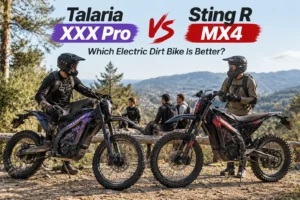
The Talaria XXX Pro and Talaria Sting R MX4 are two popular options for riders looking for a lightweight electric
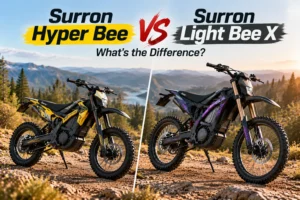
The Surron Hyper Bee and Surron Light Bee X are both high-performance electric dirt bikes, but they are designed for
