Stark Varg MX vs Stark Varg EX: Key Differences
Electric enduro motorcycles are becoming an increasingly appealing option for riders who want strong acceleration, precise low-speed control, and less

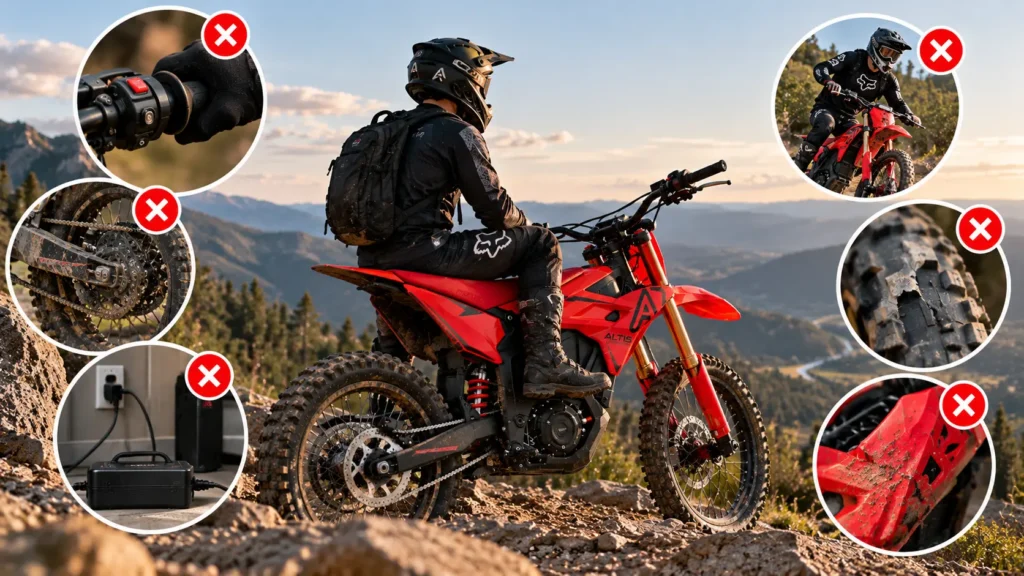
Electric dirt bikes can be easier to operate than traditional clutch-equipped dirt bikes, but easier controls do not automatically make them easier to ride well. Strong low-speed torque, relatively light chassis, powerful brakes, off-road terrain, and unfamiliar battery limitations can create a very different learning curve from either a bicycle or a gas motorcycle.
The most common electric dirt bike beginner mistakes usually come from the same misunderstanding: new riders learn how to make the bike move before they learn how to control it.
A rider may understand the throttle within a few minutes and assume the difficult part is over. In reality, good riding depends on throttle precision, braking, body position, vision, traction management, motorcycle fit, terrain selection, and knowing how the bike behaves when the battery, tires, suspension, or surface conditions change.
Electric dirt bike ownership adds another layer. Beginners sometimes focus so heavily on riding that they overlook battery charging, range planning, tire pressure, chain condition, brakes, fasteners, and where the motorcycle can legally be used. Others start modifying controllers and batteries before they understand the stock motorcycle.
Most of these mistakes are easy to avoid once you know what to look for.
The goal is not to ride slowly forever. It is to build control first so that additional speed becomes something you can manage rather than something the motorcycle gives you before you are ready.
One of the first mistakes happens before the rider reaches the trail: buying an electric dirt bike based mainly on peak power, top speed, or social-media popularity.
A beginner does not automatically need the least powerful motorcycle available, but the bike needs to fit the rider physically and match their current ability. Seat height, total weight, weight distribution, throttle response, wheel size, suspension, and how easily the rider can recover the motorcycle after a mistake may matter more during the first few months than whether the motor advertises 8kW, 12kW, or 20kW.
MSF specifically warns against putting younger or developing riders on dirt bikes that are too tall or too powerful for their capabilities. The same principle applies to adult beginners. A motorcycle that constantly feels intimidating usually slows learning rather than accelerating it. Motorcycle Safety Foundation
Electric power can make this mismatch less obvious because there is no clutch engagement or engine RPM to manage in the traditional sense. Many electric dirt bikes respond as soon as the rider rotates the throttle, and electric motors can provide strong torque from very low motor speeds. That means a small throttle mistake during a standing start, tight turn, hill start, or rough section can produce more rear-wheel force than a beginner expected.
This is where new riders often develop what motorcycle riders sometimes call “whiskey throttle.” The rider becomes nervous or gets bumped backward, tightens their grip on the bars, and unintentionally rotates the throttle farther. On a responsive electric motorcycle, that can quickly turn a small balance problem into sudden acceleration.
The solution is not simply to be afraid of the throttle. It is to learn precision.
If the motorcycle offers a lower-power riding mode, that can be useful during the first practice sessions. A new rider should become comfortable starting smoothly, riding slowly in a straight line, making large turns, stopping predictably, and controlling speed before increasing power settings or seeking higher top speed.
NHTSA recommends becoming familiar with the handling and responsiveness of any new or unfamiliar motorcycle in a controlled area before moving into more demanding conditions. That advice is particularly relevant to electric dirt bikes because throttle calibration and regenerative behavior, where fitted, can differ substantially between models. NHTSA
Another common mistake is assuming that because a bike feels easy in an open parking area, the rider is ready for a difficult trail. Loose dirt changes traction. Hills change weight distribution. Rocks and roots move the motorcycle underneath the rider. Sand can make steering feel vague. Mud can reduce braking and cornering grip dramatically.
Build difficulty in stages.
Flat controlled terrain should come before technical climbs. Predictable wide turns should come before tight switchbacks. Moderate speeds should come before jumps or high-speed trail sections. The objective is to make each new challenge small enough that the rider still has mental capacity to think about technique.
A rider who is constantly surprised by the motorcycle is progressing too quickly.
Once a beginner has the right motorcycle, the biggest mistakes become technique-related.
One of the most common is using the handlebars primarily to hold the rider’s body in place. New riders often grip extremely tightly because it feels safer. In reality, a rigid upper body makes the motorcycle harder to follow over uneven terrain and creates fatigue quickly. A death grip can also make throttle control less precise because every bump through the rider’s arms affects the hand controlling the throttle.
The rider should be connected to the motorcycle without becoming rigid. Knees, legs, core, and foot position all contribute to stability. On rough terrain, allowing the motorcycle to move beneath the rider is generally more effective than trying to lock the chassis in place with stiff arms.
Standing technique is another area beginners frequently misunderstand. Standing on the pegs is not simply a motocross style choice. It allows the rider’s legs to absorb movement and can make it easier to adjust body position as terrain changes. But standing completely upright and stiff defeats much of the benefit. Knees and elbows need enough flexibility to respond to movement.
Vision may be even more important.
A beginner’s natural reaction is to stare at whatever feels dangerous: a rock, rut, tree, edge of the trail, or front wheel. This creates target fixation and leaves less time to plan the next movement. Looking farther ahead allows the rider to process the trail earlier and make smaller steering, braking, and throttle adjustments rather than reacting at the last possible moment.
Braking creates another set of beginner mistakes. Some riders are afraid of the front brake and rely too heavily on the rear. Others grab the brakes abruptly whenever they become nervous. Neither approach produces good control.
The front and rear brakes do different jobs, and how much each contributes depends on speed, surface, slope, weight transfer, tire grip, and motorcycle design. Rather than memorizing an oversimplified percentage, beginners should practice using both brakes smoothly in a controlled area and learn how the bike responds on different surfaces.
NHTSA recommends checking both hand and foot braking systems before riding and emphasizes becoming familiar with motorcycle behavior under different conditions. NHTSA
Loose terrain makes smoothness even more important. A tire only has a limited amount of available grip. If the rider asks it to provide excessive braking or acceleration while also cornering, traction can disappear suddenly. This is why aggressive throttle input while leaned over on loose ground can turn into rear-wheel spin, while abrupt front braking on a slippery surface can create its own problems.
Current beginner electric dirt bike guidance in search results repeatedly identifies sudden throttle input, excessive corner-exit power, panic braking, stiff posture, and staring too close to the front wheel as recurring new-rider errors. EMORTAL
The useful lesson is not a complicated technique formula. It is that smooth riders usually become fast riders more safely than riders who try to become fast first.
Practice starts and stops. Practice wide circles in both directions. Practice slowing before a corner and smoothly adding power as the motorcycle straightens. Practice riding slowly enough that balance becomes the challenge rather than speed.
If those skills feel boring, that is often a sign that they are becoming automatic, which is exactly what you want before the terrain becomes difficult.
A quiet electric powertrain can make a motorcycle feel less serious than a gas dirt bike. That perception causes some beginners to ride in bicycle gear, ordinary shoes, casual clothing, or no meaningful protection beyond a basic helmet.
The motorcycle does not care how quiet it is when the rider hits the ground.
NHTSA recommends a motorcycle helmet meeting applicable U.S. safety requirements and notes that protective clothing, gloves, boots, and full coverage can reduce injuries in a crash. NHTSA MSF’s DirtBike School similarly makes personal protective gear and proper motorcycle setup part of its foundational off-road training. Motorcycle Safety Foundation
For a high-performance electric dirt bike, proper off-road motorcycle gear is the better benchmark. A suitable helmet, goggles, gloves, boots, and appropriate body protection should be considered riding equipment rather than optional accessories added after the motorcycle has already been upgraded.
Footwear deserves particular attention. Dirt-bike boots protect more than the sole of the foot. Ankles, lower legs, toes, and shins are exposed when a rider catches a foot, drops the motorcycle, hits a rock, or becomes trapped between the bike and terrain.
Another beginner mistake is skipping the pre-ride inspection because electric motorcycles appear mechanically simple.
Electric does not mean maintenance-free.
Before riding, check the tires, brakes, controls, chain and sprockets where applicable, wheels, visible fasteners, and general condition of the motorcycle. Tire pressure can have an especially large effect off-road because it influences traction, steering, rim protection, and how the bike responds to obstacles.
NHTSA advises motorcycle riders to check tire pressure and tread, brakes, lights where applicable, and the general condition of the motorcycle before riding. NHTSA Electric dirt bike maintenance guidance also consistently identifies chain adjustment, brake wear, tires, spokes, bearings, and loose hardware as areas owners still need to monitor. Two Wheels Empire
Beginners should also resist the temptation to learn everything alone.
A qualified off-road riding course can shorten the learning process because an instructor can see problems the rider does not recognize. MSF’s DirtBike School is specifically designed around hands-on instruction in controlled off-highway areas and covers motorcycle setup and basic riding skills. Motorcycle Safety Foundation
When riding remote trails, do not confuse confidence with self-sufficiency. MSF advises using the buddy system rather than riding alone in remote areas. Motorcycle Safety Foundation A simple mechanical problem, discharged battery, injury, navigation mistake, or damaged tire becomes much more serious when nobody else knows where the rider is.
The mistake is not being a beginner.
The mistake is creating situations where a beginner has no margin for error.
Battery mistakes are one of the biggest differences between learning on an electric dirt bike and learning on a gas motorcycle.
The first mistake is treating the advertised maximum range as a guaranteed trail distance.
Electric dirt bike range changes with speed, terrain, rider weight, elevation, temperature, tire pressure, surface conditions, riding mode, and how aggressively the throttle is used. Climbing a loose trail repeatedly can consume energy much faster than riding slowly on flat hardpack.
That means a motorcycle advertised with an impressive maximum range may deliver considerably less during aggressive off-road use. Current electric dirt bike reliability and ownership guides repeatedly identify the gap between advertised and demanding real-world range as one of the issues new owners misunderstand most often. VoltRipper
Beginners should leave reserve while they learn their bike. Do not plan a first remote ride around using almost 100% of the battery. Ride shorter loops, watch how quickly energy consumption changes with terrain, and gradually build your own realistic range estimate.
Cold weather can reduce available battery performance, while sustained high-power riding can increase thermal stress. A rider who gets a particular distance during mild-weather trail riding should not assume the same result under every condition.
Charging needs the same model-specific approach.
Do not assume every charger with a matching-looking connector is compatible. Use the charger supplied or approved for the exact battery system, and follow the manufacturer’s charging-temperature and storage guidance. Battery voltage, charging voltage, current, BMS requirements, and connector wiring all matter.
Beginners also sometimes believe that the battery should always be run completely flat before recharging or always stored at 100%. Those blanket rules should be avoided. Lithium-ion battery recommendations vary by manufacturer and storage situation, so the correct approach is to follow the instructions for the actual battery rather than applying habits carried over from other battery technologies.
Then there is the maintenance myth.
Electric motorcycles remove many combustion-engine service tasks. There is no carburetor, spark plug, exhaust system, or conventional engine oil routine on a typical electric dirt bike. But the chassis is still a dirt bike.
Chains stretch. Sprockets wear. Brake pads get thinner. Tires wear. Suspension requires service. Bearings develop play. Spokes may need attention. Fasteners can loosen under repeated impacts and vibration.
Some electric motorcycles also use reduction gearboxes or other drivetrain components with their own maintenance requirements, so “no oil changes” should not be treated as a universal rule for every electric motorcycle component.
Water creates another ownership mistake. Riders see an electric dirt bike being ridden through mud or light rain and conclude that all electrical components are waterproof. Water resistance and submersion resistance are not the same thing. Deep water, pressure washing around electrical connectors, or ignoring damaged seals can create expensive problems.
The underlying beginner lesson is simple: electric changes the maintenance list; it does not eliminate the maintenance list.
The electric dirt bike aftermarket makes modification extremely tempting.
A new owner buys a Surron, Talaria, E Ride Pro, Rawrr, Altis, or another e-moto and immediately sees larger batteries, high-output controllers, motors, suspension kits, wheels, brakes, pegs, handlebars, and cosmetic parts all over social media.
Within a week, a perfectly usable stock motorcycle can start to feel inadequate even though the rider has barely learned how to use it.
For beginners, this creates two problems.
The first is financial. Replacing a battery, controller, motor, suspension, brakes, and wheels can cost enough to move the bike into an entirely different price category. If you already know that you need substantially more performance, buying the correct motorcycle initially may be better value than rebuilding an entry-level platform one major component at a time.
The second problem is more important: modifications can hide rider-development issues.
If the rear tire constantly spins on climbs, the problem may not be a lack of power. The rider may need better throttle control, a more appropriate tire, different tire pressure, or improved body position.
If the front suspension feels unstable, the bike may not immediately need an expensive fork. Sag, spring rate, damping settings, tire pressure, loose steering bearings, riding position, and technique should be checked first.
If the brakes feel weak, the problem may be worn or contaminated pads rather than a need for a complete brake conversion.
Power upgrades deserve even more caution because the components interact. Increasing controller output can place additional demands on the battery, motor, drivetrain, tires, and cooling. Increasing battery voltage may require a compatible controller, charger, DC converter, display, and other electronics. Additional speed increases the importance of brakes, tires, suspension, and chassis stability.
A beginner who doubles the performance of the motorcycle before mastering the original power delivery may simply make the learning problem larger.
Ride the stock motorcycle long enough to identify real limitations.
Upgrade because you can describe the problem in a sentence: “I need more range for my normal loop,” “the suspension spring is wrong for my weight,” or “the stock tires do not work in this terrain.”
That is much more useful than upgrading because another person’s build looks faster.
The same principle applies to removing factory limits or changing software. A motorcycle may be delivered with particular settings because of market requirements, component limits, rider modes, warranty conditions, or other design considerations. Changing those settings can alter performance, range, heat, legality, and warranty implications.
Understand what is being changed before treating every restriction as something that should automatically be removed.
One of the most expensive beginner mistakes has nothing to do with riding technique.
It is buying an electric dirt bike without first determining where it can legally be used.
Lightweight electric motorcycles are regularly described online as e-bikes, e-motos, electric dirt bikes, or electric motorcycles. Those names are often used casually, but legal classification is based on applicable laws and the actual vehicle, not what the seller or owner calls it.
A high-powered throttle-controlled electric dirt bike should not automatically be assumed to have the same access as a conventional Class 1, Class 2, or Class 3 electric bicycle.
The same is true for public roads.
Adding a headlight, mirrors, turn signals, or a license-plate bracket does not automatically turn an off-road motorcycle into a street-legal electric motorcycle. Registration, certification, equipment, insurance, licensing, and operating requirements vary by vehicle and jurisdiction.
Trail access is a separate question again. Private property, OHV areas, local trails, state land, federal land, bicycle trails, and motorcycle areas can all use different rules.
For beginners, the smart sequence is to identify where the bike will actually be ridden before choosing the motorcycle.
MSF recommends riding dirt bikes on designated trails and at safe speeds. Motorcycle Safety Foundation That principle helps with both safety and access: electric motorcycles should be used where that type of motorized vehicle is permitted, not simply wherever their quiet operation makes them less noticeable.
This matters for the future of electric off-road riding as well. Quiet motors can reduce noise compared with combustion motorcycles, but responsible access depends on riders following trail rules rather than treating low noise as permission.
A motorcycle that perfectly fits your budget but cannot legally be used where you planned to ride it is not a good beginner purchase.
They can be. Electric dirt bikes remove clutch and traditional gear-shifting complexity from many models, which can make basic operation easier. However, strong low-speed torque, motorcycle weight, throttle response, and off-road terrain still require proper riding skills. Choose a bike that fits the rider rather than simply buying the most powerful option available.
Trying to progress faster than your control skills. This can mean choosing too much motorcycle, using high-power modes immediately, riding difficult terrain too early, or focusing on speed before learning smooth throttle, braking, vision, and body positioning.
If the motorcycle offers riding modes, a lower or more manageable mode can be useful while learning throttle response and basic control. The goal is not to stay in low power permanently but to make the early learning environment predictable.
Yes. Electric dirt bikes have fewer combustion-engine service requirements, but tires, brakes, suspension, chains, sprockets, bearings, wheels, spokes, seals, and fasteners still require attention. Some electric drivetrains may also have model-specific gearbox or fluid service requirements.
Usually not. Ride the stock motorcycle first and identify a real limitation before buying expensive upgrades. Tires, suspension setup, rider technique, or proper maintenance may solve a problem that initially feels like a lack of power.
No. Manufacturer range figures are based on particular test conditions. Off-road terrain, speed, elevation, rider weight, temperature, tire pressure, and throttle use can significantly change actual range. Beginners should initially leave substantial battery reserve until they understand their bike.
A properly fitting motorcycle helmet suitable for the riding environment, eye protection, gloves, boots, and appropriate protective clothing or armor are sensible starting points. NHTSA recommends motorcycle helmets meeting applicable U.S. requirements and protective gear covering the rider’s arms and legs. NHTSA
It can be easier to operate because many electric dirt bikes do not require clutch operation or conventional gear changes. However, that simplicity does not remove the need to learn braking, body position, traction management, vision, terrain selection, and throttle control.
For remote trails, riding with another person is the safer approach. MSF specifically recommends using the buddy system rather than riding dirt bikes alone in remote areas. Motorcycle Safety Foundation
Do not assume so. Trail access depends on the vehicle classification and local land-management rules. A high-powered electric dirt bike may be treated as a motorized vehicle rather than an ordinary electric bicycle.
Most common electric dirt bike beginner mistakes have the same root cause: treating easy operation as a substitute for learning.
Electric dirt bikes remove several traditional motorcycle complexities, but they still demand real riding skills. Strong low-speed torque requires smooth throttle control. Off-road surfaces require good braking and traction awareness. Rough terrain requires flexible body position and the ability to look ahead rather than react to obstacles at the front wheel.
Beginners also need to learn the motorcycle itself.
The correct tire pressure matters. Brake condition matters. Chain adjustment matters. Battery temperature and range matter. Protective gear matters. Where you are legally allowed to ride matters.
And perhaps most importantly, the rider does not need to modify everything immediately.
A stock electric dirt bike often has more capability than a beginner can use during the first weeks of ownership. Spending time learning the chassis, throttle, brakes, suspension, tires, and real-world battery range will tell you far more about the upgrades you eventually need than a social-media build list ever will.
The best beginner progression is simple: choose a bike you can physically manage, learn in a controlled environment, use manageable power settings, wear proper gear, practice smooth controls, increase terrain difficulty gradually, understand the battery, maintain the motorcycle, and modify only when you have identified a real limitation.
Electric enduro motorcycles are becoming an increasingly appealing option for riders who want strong acceleration, precise low-speed control, and less
Electric enduro motorcycles are becoming an increasingly appealing option for riders who want strong acceleration, precise low-speed control, and less
The Talaria XXX Pro and Talaria Sting R MX4 are two popular options for riders looking for a lightweight electric
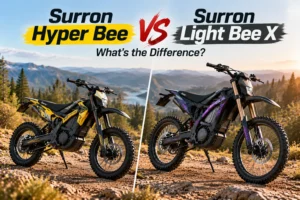
The Surron Hyper Bee and Surron Light Bee X are both high-performance electric dirt bikes, but they are designed for
