Electric Motocross vs Electric Enduro: What’s the Difference?
Electric motocross and electric enduro motorcycles can look very similar, and in some cases they even share the same motor,
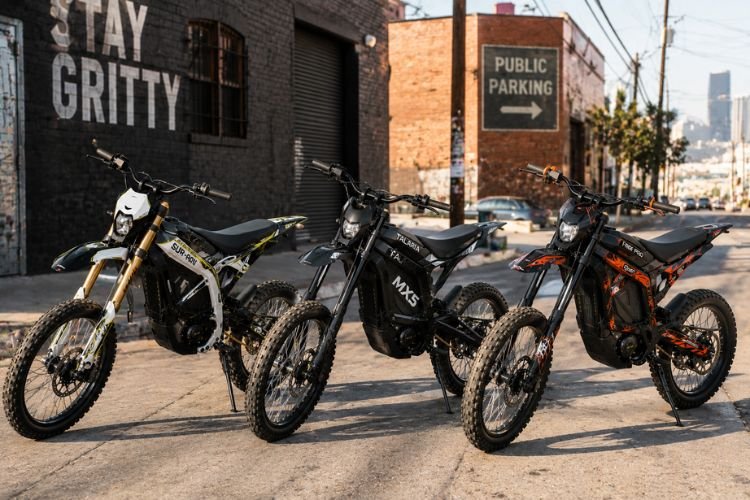
Choosing between Sur Ron, Talaria, and E Ride Pro in 2026 is harder than simply picking the bike with the highest peak-power number. All three brands now occupy important positions in the electric dirt bike market, but they appeal to riders for different reasons. Sur Ron remains the benchmark for lightweight customization and aftermarket support. Talaria has built a reputation around balanced performance and a mature platform, while E Ride Pro has attracted riders who want serious factory performance without immediately replacing the battery and controller.
There is also an important limitation to any Sur Ron vs Talaria vs E Ride Pro comparison: these are brands, not individual bikes. A Sur Ron Light Bee X and Ultra Bee belong to very different weight and performance classes, just as Talaria and E Ride Pro offer multiple models. For a useful comparison, this guide focuses primarily on the lightweight high-performance category, using bikes such as the Sur Ron Light Bee X, Talaria MX5 Sting Pro, and comparable E Ride Pro models as the main reference points.
So, which one is best? The short answer is simple: Sur Ron makes the strongest case for riders who value low weight and customization, Talaria offers one of the best all-around balances, and E Ride Pro is especially attractive if strong factory performance is your priority. The rest comes down to how and where you ride.
Before getting into individual specifications, this table shows the basic differences between the three platforms.
| Category | Sur Ron | Talaria | E Ride Pro |
|---|---|---|---|
| Factory Performance | Good | Very Strong | Excellent |
| Lightweight Feel | Excellent | Very Good | Very Good |
| Trail Handling | Light and playful | Balanced | Fast and performance-focused |
| Aftermarket | Excellent | Very Good | Growing |
| Parts Ecosystem | Excellent | Very Good | Growing |
| Customization | Excellent | Very Good | Good |
| Stock Value | Good | Excellent | Excellent |
| Upgrade Potential | Excellent | Excellent | Very Good |
| Beginner Appeal | Very Good on lower-power models | Good | Depends heavily on model |
| Best For | Builders and lightweight riders | All-around trail riders | Factory-performance buyers |
These ratings need context. Sur Ron’s “Good” factory performance rating, for example, doesn’t mean the brand lacks fast motorcycles. The Ultra Bee changes that conversation considerably. Rather, the familiar Light Bee X no longer offers the same stock power-to-price advantage it once did when compared with newer high-voltage lightweight e-motos.
Likewise, E Ride Pro’s performance advantage doesn’t automatically make it the best trail bike. On tight terrain, weight, throttle control, suspension setup, tires, and rider confidence can matter much more than maximum output.
The easiest way to understand these brands is to think about what you’re actually paying for.
Sur Ron is the platform choice. The Light Bee X has been around long enough to develop one of the deepest aftermarket ecosystems in the category. It may no longer dominate stock specification comparisons, but owners can change almost everything: battery, controller, motor, suspension, brakes, wheels, ergonomics, drivetrain, and appearance. Parts knowledge is extensive, and there is a huge amount of community experience available.
Talaria is the balance choice. Models such as the MX5 Sting Pro provide much stronger factory performance than older lightweight e-motos while retaining the compact dimensions that make this category fun. Talaria’s gearbox-based drivetrain also differentiates the platform mechanically, while a mature aftermarket gives owners plenty of room to modify the bike later.
E Ride Pro is the factory-performance choice. Its appeal is straightforward: instead of buying a relatively modest bike and immediately budgeting for a high-voltage battery and controller, buyers can start with a much stronger electrical package. That is especially attractive to riders who want to spend more time riding and less time planning a powertrain build.
These descriptions aren’t absolute. A Talaria can be heavily modified, a Sur Ron can be left completely stock, and an E Ride Pro can become a project bike. They simply explain why each platform tends to appeal to a different type of buyer.
The Sur Ron Light Bee X helped define the lightweight electric dirt bike category, and its biggest advantage in 2026 is no longer simply the motorcycle itself. It is everything surrounding the motorcycle.
Years of owner experience have created a huge knowledge base. Want a larger battery? There are established options. Want a different controller, suspension setup, 16/19 wheel combination, brakes, pegs, handlebars, seat, or bodywork? Someone has probably already installed it, tested it, and documented the process.
That matters more than it might seem when buying a bike for long-term ownership. A strong aftermarket gives riders options when original components wear out or when their riding style changes. It can also make troubleshooting easier because common setup questions have often already been answered by the community.
The other major Sur Ron advantage is weight. A Light Bee X remains extremely playful compared with larger electric dirt motorcycles. On tight trails, low mass can be more useful than another several kilowatts of peak output. It is easier to change direction, easier to catch when balance goes wrong, easier to lift after a fall, and generally less physically demanding in technical terrain.
The weakness appears when a buyer wants modern high-output performance immediately. Building a very fast Light Bee X is absolutely possible, but once a battery, controller, brakes, suspension, and other supporting upgrades are included, the total investment can become substantial. If you already know you want serious factory power, starting with a newer high-performance platform may make more financial sense.
Talaria occupies an interesting middle position. It has enough history and aftermarket support that it no longer feels like an unknown platform, but newer models have also kept pace with the industry’s move toward higher-voltage factory performance.
The Talaria MX5 Sting Pro is a good example. Its commonly sold configuration uses a 72V battery system and is widely associated with roughly 13.4 kW of peak output, representing a major step beyond the 60V MX4 Sting R. More importantly, Talaria didn’t simply increase motor output. The MX5 also received stronger supporting hardware, including upgraded braking equipment.
Talaria’s gearbox is another defining feature. Rather than using a primary belt arrangement, Talaria uses a reduction gearbox with a chain final drive. The system requires periodic gear-oil maintenance, so “electric means zero maintenance” certainly doesn’t apply, but many off-road riders appreciate the robust drivetrain design.
For the typical buyer, Talaria’s strongest argument is that it doesn’t force an extreme choice. You don’t have to accept relatively modest stock performance just to get a mature platform, and you don’t have to buy an entirely performance-first machine either. The MX5 offers enough power for serious riding while retaining the agility associated with lightweight e-motos.
That makes Talaria particularly attractive to someone who wants to buy the bike, make a few personal changes such as tires or ergonomics, and ride it without immediately replacing major electrical components.
E Ride Pro became popular for a straightforward reason: riders wanted more performance without turning a new electric dirt bike into a battery-and-controller project on day one.
That factory-performance philosophy remains the brand’s biggest strength. Depending on the exact model being compared, E Ride Pro can offer the kind of acceleration and power that previously required significant aftermarket spending on older lightweight platforms.
This changes how value should be calculated.
Suppose one motorcycle costs less initially, but the owner immediately spends thousands upgrading its electrical system and supporting components. A more expensive factory-performance bike can actually become the cheaper finished product. It also avoids some compatibility questions that come with combining aftermarket batteries, controllers, motors, and software.
The tradeoff is ecosystem maturity. Sur Ron has had much longer to build its enormous aftermarket, while Talaria also benefits from years of Sting-platform development. E Ride Pro’s ecosystem continues to grow, but riders who enjoy endless customization may still find the older platforms more established.
This doesn’t matter equally to everyone. If you plan to leave the major electrical system stock, a huge controller-and-battery aftermarket isn’t necessarily a major advantage. For that buyer, strong factory integration may be more valuable.
Performance is where this comparison can become misleading if we treat all three brand names as if they represent one motorcycle.
A stock Light Bee X is not designed to compete directly with every modern high-output Talaria or E Ride Pro on peak power. Sur Ron also offers larger and more powerful machines, but moving to an Ultra Bee changes the weight, dimensions, and overall riding experience.
In the lightweight category, newer Talaria and E Ride Pro models generally make a stronger case for riders who prioritize stock acceleration and power. The MX5’s 72V architecture gives Talaria serious factory performance, while E Ride Pro has made high-output stock setups central to its identity.
The Light Bee X answers with power-to-weight feel and agility rather than headline output. On a tight technical trail, that distinction is important. A motorcycle can have substantially more power than the rear tire can use on loose dirt. Once traction becomes the limit, throttle control and chassis behavior matter more than another impressive number on the specification sheet.
For open riding and acceleration-focused use, factory power becomes more noticeable. For technical trail riding, the performance gap may matter less than buyers expect.
Electric motors deliver torque immediately, which makes high-performance e-motos feel extremely responsive. Strong acceleration can be useful for steep climbs, exiting corners, crossing soft terrain, and quickly rebuilding momentum.
E Ride Pro and newer Talaria platforms are especially attractive if this is what you want from a stock motorcycle. There is much less need to begin researching an aftermarket controller simply because the original bike feels underpowered.
Sur Ron’s Light Bee X is more modest in stock form, but its lighter character can make it feel lively and controllable. And once modifications enter the discussion, a built Light Bee can reach performance levels far beyond its original specification.
The question is whether you actually want to build it.
For many buyers, factory performance is cheaper and simpler than upgrade potential. For enthusiasts who enjoy choosing every component themselves, the opposite can be true because customization is part of the experience.
Top-speed comparisons attract attention, but this is another area where exact model selection matters. There is no honest single answer to “How fast is a Sur Ron, Talaria, or E Ride Pro?” because each company offers different motorcycles and configurations.
A stock Light Bee X sits in a different performance class from a Talaria MX5 or high-output E Ride Pro model. The MX5 is commonly associated with roughly the 60 mph class under suitable conditions, while specific E Ride Pro models may compete at or above that general performance level depending on configuration.
But once lightweight electric dirt bikes reach approximately motorcycle-level road speeds, maximum speed becomes less important for most trail riders.
On woodland single-track, you may rarely have enough space to approach maximum speed. Even on faster trails, the more useful questions are how quickly the bike accelerates to normal riding speed, whether the chassis remains stable, how confidently it brakes, and how much battery that pace consumes.
Top speed also varies with rider weight, battery state of charge, gearing, tire setup, wind, temperature, terrain, and measurement method. GPS data is generally more meaningful than simply repeating the highest number shown on a bike’s display.
So if your buying decision is between Sur Ron, Talaria, and E Ride Pro, don’t choose from top speed alone. By 2026, all three ecosystems can provide serious performance—the bigger difference is how much comes from the factory, how much the bike weighs, and how much you need to spend to reach your desired setup.
Part 1 established the biggest difference between these three brands: Sur Ron is especially strong as a lightweight, highly customizable platform; Talaria offers a balanced combination of factory performance and platform maturity; and E Ride Pro puts greater emphasis on delivering serious performance before aftermarket upgrades begin. But acceleration and top speed only tell part of the story. Once you start riding regularly, battery range, weight, handling, brakes, maintenance, and parts availability often matter more.
Battery comparisons can become confusing because voltage and amp-hours are often discussed separately. A 72V battery isn’t automatically “better” than every lower-voltage battery, and comparing amp-hours between packs of different voltages can also be misleading. Total stored energy, usually measured in watt-hours or kilowatt-hours, provides a more useful starting point.
Talaria’s MX5 represents the industry’s shift toward higher-voltage factory systems with its commonly sold 72V 40Ah configuration. E Ride Pro has also made high-voltage battery systems a major part of its performance strategy, although exact capacity depends on the model. The familiar Sur Ron Light Bee X takes a more modest stock approach, while Sur Ron’s aftermarket gives owners numerous battery upgrade paths.
In real riding, however, battery size is only part of the equation. Rider weight, speed, elevation, tire choice, temperature, terrain, and throttle use can dramatically change range. A rider cruising fire roads at moderate speed may travel much farther than someone repeatedly using maximum acceleration on steep trails.
This is especially important with Talaria and E Ride Pro because more available power makes it tempting to ride harder. A larger battery doesn’t necessarily translate into dramatically longer rides if the extra performance is being used constantly.
For most buyers, claimed maximum range should therefore be treated as a reference rather than a guarantee. Look at independent testing under conditions similar to your riding and plan to finish longer trips with a reasonable battery reserve.
This is where Sur Ron still has a very clear reason to exist even as competitors become more powerful.
The Light Bee X’s low weight makes it extremely playful. On tight trails, that can be more valuable than having the strongest motor. Quick direction changes require less effort, the bike is easier to catch when balance goes wrong, and lifting it after a fall is less demanding.
Talaria sits in a useful middle ground. Models such as the MX5 are heavier than the lightest Sur Ron platform because stronger batteries and supporting hardware add mass, but they remain substantially more manageable than full-size electric dirt motorcycles. That balance works particularly well for riders who want stronger factory performance without losing the compact e-moto feel.
E Ride Pro also competes within this performance-focused lightweight category, but the exact handling comparison depends on which model you choose. Higher-output versions may carry different batteries, suspension, wheels, and hardware, so buyers should compare actual curb weight rather than assuming every bike from one brand feels the same.
The key lesson is simple: power is something you use occasionally; weight is something you manage every second of the ride.
For fast open terrain, a little additional mass can contribute to a planted feeling. On extremely technical single-track, lower weight can save energy throughout the entire day.
For tight technical trails, Sur Ron remains very appealing because of its low mass and easy maneuverability. The Light Bee X doesn’t need maximum power to be fun when the trail consists of roots, rocks, switchbacks, and short climbs.
Talaria arguably offers the strongest compromise for mixed trail riding. An MX5 gives the rider considerably more performance while remaining compact enough for technical terrain. Strong torque also helps on climbs, although throttle control becomes important when traction is limited.
E Ride Pro makes sense for riders who enjoy faster trail sections and want strong acceleration without modifying the powertrain first. But more output doesn’t automatically produce better trail performance. On loose terrain, the rear tire can only transfer so much torque before it spins.
For trail riding, the best bike is therefore often the one that gives you the easiest control over usable power, not the one with the largest peak-power figure.
As electric dirt bikes become faster, suspension and brakes become increasingly important. A high-output motor attached to a chassis that cannot control the additional speed isn’t a well-balanced package.
Sur Ron’s Light Bee X has enormous suspension upgrade potential, but riders pushing significantly beyond its original performance level often begin looking at aftermarket suspension and braking components. This is part of both the appeal and cost of the platform: you can build almost anything, but serious performance may encourage upgrades elsewhere.
Talaria has responded to increased MX5 performance with stronger supporting hardware, including upgraded braking equipment. For many recreational riders, the stock setup provides a reasonable starting point without making immediate brake replacement necessary.
E Ride Pro has similarly benefited from designing its higher-performance models around stronger factory output rather than simply attaching a powerful controller to an old chassis concept. Exact suspension and brake specifications vary by model, so buyers should compare the current bikes they are actually considering.
Rider weight matters here too. A suspension setup that works well for a lighter recreational rider may feel too soft for a heavier rider hitting jumps at speed. Before replacing expensive components, correct sag, compression, rebound, tire pressure, and control position should be addressed.
Reliability is difficult to rank responsibly because owner reports are affected by modifications, maintenance, terrain, crashes, water exposure, and riding intensity.
Sur Ron has one major advantage: time. The Light Bee platform has existed long enough for common maintenance needs and repair procedures to be well understood. There is an enormous amount of owner knowledge available, and many independent shops already have experience working on the platform.
Talaria also benefits from several years of Sting development. Its gearbox-based drivetrain is well known within the community, and maintenance procedures are widely documented. The MX5 adds newer electrical hardware, but it isn’t coming from a company with no previous platform experience.
E Ride Pro has a younger ownership ecosystem. That doesn’t mean it is inherently less reliable; it simply means Sur Ron has accumulated more years of real-world data and community troubleshooting. As E Ride Pro’s owner base grows, that knowledge gap continues to narrow.
The most important rule when researching reliability is not to confuse individual reports with model-wide defects. One failed controller or leaking fork posted online doesn’t automatically establish a “common problem.”
Look for repeated patterns across many stock motorcycles, especially when the manufacturer or dealer network has acknowledged the issue.
Electric dirt bikes require less powertrain maintenance than gasoline motorcycles in several areas, but none of these bikes should be considered maintenance-free.
All require attention to tires, brakes, chains, sprockets, bearings, suspension, spokes, fasteners, and electrical connections. Hard off-road riding accelerates wear regardless of the logo on the frame.
Talaria has one additional maintenance consideration because of its gearbox. Gear oil requires periodic service according to the manufacturer’s schedule. The job isn’t particularly complicated, but owners shouldn’t assume that an electric motorcycle contains no oil simply because it has no combustion engine.
Sur Ron’s Light Bee platform uses a different primary-drive arrangement and has its own wear items. Modified bikes also create another variable: increasing power can increase loads on chains, sprockets, brakes, tires, and other components.
E Ride Pro ownership follows the same basic principle. Strong factory performance may reduce the need for immediate electrical modification, but consumable mechanical parts still wear normally.
In practice, riding style often affects maintenance cost more than brand choice. A rider who constantly uses maximum acceleration, jumps frequently, and rides through mud will spend more on tires, brakes, drivetrain parts, and suspension service than a moderate recreational rider.
This category is less exciting than horsepower, but it can become one of the most important differences after purchase.
Sur Ron has the strongest position because of the size and age of its ecosystem. Replacement components and aftermarket options are widely available, and the large owner community makes it easier to identify compatible parts.
Talaria is also well established. The Sting family has developed a significant aftermarket, and consumables and common upgrades are generally straightforward to source through established dealers and specialists.
E Ride Pro’s ecosystem is newer but growing. For buyers considering one, local dealer quality deserves particular attention. A strong dealer who stocks proprietary components and understands diagnostics can make ownership significantly easier.
Before purchasing any of the three, ask the seller about more than brake pads and tires. Find out whether they can supply a replacement charger, display, controller, battery, sensors, wiring components, body panels, and model-specific drivetrain parts.
A bike that is 5% better on a specification table may not be the better ownership experience if a proprietary replacement part takes months to obtain.
If aftermarket depth is your number-one priority, Sur Ron remains the benchmark.
The Light Bee X can be transformed almost completely. Batteries, controllers, motors, suspension, brakes, wheel combinations, seats, pegs, bars, lighting, bodywork, and protection are available from numerous manufacturers. That makes Sur Ron especially attractive to riders who see customization as part of the hobby.
Talaria isn’t far behind for the upgrades most owners actually want. The growing Sting ecosystem provides plenty of options for wheels, suspension, brakes, ergonomics, protection, and performance. The difference is that an MX5 already delivers enough factory power that many riders may not feel an immediate need to replace its main electrical system.
E Ride Pro takes that logic even further. Its appeal is partly that the buyer can start with substantial factory performance. The aftermarket is developing, but someone buying primarily to install a completely different battery and controller immediately should consider whether another platform offers a better foundation for that kind of build.
This creates a useful distinction:
Sur Ron is strongest if you want to build. Talaria is strong if you want to ride now and modify later. E Ride Pro is especially compelling if you want high performance from the factory.
Sur Ron has an advantage for complete beginners because a stock Light Bee X combines manageable performance with low weight. A lighter motorcycle is easier to control at low speeds and less intimidating when learning basic off-road technique.
Talaria can still be beginner-friendly, but an MX5 offers much more performance than a completely new rider needs. Lower power settings can help, but throttle discipline remains important.
The same applies even more strongly to higher-output E Ride Pro models. Removing a clutch and manual gearbox makes electric motorcycles mechanically easier to operate, but immediate torque can punish careless throttle inputs.
A rider with mountain-bike, e-bike, scooter, or motorcycle experience may adapt quickly to a higher-performance bike. Someone with no two-wheel experience at all may learn faster on a lighter, calmer platform.
Buying the most powerful bike available isn’t automatically “future-proofing.” Sometimes it simply makes the first stage of learning harder.
Experienced riders are more likely to benefit from Talaria and E Ride Pro’s stronger factory performance because they can actually use the additional acceleration and understand how to manage traction.
The MX5 is particularly attractive to riders who want a balance between agility and power. E Ride Pro becomes compelling when factory output sits near the top of the priority list.
Experienced riders shouldn’t automatically dismiss Sur Ron, though. On very technical terrain, the Light Bee X’s low weight can be a genuine performance advantage. And for riders who enjoy tuning, a modified Sur Ron offers almost unlimited possibilities.
Experience often changes the question from “Which bike is fastest?” to “Which bike gives me the characteristics I want?”
That is a much better way to shop.
Electric motocross and electric enduro motorcycles can look very similar, and in some cases they even share the same motor,
Electric enduro motorcycles are becoming an increasingly appealing option for riders who want strong acceleration, precise low-speed control, and less
Electric enduro motorcycles are becoming an increasingly appealing option for riders who want strong acceleration, precise low-speed control, and less
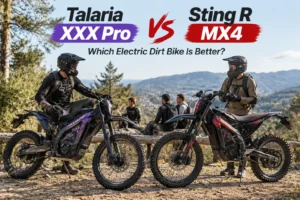
The Talaria XXX Pro and Talaria Sting R MX4 are two popular options for riders looking for a lightweight electric
