Electric Motocross vs Electric Enduro: What’s the Difference?
Electric motocross and electric enduro motorcycles can look very similar, and in some cases they even share the same motor,

The Altis Sigma makes a strong first impression. Its high-voltage powertrain, serious acceleration, motorcycle-style components, and aggressive off-road design have helped it stand out in the increasingly crowded electric dirt bike market.
But first impressions only tell part of the story.
A much more useful question for someone considering buying one is:
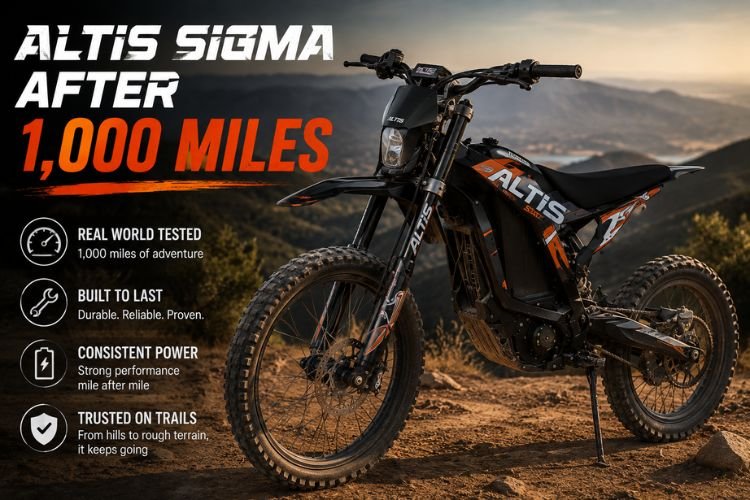
What happens after 1,000 miles?
By that point, the excitement of riding a brand-new bike has worn off. Tires have seen real use. The drivetrain has experienced hundreds of acceleration cycles. The suspension has absorbed countless bumps and impacts. The battery has been charged and discharged repeatedly.
That’s when reliability, maintenance, and ownership experience become much more important than a specification sheet.
Published professional testing has generally praised the Sigma’s power delivery and component package. RiderGuide highlighted its strong 98V-class system, trail performance, gearbox, substantial brakes, and well-tuned throttle, while also noting its relatively heavy feel and compact ergonomics for taller riders. Electric Cycle Rider similarly found the production bike extremely powerful and evaluated it across desert terrain and a pit-bike track.
More importantly for this article, real owner reports are now beginning to provide a clearer picture beyond the first ride. One owner documented reaching the 1,000-mile mark, while a 2026 owner reported more than 1,800 miles and still praised the Sigma’s torque and throttle response, although that rider was less impressed by range, brakes, and rear suspension geometry. These are individual experiences rather than controlled reliability studies, but they provide useful context for prospective owners.
This guide therefore doesn’t pretend that every Altis Sigma will look or perform exactly the same at 1,000 miles. Instead, we’ll examine what riders should expect, what needs inspection, what appears to hold up well, and which areas deserve attention as mileage increases.
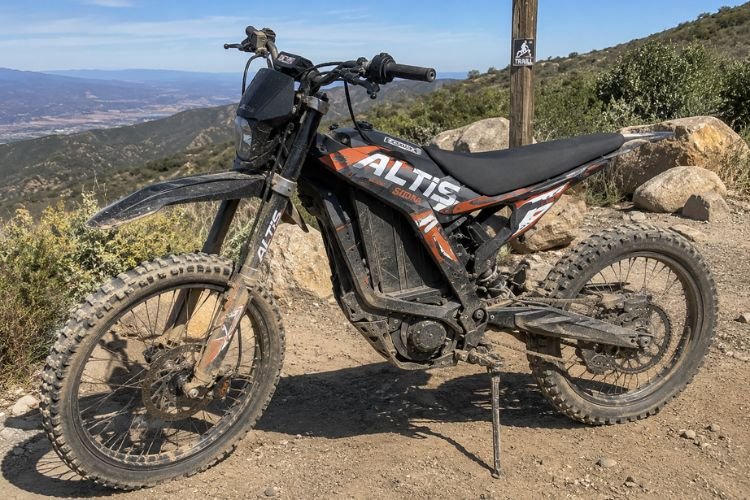
The available long-term owner feedback suggests that an Altis Sigma reaching 1,000 miles doesn’t automatically mean expensive repairs or major battery problems.
In fact, some high-mileage owners report continuing to enjoy their bikes well beyond that point. However, 1,000 miles is enough riding time for normal wear—and some of the Sigma’s compromises—to become easier to identify.
Here’s what deserves the closest attention:
| Area | What to Check Around 1,000 Miles | What It Can Tell You |
|---|---|---|
| Battery | Range consistency, charging behavior | Overall battery condition |
| Motor | Noise, heat, consistent power delivery | Motor health |
| Gearbox & Drivetrain | Noise, lubrication, chain and sprocket wear | Mechanical wear |
| Brakes | Pads, rotors, lever feel | Normal wear and braking condition |
| Tires | Tread, cuts, uneven wear | Riding style and replacement needs |
| Suspension | Seals, damping and overall feel | Service or setup requirements |
| Hardware | Bolts, pegs, controls and fasteners | Effects of off-road use |
| Plastics | Cracks and impact damage | Crash and trail wear |
The important point is that 1,000 miles isn’t the end of the Altis Sigma’s useful life. It is better viewed as a meaningful maintenance milestone.
Not every change after 1,000 miles should be considered a problem.
Electric dirt bikes still contain many conventional motorcycle components that wear through normal use.
Tires wear.
Brake pads wear.
Chains stretch.
Suspension components require attention.
Fasteners should be checked.
The electric drivetrain eliminates many jobs associated with gas motorcycles, but it doesn’t eliminate off-road maintenance.
And riding conditions matter enormously.
One rider might accumulate 1,000 relatively easy street and fire-road miles. Another might reach the same number after riding mud, rocks, jumps, steep climbs, and technical single-track.
Those two bikes could look completely different despite showing the same mileage.
That’s why mileage should always be considered alongside how the motorcycle was ridden and maintained.
Battery health is probably the biggest concern for anyone considering a high-mileage electric dirt bike.
A lithium-ion battery gradually loses usable capacity over its service life. However, reaching 1,000 vehicle miles does not automatically tell you how much degradation has occurred.
Battery aging depends heavily on:
Range is also a poor battery-health measurement when considered by itself.
A rider repeatedly using high-power modes, climbing steep terrain, or riding aggressively can consume dramatically more energy than someone cruising at moderate speeds.
This makes it important to distinguish between battery degradation and simply high energy consumption.
Rather than expecting exactly the same number of miles from every charge, look for consistency.
Ask:
A gradual difference in range isn’t automatically evidence of a failing battery.
A sudden or significant change deserves more attention.
This is particularly important with the Sigma because it has substantial performance available.
Professional testing has emphasized how powerful the bike feels, with RiderGuide recording more than 70 mph on the displayed speedometer during its test and praising the throttle calibration despite the available output.
Using that performance frequently comes with an obvious tradeoff:
Energy consumption increases.
Long-term owners shouldn’t compare their range blindly with another person’s number online.
Instead, compare the bike against itself.
If you regularly ride the same route in similar weather and riding modes, changes in energy use over time become much more meaningful.
One advantage of an electric drivetrain is mechanical simplicity.
There are no:
That doesn’t mean the motor and drivetrain should simply be ignored.
At 1,000 miles, owners should pay attention to changes in:
The Sigma’s power delivery has been one of its most consistently praised characteristics. Professional reviewers have highlighted both its strong output and surprisingly controlled throttle response, while even a 1,800-mile owner report in 2026 continued to praise the throttle feel and torque.
That’s encouraging, but one owner report isn’t enough to establish a universal failure rate or long-term durability figure.
The better rule is simple:
Know how your bike normally feels.
A new noise or sudden change in power delivery is far more useful diagnostically than comparing your bike with somebody else’s mileage.
The Sigma’s drivetrain deserves special attention because it differs from some lightweight electric dirt bikes that rely on a belt-based primary reduction system.
RiderGuide specifically highlighted the Sigma’s gearbox as a stronger solution suited to the bike’s high output.
From an ownership perspective, that’s important.
A performance drivetrain has to repeatedly handle the motor’s torque while the motorcycle encounters impacts, changing traction, and hard acceleration.
At 1,000 miles, riders should pay attention to:
The last point matters.
Electric doesn’t mean maintenance-free.
Owners should follow the current Altis service recommendations rather than relying on generic e-bike maintenance intervals.
One of the most likely components to show obvious wear by 1,000 miles isn’t the battery or motor.
It’s the tires.
RiderGuide noted that the stock CST tires were adequate during testing but suggested aggressive riders could wear through them relatively quickly.
That makes sense.
A motorcycle with substantial instant torque can be hard on rear tires, particularly when ridden on:
By 1,000 miles, inspect both tires for:
A worn rear tire can also make the motorcycle feel as though its handling or power delivery has changed when the real issue is simply reduced traction.
A first-ride review can tell you whether a motorcycle is fast.
A 1,000-mile evaluation tells you something much more useful:
whether you still enjoy owning it once maintenance, wear, and everyday compromises enter the picture.
So far, available long-term owner reports paint a mixed but useful picture. Some owners around or beyond 1,000 miles report strong reliability and say they would choose the Sigma again. Others identify compromises involving weight, plastics, parts availability, range, brakes, or suspension characteristics.
That’s exactly why a long-term review matters.
The question isn’t whether the Altis Sigma remains impressive after the honeymoon period.
It’s whether its strengths still outweigh its weaknesses once the odometer reaches four digits.
At 1,000 miles, the Altis Sigma’s motor and headline performance are only part of the ownership story.
This is the point where the wear components start telling you much more about how the bike has been treated. Tires, brake pads, chain condition, suspension, fasteners, and gearbox maintenance become increasingly important.
There’s also an important distinction between a worn component and a reliability problem. A rear tire that needs replacement after hard riding doesn’t mean the bike is unreliable. Neither does a chain that needs adjustment.
For context, the Sigma owner’s manual specifies recurring maintenance rather than treating the electric drivetrain as maintenance-free. It calls for chain inspection/cleaning at 500 km intervals, motor gear-oil service beginning at 600 km, and periodic checks of the suspension, tires, brakes, and electrical equipment.
That makes 1,000 miles—or roughly 1,600 km—a useful point for a more thorough inspection.
The Sigma’s braking system receives plenty of attention because this is a relatively heavy, powerful machine.
Professional testing by Electric Cycle Rider put the production Sigma through desert riding and pit-bike-track testing, while long-term owner discussions show mixed experiences: some owners describe the brakes as strong and consistent, while others eventually look for more stopping power or different setups.
That variation is exactly why brake condition should be judged on the individual bike.
After 1,000 miles, inspect:
The official manual specifies a 2.5 mm brake-pad wear limit and recommends inspecting pads and discs rather than relying only on mileage.
A rider who uses regenerative braking frequently and rides flowing terrain may experience relatively little mechanical brake wear.
Someone repeatedly descending steep technical trails may consume pads considerably faster.
So there’s no meaningful rule that says:
“Altis Sigma brake pads last exactly X miles.”
At 1,000 miles, condition matters more than mileage.
Suspension is another area where owner opinions become more useful after the first few hundred miles.
When a bike is brand new, almost everything feels impressive.
After months of riding, owners become much better at identifying what they actually want from the chassis.
Some Sigma riders have looked into aftermarket suspension options, while one owner reporting more than 1,800 miles specifically criticized the rear suspension geometry for their off-road use. That’s useful owner feedback, but it shouldn’t be interpreted as proof of a universal suspension defect.
The better question at 1,000 miles is:
Has the suspension changed compared with when the bike was new?
Look for:
Altis’s maintenance schedule calls for suspension-system inspection and checking the rear shock for oil leakage at specified service intervals.
If everything is mechanically healthy but the bike still doesn’t feel right, setup may be the issue rather than wear.
The chain deserves more attention than many first-time electric motorcycle owners expect.
Electric motors deliver torque immediately, and the Sigma puts substantial load through its drivetrain.
Combine that with:
and drivetrain wear can accelerate quickly.
Some early online discussions mentioned chain slap, but owners also pointed out that incorrect chain tension can create the same symptom. The official manual specifies 10–15 mm chain slack and emphasizes keeping the front and rear sprockets aligned during adjustment.
At 1,000 miles, inspect the chain for:
Also inspect the sprocket teeth for uneven or excessive wear.
If you hear rattling while riding, don’t immediately assume the motor or gearbox is failing. Recent owner discussions have also traced some rattling complaints to chain tension or the chain-guard area.
This is probably one of the most important points for anyone buying a used Sigma.
The Altis Sigma may be electric, but its reduction gearbox still uses gear oil.
According to the owner’s manual, the reducer holds approximately 0.10–0.12 L of gear oil, and the maintenance schedule includes a motor gear-oil change beginning at 600 km.
That means a Sigma with 1,000 miles should already have passed its initial gearbox-service milestone.
This creates a very useful question when evaluating a used bike:
Was the scheduled gear oil service actually performed?
If the seller has maintenance records, even better.
One owner discussion about purchasing a used Sigma with 700 miles specifically raised skipped gearbox-oil changes and neglected chain lubrication as things buyers should investigate.
That’s much more useful than simply asking whether the bike “runs fine.”
By 1,000 miles, the original tires may tell you a lot about how the bike was ridden.
High torque combined with mixed off-road and pavement riding can be particularly demanding on the rear tire.
One owner who reported more than 600 hard-ridden miles said the main issue encountered was worn stock tires, while another owner in the same discussion reported 1,100 miles without problems. These are anecdotal reports, but they illustrate why consumable wear and mechanical reliability should be evaluated separately.
Check for:
Altis’s manual specifies a minimum tread depth of 2 mm and recommends inspecting tires for damage and embedded foreign objects.
If you’re buying used, heavily worn tires can also give you clues about how aggressively the previous owner rode.
Off-road riding is hard on hardware regardless of whether the motorcycle uses gasoline or electricity.
At 1,000 miles, a thorough inspection should include:
Pay particular attention to anything that has developed a new rattle, click, or movement.
Small noises don’t automatically indicate serious mechanical damage.
But ignoring them isn’t a good strategy either.
The best time to investigate a loose component is before it becomes a failed component.
Electronics are another area worth checking on a higher-mileage bike.
There have been individual owner reports involving display behavior, including mileage tracking or resetting concerns. Earlier owner discussions also raised questions about display wiring and mileage accuracy. These reports are useful to know about, but they aren’t enough to establish that every Sigma has a display problem.
At 1,000 miles, verify that:
This is especially important when purchasing used because an inaccurate or reset odometer can make maintenance history harder to verify.
There’s no universal answer.
For a properly maintained Sigma, the first 1,000 miles are more likely to involve consumables and scheduled maintenance than rebuilding the electric powertrain.
A typical inspection might look like this:
| Component | Around 1,000 Miles |
|---|---|
| Battery | Check performance and charging consistency |
| Motor | Inspect for abnormal noise or behavior |
| Gearbox | Verify scheduled gear-oil service |
| Chain | Inspect, clean, lubricate and adjust |
| Sprockets | Inspect for wear |
| Brake Pads | Measure and inspect |
| Rotors | Check condition |
| Tires | Inspect tread and damage |
| Suspension | Inspect seals, damping and mounts |
| Hardware | Check critical fasteners |
| Electronics | Verify display, controls and fault-free operation |
Notice what’s missing:
A mandatory motor replacement or battery replacement.
The owner feedback currently available does not support claiming that either component routinely fails around 1,000 miles. In fact, individual owners have reported 1,100 miles without issues, 1,800+ miles with the bike still in regular use, and, more recently, even 4,000+ miles. These are encouraging anecdotes rather than statistically meaningful reliability data, so they should be treated accordingly.
This is perhaps the most important takeaway from a long-term Altis Sigma review.
Two Sigmas showing exactly 1,000 miles can be completely different motorcycles.
Bike A may have:
Bike B may have:
Both odometers say 1,000 miles.
Their condition may be dramatically different.
That’s why mileage alone isn’t the best measure of Altis Sigma reliability.
Maintenance history, riding conditions, and the current condition of the bike matter more.
Based on the evidence currently available, 1,000 miles should not automatically be considered high mileage for an Altis Sigma.
It’s better viewed as the point where a prospective owner should stop judging the bike as “almost new” and start evaluating it as a used performance motorcycle.
At this mileage, you want evidence that routine maintenance hasn’t been ignored.
And for existing owners, 1,000 miles is an excellent opportunity to perform a comprehensive inspection.
The Sigma’s electric drivetrain removes much of the routine engine maintenance associated with a gas dirt bike, but its chassis, gearbox, brakes, tires, suspension, chain, and bearings still live a hard off-road life.
That’s the reality of owning a high-performance electric dirt bike.
After 1,000 miles, the most useful question is no longer whether the Altis Sigma is fast.
We already know it is.
The more important questions are whether the bike remains enjoyable to own, what maintenance it needs, what a used buyer should inspect, and whether the advantages that make the Sigma exciting when new still matter once the odometer reaches four digits.
The available long-term evidence is still developing. The Sigma is a relatively young platform, so there isn’t yet the kind of multi-year, high-mileage reliability dataset available for older motorcycles.
That means we should be careful about making sweeping claims.
What we can do is combine the official maintenance requirements with published professional testing and the growing number of higher-mileage owner reports to understand what ownership looks like once the bike is no longer new.
There isn’t one universal 1,000-mile maintenance cost.
A rider who spends most weekends on easy trails may consume very few parts. Someone riding hard terrain, pavement, jumps, or repeated high-power sessions may go through tires and brake components much faster.
The important distinction is between scheduled maintenance and wear items.
Scheduled maintenance includes tasks such as:
Wear items may include:
The electric drivetrain removes expenses such as engine-oil changes, spark plugs, fuel-system servicing, and many of the other jobs associated with a combustion dirt bike.
However, don’t interpret that as zero maintenance.
A more realistic way to budget is to expect relatively low routine drivetrain costs, with tires and brakes creating the biggest variability depending on riding style.
If you pay a shop rather than performing routine work yourself, labor should also be included in your ownership budget.
Perhaps the most encouraging part of the available long-term feedback is that the conversation doesn’t suddenly change at 1,000 miles from performance to catastrophic powertrain failures.
Some owners have reported passing 1,000 miles without significant problems, while higher-mileage examples have continued to receive positive comments about torque and throttle response.
That’s meaningful because the Sigma’s powertrain is one of the bike’s defining features.
A high-performance electric motorcycle needs more than impressive peak output when new. Riders want consistent, controllable performance after hundreds of charge cycles and many hours of hard riding.
At the same time, owner anecdotes shouldn’t be turned into a claim that every Sigma will achieve the same result.
Long-term durability depends on maintenance, terrain, modifications, temperature, charging habits, and riding intensity.
The encouraging takeaway is simpler:
1,000 miles itself doesn’t appear to be a reason to fear the Sigma.
Some characteristics that seem minor during a short test ride can become much more important during long-term ownership.
The Sigma’s substantial build contributes to its planted motorcycle-like character, but riders coming from lighter e-moto platforms may notice the weight more during technical riding.
Picking up the bike after a fall, changing direction repeatedly on tight trails, and maneuvering at very low speeds can make weight more noticeable than it appears on a specification sheet.
The Sigma has serious performance available, and using that performance consumes energy.
A rider expecting maximum power and maximum range simultaneously may be disappointed.
After months of ownership, most riders become better at understanding how terrain, speed, temperature, tire choice, and throttle behavior affect their actual range.
Power and weight also affect tires, brakes, chains, and sprockets.
Again, that’s not necessarily a reliability problem.
It’s part of owning a performance-focused off-road motorcycle.
Normal wear shouldn’t scare a used buyer.
Certain symptoms should.
If you’re inspecting an Altis Sigma with around 1,000 miles, take the following warning signs seriously:
A heavily worn tire is easy to replace.
A neglected drivetrain or damaged electrical system deserves much closer investigation.
This is where the long-term information becomes especially useful.
If you’re looking at a used Sigma showing 1,000 miles or more, don’t judge the motorcycle on mileage alone.
Start with its history.
Ask the seller:
Then inspect the bike itself.
Check that charging is normal and the state-of-charge display behaves predictably.
If possible, perform a meaningful test ride rather than judging battery health from a five-minute ride around a parking lot.
Listen for abnormal sounds and inspect the chain and sprockets.
A neglected chain can tell you something about how seriously the previous owner treated maintenance overall.
Look closely for leaks and check whether the front and rear suspension operate smoothly.
Inspect pad and rotor condition and make sure the levers feel consistent.
Look for:
Cosmetic scratches are normal on an off-road bike.
Structural damage is different.
Not necessarily.
Electric dirt bike owners love modifications, and a well-selected upgrade can improve the riding experience.
But modifications introduce another variable when evaluating a used motorcycle.
Ask what was changed.
Pay particular attention to modifications involving:
Professional-quality upgrades with documentation can add value.
Poor wiring, improvised electrical work, or mismatched components can create problems that have nothing to do with the original motorcycle.
A heavily modified bike deserves a more careful inspection than a stock example.
| Area | What to Look For | Concern Level |
|---|---|---|
| Battery | Stable charging and predictable performance | High |
| Motor | Smooth, consistent operation | High |
| Gearbox | Service history and abnormal noise | High |
| Frame | Cracks or structural damage | High |
| Suspension | Leaks and damping condition | Medium–High |
| Brakes | Pads, rotors and lever feel | Medium |
| Chain | Tension, lubrication and wear | Medium |
| Sprockets | Damaged or worn teeth | Medium |
| Tires | Tread and physical damage | Low–Medium |
| Plastics | Scratches or cracks | Usually Low |
| Display | Mileage, modes and error messages | Medium |
| Hardware | Missing or loose fasteners | Medium |
A bike with worn tires but excellent maintenance history may be a much better purchase than a cleaner-looking motorcycle with questionable battery or drivetrain history.
Based on the evidence available so far, yes—with the same qualification that should apply to any high-performance electric dirt bike: buy the condition and maintenance history, not just the model name.
The Sigma’s core strengths remain compelling:
Its compromises also become clearer with long-term use.
Riders need to accept that performance can mean faster tire and drivetrain wear. Weight may matter on technical terrain. Real-world range can change dramatically depending on how aggressively the bike is ridden.
Those aren’t necessarily reasons not to buy one.
They’re reasons to buy one with realistic expectations.
Not necessarily.
Mileage should be considered alongside maintenance history and riding conditions. A properly maintained 1,000-mile bike may be in considerably better condition than a neglected example with much lower mileage.
Lithium-ion batteries gradually age, but mileage alone cannot determine battery degradation. Charge cycles, temperature, storage, terrain, and riding style all influence battery health and real-world range.
A sudden change under similar riding conditions deserves more attention than simply comparing your range with another owner’s number.
It doesn’t require conventional engine-oil changes like a gas motorcycle, but the Sigma’s reduction gearbox does use gear oil and should be serviced according to the manufacturer’s current maintenance schedule.
Consumables such as tires, brake pads, and drivetrain components are more likely to require attention before the electric motor itself under normal use. The actual lifespan depends heavily on terrain and riding style.
It can be.
Check battery behavior, gearbox maintenance, drivetrain condition, suspension, brakes, frame integrity, electronics, modifications, and service history before deciding.
There isn’t enough long-term fleet data to give a credible universal mileage lifespan yet. Individual higher-mileage reports are encouraging, but maintenance and usage will play a major role in how long each motorcycle lasts.
The most important lesson from looking at the Altis Sigma after 1,000 miles is that the odometer doesn’t tell the entire story.
At this point, the bike should no longer be evaluated like a showroom-new motorcycle.
Its maintenance history matters.
Its battery behavior matters.
Its drivetrain condition matters.
And the way those 1,000 miles were accumulated matters enormously.
The available evidence doesn’t suggest that 1,000 miles represents some kind of reliability cliff for the Altis Sigma. Instead, it appears to be a sensible milestone for performing a thorough inspection and evaluating how well the motorcycle has been maintained.
For existing owners, that means checking the bike carefully and keeping up with scheduled maintenance.
For used-bike shoppers, it means looking beyond cosmetic condition and asking detailed questions about servicing, charging, modifications, and riding history.
And for riders considering a new Sigma, the long-term picture so far is encouraging—but still developing.
The Altis Sigma remains a young platform. More bikes need to accumulate several thousand miles before anyone can make strong statistical claims about long-term reliability.
For now, the most defensible conclusion is also the simplest:
A well-maintained Altis Sigma at 1,000 miles can still have plenty of riding ahead of it.
Electric motocross and electric enduro motorcycles can look very similar, and in some cases they even share the same motor,
Electric enduro motorcycles are becoming an increasingly appealing option for riders who want strong acceleration, precise low-speed control, and less

Electric enduro motorcycles are becoming an increasingly appealing option for riders who want strong acceleration, precise low-speed control, and less

The Talaria XXX Pro and Talaria Sting R MX4 are two popular options for riders looking for a lightweight electric
