Electric Motocross vs Electric Enduro: What’s the Difference?
Electric motocross and electric enduro motorcycles can look very similar, and in some cases they even share the same motor,

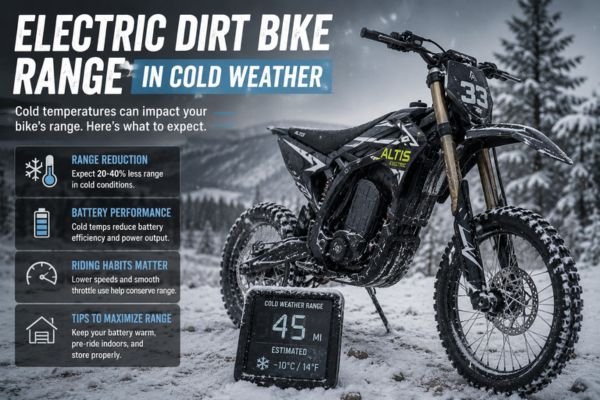
Winter doesn’t stop many riders from hitting the trails.
In fact, cooler temperatures often mean fewer crowds, better traction on certain terrain, and a completely different riding experience. But there’s one thing almost every electric dirt bike owner notices the first time they ride in cold weather:
The battery doesn’t seem to last as long.
Maybe your bike usually covers 45 miles on a full charge, but during a cold morning ride it only manages 35.
Or perhaps the bike feels slower during the first few minutes before gradually becoming more responsive.
Neither of these situations is unusual.
Cold weather affects every lithium-ion battery to some degree, whether it’s installed in an electric dirt bike, an electric mountain bike, or an electric car. The good news is that most of these changes are temporary, and understanding why they happen can help you get much better performance throughout the winter.
The bigger question isn’t whether cold weather reduces range.
It’s how much.
The answer depends on several factors, including the outside temperature, battery temperature, riding style, terrain, elevation, and even where you stored the bike before heading out.
In this guide, we’ll explain what really happens inside your battery during winter, how much range you can realistically expect to lose, and the simple habits that experienced riders use to maximize battery performance when temperatures drop.
Yes—cold weather reduces the range of almost every electric dirt bike.
For most riders, the reduction is temporary rather than permanent.
Under typical winter riding conditions, here’s what you can generally expect.
| Outside Temperature | Typical Range Reduction |
|---|---|
| 59°F (15°C) or above | 0–5% |
| 50°F (10°C) | 5–10% |
| 41°F (5°C) | 10–15% |
| 32°F (0°C) | 15–25% |
| 14°F (-10°C) | 30–40% |
These figures are estimates rather than fixed numbers.
A rider using full throttle on steep, muddy trails will usually see a larger reduction than someone riding smoothly on flat fire roads.
The condition of the battery also matters.
A newer battery generally performs better in cold weather than one that’s already been through hundreds of charging cycles.
Many riders assume the battery is losing capacity during winter.
That’s not exactly what’s happening.
In most cases, the battery still stores nearly the same amount of energy. The challenge is that it can’t deliver that energy as efficiently when it’s cold.
To understand why, it helps to know a little about how lithium-ion batteries work.
Inside every battery, lithium ions move between the positive and negative electrodes during charging and discharging.
When temperatures drop, that movement slows down.
The result is increased internal resistance.
Higher resistance means:
Think of it like drinking a thick milkshake through a straw.
At room temperature, the liquid flows easily.
After sitting in the freezer, it becomes much harder to drink.
The milkshake hasn’t disappeared—it simply moves more slowly.
A cold battery behaves in much the same way.
The battery isn’t the only factor affecting winter range.
Several other conditions work together to reduce how far your bike can travel on a single charge.
Winter trails are rarely the same as summer trails.
Snow, wet soil, frozen mud, and soft ground all require more energy to ride across than dry, compact dirt.
Even if the battery were performing perfectly, these conditions would still increase energy consumption.
Slippery terrain often requires more careful throttle control.
Constantly accelerating and adjusting speed places additional demand on the battery.
Over the course of a long ride, those small adjustments can noticeably reduce total range.
Winter jackets, boots, protective layers, hydration packs, and cold-weather equipment add weight.
While the increase isn’t dramatic, every additional pound requires a little more energy to move.
Combined with colder battery temperatures, the effect becomes easier to notice.
One of the most common questions new owners ask is:
“Why does my bike feel weak for the first few miles?”
This is completely normal.
When the battery starts the ride at a low temperature, the Battery Management System (BMS) may temporarily limit power output to protect the battery.
As you continue riding, something interesting happens.
The battery naturally warms itself.
Every discharge cycle generates a small amount of heat.
After fifteen to thirty minutes of riding—depending on the outside temperature—the battery reaches a more efficient operating range.
Many riders notice:
Even though the outside air is still cold.
That’s because the battery temperature—not just the air temperature—is what matters most.
This is one of the biggest misconceptions surrounding electric dirt bikes.
Simply riding in cold weather does not permanently reduce battery capacity.
In most cases, once the battery returns to a normal operating temperature, its performance returns as well.
What can cause long-term damage is improper battery care during winter.
Examples include:
Fortunately, all of these situations are easy to avoid with a few simple maintenance habits, which we’ll cover later in this guide.
You can’t change the temperature outside, but you can change how your battery performs in winter.
Many riders accept losing 30–40% of their range simply because it’s cold.
In reality, a few simple habits can make a noticeable difference.
The goal isn’t to eliminate winter range loss completely—that isn’t realistic.
The goal is to help the battery start the ride in the best possible condition and reduce unnecessary energy consumption once you’re on the trail.
The easiest way to improve winter range is to start with a warm battery.
If your bike is stored in an unheated garage, shed, or trailer overnight, the battery temperature may be close to the outside air temperature before you even begin riding.
Whenever possible:
A battery that’s already warm delivers power more efficiently from the first mile.
This doesn’t mean heating the battery with external devices.
Simply storing it in a heated room is usually enough.
One mistake many riders make is demanding maximum power as soon as the ride begins.
When the battery is still cold, the cells have higher internal resistance.
Aggressive acceleration places additional stress on the battery and increases energy consumption.
Instead, spend the first several minutes riding at a moderate pace.
As the battery warms naturally during use, performance gradually improves.
Many riders notice that throttle response becomes smoother after 10 to 20 minutes of riding.
If your bike offers multiple power modes, winter is a good time to use them strategically.
For casual trail riding:
You don’t need to stay in Eco Mode all day, but using a lower power setting during the first part of your ride can help conserve battery capacity.
Battery range is heavily influenced by riding style.
Repeated hard acceleration uses much more energy than maintaining a smooth, consistent pace.
On winter trails, smooth throttle control offers two advantages:
Instead of accelerating hard after every corner, try maintaining momentum whenever possible.
Small changes in riding style can add meaningful range over the course of a longer ride.
Cold weather causes tire pressure to drop.
Underinflated tires create additional rolling resistance, forcing the motor to work harder.
Before each winter ride:
Proper tire pressure improves both efficiency and handling.
Charging is one area where riders should be especially careful.
A common misconception is that you can bring a freezing battery indoors and plug it in immediately.
That’s not always recommended.
If the battery has been sitting outside in very cold temperatures, allow it to warm gradually before charging.
Most lithium-ion batteries perform best when charged within the temperature range specified by the manufacturer.
Charging a battery that’s too cold can reduce charging efficiency and, in some cases, shorten battery life over time.
When possible:
Patience here can help protect one of the most expensive components on your bike.
Experienced riders often develop small habits that add up over an entire season.
Some of the simplest include:
These habits won’t completely eliminate winter range loss, but together they can noticeably improve real-world performance.
Many winter battery problems aren’t caused by cold weather itself.
They’re caused by avoidable mistakes.
It’s convenient—but not ideal.
If possible, remove the battery and store it indoors before your next ride.
Starting with a warmer battery almost always improves performance.
A battery that’s been exposed to very low temperatures should be allowed to warm gradually before charging.
Avoid rushing this process.
Snow eventually melts.
Water around the charging port, battery compartment, or electrical connectors should always be dried before storing or charging the bike.
Cold weather changes battery behavior.
Planning your route with slightly reduced range expectations helps prevent surprises on longer rides.
Yes.
For a healthy lithium-ion battery, the reduced range you notice in winter is usually temporary.
Once temperatures return to normal, battery performance generally returns as well.
Cold weather slows the chemical reactions inside the battery, but it doesn’t permanently remove capacity simply because you rode in lower temperatures.
If you notice poor range even during warm weather, other factors may be involved, including:
In those situations, the weather may not be the primary cause.
No battery performs exactly the same under every condition.
Instead of expecting a specific mileage figure, it’s more realistic to think in percentages.
For many riders:
Knowing this ahead of time allows you to plan rides more confidently and avoid running the battery lower than expected.
In the final section, we’ll answer the most common questions about winter riding, explain how to store an electric dirt bike battery during cold months, provide a winter maintenance checklist, and share the best practices for keeping your bike reliable throughout the season.
Most electric dirt bikes lose between 10% and 40% of their riding range in cold weather.
The exact reduction depends on several factors, including air temperature, battery temperature, terrain, rider weight, throttle use, and elevation. On a cool fall day, the difference may be barely noticeable. On a freezing winter morning, the reduction can be much more significant.
No.
Simply riding in cold weather does not permanently reduce battery capacity.
In most cases, the battery returns to normal performance once it warms back to its normal operating temperature.
Permanent damage is far more likely to result from improper charging, poor storage conditions, or leaving the battery completely discharged for extended periods.
Yes.
Starting your ride with a battery that has been stored at room temperature is one of the easiest ways to improve winter performance.
If possible, keep the battery indoors and install it shortly before heading out.
Avoid using external heaters or placing the battery near direct heat sources. Let it warm naturally.
It’s best to avoid charging a battery immediately after it has been exposed to freezing conditions.
Allow the battery to warm gradually to room temperature before connecting the charger.
Always follow the charging recommendations provided by your bike’s manufacturer, as acceptable charging temperatures may vary between battery systems.
As you ride, the battery naturally generates heat.
Once the battery reaches a more efficient operating temperature, internal resistance decreases and power delivery improves.
That’s why many riders notice stronger acceleration and smoother throttle response after the first part of a winter ride.
Usually, yes.
Lower power modes reduce energy consumption and place less stress on the battery.
While Eco Mode won’t completely eliminate range loss, it can noticeably extend riding time compared with riding aggressively in the highest power setting.
Yes, provided the terrain is suitable and the manufacturer allows riding in those conditions.
Keep in mind that snow reduces traction, increases rolling resistance, and usually shortens battery range.
After riding, clean the bike thoroughly and dry the charging port, battery compartment, and electrical connectors before storing it.
Generally, yes.
As lithium-ion batteries age, their overall capacity gradually decreases.
Older batteries may experience a slightly greater reduction in usable range during cold weather than newer batteries.
Keeping the battery properly charged and stored can help slow this natural aging process.
Cold-weather riding doesn’t require complicated maintenance, but a consistent routine goes a long way toward protecting your bike.
Before every winter ride, make sure you:
After every ride:
A few extra minutes of maintenance can help prevent many of the problems riders experience during winter.
While every riding environment is different, experienced riders often follow a few simple habits during the colder months.
They don’t expect the same range they get in summer. Instead, they plan shorter rides, leave a larger battery reserve, and avoid running the battery completely flat in freezing conditions.
They also tend to ride more smoothly.
Hard acceleration drains energy faster, especially when the battery is cold. Maintaining steady speed and carrying momentum through corners is often more efficient than repeatedly accelerating and braking.
Perhaps the most overlooked habit is checking the bike after every ride.
Snow, mud, and moisture can hide around the battery compartment, charging port, brake components, and suspension. Cleaning the bike promptly helps prevent corrosion and makes it easier to spot small issues before they become expensive repairs.
Cold weather changes the way every lithium-ion battery performs, but it doesn’t mean you have to put your electric dirt bike away for the winter.
By understanding how temperature affects battery chemistry, you can adjust your expectations and your riding habits to get the most from every charge.
For most riders, winter range loss is temporary. A battery that delivers less power on a freezing morning will usually return to normal performance once temperatures rise again.
The key is preparation.
Start with a warm battery whenever possible. Ride smoothly during the first few miles. Keep the bike clean and dry after every outing. Charge and store the battery correctly, and you’ll not only improve winter performance but also help extend the overall life of your battery.
Electric dirt bikes are built to be ridden year-round. With the right maintenance routine and realistic expectations, winter can be just as rewarding as any other riding season.
Electric motocross and electric enduro motorcycles can look very similar, and in some cases they even share the same motor,

Electric enduro motorcycles are becoming an increasingly appealing option for riders who want strong acceleration, precise low-speed control, and less
Electric enduro motorcycles are becoming an increasingly appealing option for riders who want strong acceleration, precise low-speed control, and less
The Talaria XXX Pro and Talaria Sting R MX4 are two popular options for riders looking for a lightweight electric
