Stark Varg MX vs Stark Varg EX: Key Differences
Electric enduro motorcycles are becoming an increasingly appealing option for riders who want strong acceleration, precise low-speed control, and less

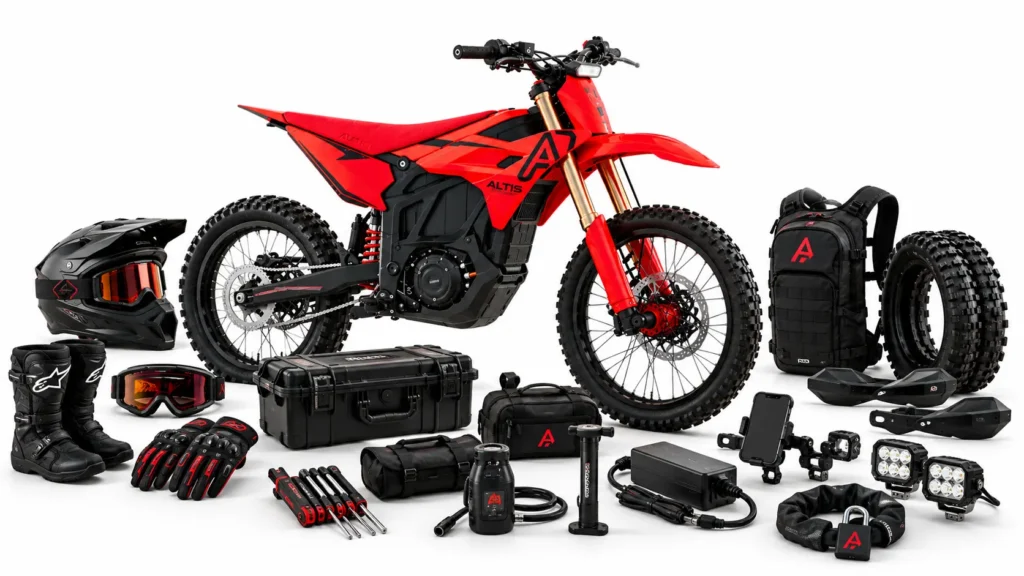
The best accessories for an electric dirt bike are not necessarily the parts that make it faster. For most riders, the smartest first purchases are proper riding gear, bike protection, theft security, reliable transport equipment, a useful trail tool kit, and charging equipment that is actually compatible with the battery. Performance upgrades such as foot pegs, handlebars, brakes, suspension, controllers, or larger batteries can come later, once you know what the stock bike genuinely needs.
That distinction matters because the accessory market around Surron, Talaria, E Ride Pro, Rawrr, Altis, and other electric dirt bikes has become enormous. It is easy to spend hundreds or thousands of dollars replacing perfectly functional parts before you have even learned how the motorcycle behaves.
Current accessory guides increasingly make the same point. VoltRipper’s 2026 guide reduces the useful accessory list to practical jobs such as hauling, locking, charging, storing, and repairing the bike, while its protection guide separates genuine impact protection such as skid plates and rotor guards from cosmetic frame guards.VoltRipper
That is the approach worth following.
Before asking what looks best on an electric dirt bike, ask what is most likely to protect the rider, prevent an expensive repair, stop a ride from ending early, or make the motorcycle easier to own.
The most important accessories are worn by the rider rather than installed on the motorcycle.
A modern electric dirt bike can feel deceptively approachable because there is no loud engine, clutch, or exhaust. That does not mean it has bicycle-level performance. Lightweight electric motorcycles such as Surron, Talaria, and E Ride Pro models can reach speeds and acceleration levels that justify motorcycle-specific protective equipment.
A properly fitting off-road or motocross helmet should come first. In the United States, NHTSA recommends checking for the DOT marking showing that a motorcycle helmet is certified by the manufacturer to comply with FMVSS No. 218. NHTSA also specifically describes off-road helmets as having an extended chin bar and being suitable for motocross and other off-road activities.NHTSA
Do not confuse a lightweight bicycle helmet with a motorcycle helmet simply because the electric dirt bike is small. The motorcycle may weigh much less than a conventional dirt bike, but the rider can still hit the ground, rocks, trees, or other vehicles at motorcycle-like speeds.
Goggles are the next obvious accessory. Off-road riding produces dust, mud, branches, insects, and roost from other riders. Sunglasses offer limited coverage and can move during rough riding, while motocross goggles are designed to work with an off-road helmet and provide much more complete eye protection.
Gloves, motocross boots, knee protection, and chest or back protection should follow. Boots are especially important because feet and ankles are exposed to rocks, foot pegs, bike weight, and twisting impacts during falls. A rider who spends several thousand dollars upgrading the motorcycle but rides in ordinary sneakers has the priorities backward.
NHTSA’s broader motorcycle safety guidance also recommends keeping arms and legs covered and wearing appropriate protective equipment rather than treating the helmet as the only piece of safety gear.NHTSA
The exact level of armor should match the riding. A beginner riding slowly on easy private trails may not choose the same setup as someone riding fast rocky terrain or jumping an electric motocross bike. But the principle is consistent: spend on rider protection before spending on cosmetic upgrades.
Fit matters as much as price. A premium helmet that does not match the rider’s head shape or a pair of boots that prevents normal control operation is not automatically better than properly fitted equipment at a lower price.
This is one reason generic “best accessory” lists can be misleading. The best helmet or boot is not simply the most expensive one. It needs to fit the rider, suit the terrain, and meet the applicable safety requirements.
After rider protection, the most valuable accessories are often the ones that prevent expensive damage.
Electric dirt bikes place important components relatively low in the chassis, particularly around the motor, battery enclosure, drivetrain, brake rotors, and lower frame. Rocks, logs, roots, and crashes can damage those areas long before the rider ever needs more power.
A skid plate is one of the most useful upgrades for riders who regularly ride rocky or technical terrain. Its job is simple: take an impact before the lower motor or chassis does. Fitment is important because skid plates are usually designed around a specific frame and model generation. A Surron Light Bee plate should not be assumed to fit a Talaria or even every generation of the same model.
Current electric dirt bike protection guides make the same distinction. VoltRipper notes that skid plates, handguards, and rotor guards protect genuinely exposed components, while some products marketed as frame protection are more about reducing boot rub and cosmetic wear than stopping a hard impact.VoltRipper
Handguards are another worthwhile upgrade for trail riders. They can help protect the rider’s hands from branches and reduce the likelihood of brake levers being damaged in a tip-over. Full-wrap guards offer more structural protection than simple plastic roost deflectors, although the correct style depends on the handlebars, controls, and riding environment.
Brake rotor guards can make sense where rocks and roots are common. A slightly bent rotor can create rubbing, poor braking feel, or end a riding session, so protecting an exposed disc can be worthwhile on terrain where impacts are likely.
Frame and swingarm guards are more situational. They are useful for reducing scratches, boot wear, and cosmetic damage, but they should not be confused with structural armor. If the budget is limited, protecting the motor, lower chassis, brake components, and rider controls usually matters more.
Wider or stronger foot pegs can also be a meaningful functional upgrade. Stock pegs on some lightweight e-motos are relatively small, and riders who spend a lot of time standing may prefer a wider platform with better grip. The benefit is not extra horsepower. It is better control and less foot fatigue.
Handlebars, grips, and controls belong in the same category. Upgrade them because they improve fit or because the stock components have a specific weakness, not simply because aftermarket parts exist.
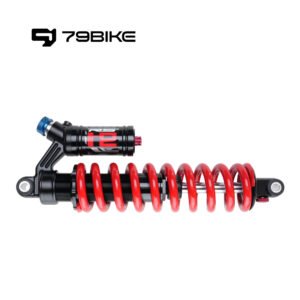
The same rule applies to brakes and suspension. Better pads, rotors, master cylinders, forks, or shocks can transform an electric dirt bike when the original components are genuinely limiting the rider. But these upgrades should be based on a problem you have identified.
A rider who has not yet set sag, checked tire pressure, or learned the stock suspension may gain less from an expensive shock than from spending time properly setting up the motorcycle.
That principle becomes even more important with electric powertrain upgrades.
A controller or larger battery can increase available performance, but greater speed and power place additional demands on brakes, tires, suspension, drivetrain components, and the rider. The best accessory path is usually to improve control and protection before output.
Some of the least exciting accessories are the ones owners appreciate most after living with an electric dirt bike for several months.
The first is a proper theft-security setup.
Lightweight electric motorcycles can be easier to physically move than full-size motorcycles, which means an electronic key or factory immobilizer should not be treated as complete theft protection. A strong chain or motorcycle-rated lock attached to an immovable object, combined with a second lock or alarm and a discreet tracker, provides a much stronger layered approach.
The National Insurance Crime Bureau recommends heavy-duty locks attached to fixed objects, alarms, covers, additional immobilizers, and GPS tracking for motorcycles.National Insurance Crime Bureau
That makes a quality lock and tracker much more useful than another decorative bolt kit.
Transportation equipment is equally important.
A lightweight electric dirt bike may look small enough for bicycle equipment, but many adult e-motos weigh well over 100 pounds. A bicycle rack designed for ordinary mountain bikes should not be assumed capable of carrying one safely.
Use a motorcycle or powersports carrier whose capacity exceeds the actual weight of the bike, and verify the vehicle’s hitch class and tongue-weight limits as well. If the motorcycle is loaded into a truck or trailer, a properly rated ramp, quality tie-down straps, and soft loops can make loading safer and reduce damage to handlebars or controls.
VoltRipper’s 2026 accessory guide identifies transport equipment as one of the most underestimated parts of electric dirt bike ownership for exactly this reason: compact dimensions can make owners underestimate actual motorcycle mass.VoltRipper
Charging equipment deserves even more caution because not every accessory should be purchased from the cheapest marketplace listing.
The safest general rule is to use the charger supplied with the motorcycle or a replacement explicitly approved for the exact battery system. The U.S. Consumer Product Safety Commission has warned against chargers marketed as “universal” for broad categories of micromobility products because physical connector compatibility does not guarantee electrical compatibility. CPSC advises using the supplied charger or a manufacturer-approved replacement.U.S. Consumer Product Safety Commission
That warning is particularly relevant to electric dirt bikes because owners frequently modify batteries and electrical systems.
A charger must match more than the nominal voltage printed on the battery label. Charging voltage, current, connector wiring, battery-management requirements, and charging protocol all matter. Using a charger from another bike simply because the connector fits is a poor way to save money.
A spare charger can still be a useful accessory for riders who regularly charge in two locations, but it should be a genuinely compatible unit rather than a generic substitute.
Battery storage accessories should be approached with the same caution. Avoid accessories or enclosures that interfere with battery cooling, create mechanical pressure, or conflict with manufacturer storage guidance. The correct charging and storage procedure should come from the battery or motorcycle manufacturer, not from a universal accessory seller.
Electric dirt bikes need fewer engine-specific tools than conventional gas motorcycles, but that does not mean a trail tool kit is unnecessary.
A compact kit should be built around the fasteners and components actually fitted to your bike. That may include appropriate hex keys, Torx bits, sockets, combination wrenches, screwdrivers, pliers, tire-pressure equipment, a compact pump or inflator, and a few model-specific tools.
Do not buy a huge generic tool roll simply because it says “motorcycle” on the packaging. Open the bike’s manual, inspect the common fasteners, and build the kit around real maintenance needs.
A small tire-pressure gauge can be particularly useful because tire pressure has a major effect on traction, handling, and rim protection off-road. Riders who change between hardpack, rocks, loose soil, and road transport may need to check pressure more often than they expect.
If the bike uses tubes, the appropriate puncture equipment and knowledge to use it can save a ride. If it uses another tire system, carry tools that match that setup instead. A universal repair kit is only useful when it works with the tires actually installed.
Basic consumables can be helpful as well. Heavy-duty zip ties, a small amount of suitable tape, spare fuses where the manufacturer specifies them, a master link where appropriate, and a few model-specific bolts can help with minor trail problems.
A compact first-aid kit belongs in the same bag. It is technically a rider accessory rather than a motorcycle part, but it is more useful on a remote trail than another anodized cosmetic component.
The same applies to a phone or GPS system. A secure mount can be useful for navigation, particularly on long trail systems, but handlebars are a high-vibration environment. Make sure the mount is designed for rough riding and does not interfere with steering, brake hoses, controls, or the rider’s ability to move around the motorcycle.
A small handlebar or frame bag can carry tools and essentials on bikes with almost no factory storage. Avoid overloading the handlebars or attaching a bag where it interferes with steering, cables, suspension movement, or battery access.
For longer rides, the best accessory may simply be better planning. Knowing the route, carrying water, checking the battery state before leaving, and understanding where the bike can realistically be recovered are often more useful than adding another electronic gadget.
Performance accessories are not bad. They are simply easier to waste money on.
The best upgrade is the one that solves a problem you can already describe.
If your feet regularly slip from the stock pegs, wider pegs make sense. If the brake pads fade or lack feel for your riding style, better pads may make sense. If suspension bottoms despite correct setup, suspension work may be justified. If the battery cannot provide the riding time you genuinely need, a compatible higher-capacity battery may be valuable.
What does not make sense is replacing the battery, controller, motor, suspension, brakes, wheels, and handlebars simply because those parts appear on every modified Surron on social media.
Performance modifications also interact.
Increasing controller output places more load on the battery and motor. A higher-voltage battery may require a compatible controller and electrical system. More speed raises braking and chassis demands. Larger wheels or different tire sizes alter gearing, geometry, weight, and handling.
That means the electric dirt bike should be treated as a system.
A spare battery is a good example. Some accessory guides describe it as the best range upgrade, and for a bike designed around easily removable batteries that can be correct.HappyRun G300 But a second battery is expensive, heavy, model-specific, and must be transported and stored appropriately. It only makes sense when the rider actually needs another full riding session without waiting for a recharge.
The same is true for high-output controllers. They can significantly change how a motorcycle performs, but they should not be purchased before confirming battery compatibility, motor limits, wiring requirements, thermal behavior, and braking capability.
Suspension may be a better first performance upgrade for a serious trail rider. A motorcycle with controlled suspension and predictable traction can often be ridden more effectively than a more powerful bike with a poorly matched chassis.
Tires may be an even better value. The correct tire for the terrain affects acceleration, braking, cornering, and climbing at the same time. Extra motor power is of limited use if the rear tire cannot transmit it to the ground.
That is why riders should upgrade in this order:
fix limitations first, increase capability second, add cosmetics last.
It produces a better motorcycle and usually costs less.
For a new owner, the first accessory budget should be simple.
Buy appropriate rider protection first. A motorcycle-grade off-road helmet, goggles, gloves, boots, and suitable body protection do more for the rider than any controller or battery upgrade.
Then protect the motorcycle according to where you ride. Technical trails may justify a skid plate, handguards, and rotor protection. A bike used mainly on smooth private land may need much less armor.
Next, solve theft and transport. A serious lock and tracker make sense for an expensive lightweight electric motorcycle. If you transport the bike regularly, use equipment actually rated for its weight.
Build a compact tool kit after you have inspected the motorcycle. Carry the tools needed for the fasteners and common problems on your particular bike rather than buying an oversized universal kit.
Finally, ride the motorcycle before modifying its performance.
After several rides, you will know much more about what the bike actually needs. Perhaps the suspension is too soft for your weight. Perhaps the stock tires do not suit the terrain. Perhaps you need more range rather than more power. Or perhaps the motorcycle already does everything you expected it to do.
This approach is less exciting than ordering ten upgrades on the day the bike arrives, but it creates a much better accessory budget.
The best accessories for electric dirt bikes are the ones that solve real problems.
For most riders, the highest-priority accessories are a proper off-road motorcycle helmet and protective riding gear, followed by a skid plate or other bike protection where terrain requires it, theft security, transport equipment, a basic tool kit, tire-pressure equipment, and a compatible charger.
Start with rider safety equipment rather than power upgrades. After that, consider protection such as a skid plate and handguards, a quality lock and tracker, useful tools, and transport equipment. Upgrade the motorcycle itself only after you understand what the stock bike is lacking.
For high-performance electric dirt bikes, motorcycle-specific protection is the appropriate benchmark. NHTSA says motorcycle helmets sold for U.S. road use should carry the DOT marking indicating compliance with FMVSS No. 218, and it specifically identifies off-road-style helmets as suitable for motocross and off-road activities.NHTSA
A skid plate can be very worthwhile for riders who encounter rocks, logs, roots, or other obstacles that may strike the lower motor or chassis. Fitment is model-specific, so confirm that the plate is designed for your exact bike and generation.
Yes, particularly for trail riding. They can help protect the rider’s hands from branches and debris and reduce the risk of control-lever damage during minor falls.
A spare battery can be useful when your motorcycle supports quick battery changes and you regularly need more riding time than one battery provides. It is an expensive and model-specific accessory, so it should be purchased for a genuine range requirement rather than as an automatic upgrade.
Avoid assuming that a universal charger is compatible. CPSC has warned that chargers marketed as universal can still be electrically incompatible with a battery and create fire hazards. Use the supplied charger or a replacement approved for the exact battery system.U.S. Consumer Product Safety Commission
There is no single best device. A strong lock attaching the motorcycle to an immovable object should be combined with additional measures such as an alarm or second lock and a hidden tracker. NICB recommends this layered approach for motorcycle security.National Insurance Crime Bureau
Yes. They still have tires, brakes, chains, fasteners, suspension, wheels, and other mechanical components that can need adjustment or repair. Build the tool kit around the hardware actually fitted to your motorcycle.
They can be, but only when they solve a specific limitation. Tires, brakes, suspension, pegs, or range may provide more useful improvement than simply increasing peak power. Ride the stock motorcycle first before deciding what needs to change.
The best accessories for electric dirt bikes are not the ones that create the longest modification list.
They are the accessories that make the rider safer, protect expensive components, keep the motorcycle secure, make transportation easier, and prevent minor problems from ending a ride.
Start with protective gear. A proper off-road motorcycle helmet, goggles, gloves, boots, and appropriate body protection should come before cosmetic or performance modifications.
Then protect the bike itself. For riders on technical terrain, a skid plate, handguards, and other correctly fitted guards can protect components that are far more expensive to replace than the accessory.
After that, think about ownership. A strong lock, alarm or secondary immobilizer, hidden tracker, proper motorcycle carrier or tie-downs, compatible charger, tire-pressure equipment, and compact tool kit may not make the electric dirt bike faster, but they can make it dramatically easier to own.
Performance modifications should come last.
A controller, larger battery, suspension upgrade, brake kit, or different wheel setup can be worthwhile when it solves a real problem. But an electric dirt bike is a complete system, and changing one component can affect the battery, motor, controller, brakes, chassis, or handling.
That leads to the most useful buying rule:
Protect the rider first, protect the motorcycle second, solve ownership problems third, and upgrade performance only when the stock bike shows you what it actually needs.
That approach gives you a better electric dirt bike without wasting money on accessories that look impressive but do very little once the trail begins.
Electric enduro motorcycles are becoming an increasingly appealing option for riders who want strong acceleration, precise low-speed control, and less
Electric enduro motorcycles are becoming an increasingly appealing option for riders who want strong acceleration, precise low-speed control, and less
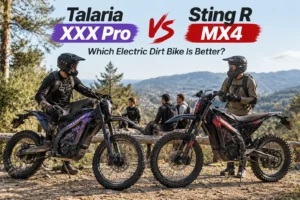
The Talaria XXX Pro and Talaria Sting R MX4 are two popular options for riders looking for a lightweight electric
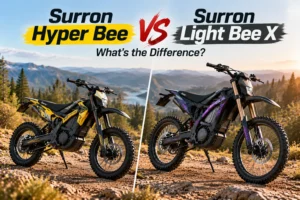
The Surron Hyper Bee and Surron Light Bee X are both high-performance electric dirt bikes, but they are designed for
